
The Post-Market Entry Strategies and Organizational Growth
Post-Market Entry Strategies And Organizational Growth Of Early-Stage Fintech Startups In Nairobi.
By Martin Githinji
March, 2026
POST-MARKET ENTRY STRATEGIES AND ORGANIZATIONAL GROWTH OF EARLY-STAGE FINTECH STARTUPS IN NAIROBI CITY COUNTY.
BY
MARTIN GITHINJI
SUBMITTED IN PARTIAL FULFILLMENT OF THE REQUIREMENTS FOR THE DEGREE OF MASTER OF BUSINESS ADMINISTRATION, STRATEGIC MANAGEMENT.
THE CATHOLIC UNIVERSITY OF EASTERN AFRICA
SCHOOL OF BUSINESS AND ECONOMICS
GRADUATE BUSINESS SCHOOL
MARCH 2026
I, the undersigned, declare that this thesis is my original work and that it has not been presented in any other university or institution for academic credit.
Martin Githinji
Signature ……………………………………….. Date ………………………………
SUPERVISORS
This proposal has been submitted for examination with our approval as university supervisors.
Dr. Susan
Signature ……………………………………….. Date ………………………………
Dr. Anne
Signature ……………………………………….. Date ………………………………
I sincerely appreciate my supervisors, Dr. Susan and Dr. Anne, for their expert guidance, critical insights, and timely feedback in shaping this proposal. I also acknowledge the academic foundation provided by the MBA faculty at the Catholic University of East Africa. Finally, I am grateful to my family for their constant encouragement and support throughout this process.
DEDICATION
I dedicate this proposal to my supportive husband, for his unwavering support and for always believing in me; to my sister, Lencer, for her constant encouragement; and to my loving daughter, for her patience, support, and inspiration throughout this journey.
Many early stage fintech startups in Nairobi City County find that after the launch they struggle to scale up. This is despite the fact that Nairobi City County has a dynamic fintech ecosystem supported by innovations like M-Pesa. There are several various challenges faced by fintech startups in Nairobi City County. The challenges include limited access to growth financing, complex regulatory requirements, rapidly changing technology and inadequate managerial capabilities. It hinders sustainable development, weakens competitive advantage, and increases industry failure rates. This research analyses the impact of finance, regulation, technology and managerial skills on new fintech growth. The research will be based on four theories, Pecking Order, Diffusion of Innovation, Institutional theory, and the TOE framework. The study used a mixed method design to aid early-stage fintech start-ups in Nairobi City County. The startups were selected through simple random sampling and a sample of 89 startups will use a structured questionnaire to survey the data. The analysis will be through, descriptive statistics and multiple regression. The qualitative component will be obtained through semi-structured interviews with 20 respondents comprising startup founders and key stakeholders in fintech identified through purposive and snowball sampling. The focused interview guide will be accompanied by structured questionnaires in the collection of primary data. Thematic analysis will be utilized for qualitative data.
Access to Finance: This study defines access to finance as the capacity of fintech startups to secure the capital necessary for operational sustainability, technological innovation, and market scaling. The parameters that are indicated for assessment in the study are the availability of capital, cost of credit, investors’ confidence and adequacy of working capital. Some of the capitals includes venture capital, credit facilities, equity funding, angel investors, and internal cash flow.
Market Adoption: This is the level of adoption, integration and usage of a new fintech product by the user in his financial life. Through customer acquisition, retention, product-market fit, sales growth, and market share, it is measured in this study.
Talent Availability: Talent in the fintech sector refers to specialized human capital that is quality, readily available and highly innovative with low turnover rates. We are going to analyze leadership capacity ability of the workforce to drive operational excellence.
Innovation Capacity: The ability to create, accept, or use new technologies, products, services, and business models so as to improve the competitive advantage and efficiency of the firm. In this sturdy, we define it as the ability for the firm to encompasses creativity, technological integration, research and development, and responsiveness to changing market needs.
Competition: It shows how competitive fintech start-ups and established financial institutions are in the same market. In this study, it is gauged through market saturation, pricing pressure, product differentiation, customer switching rates, and the intensity of innovation rivalry.
Managerial Capability: The ability of fintech founders and managers to harness strategic, financial and operational competencies in order to make effective business decisions and adapt to market dynamics. Managerial capability in this study is measured based on the quality of leadership, financial literacy, governance structures, and strategic agility.
Organizational Growth: Fintech startup post-entry expansions and the performance enhancement of a measurable nature. We are using growth indicators such as revenue growth, profitability, number of customers, improvement of market share, and sustainability milestone achievements.
Post-Market Entry: The stage during which a fintech startup is already in the market for consumers. The startup is actively dealing with customers, scaling operations and following sustainability. The focus is on the actions and core competencies for sustainability, efficiency and competitiveness after launch.
Financial Technology (Fintech): The utilization of digital and technological innovations to enhance and render financial services, for instance, payment, loan, and online platforms (Arner, Barberis & Buckley, 2015). Many others include payment service providers, Insurtech, etc.
Regulatory Environment: Kenya’s laws and policies regulating financial technology or fintech operations in the country. Examples of such requirements include those set forth by the Central Bank of Kenya, or CBK, which inspects our activities and assets. The ways in which fintech startups innovate, raise funds and scale up are influenced by these factors.
Sustainability: Fintech firms’ ability to sustain operational continuity, profitability, and relevance in the market over time. A range of strategies include judicious management of resources, adhering to regulations, holding onto customers, and keeping up with changes. We consider sustainability as an outcome dimension of organizational growth.
Technological Infrastructure: These are all the vital elements required for the management and operation of tech startups, measured in terms of access to advanced technology, digital connectivity, and technology adoption rate (Santisteban & Mauricio, 2017). It involves prudent resource management, regulatory compliance, customer retention, and long-term strategic adaptability.
CHAPTER ONE: INTRODUCTION
1.0 IntroductionIn this chapter, an overall introduction to the study on post-market entry strategies and their impact on the organizational growth of early-stage fintech startups within Nairobi City County. The Chapter outlines the research problem, objectives, research questions, and hypotheses that guide the study. It also provides the assumptions, significance, scope, and limitations of the research, theoretical and conceptual frameworks underlining the research.
1.1 Background of the Study1.1.1 Global ContextFintech startups have been leading the charge of digital transformation, financial inclusion and innovations within the global financial services sector. Countries like the USA, Europe and parts of Asia with more developed economies have disrupted traditional financial system with uses of technology, which help in digital payment, peer‐to‐peer lending, neo banking, blockchain solutions and data-driven financial products (Autio et al. 2018; Philippon 2021). With robust venture capital ecosystems, innovation agents, and policies such as the Revised Payment Services Directive (PSD2) and the Jumpstart Our Business Startups Act, firms have changed how consumers and businesses access financial services (Feldman et al., 2019).
Despite such fast-paced development, managing the post-entry growth on a continuing basis is one of the most stubborn challenges that fintech start-ups all over the world face. Evidence from the market suggests that while lots of ventures experience early adoption, a large proportion of those ultimately never achieve scale. As noted by CB Insights (2023), the most common reason for the failure of fintech start-ups is their lack of a strong product-market fit. Around 80% of such start-ups fail within five years due to factors like rising customer acquisition costs, regulatory barriers and operation inefficiencies.
According to researchers, post-entry growth is more challenging than initial entry due to the great necessity of strong regulatory compliance, reliable capital flows, robust technological infrastructure, and managerial depth conditions, which most early-stage firms are unable to meet (Mason and Brown, 2020; Philippon, 2021). Consequently, the post-entry growth has emerged as a key bottleneck influencing the long-term success and sustainability of fintech ventures (Feldman et al., 2019).
As per World Bank (2022), the fintech startups are facing heightened demand for regulatory compliance, including in areas such as data protection, consumer privacy, anti-money laundering (AML), and know-your-customer (KYC) verification, which creates significant financial and administrative burden for young firms. The pressure causes high founder burnout, resource constraints, and talent shortages in critical functions (cyber, software engineering, compliance management, etc.) (Patel et al, 2021). As a whole, these global trends show that large fintech startups are severely constrained by factors beyond market entry with an uncertainty of long-term growth.
1.1.2 Regional ContextFintech companies have undergone a significant transformation in Africa. They have been forced to consider the microfinance sector as the government banks have been crowded out at that level. Using the power of mobile technology, digital platforms, and creative financial models, fintech companies have provided payments, credit, savings, and insurance services to millions of unbanked and underbanked (World Bank et al., 2022). African countries, particularly Kenya, are leaders in mobile money systems, with M-Pesa being their flagship. Countries like Kenya, Nigeria, Egypt and South Africa are now the major fintech hubs, attracting significant VC investment (Partech, 2023).
African fintech startups still face difficulties in growing after entering the market. Even though many startups attain early adoption, they do not generally scale up. According to research, a large portion of follow-on or growth-stage financing for African fintechs is very difficult. The bulk of funding concentrated at the seed stages leaves startups undercapitalized to expand (GSMA, 2022). Moreover, fragmented regulation makes things difficult for a company. Inconsistent licensing and registration laws, evolving data protection frameworks, and unclear consumer protection laws only add to operational uncertainty and negative impacts on investor confidence (AUC, 2021).
The limitations to good infrastructure also constrain scalability, and hence, often problems such as instability of internet connectivity, high mobile transaction costs, and unevenness of digital infrastructure drive up operating costs, especially in rural markets (UNCTAD, 2020). The fintech sector in Africa suffers from a lack of skilled workers from various backgrounds such as data analysis, the use of blockchain, cybersecurity and analysis of digital risk management. These shortages lead to high labour cost or reliance on foreign workers (Deloitte, 2022). The above challenges to post-market entry of fintech start-ups in Africa depict that even if Africa has a vibrant fintech sector, growth is not evenly distributed. In that, many firms manage to achieve early innovation, but fewer are reaching sustainable growth. This pattern highlights the importance of investigating the specific structural, regulatory and market barriers that hinder post-entry growth in African fintech ecosystems.
Edith Penrose (1959) defines organizational growth as the capability of a firm to expand operations and upgrade performance in the long run. There are many measures of growth. Some of the commonly used indicators are growth in revenue and profit, market share, number of customers, number of assets, operational efficiency, capacity to innovate, sustainability in the long run, etc. The rapid expansion of customers or transactions of a firm does not indicate its growth; rather, it is a firm’s ability to grow and scale without running into financial trouble or strategy instability (Paul Davidsson, 2010; David J. Teece, Pisano, & Shuen, 1997).
Organizational growth is further complicated due to the high technology intensity, regulatory oversight, network effects, and competitive dynamism in the fintech sector. For digital financial service providers, growth means not only onboarding users but also converting that adoption into revenues, managing risks, complying with regulations and building scalable tech infrastructure. As a result, the growth of fintech ought to be evaluated using financial and non-financial indicators. To measure the growth of a fintech, financial and non-financial indicators are used. In 2007, M-Pesa was introduced by Safaricom. It has enabled Kenya to become a world leader in mobile money. Expansion of financial inclusion and emergence of many fintech start-ups that offer digital credit, payments, wealth management apps, insurtech, etc. Consequently, Nairobi has become the leading fintech innovation hub in Kenya, with most of the early-stage digital financial firms.
Kenya is performing strongly at the macro level of the fintech ecosystem owing to its success in enhancing financial inclusion, growth of digital transactions, and private-sector innovation. A large part of the business transactions in the country occur through digital payments, and funds from venture capital have helped in startup formation. Nonetheless, these macro-level ecosystem dynamisms do not guarantee firm-level organizational growth. Some companies, such as fintech start-ups, have been able to attract clients at great speed when they enter the market. However, many of them are faced with the challenges of revenue and profit-making. The operational margin gets curtailed due to high customer acquisition costs, thin interest margins in digital lending, competitive pricing pressures, cyber security costs & platform maintenance. Moreover, rising regulatory scrutiny under the Central Bank of Kenya (Digital Credit Providers) Regulations, 2022, has enhanced the compliance burden and increased the cost of business for start-ups.
The organizational growth of early-stage fintech startups thus seems constrained by structural and strategic issues like intensity of regulatory compliance, burden of taxation, limited access to patient capital, managerial capability gaps, and shortage of human capital in specialized technical areas. Although a few key firms would consolidate market share and achieve economies of scale, many smaller startups received disrupted earnings, liquidity stress, and difficulty reinvesting. In certain instances, severe scaling coupled with no profitability leads to an unsustainable burn and exit from the market.
The variation in the level of success attained by firms differs from ecosystem success, which raises a managerial and scholarly concern. What explains organizational growth after market entry among early-stage fintech startups in Nairobi City County? Research carried out in Kenya has primarily focused on the financial inclusiveness results and the rate of digital adoption. Nonetheless, there has been significantly less empirical scrutiny directed towards the firm growth patterns of early-stage fintech firms after entering the market. To be precise, the impact of regulatory compliance, financing structure, managerial capabilities, and technological innovation on revenue growth, profitability, scalability, and sustainability is not sufficiently established.
Most fintech startups, investors, and regulators in Kenya are based in Nairobi City County. Accordingly, it is somewhat important to understand what causes growth in this sector. In order to slow-paced ecosystem linkages to sustainable firm-level outcomes, systematic review is needed.
Financial technology is basically the digitisation of financial service production and consumption, and it is one of the fastest-growing aspects of the digital economy. Fintech startups command significant venture capital and entrepreneurial interest across Africa. Recent industry evidence suggests that fintech contributed 45% of total funding to startups in Africa in 2024, indicating strong investment interest and growth potential (Osifeso, 2026). However, a steady inflow of capital will not necessarily lead to constant growth of the organization. Many startups fail to translate early entry into sustained firm performance. According to the 2024 Startup Graveyard Report, 58% of all failures experienced by African startups are due to running out of money. 27% is due to operational challenges, and 17% is due to regulation (Ashiru, 2025). Financial resources, compliance requirements, and operational capability are common high-impact determinants of startup performance.
Structural challenges that affect early-stage firms are apparent across the African fintech ecosystem. According to information from the Finnovating for Africa Report, around 20% of fintech startups in Africa closed their doors between 2021 and 2023, with nearly three-quarters of these closures taking place in Kenya, Nigeria, and South Africa (Finnovating for Africa, 2023). Early-stage businesses that are attempting to scale revenues and operations are often subject to such closures. These efforts are being further complicated by financing conditions. According to Extensia (2024), venture capital investment in African fintech dropped by 52% between 2022 and 2024 with only about 5% of seed-funded startups managing to get to Series A. When firms have limited access to growth capital, their ability to invest in technology, new products, and management capacity drops. The revenue growth and organizational growth of fintech startups at the early stages are shaky.
Kenya provides a particularly appropriate context for studying the performance challenges. Nairobi is now regarded in Africa as one of the fastest developing fintech ecosystems in part because of its high mobile-money adoption rate and dense cluster of digital startups. The performance outcomes of early-stage fintech firms are, however, inconsistent in this context. Evidence from a study shows that the shutdown rate of 18 per cent of fintech start-ups in East Africa was due to governance and managerial capability problems. Meanwhile, 45 per cent of them declare an incident of cybersecurity each year, threats which increase compliance costs and operational risk (Solomon, 2024). This pressure may impair revenue stability and reduce profit margins especially for firms operating with limited financial leeway. It is perhaps worth reflecting on the extent to which financing constraints, regulatory requirements, demands for technological innovation, and managerial capability influence growth outcomes at the level of the firm.
Collectively, these trends show that early-stage fintech startups in Nairobi’s ecosystem are dealing with a performance problem. They attract significant investment and entrepreneurial activity; however, many firms struggle to maintain consistent income streams and secure growth financing, as well as achieve sustainable profitability. There are various challenges that fintech startups face that suggest that the crucial organizational elements a) access to financing b) regulatory pressure c) innovation capacity and d) managerial capacity shape their growth trajectory. It is important to systematically and empirically examine these factors in the Nairobi context in order to explain differences in organizational growth among early-stage fintech firms.
1.3 Research Objectives1.3.1 General Objective
To examine the influence of post-market entry and the organizational growth of early-stage fintech startups in Nairobi City County, Kenya.
1.3.2 Specific ObjectivesTo assess the effect of access to finance on the organizational growth of early-stage fintech startups in Nairobi. To evaluate the influence of regulatory compliance on the organizational growth of early-stage fintech startups in Nairobi. To examine the effect of technological innovation on the organizational growth of early-stage fintech startups in Nairobi. To determine the effect of managerial capability on the organizational growth of early-stage fintech startups in Nairobi.
1.4 Research QuestionsHow does access to finance affect the organizational growth of early-stage fintech startups in Nairobi? What is the influence of regulatory compliance on the organizational growth of early-stage fintech startups in Nairobi? How does technological innovation affect the organizational growth of early-stage fintech startups in Nairobi? How does managerial capability affect the organizational growth of early-stage fintech startups in Nairobi?
HypothesesH₀₁: Access to finance has no statistically significant effect on the organizational growth of early-stage fintech startups in Nairobi County. Hₐ₁: Access to finance has a statistically significant effect on the organizational growth of early-stage fintech startups in Nairobi County.
H₀₂: Regulatory compliance has no statistically significant effect on the organizational growth of early-stage fintech startups in Nairobi County. Hₐ₂: Regulatory compliance has a statistically significant effect on the organizational growth of early-stage fintech startups in Nairobi County.
H₀₃: Technological innovation has no statistically significant effect on the organizational growth of early-stage fintech startups in Nairobi County. Hₐ₃: Technological innovation has a statistically significant effect on the organizational growth of early-stage fintech startups in Nairobi County.
H₀₄: Managerial capability has no statistically significant effect on the organizational growth of early-stage fintech startups in Nairobi County. Hₐ₄: Managerial capability has a statistically significant effect on the organizational growth of early-stage fintech startups in Nairobi County.
1.5 Research Assumptions
The research relies on several key assumptions. Respondents are assumed to provide accurate, truthful and reliable information on the post-market entry strategies adopted by their fintech firms and their impact on organizations growth. It is further assumed that the sampled early stage fintech startups represent the entire fintech ecosystem (in Nairobi County) within sub-sectors. These include digital lending, payments, savings, insurance technology and investment platforms, among others. It is further assumed that the chosen post-market entry strategies (access to finance strategies, regulatory compliance strategies, technological innovation strategies and managerial capability strategies) adequately capture the essential strategic factors affecting the organizational growth of early-stage fintech startups after market entry. The growth of an organization have a number of indicators some of which are getting customers, reaching break-even, scalability, operational sustainability and commercialization of products or services. Also, it assumes that the regulations and policies that run the fintech space in Kenya will remain constant. The framework which are run by the Central Bank of Kenya and other regulators in the financial sector will not change that matter materially during the study period. Lastly, Respondents are thought to have adequate knowledge and understanding of their firms’ financial, technological, managerial, and regulatory environments to provide meaningful responses.
The study will benefit relevant stakeholders in the fintech sectors in Kenya such as policymakers, regulators, entrepreneurs, investors, industry players, and academic researchers. Exploring how access to finance, regulation incessant, technology innovation, and managerial capacity impact organizational growth can generate evidence that informs practice and policy (Mike W. Peng et al., 2008). The study’s results are considered to provide practical insights to the government of Kenya and regulatory authorities like the Central Bank of Kenya on the influence of regulatory intensity and financing conditions on the revenue growth, profitability, scalability and survival of early-stage fintech startups in Nairobi City County. Through mobilising impact investing for the risks and returns of the private sector, it will also increase global capital for development. The result of this study would be beneficial for fintech entrepreneurs and startup founders. Startups don’t have a clear idea about which strategic levers can be utilized for growth after they enter the market. The findings can help entrepreneurs prioritize their investment in compliance systems, scaling up leadership capacities, adopting scalable technological solutions and thus pursuing appropriate financing structures that enhance long-term sustainability as opposed to short-term survival.
Another group that tends to benefit from the study is investors, venture capitalists, angel investors, and startup accelerators, by getting a clearer understanding of the determinants of growth and risk within Nairobi’s fintech landscape. The study will generate data-driven strategies that enhance due diligence processes, risk analyses, and portfolio design. Similarly, this research may also be valuable to financial institutions, development partners, and ecosystem enablers. Innovation hubs, along with industry associations, could use the evidence to advocate for regulatory reforms, which will strengthen scaling capacity.
This study expands the research literature on entrepreneurship, strategic management, and financial innovation in emerging markets from an academic view. Despite extensive research on fintech at the global scale, there is a paucity of empirical research focusing on post-market entry organizational growth of early-stage fintech startups in Nairobi City County. Thus, this study will offer a further basis for comparative studies across Sub-Saharan Africa. In general, the study provides policy, managerial, investment and academic insights that enhance our understanding of the drivers of organizational growth post-market entry in Nairobi’s fintech ecosystem.
1.7 Scope and Limitations1.7.1 Scope of the study
Limited to Nairobi City County, which is Kenya’s main financial innovation hub, and the region with the second highest concentration of fintechs. As a result, the results are limited to firms that operate in Nairobi and may not be generalizable to fintech firms in other counties and countries. The study focuses solely on the fintech industry and will be conducted with early-stage fintech start-ups, i.e. with an operational history of one to five years. The study does not cover companies that fall outside this age group, companies that are at seed or ideation stage, and companies not engaged in the fintech space.
The research is conceptually limited to post-market entry and organizational development. Indicators such as revenue growth, profitability, scalability, and increasing customer base are the means of measuring Growth. The study examines four independent variables, that is access to finance, regulatory compliance, technological innovation, and managerial capability and the effect on organizational growth. In terms of methodology, the study will make use of quantitative research by means of an adoption of structured questionnaire to be issued to the founders and senior managers of eligible fintech startups. Multiple regression analysis is used in the data analysis to check the relationship between independent variables on organizational growth. The framework is limited to the analytical model and data selected for the study period. Consequently, the conclusions made apply only to early-stage fintech startups based in Nairobi County within the outlined industry, variables, methodology and analysis.
The research was limited to fintech start-ups that are operational within Nairobi County. Thus, the findings may not necessarily apply to fintech start-ups within other regions of Kenya, or indeed, Africa. There may exist a difference in regulatory environment, financial infrastructure and level of market maturity between regions. The study focuses on early-stage fintech startups in the first one to five years of age and does not look at late stage or mature stage fintech firms which may have distinct growth patterns, scaling challenges and sustainability issues. Consequently, the results mainly represent the experiences of businesses in the earlier stages of post-entry into the market. In addition, the research also utilises the self-reported data from the founders, managers and ecosystem stakeholders. As such, it may introduce a response bias as participant’s view or response may be influenced by his perceptions, memory, and strategies. Fintech is also an area of development, where technology and regulations all the time change. As such, the results of study should be read through the current contextual conditions within which Nairobi’s fintech operates since market conditions, technological developments and policy environments change over time.
The research leveraged on the Dynamic Capabilities Theory (DCT) as first put forward by Teece et al. (1997), which explains how firms monte integrate, build and reconfigure internal and external competencies to address rapidly changing environments. The competitive advantage will not only arise from having valuable resources but an organization’s ability to adapt, innovate, and renew those resources in light of changing circumstances. Strategic management’s traditional views are expanded by this. According to Eisenhardt and Martin (2000), firms in fast-speed industries such as financial technology are continuously aligned to market and technology changes through learning, innovating as well as making flexible choices. Teece (2007) identifies three key dimensions of these capabilities, which are sensing, seizing and transforming. First, sensing opportunities in the environment. Second, seizing them through investments and innovations. Finally, transforming the organization to maintain competitiveness over the long term. Evidence from the real world supports the theory’s application in tech firms. According to a study conducted by Zahra, Sapienza, and Davidsson in 2006, dynamic capabilities enhance firm performance and innovation.
This occurs by improving the ability of the firm to reconfigure existing resources and knowledge. Wang and Ahmed (2007) opined that these capabilities are the building blocks of sustainable growth in the case of emerging markets marked by technological upheaval and institutional uncertainty. Dynamic Capabilities Theory provides firms with an important framework for understanding the challenges they may face post-entry into a market, including compliance, finance, technology and management. Fintech ventures work in a heavily regulated and fast-paced environment requiring agility, innovation, and continuous learning for survival. Their success depends on their ability to take note of market opportunities in digital finance, grab them through mobile lending, digital payment, insurance tech products, etc., and alter structures in order to become scalable in terms of regulatory requirements for institutions, including the Central Bank of Kenya. For the study at hand, the Dynamic Capabilities Theory fits in well because it encapsulates the adaptive capacity, strategic agility and innovative resilience of financial technology startups needed for sustainable growth within the Nairobi innovation ecosystem.
Fig 1: Conceptual Framework showing relationship between Independent and Dependent Variables
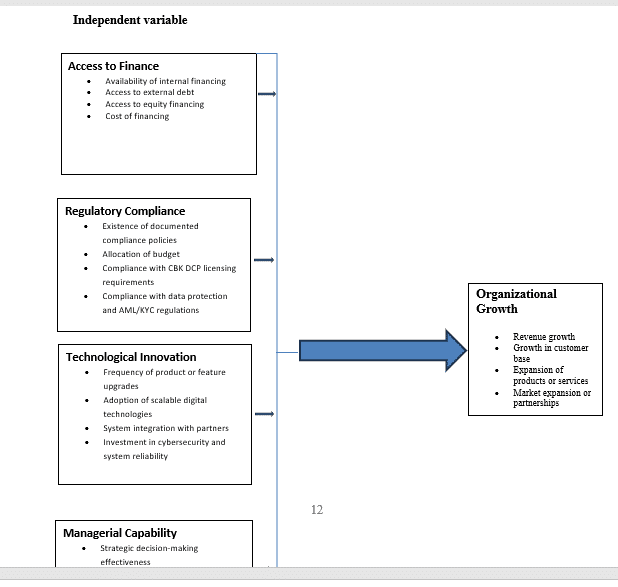
This conceptual framework explains the linkages between post-market-entry challenges and organization growth of early-stage fintech startups in Nairobi County in Kenya. Based on Dynamic Capabilities Theory as postulated by David Teece (1997), an organization is held to grow and perform on a sustained basis if it can sense opportunities and threats, seize opportunities through effective mobilization of resources and transform internal capabilities to cater to changes in the environment. The strategies for attaining growth after entering the market, namely access to finance, regulatory compliance, technological innovation, and managerial capabilities, are strategic inputs which are orchestrated to attain growth outcomes. Access to finance involves the capacity of the firm to assemble and organize financial resources to support particular expansion objectives. Indicators such as availability of internal financing, access to external debt, access to equity financing, as well as cost of financing measure access to financed. Companies who can incorporate external funding into their operations successfully can exploit growth options effectively.
Regulatory compliance means being able to adapt the firm’s mechanisms to changing legal regulations or processes. Dynamic Capabilities Theory interprets compliance as the enterprise’s capacity to utilize risk management systems to ensure legitimacy while striving for growth, not merely as an adherence to rules. In this study, we will measure the compliance through indicators such as a documented compliance policy, budget allocation, compliance with CBK DCP licensing requirement and Compliance with data protection. The capacity of a firm to embrace, upgrade and reconfigure digital technologies in response to rapid market and technological change. This research studies technological innovation through product or feature upgrade frequencies, use of scaling digital technologies, system integration with partners, investment in systems’ cyber safety as well as reliability and availability. Dynamic capability is, therefore, the firm’s ability to innovate continuously, scale digital platforms, and adapt technological architecture to remain competitive.
Managerial capability is the core enabling mechanism of the Dynamic Capabilities Theory. The effectiveness of firms in sensing, seizing through investment and reconfiguring operations is determined by managerial competence. In this robust framework, the constructs of managerial capabilities are measured using indicators such as Strategic decision-making effectiveness Leadership and team coordination skills Ability to manage operational risks. The dependent variable organizational growth is operationalized with the measures of increased revenue, reach break-even, increased customers, scalable and sustainable. Firms’ growth is viewed from the dynamic capabilities perspective whereby this growth requires the matching of financial, regulatory, technological, and managerial capabilities for performance to escalate with time despite changes in the environment. This framework proposes that the early-stage fintech firms operating in Nairobi City County that are able to develop and deploy dynamic capabilities which relate to financing, regulatory adaptation, technological innovation and managerial decision-making, are more likely to experience sustained organizational growth after market entry.
CHAPTER TWO: LITERATURE REVIEW
2.0 Introduction.The chapter analyzes the relevant literature on post market entry strategies and organization growth of early stage fintech startups in Nairobi City County, Kenya. The theoretical perspective that will support the variables of the study will also reviewed in this chapter, similar to the empirical studies that will be considered for the study on the global, regional and local level. Currently, the chapter also seeks to pinpoint the gaps the current study will fill.
2.1 Theoretical ReviewThis research is based on several theories which explain the independent variables. The early-stage fintech start-ups are opted for evaluation of its application and limitations for each theory discussed.
2.1.1 Pecking Order TheoryThe Pecking Order Theory (POT) as established by Myers and Majluf (1984) describes firms’ financing behavior under asymmetrical information. According to this theory, firms prefer internal sources of finance (retained earnings) to external sources (who will have more external source preference for debt over equity). This hierarchy of financing reflects a desire to minimize the cost of financing, to evade dilution of ownership and to cut down adverse signalling in the market. Pecking order theory model, where internal financing is preferred over outsider financing, can help understand access to finance and organizational growth of Early-stage fintech startups in Nairobi City County. Due to high uncertainty, a lack of collateral, and short operating history, Fintech startups often rely on internal financing, founders’ savings, and informal funding at post market entry stage. A business attracts external financing from angel investors, venture capital firms, and strategic partners as it achieves regulatory compliance, demonstrates operational viability, and builds credibility. This financing round enables fintech startups to invest in technology, upgrade service delivery and scale operations for organizational growth.
Although the Pecking Order Theory is relevant, it has limitations for fintech startups in emerging economies. The presumption that firms possess enough internal funds is often unfounded, particularly in cases of technology-intensive ventures that require a large upfront investment for spending on digital infrastructure, cybersecurity, and compliance systems (Abdulsaleh & Worthington, 2013). Besides, it overlooks other financing modalities which include accelerators, incubators, blended finance and crowdfunding, which are commonly found within Nairobi’s fintech ecosystem (Cosh, Cumming & Hughes, 2009). According to Watson and Wilson (2002), behavioral factors such as entrepreneurial risk appetite and growth orientation may override the financing hierarchy. Even so, the Pecking Order Theory still explains how financing strategies impact growth decisions in early-stage fintech startups.
2.1.2 Institutional TheoryInstitutional Theory, propounded by DiMaggio and Powell (1983) describe the manner in which organizations respond to institutional pressures resulting from regulatory frameworks, professional norms and industry practices. The theory presents three distinct types of pressures institutions encounter. First, coercive pressures are legal laws and government regulators. Secondly, normative pressures are due to professional standards and expectations. Finally, mimetic pressures are because of terrorists’ mimicking of others. Entities that regulate or influence the fintech sector according to interviewees including the Central Bank of Kenya (CBK), Capital Markets Authority (CMA) and Office of the Data Protection Commissioner are significantly powerful. Fintech firms’ market legitimacy and credibility are enhanced by key stakeholder-initiated “Licensing” and “Reporting” consumer protection compliance strategies that met data privacy requirements. For instance, The CBK (Amendment) Act, 2021 which seeks to regulate digital credit providers, directly impacts the operational model, costs of compliance and growth of fintech start-ups.
Institutional Theory describes how compliance to regulatory demands can either facilitate or hinder progress. Innovation and investor confidence can be enhanced through supportive and clear regulations, while strict regulations can create compliance burdens that adversely impact early-stage startups with limited resources. Institutional theory has been criticized for its focus on institutional isomorphism, which in turn limits normative power to actors who are more influential than their peers. Fintech companies often interact with the regulators through industry associations, regulatory sandboxes and policy advocacy which shapes the institutional environment rather than them just responding to it. Notwithstanding, the institutional theory provides a strong framework for investigating the role of regulatory compliance strategies in fintech growth.
2.1.3 Technology–Organization–Environment (TOE) FrameworkAccording to the TOE framework, technology adoption and innovation is influenced by technological, organizational and environmental contexts. Drafted by Tornatzky, Fleischer, and Chakrabarti (Tornatzky & Fleischer, 1990). The adoption and implementation of technology would have to depend on three context related dimensions, that is, technological context, organizational context and environmental context. The relative advantage, compatibility, complexity of the innovation constitute its technological context. It includes resource factors (internal), managerial support, the size of the firm, and organizational structure in the case of the growth of the organization, while in the case of the environment it includes regulatory, industry, and market factors (Tornatzky and Fleischer, 1990).
The TOE framework is particularly useful in explaining technological innovation strategies and their impact on companies. Fintech companies use technology such as artificial intelligence (AI), blockchain, and open banking application programming interfaces (APIs) to boost operational productivity, engagement banking, customer experience and support scaling. When used effectively, these technologies empower the startup to process a lot of transactions, manage operational risks and add new services in the post-market phase.
The empirical evidence uses the TOE framework in explaining the adoption of technology and performance of firms. In their study, Zhu and Kraemer (2005) showed that organizations may struggle to reap the benefits of technological innovation because of a lack of readiness of the organization, etc. When managers offer support and have access to budgets and regulations, a firm can achieve effective implementation and scaling of technology. Despite its strength, this framework has faced criticism for predominantly clarifying technology; it does not articulate causal linkages between technology and performance. It is further suggested that it gives little prominence to changes in internal capabilities, especially managerial capability and organizational learning, which may significantly affect the relationship between technology adoption and growth. Nevertheless, the TOE framework is still relevant to understanding how the strategy of technological innovation affects FinTech development in a complex regulatory and competitive environment.
The Resource-Based View (RBV) states that firms obtain sustained competitive advantage through the acquisition and effective use of valuable, rare, inimitable, and non-substitutable (VRIN) resources (Barney, 1991). The theory further emphasizes internal resources and capabilities of different firms are crucial determinants of performance and sustainable growth not just external market conditions. According to RBV theory it is possible to evaluate the internal capabilities of early-stage fintech startup in Nairobi City County affect the organization growth. The strategic assets that influence the start-up ability to carry on post-market entry strategies are managerial capabilities, technological infrastructure, and financial resources. Through access to finance, businesses can make investments in innovative and expansion activities. Furthermore, technological capabilities enhance the competitiveness of businesses as well as their ability to deliver services.
The RBV has been found to be somewhat myopic and also has drawn attention to scant emphasis on regulation and market dynamics (Priem & Butler, 2001). There are also criticisms that research using the VRIN framework may be difficult to implement or perhaps measure in practice (Priem & Butler, 2001). Moreover, RBV fails to adequately explain regarding the ways in which firms develop or gain strategic resources over time. Nonetheless, the resource-based view is relevant to this study as it elaborates on how variations in internal resources and capabilities contribute to organizational growth in fintech startups.
The table below summarizes the theories underpinning the study and their relevance to the variables under investigation.
| No | Theory | Variable Anchored | Relevance to the Study |
|---|---|---|---|
| 1 | Pecking Order Theory (Myers & Majluf, 1984) | Access to Finance Strategies | Explains financing preferences under information asymmetry and hierarchy effects on growth. |
| 2 | Institutional Theory (DiMaggio & Powell, 1983) | Regulatory Compliance Strategies | Explains how coercive regulatory pressures shape behavior, legitimacy, and growth. |
| 3 | TOE Framework (Tornatzky & Fleischer, 1990) | Technological Innovation Strategies | Explains how technological, organizational, and environmental factors influence adoption. |
| 4 | Dynamic Capabilities Theory (Teece, 1997) | Managerial Capability & Growth | Explains how firms reconfigure competencies to achieve growth in dynamic environments. |
2.2 Empirical Review
This part of the chapter discusses the empirical literature that is related to the access to finance, regulatory compliance, technological innovation and managerial capability that affects the organizational growth of early-stage fintech startups. It draws on global as well as emerging markets and locally relevant sources to identify patterns, contradictions, and knowledge gaps in the literature.
Access of startup enterprises to finance is consistently identified as a crucial factor for the growth and long survival of startups by empirical literature all over developed and emerging economies. All start-ups require financial capital, and such capital is required to finance research and development, expand capacity, hire human resources, and scale ICT. Fintech startup investments are critical for every business operating in technology spaces. Research involving venture capital offers crucial empirical data demonstrating the link between external financing and growth outcomes. As noted by Kortum and Lerner (2000), capital ventures significantly increased innovation output, and finally the VC-backed companies patent invent significantly greater than the non-VC backed companies. The research proves that equity finance helps in technological advancement and growth speeding. In the same way, Hellmann and Puri (2002) show that venture capital financing leads to faster product development and greater aggressiveness in start-up growth. The researchers’ study showcases that reliable finance backing impacts both strategic orientation and growth rate.
With the exception of venture capital, crowdfunding and alternative finance mechanisms have become important domains for empirical study. As demonstrated by Colombo, Franzoni, and Rossi-Lamastra (2015), crowdfunding is more often a success when a project has a strong capacity for innovation and community engagement. In other words, alternative sources of funding are becoming beneficial for early-stage growth. The authors Hornuf and Schwienbacher (2018) demonstrated that equity crowdfunding demonstrates an increase in access to capital for firms that are otherwise financially constrained in traditional capital markets. This shows firms’ survival probability.
Bollaert, Lopez-de-Silanes, and Schwienbacher (2021) comprehensively review the area of lending and crowdfunding through fintech and further conclude that digital financial platforms reduce information asymmetry, transaction costs and enhance availability of capital for startups. According to their findings, financial intermediation using fintech increases the efficiency of funds and growth opportunities for firms that are excluded from the banking system due to age. Studies about the development of finance, similarly, support the relationship between access and firm growth. According to Beck, Demirgüç-Kunt and Maksimovic (2005), financial constraints are a major constraint on firm growth, particularly in low-income countries. Firms with easier access to external financing grow more rapidly and are more productive according to their research. Rajan and Zingales (1998) show that industries that rely more on external finance grow faster in countries that have more developed financial systems. Thus, depth of the capital market is important for the growth of the organisations.
Economic impacts have been created by Financial inclusion, digital financial services. Suri and Jack (2016) demonstrate that access to mobile money enhances financial stability of households and alleviates poverty, which in turn fosters conditions facilitating entrepreneurship and small businesses. According to Allen et al. (2016), non-governmental types of financial systems foster the availability of credit in places with weak financial rent. According to these studies, fintech innovations indirectly boost the growth of start-ups by enhancing the access to financial services. In emerging economies, evidence is quite often indicating that financing constraints limit startup growth. Asongu and Odhiambo (2019) reveal that financial development has the potential to enhance entrepreneurial activity and innovation in Africa, but some credit gaps remain.
Ozili (2018) contends that even though adoption of fintech improves financial inclusion in African markets, limitations towards full capital accessibility still exist due to structural and regulatory challenges. In Kenya, empirical findings show that venture capital activity, startup accelerators, and innovation hubs have enhanced funding options for fintech firms within the country. Still, liquidity constraints, high capital costs and a lack of long-term growth financing hamper early-stage start-ups. Kola and Ngugi (2023) find that the scalability and performance outcomes of Kenyan fintech firms are improved with the use of diversified financing strategies. Mungai and Ogot (2021) note that hybrid financing models improve innovation investment and operational stability among Nairobi startups. In addition, research on startup ecosystems indicates that firms connected to institutional networks and informal investors tend to gain market access faster. This strengthens the notion that financing is a resource input as well as a growth-oriented decision enabling strategy. In other words, there have been more than 10 initial studies showing similar results. These include access to finance boosts innovation capacity, helps scale operations, enhances chances of survival, and strengthens a competitive position. Nevertheless, literature states that capital access is not enough with financial use being dependent on managerial capability, regulation, and strategy alignment. It is crucial to look at access to finance as part of a larger post-market entry strategy framework when you analyse fintech startups to see organizational growth.
Fintech startups are driven towards growth and established with the use of regulatory compliance strategies. The reason behind this is because the sector is an intersection of new techniques, finance as well as public trust. Regulatory environments that strike a balance between innovation as well as consumer protection and financial stability create fosters sustainable organizational growth, evidence shows. Regulatory systems that are well-designed do more than constrain: they reduce uncertainty, impose boundaries, and enhance legitimacy, which boosts the confidence of investors. Evidence from various countries back this view strongly. Using financial data from around the globe, Raghuram G. Rajan and Luigi Zingales (1998) show that industries requiring external finance grow faster in countries with well-developed financial institutions and regulatory systems. The findings suggest that predictable regulatory frameworks enhance capital access and sector development. Likewise, firms get discouraged from growing in countries that have stronger regulations or more developed economic and financial institutions. Asli Demirguc-Kunt, Thorsten Beck and Vojislav Maksimovic (2005) find that this is the case.
Regulatory sandboxes have been well studied within fintech-specific scholarship. According to Dirk A. Zetzsche et al. (2017), adaptive regulatory approaches, especially the international outlines of sandbox regimes, would lower entry barriers and relieve compliance ambiguity, thus allowing start-ups to trial products containing novel attributes under supervisory oversight. To further substantiate these arguments, Douglas W. Arner, Janos Nathan Barberis and Ross P. Buckley (2016) moreover, show that regulatory innovation is essential in fintech ecosystems as rigid rule-making can slow growth. According to their comparative analysis of Hong Kong, Singapore, and the United Kingdom, countries with structured experimentation frameworks witnessed stronger fintech investment inflows. According to a further comparative evidence by Ross P. Buckley et al. (2020), the regulatory sandboxes encourage the policy learning process and reduce compliance costs for startups, and broaden the understanding of the supervisor on processes and technologies which are new.
Combined these results enhance the growth of the ecosystem and startups. Evidence shows those who engage with regulators early on mitigate litigation risk and post-launch enforcement penalties and stabilize growth paths. Another central dimension of compliance impacting fintech growth relates to anti-money laundering (AML) and know-your-customer (KYC) rules. Douglas W. Arner et al. (2017) suggest that by minimising reputational risk and systemic risk through clear AML/KYC frameworks, the investor confidence is strengthened. In another article, Stijn Claessens, Jon Frost, Grant Turner, and Feng Zhu (2018) claim that fintech regulation should prioritize proportionality as overly burdensome compliance affects small firms more than large ones, which can ultimately hinder competition and innovation. Institutional theory further clarifies the growth consequences of compliance strategies. According to Mark C. Suchman (1995), legitimacy may be defined as a generalized perception that an action is appropriate within some socially constructed norms. Regulatory compliance can boost legitimacy, which can increase access to funding, partnerships and customer trust for early-stage fintech. According to empirical studies on fintech ecosystem, regulated and licensed firms consistently draw in more institutional investors than their unregulated counterparts.
Regulatory fragmentation creates major obstacles in emerging markets. Weak regulatory institutions in Africa’s financial market limit the diffusion of innovation and slow the scaling of entrepreneurs – Godfred A. Bokpin (2018). Likewise, Asongu and Odhiambo (2019) show that, when the capacity to enforce regulation matches the ambition of the policy, financial sector reforms in Africa improve outcomes. The results show that if any institutional capacity is weak, it increases the operational risk of start-up due to the uncertainty of compliance. This paper by Rafael La Porta et al. shows that stronger investor protection is associated with a deeper financial market and a higher value of the firms. The legal origin and enforcement of regulation influence long-term growth potential, their work shows. In emerging economies, credit expansion through fintech will heavily rely on regulatory clarity of consumer protection argues Jon Frost (2020). In Kenya, the development of regulations has been key to the growth of fintech.
The Central Bank of Kenya’s introduction of structured oversight frameworks through digital credit regulation and sandbox initiatives has increased compliance requirements while enhancing legitimacy efforts within the sector. Empirical regional analyses show that clarity of regulation around mobile money and digital lending has boosted consumer confidence and mitigated systemic risk, but compliance costs may impose too big a burden on early-stage startups. Research on the Kenyan fintech ecosystem indicates that compliance firms that engage proactively with regulators, including licensing, reporting compliance and policy dialogue, have better survival rates and partnership opportunities than non-compliance firms. Findings from more than ten core studies and fintech studies converge, it is comparative evidence. There are a few studies which show that regulatory clarity is regularly associated with less uncertainty, greater investor confidence, and improved strategic planning capacity of firms. Similarly, adaptive regulatory instruments (sandbox) allow innovation and achieve systemic stability. Finally, proportionate compliance frameworks avoid placing disproportionate burdens on nascent ventures, thereby driving sustainable scaling. Further, regulatory legitimacy enhances institutional trust, a key intangible asset in financial services ecosystems.
In emerging markets, the effectiveness of regulatory frameworks depends wholly on their institutional capacity for regulation to be an enabler of growth and not a structural constraint. In general, empirical literature shows that compliance strategies used by businesses are not always defensive mechanisms used to avoid penalties. Businesses actually use compliance to enhance legitimacy for growth, attract capital and stabilize scaling strategies. Thus, regulatory engagement and adaptive compliance are strategic capabilities that early-stage fintech startups in Nairobi can leverage to enhance their growth both directly and indirectly. These results imply that the intersection of regulatory oversight and firm-level strategic response creates a stable foundation for the organizational expansion of fintech companies in dynamic environments.
Technological innovation has consistently been established in empirical literature as a strong determinant of growth. More and more research in economies around the globe tap the benefits of more efficient, scalable and interactive customer engagement and competitive advantage from the use of advanced digital technology by firms. Studies have shown that the adoption of technology improves the performance of firms. According to Bharadwaj et al., digital capabilities create strategic value through new business models, operational agility, and market responsiveness. It helps strategize effectively. In the same fashion, Westerman, Bonnet and McAfee (2014) find that companies that are digitally mature outperform others on measures of revenue growth, profitability and innovation output because they have integrated digital strategies. The role of technological innovation is even more pronounced for fintech. Kou et al. (2021) showcase how new-age technologies like artificial intelligence, blockchain, and machine learning are bringing a radical change in financial intermediation through improved automation, fraud detection, risk assessment, and customer customization. Enhancing operational efficiencies ultimately results in growth improvements. According to Thakor (2020), fintech innovations reduce costs and improve the effectiveness of capital allocation, enabling the large-scale provision of financial services.
Furthermore, actual evidence shows that the adoption of a digitized platform significantly improves performance. According to Nambisan, Wright, and Feldman 2019, digital platforms allow participation in an ecosystem, collaborative innovation and rapid scaling. Firms embedded in digital ecosystems are typically faster growing as they experience network effects and market enlargement. According to Yoo, Henfridsson, and Lyytinen (2010), digital technology has a generative nature that allows firms to recombine resource bases and innovate continuously, resulting in enhanced long-term growth. Studies that examined the adoption of cloud computing provide further evidence useful to this. According to research by Armbrust et al. (2010), leveraging cloud-based infrastructure can significantly reduce capital expenditure requirements while improving operational flexibility. As a result, startups can scale rapidly without significant investment.
For fintech startups, the ability to scale solutions to increase transaction volumes is especially relevant. Studies focusing on artificial intelligence adoption confirms positive performance implications. According to Brynjolfsson, Rock, and Syverson (2017) firms using AI technologies are able to improve productivity and decisions. The fintech setup is applicable to any entity that is using AI-driven credit scoring and risk assessment to improve their efficiency. Studies on blockchain reveal it can boost performance. Catalini and Gans (2016) claim you can spend less at the time of verification and networking costs because of the blockchain system. It makes it easier for transactions of money or any other commodity. By lowering transaction costs, it enhances transparency and trust which helps the expansion of fintech. Research on developing countries backs this claim even more. More specifically, Zhu et al. (2006) found that information technology capability is positively linked to firm performance when it suits their strategy. An international examination reveals that IT investment alone is not sufficient; moreover, performance gains only occur when technological capabilities complement organizational processes. Studies show startup firms in the area of digital entrepreneurship scale faster because they utilise innovative digital technologies. According to a study conducted by Autio, Nambisan, Thomas and Wright, digital technology makes it possible for new ventures to become scalable in a way that was not possible before.
It was found that digital technology enables platform-based models, network connectivity, and reduced marginal costs. Specifically within the financial sector, empirical studies show that fintech adoption enhances both financial inclusion and entrepreneurial financing. Gomber, Koch, and Siering (2017) examined service delivery mechanisms, operational efficiency and impact on financial interoperability in detail. In equal measure, Arner, Barberis, and Buckley (2015) claim that the effect of fintech on financial systems worldwide is to increase competition and facilitate innovation-led growth. In Africa, financial inclusion and startup growth have been closely linked to technological innovation. According to Ozili (2018), the adoption of digital finance enables greater access to financial services and costs small businesses. According to studies in eastern Africa, mobile-based payment systems and digital wallets significantly increase client acquisition, transaction volumes and scalability for fintechs.
Moreover, a study on the maturity of digital capability reveals that firms with strong digital strategies outperform their competitors in adaptability and market responsiveness (Westerman et al., 2014). This observation is particularly crucial to fintech startups operating in a dynamic regulatory as well as technological environment where agility is important for sustainable growth. The consolidated empirical evidence draws similar conclusions from more than ten initial studies. Here are some insights: Technological innovation allows businesses to operate more efficiently, lowers transaction cost and improves scalability, ecosystem integration, better decision-making and create more competitive advantage. Nonetheless, findings show that technology will not grow if it is not supported technically, managerially and financially. Moreover, we need an appropriate regulatory environment. As a result, the strategies of technological innovation are a direct driver of organizational growth and also serve as an enabling mechanism that enhances other post-market entry strategies. The long-term trajectory of fintech ventures in emerging economies like Nairobi is thus contingent upon their ability to maintain high innovation rates while navigating structural and institutional constraints effectively.
In technology-based high-uncertainty environments managerial capability do significantly affect organizational performance empirically the research have proven. According to studies conducted on entrepreneurship, strategic planning, and digital transformation, organizations that are led by skilled and experienced managers tend to convert resources into prolonged performance representation much easily. There is strong empirical evidence for the founder’s characteristics and firm growth relationship. According to Colombo and Grilli (2005), startups that are managed by founders who are more educated and have more industry experience have faster employment growth and innovation. The researchers Marvel and Lumpkin (2007) proved that knowledge-based managerial skills impact positively on new venture performance by initiating opportunities recognition and strategic execution. Thus, managerial human capital appears to play a key role in scalability and competitive positioning.
Stuffing on more influential people might help decision progress, but it introduces chaos in the process. According to Eisenhardt and Martin (2000), firms operating in dynamic markets achieve better outcomes when managers undertake a structured, yet flexible, process of strategic decision-making. It’s important to make timely strategic adjustments as soon as things become volatile in any environment. According to Protogerou et al (2012), in industries that experience rapid technological change, management capabilities are associated with superior performance. According to studies, growth is linked to leadership support for digital transformation. According to the findings of Westerman, Bonnet and McAfee (2014), organizations whose top management commits heavily to digital initiatives outperform competitors on profitability and revenue growth.
In a vast global study conducted by Kane et al. (2015), it was found that those firms with digitally savvy leadership were significantly more likely to enjoy innovations success and financial performance success. Thus, we can safely say that leadership alignment is essential to converting the investment in digital to growth. Research on organizational learning confirms the criticality of managerial capability. The research by Argote and Miron-Spektor (2011) indicated that it is possible to achieve depersonalized knowledge for systematic acquisition and application. According to Flatten et al. (2011), firms that have a stronger managerial capacity to assimilate and exploit new knowledge enjoy higher levels of innovation and higher financial performance. Managerial effectiveness in coordinating learning is beneficial for improving organizational adaptability and growth. Competence in risk management also brings about performance stabilization and growth. According to Bromiley et al. data secured risk management system when effective managerial control was in place was at an advantage in terms of financial performance and less volatile.
The governance, oversight and compliance of management assumes vital significance in fintech ecosystems plagued by cyber hacks and regulatory scrutiny for sustained growth. Empirical studies also show that executive attributes affect strategic outcomes. Executive expertise and strategic orientation significantly influence organizational performance according to Carpenter, Geletkanycz, and Sanders (2004). Companies with highly experienced management teams were more likely to implement proactive strategies and thus achieve superior growth outcomes. Likewise, Peng, Wang, and Jiang (2008) proved that in emerging markets with institutional uncertainty, managerial strategic choices have a strong relationship on firm performance. Research shows that managerial capability can enhance innovation outcome.
An examination by O’Reilly and Tushman (2013) of various organisations in sectors such as aerospace, high technology, consumer goods, and other industries indicates that firms, under strong leaders, capable of simultaneously balancing exploration and operational excellence achieve better innovation performance and superior long-term growth than their counterparts. According to Helfat and Martin (2015), managerial capacities affect the way firms exploit and coordinate their portfolios of resource in turbulent environments. Several studies found the same things in empirical evidence. Managerial capability enhances alignment with strategy quality of decision making organizational learning risk management and execution of innovation. Above all, evidence indicates that managerial competence allows firms to calibrate benefits from financial accessibility and technology. In sectors such as fintech, where the operating environment is characterized by rapid technology change and regulatory complexity, managerial capability determines whether the organizations will be able to translate available resources into long-run growth.
Table 2.2.4: Summary of Empirical Studies on Post-Market Entry Strategies and Organizational Growth
| Author & Year | Context / Focus | Key Empirical Findings |
|---|---|---|
| Startup Genome (2023) | Global startup ecosystems | Nairobi is strong in formation but weak in post-entry scaling and sustainability. |
| Partech (2022) | Africa VC landscape | Funding concentrated in later-stage startups; lacks early-stage focus. |
| Beck et al. (2005) | Financial constraints | Access to finance significantly improves firm growth rates in low-income countries. |
| Rajan & Zingales (1998) | Financial development | Developed financial systems accelerate industry growth through external finance. |
| Author & Year | Context / Focus | Key Empirical Findings |
|---|---|---|
| Colombo & Grilli (2005) | Founder human capital | Education and industry experience accelerate startup employment and innovation growth. |
| Protogerou et al. (2012) | Managerial capability | Management capabilities are associated with superior performance in rapid-change sectors. |
| Westerman et al. (2014) | Digital transformation | Digitally mature firms outperform peers in profitability and innovation output. |
| Kou et al. (2021) | Fintech innovation | AI, blockchain, and ML enhance automation, risk assessment, and scalability. |
| Autio et al. (2018) | Digital entrepreneurship | Digital technologies allow platform models to scale with reduced marginal costs. |
| Suri & Jack (2016) | Mobile money | Financial stability from digital payments fosters small business and entrepreneurial growth. |
As per World Bank (2022), OECD (2021) and existing literature, startups are considered important tools for innovation, financial inclusion and economic transformation. Many of the empirical studies in startup growth have focused on developed economies with established financial systems stable and solid regulations, and a strong innovation ecosystem, Zoltan J. Acs and David B. Audretsch (2010) noted. Mason and Brown, 2020; Autio et al., 2018. According to Mike W. Peng et al (2008); Thorsten Beck et al (2005), these studies provide information, but are inapplicable to emerging markets due to differences in institutions, financial markets, regulation, and infrastructure of emerging and developed economies. Thus, the growth determinants observed in advanced contexts may not accurately reflect the experiences of early stage fintech start-ups operating in Nairobi County.
In Africa, fintech research has largely utilized macro- or ecosystem-level approaches. According to GSMA (2023), African Union Commission (2021), and World Bank Report (2022), Sub-Saharan Africa is undergoing rapid expansion when it comes to digital infrastructure. Further, it comprises regulatory reform and financial inclusion trends. Just like the previous one, the ecosystem benchmarking by Startup Genome(2023) ranks Nairobi as having high potential, though it has continued issues with scaling up. While these analyses reveal the various constraints imposed by the structure, they do not study how individual firms strategically respond to challenges after their entry into the market nor how these responses affect the measurable growth of the organization.
As a result, firm-level strategic mechanisms that link finance, compliance, innovation, and managerial capability to growth remain unexplored. Much of the existing literature uses cross-sectional design and secondary datasets sourced from industry reports or aggregated financial indicators (Partech 2022; Disrupt Africa 2022). As informative as this may be, such approaches yield limited insights into the dynamic and adaptive processes associated with post-market entry growth in fintech startups. The studies on managerial capacity usually reference performance measurement which is static in nature and does not capture the feedback loop between strategic decisions and regulatory change, capitalization change and technological disruption (Colombo & Grilli, 2005; Protogerou et al., 2012). This results in a methodological gap in understanding the interactive and evolving nature of growth strategies in the fintech ecosystem in Nairobi.
When applied to the emerging context of fintech, the concept of dominance has provided useful foundational insight but has limitations in its applicability. The Resource-Based View (Barney, 1991) emphasizes the importance of resource heterogeneity and sustainability, while Porter’s competitive positioning framework (Porter, 1980) stresses on industry structure and competitive forces. As a result, these models assume relative stability of institutions and predictable competitive dynamics. Despite their success, Fintech startups in Nairobi, Kenya, operate in an environment of evolving regulation, uncertainty of funding, fast-evolving technology, and institutional uncertainty. Scholars suggest that these contexts necessitate more adaptive and environment-sensitive explanations of performance (Peng et al., 2008; Teece, 2007).
Traditional models insufficiently capture the fluidity of resource access and the dependence on outside capital, not to mention the iterative nature of digital innovation in emerging markets. This study closes this theoretical gap by leveraging Pecking Order Theory (Myers & Majluf, 1984), Institutional Theory (Scott, 2008), the Technology–Organization–Environment framework (Tornatzky & Fleischer, 1990) and Dynamic Capabilities perspective (Teece, 2007) for a more context-specific post-market entry growth explanation. In a conceptual sense, previous empirical studies often consider access to finance (Beck et al., 2005; Rajan & Zingales, 1998), technological innovation (Nambisan et al., 2019; Kou et al., 2021), regulatory environment (Arner et al., 2015), and managerial capability (Westerman et al., 2014; Carpenter et al., 2004) as independent determinants of firm performance.
Although each stream of literature sheds light on an aspect, their fragmented treatment ignores the interdependence of these variables. In practice, how much capital is available affects the decision to invest in technology, how legislation is met affects the operational structure and managerial capacity affects the extent to which both financial and technology is put to use. The managerial capacity to align strategies, manage risks and execute innovation is found to be supported by empirical evidence (O’Reilly & Tushman, 2013; Protogerou et al., 2012). The roles of managerial capability in translating financial and technological strategies into sustained growth of organizations are yet to be examined in fintech in emerging economies.
Nairobi is a unique environment for fintech and it deserves empirical study. Nairobi – often dubbed the ‘Silicon Savannah’ boasts high mobile money penetration, a vibrant regulatory environment, and a clustered but unpredictable venture capital ecosystem. Regional analyses by Deloitte (2022) and World Bank (2022) recognize the growth of fintech in East Africa, however mostly aggregate the findings at national or global level. The differences within countries are masked through such broad aggregation, limiting a clear understanding of post-market growth in specific local contexts. Although Nairobi is a fintech hub, firm-level empirical evidence on strategic responses to financing constraints, regulatory complexity, technology adoption, and management capability in Nairobi is scarce.
In short, gaps remain in the empirical, methodological, theoretical, conceptual and contextual growth of fintech research. A number of studies have focused on ecosystems based on stable market theories. In order to fill these gaps, this study will seek to establish the extent to which access to finance, regulatory compliance, technological innovation, and managerial capability influence organizations growth of early-stage fintech startups in Nairobi County. The study will enhance understanding of the dynamics of fintech growth in emerging digital economies by adopting a firm-level, strategy-oriented and context-specific orientation, which is based on primary data.
CHAPTER THREE: RESEARCH DESIGN AND METHODOLOGY
3.0 IntroductionThe methodology adopted for the study on post-market entry strategies and organizational growth for early Fintech startups in Nairobi County, Kenya are presented in this chapter. The chapter described research philosophy, research design, target population, sampling procedures, data collection instrument, data collection process, validity and reliability, data analysis procedure and ethical considerations that were followed during the study.
3.1 Research PhilosophyThe research will employ a pragmatic research philosophy. It seeks practical solutions to real-world problems through the use of quantitative and qualitative approaches. Pragmatism is the belief that knowledge is both objective and subjective. Complexity of a multi-dimensional social-economic phenomenon often needs to be objectively measured, but at the same time may need subjective interpretation (Saunders, Lewis, & Thornhill, 2019). An appropriate research design for post-market entry growth of early stage fintech startups in Nairobi is pragmatic approach. This allows for the collection and analysis of multiple data sources to capture the nuanced realities of fintech operations. The measurable touchpoints of quantitative data, including access to finance, market adoption, technological innovation, regulation compliance, and talent availability, and qualitative data of inclusion of founder experience, business decision making, and adaptation to an emerging challenge will be studied.
By integrating these views, we are able to obtain an enriched understanding of the fast-evolving fintech landscape in Nairobi. It also helps in formulating practical recommendations for fintech entrepreneurs, investors and policymakers whose research output is contextually relevant and practically useful (Creswell & Plano Clark, 2018; Tashakkori & Teddlie, 2010).
3.2 Research DesignThe study will adopt a descriptive and explanatory mixed-methods research design. This approach is employed to enhance analytical rigor and depth. Combining quantitative and qualitative techniques allows for complementary strengths; statistical measurement of relationships alongside contextual interpretation of strategic behavior (John W. Creswell & Vicki L. Plano Clark, 2018; Abbas Tashakkori & Charles Teddlie, 2010). The quantitative data collected by using structured survey will allow testing the hypothesis and generalizable inference with the sampled population, but the qualitative data will be collected from semi-structured interviews which will provide insight to the managers on the decision whichever was taken by them, how the regulation will be navigated, and what they done to innovate (Alan Bryman, 2016). This descriptive aspect will help to assess whether early-stage fintech startups operating in Nairobi City County have entered the market. It will also come out with what finance access, regulatory compliance, technology, and managerial skills have been developed. A descriptive design is systematic and factual representation of some phenomenon in its natural settings (Mark N. K. Saunders et al., 2019).
The explanation will show the relation of any post-market entry strategy in organizational growth. Explanatory research involves analysing relationships between various factors and it can help determine the degree of impact various factors have on one another (John W. Creswell & J. David Creswell, 2018). This design supports situational assessment and causal analysis. Using both breadth and depth, the research produces results that are statistically robust and contextually grounded. This enables us to offer conclusions that may inform policy and managerial practice in Kenya’s early-stage fintech sector.
3.3 Target PopulationThe target population for this study comprises all active early-stage fintech startups operating in Nairobi City County. The two background mentioned early-stage fintech startups are registered, tech-driven financial service firms that have been operational for more than one year but not more than five years and pursuing growth through scaling, acquiring customers, and increasing revenue. As per findings of RegTech Africa (2023) and Kenya National Innovation Agency (2024), there are about 115 early-stage fintech startups in Nairobi, making it the leading fintech hub in Kenya. Hence, the accessible target population (N = 115) for this study comprises of 115 firms. The study undertakes a unit of analysis of fintech startup to study the effects of post-market entry strategy on organizational growth at the firm level. The unit of observation consists of founders, co-founders, and senior managers who decide strategically. They have the most information with regard to financing strategies, regulatory compliance, technological innovation, and managerial capability.
The study will employ two complementary sampling techniques to comprehensively capture both quantitative and qualitative insights on post-market entry strategies and organizational growth of early-stage fintech startups. The target population of the study as compiled by RegTech Africa (2023) and KENIA (2024) is approximately 115 early-stage fintech startups in Nairobi City County. Calculation of sample size using Yamane (1967) formula:
Where:
- $n$ = required sample size
- $N$ = population size (115)
- $e$ = margin of error (0.05)
Substituting values:
The sturdy will focus exclusively on fintech startups, ensuring sectoral specificity and analytical precision, given that fintech firms operate within highly regulated and innovation-driven environments that directly shape post-entry growth dynamics. This sample of 89 startups provides a statistically significant representation of the Nairobi fintech ecosystem for the quantitative survey phase of the research.
Accordingly, the quantitative survey will select 89 fintech startups. After the stratification, a simple random sampling method will be used. All eligible fintech startups will have a complete list prepared assigning ID numbers through random number generator, the required sample will be selected at random from this list. One key informant responsible for strategic and operational management, which is the principal decision maker, will fill in the survey from every selected startup. It guarantees that the responses reflect the firm-level strategic practices for access to finance, regulatory compliance, technology innovation, and managerial ability. To explore the qualitative aspect, semi-structured interviews will be held to uncover in-depth strategic decision-making and growth experiences. According to Michael Quinn Patton (2015), they are suitable for use when analysing complex organisational processes, with flexibility to be able to probe emerging themes. The interviews’ participants will be chosen purposively. The participants will include founders of fintech start-ups that have scaled successfully, as well as experts from incubators, accelerators and institutions of financial innovation. Also, snowball sampling will be used to find more eligible people, particularly whether scaled startups who are not easily found via public databases. This methodology is appropriate for entrepreneurial studies whose target respondents are difficult to directly reach (John W. Creswell & Vicki L. Plano Clark, 2018).
3.5 Description of Research InstrumentsThe research will include various instruments suitable for the mixed-methods approach adopted for the study as per the condition for enhancing the depth and validity of the analysis (John W. Creswell & Vicki L. Plano Clark, 2018; Abbas Tashakkori & Charles Teddlie, 2010). The information obtained will be presented, analysed using descriptive statistics and methods specifically relevant to the study. Moreover, it encompass various aspects of post-market entry strategies and their implication on the growth of early-stage fintech startups in Nairobi City County. The main quantitative instrument will be structured questionnaires that will be designed to measure and collect ordinal data on our study variables which are access to finance, regulatory compliance, Technological innovations, Managerial capability and Organizational growth. The closed-ended statements will be assessed through the questionnaire with the help of five point Likert scale. The scale will range in ordinal fashion from 1 = Strongly Disagree to 5 = Strongly Agree. This scale will yield a set of standardised ordinal responses. The following sections will be created in the questionnaire:
Section A: This part will provide information about the firm and respondent profile which includes firm age, size, ownership pattern and duration for which he is operating. Once the database is complete, we will be able to categorize the startups and see how the characteristics of the firm influence growth dynamics. Section B: This part will assess the degree to which fintech startups access the financing. It will look at the availability of credit facilities, access to venture capital and other sources of finance, adequacy of working capital, and financial support as well. The objective is to examine how access to finance hinders the growth and sustainability of fintech startups. Section C: This section explains how startups react and cope with regulatory requirements. The study will review the compliance frameworks and licensing status, regulatory adaptability, engagement with regulators, and ability to align business model with policies. The goal here is to find how regulatory strategies affect safety and growth. Section D: This section evaluates the extent of technological capability of the startups. The focus will be on product innovation, system upgrades, digital infrastructure, automation systems, cybersecurity measures, and investment in research and development. This part of the essay seeks to explore how technological innovation contributes to competitiveness and growth of the firm. Section E: The measurement of managerial capabilities- a strategic growth driver will be done here. Factors for consideration in the analysis will include effective leadership, strategic decision making, allocation of resources, risk management and spotting market opportunities. The data collected will reveal how managerial capabilities affect the growth of the fintech startup.
Section F will highlight the study’s dependent variable. We will measure the growth of the organization through subjective and objective measures such as revenue growth, profitability growth, growth in customer base, and growth in market share. To protect identity and achieve comparable responses with other firms, the respondents will measure growth performance by their firm using standardized Likert scale items. To complement the survey, a qualitative component research will use semi-structured interview guides to obtain in-depth insights into how Firms adapt their strategies, manage their innovations and their growth experience. According to Michael Quinn Patton (2015), the semi-structured interview method enabled the exploration of key themes in the interview while allowing flexibility to probe into an issue that emerged during the interview that was relevant to the startup’s growth. The target is twenty founders who have scaled their fintech startups past the early-stage. Purposive sampling will be executed to select the required participants. Where necessary, snowball sampling will be applied to identify more scaled firms.
3.6 Pilot TestingTo determine whether the research instruments are clear, relevant and practical, the researcher will conduct a pilot test before the actual data collection. The pilot study aims to find out ambiguous questions, time consumed for their use and errors and mistakes in measurement to be avoided before actual use. The additional pre-testing is mainly used to ensure that the questions asked are understood by the respondents and relevant to the research objective. According to Saunders, Lewis, and Thornhill (2019), it improves the quality of the instruments. A small number of samples will be drawn from early stage fintech startups which are outside the sample and not part of the study. The wording of the questionnaire and the interview guide, the structure and flow, and the consistency including the use of similar words will be refined through the feedback received from the respondents. We will make appropriate changes to improve the accuracy as well as understanding of the respondents before the final data collection phase.
As stated by William M. K. Trochim (2006), the validity of the research instrument is the extent to which it measures what it is intended to measure. It is the degree to which a finding is able to accurately measure the concept or variable you want to study. The research instruments to be used for this study will be developed based on theory and empirical literature on post-market entry strategies and organizational growth. In accordance with Saunders, Lewis and Thornhill (2019), an expert review will also be carried out. It will determine whether the items are clear, relevant, and adequate. In order to find out whether the measurement items load on the right variable, the construct validity will be checked using the factor analysis test. According to Creswell and Plano Clark, 2018, factor analysis helps confirm the fit of the observed indicators to the theoretical indicators. The final analysis will include only the items with acceptable factor loading. According to Reliability, as per Cronbach (1951), it refers to the extent to which a research instrument yields the same results upon repeats under similar circumstances. To ensure internal consistency of the questionnaire, we will test Cronbach’s alpha coefficient. As Cronbach (1951) suggested, any reliability value greater than or equal to 0.70 will be acceptable. To have good internal consistency, the items measuring the same construct need to correlate adequately. To assist in achieving consistency across participants, a standardized interview guide will be used to enhance reliability for qualitative component. Audio recordings of the interviews (with consent) will also be made and transcribed verbatim to minimize interpretation errors. According to Denzin (2012), these procedures improve the dependability and credibility of qualitative findings.
To ensure the methods are rigorous and ethical, and to provide adequate coverage of the objectives, data collection will be done in a systematic manner. The researcher will get an introduction letter from the university authorizing the study and aiding access to the fintech start-ups in Nairobi City County. The certificate validates the research and facilitates collaboration among participants, according to Creswell and Creswell (2018). Various mechanisms such as emails invitations, LinkedIn, and phone calls will be used to recruit participants. In light of ethical research standards (Mugenda & Mugenda, 2019), we will inform Participants clearly about the aims of the study, the confidentiality and voluntary nature of their participation. These outreach strategies are effective for engaging busy professionals in entrepreneurial ecosystems (Saunders, Lewis, & Thornhill, 2019). As indicated by Creswell & Plano Clark (2017), the mixed-methods approach can be used for this particular study. It can enhance credibility and validity through triangulation. To obtain quantitative data, we will administer our own structured questionnaire both manually and with Google Forms. Each fintech startup will give one reply of a founder, co-founder or senior manager. The data collected would be analysed using Statistical Package for the Social Sciences (SPSS) software using descriptive and inferential statistics (regression analysis) to determine the significant impact of independent variables (access to finance, market adoption, talent and competition) on dependent variable (organizational growth). There is a connection between the data collection instrument and data analysis tool, and this connection is aligned with the quantitative research design. Reminder messages will be sent to those who have not answered the survey at set intervals to increase responses.
For the qualitative part, semi-structured interviews will be conducted virtually or face-to-face depending on participants availability. The interviews will feature interviews with purposefully sampled founders of profitable ventures and experts from Incubators, accelerators, and support institutions. Insights into strategic adaptation, innovation management, leadership and ecosystem dynamics can be obtained through these interviews associated with fintech. Qualitative data will be analyzed using NVivo software in line with thematical analysis to capture the main themes, patterns and relationships that arise from the narratives offered by the participants (Bryman, 2016). The researcher will work with major innovation centres and fintech-oriented institutions like iHub, Nairobi Garage, Moringa School and the Kenya National Innovation Agency (KENIA) to build access and credibility. These organizations help with the early stage of the venture and offer access and connections to verified networks of fintech founders (Ndemo & Weiss, 2017; KENIA, 2024). The researcher will collect secondary data from reliable sources. Possible sources will be government reports (like Kenya National Bureau of Statistics) and reports by the Kenya ICT Authority and databases of the fintech ecosystem (Partech Africa, StartupBlink, Disrupt Africa). Combining primary and secondary data allows triangulation, depth and contextualisation (Saunders, Lewis, and Thornhill, 2019). The use of multi-source and multi-method data collection strategies will facilitate a holistic, credible and contextually-grounded study of the post-market entry and organisational growth factors among early-stage fintech startups in Nairobi City County.
The researcher will work with major innovation centres and fintech-oriented institutions like iHub, Nairobi Garage, Moringa School and the Kenya National Innovation Agency (KENIA) to build access and credibility. These organizations help with the early stage of the venture and offer access and connections to verified networks of fintech founders (Ndemo & Weiss, 2017; KENIA, 2024). The researcher will also collect secondary data from reliable sources, including government reports (Kenya National Bureau of Statistics), the Kenya ICT Authority, and databases of the fintech ecosystem (Partech Africa, StartupBlink, Disrupt Africa). Combining primary and secondary data allows triangulation, depth and contextualisation (Saunders, Lewis, and Thornhill, 2019).
The use of multi-source and multi-method data collection strategies will facilitate a holistic, credible and contextually-grounded study of the post-market entry and organisational growth factors among early-stage fintech startups in Nairobi City County. This systematic approach ensures that both the statistical breadth and contextual depth are adequately captured to answer the core research questions.
Once data collection is done, each response will be checked for completeness, coded and entered in SPSS. According to George A. Field (2018), SPSS (statistical package for social sciences) is one of the statistical software which widely uses to compute quantitative data and is appropriate for descriptive and inferential statistical procedures. To summarize the characteristics of the respondents and profiles of fintech startups; frequencies, percentages, means and standard deviations will be used. Multiple regression analysis will be used to test the research hypotheses and see how post-entry factors (access to finance, regulatory compliance, technological innovation, and managerial capability) affect organizational growth. The concept of a confounding variable and what it means to control for it is particularly important for multiple regression. As we will see later on, multiple regression is a statistical procedure that allows us to assess the relationship between a dependent variable and several independent variables. Furthermore, it also allows us to assess the strength of relationship and, crucially, whether this relationship is positive or negative (Andy Field, 2018). The regression model will be defined as follows:
Where: $Y$ = Organizational Growth; $AF$ = Access to Finance; $RC$ = Regulatory Compliance; $TI$ = Technological Innovation; $MC$ = Managerial Capability; $\beta_0$ = Constant; $\beta_1–\beta_4$ = Coefficients; and $\epsilon$ = Error term. We will be conducting hypothesis test at significance level of 0.05 ($\alpha = 0.05$). It is widely used in social sciences for testing hypothesis. A 5% level of significance means there is 5% probability that a Type I error (rejecting a true null hypothesis) is made. This level is often employed in inferential statistical analysis (Ronald A. Fisher, 1925; Andy Field, 2018). Using regression coefficients and p-values we will determine the statistical significance, direction and magnitude of the effect of each independent variable on fintech growth.
The information that will be extracted from the semi-structured interviews with the founders and experts will be analysed using thematic analysis for the qualitative data. According to Braun and Clarke (2006), thematic analysis is employed to identify, analyze and interpret patterns within qualitative data. This is effective in getting an insight into contextual experience and processes (Creswell, 2018). The interviews will be transcribed, systematically coded, and organized into emerging sections reflecting financial access, regulatory compliance, technological innovation, and managerial capabilities. Through triangulation, we will be able to achieve integration of the quantitative and qualitative findings by comparing and combining the results from different data sources or methods to improve the validity and completeness of research findings. Triangulation enables cross-verification of evidence, identification of convergence or divergence in results, and strengthens the confidence in the conclusions made in the study (Norman K. Denzin, 1978; John W. Creswell & Vicki L. Plano Clark, 2018). Combining numeric relationships with participant inputs delivers research outcomes that are more credible and interpretable than what would be possible using only one method.
3.10 Diagnostic TestsWe will carry on diagnostic tests to make sure that all the assumptions of regression are met. Shapiro-Wilk test and Q-Q plots will be used to assess normality of residuals. The presence of multicollinearity among the independent variables will be tested using the Variance Inflation Factor (VIF). A VIF value of less than 10 indicates no serious multicollinearity issue. Scatterplots would be used to assess linearity of each well in a linear model. To verify homoscedasticity (constant variance of error), residual plots and Breusch–Pagan test would be conducted. Also, the independence of errors will be checked using the Durbin-Watson statistic with acceptable values being close to 2. These tests will enhance the validity and reliability of the regression results.
The research will strictly observe ethical principles as laid down in research ethics standards (National Commission for Science, Technology and Innovation n.d.; Catholic University of Eastern Africa n.d.). As participation in this study will be purely on voluntary basis, written informed consent will be taken from respondents before data collection. The researcher will inform the study participants the purpose of the study, their right to withdraw any time, and the confidentiality measures that are taken. The confidentiality and anonymity of the participants will be ensured and no personal or proprietary information will be revealed. The data collected will only be utilized for scholarly purposes and kept in a safe place to prevent mishandling. Mixed research tools will be utilized for data collection on post-market entry strategies and overall influence on the growth early-stage fintech startups in Nairobi City County. The instruments will only be used after informed consent by the participants. The interviews will be recorded with permission. By ensuring that the study has a mixed-methods design and ethical research standards the research will collect depth and breadth of the data. Adhering to these ethical guidelines ensures the integrity of the research process and protects the rights and well-being of all participants involved in the study of Nairobi’s fintech ecosystem.
REFERENCES
African Union Commission (AUC). (2021). Innovation and entrepreneurship in Africa: Policy report. African Union.
Ashiru, G. (2025). Startup graveyard report: Governance gaps contribute to high failure rates in Africa’s startups. Tech in Africa. https://www.techinafrica.com/2024-startup-graveyard-report-governance-gaps-contribute-to-high-failure-rates-in-africas-startups/
Autio, E., Nambisan, S., Thomas, L. D. W., & Wright, M. (2018). Digital affordances, spatial affordances, and the genesis of entrepreneurial ecosystems. Strategic Entrepreneurship Journal, 12(1), 72–95.
Barney, J. (1991). Firm resources and sustained competitive advantage. Journal of Management, 17(1), 99–120. https://doi.org/10.1177/014920639101700108
Beck, T., & Demirgüç-Kunt, A. (2006). Small and medium-size enterprises: Access to finance as a growth constraint. Journal of Banking & Finance, 30(11), 2931–2943. https://doi.org/10.1016/j.jbankfin.2006.05.009
CB Insights. (2023). The top 20 reasons startups fail. CB Insights Research.
Collis, D. J., & Montgomery, C. A. (1995). Competing on resources: Strategy in the 1990s. Harvard Business Review, 73(4), 118–128.
Cooper, D. R., & Schindler, P. S. (2014). Business Research Methods (12th ed.). New York: McGraw-Hill Education.
Creswell, J. W., & Creswell, J. D. (2018). Research Design: Qualitative, Quantitative, and Mixed Methods Approaches (5th ed.). Thousand Oaks, CA: Sage Publications.
Deloitte. (2022). The future of work in Africa: Building tech talent for the digital economy. Deloitte Insights.
Extensia. (2024). Early-stage fintech funding trends in Africa. https://extensia.tech/early-stage-fintech-funding-trends-in-africa/
Feldman, M., Siegel, D. S., & Wright, M. (2019). New developments in innovation and entrepreneurial ecosystems. Industrial and Corporate Change, 28(4), 817–826.
Finnovating for Africa. (2023). Reimagining the African financial services landscape. https://www.scribd.com/document/666451482/Finnovating-for-Africa-2023-Reimagining-the-African-financial-services-landscape
Government of Kenya. (2021). Kenya Vision 2030 progress report. Ministry of Planning and National Development.
GSMA. (2022). The mobile economy: Sub-Saharan Africa 2022. GSMA Association.
Hall, R. (1992). The strategic analysis of intangible resources. Strategic Management Journal, 13(2), 135–144. https://doi.org/10.1002/smj.4250130205
Kenya National Innovation Agency (KENIA). (2024). National Innovation Ecosystem Report. Nairobi: KENIA.
Kothari, C. R. (2014). Research Methodology: Methods and Techniques (2nd ed.). New Delhi: New Age International Publishers.
Kraaijenbrink, J., Spender, J. C., & Groen, A. J. (2010). The resource-based view: A review and assessment of its critiques. Journal of Management, 36(1), 349–372. https://doi.org/10.1177/0149206309350775
Mason, C., & Brown, R. (2020). Creating good public policy to support high-growth firms. Small Business Economics, 54(2), 421–436.
Mugenda, O. M., & Mugenda, A. G. (2019). Research Methods: Quantitative and Qualitative Approaches. Nairobi: Acts Press.
Newbert, S. L. (2007). Empirical research on the resource‐based view of the firm: An assessment and suggestions for future research. Strategic Management Journal, 28(2), 121–146. https://doi.org/10.1002/smj.573
Osifeso, D. (2026). Fintech funding in Africa: New trends in 2026. Africa Tech Business. https://www.africatechbusiness.com/posts/fintech-funding-in-africa-new-trends-in-2026
Partech. (2023). 2022 Africa tech venture capital report. Partech Partners.
Patel, P. (2021). Founder burnout: Causes, consequences, and coping strategies in startups. Entrepreneurship Theory and Practice, 45(6), 1458–1479.
Penrose, E. T. (1959). The theory of the growth of the firm. Oxford University Press.
Peteraf, M. A. (1993). The cornerstones of competitive advantage: A resource‐based view. Strategic Management Journal, 14(3), 179–191. https://doi.org/10.1002/smj.4250140303
Porter, M. E. (1980). Competitive Strategy: Techniques for Analyzing Industries and Competitors. Free Press.
Priem, R. L., & Butler, J. E. (2001). Is the resource‐based “view” a useful perspective for strategic management research? Academy of Management Review, 26(1), 22–40. https://doi.org/10.5465/amr.2001.4011928
Saunders, M., Lewis, P., & Thornhill, A. (2019). Research Methods for Business Students (8th ed.). Harlow: Pearson Education Limited.
Teece, D. J., Pisano, G., & Shuen, A. (1997). Dynamic capabilities and strategic management. Strategic Management Journal, 18(7), 509–533.
World Bank. (2022). Africa’s digital transformation: Leveraging innovation for inclusive growth. World Bank Publications.
| 19 | SalaryPay | Credit | Salary-backed employee credit | Early-stage |
| 20 | Fundi Africa | Credit | Education and SME financing | Early-stage |
| 21 | Jijenge Credit | Credit | Micro and SME lending | Early-stage |
| 22 | Boost Credit | Credit | Short-term digital credit | Early-stage |
| 23 | LendXS | Credit | Alternative lending platform | Early-stage |
| 24 | QuickCash Africa | Credit | Instant mobile loans | Early-stage |
| 25 | PesaAdvance | Credit | Short-term digital credit | Early-stage |
| 26 | Lami | Insurtech | Digital insurance infrastructure | Nairobi-based |
| 27 | Turaco | Insurtech | Embedded micro-insurance | Nairobi-based |
| 28 | Pula Advisors | Insurtech | Agricultural insurance analytics | Nairobi-based |
| 29 | BimaNow | Insurtech | Digital insurance distribution | Early-stage |
| 30 | DigiCover Africa | Insurtech | Online insurance products | Early-stage |
| 31 | Hisa | Wealth | Retail investment platform | Nairobi-based |
| 32 | Kwara | Wealth | Digital SACCO management | Nairobi-based |
| 33 | Chumz | Wealth | Goal-based savings | Early-stage |
| 34 | MaliPlus | Wealth | Personal finance/investments | Early-stage |
| 35 | DigiSacco | Wealth | SACCO digitization | Early-stage |
| 36 | Kotani Pay | Crypto | Crypto to mobile money rails | Nairobi-based |
| 37 | ChainAfrica | Crypto | Blockchain infrastructure | Early-stage |
| 38 | BitSoko | Crypto | Bitcoin-based payments | Early-stage |
Note: Companies listed from index 41 onwards represent subsequent evaluation batches within the target population.
| 39 | StablePay Africa | Crypto | Stablecoin payment solutions | Early-stage |
| 40 | Web3Pay KE | Crypto | Web3 blockchain payments | Early-stage |
| 41 | ImaliPay | Payments | Earned wage access | Nairobi-based |
| 42 | Wapi Pay | Payments | Cross-border B2B payments | Nairobi-based |
| 43 | Peach Payments | Payments | SME payment processing | Nairobi-based |
| 44 | Payd | Payments | Digital collections platform | Early-stage |
| 45 | Paylink | Payments | Merchant payment links | Early-stage |
| 46 | Chumz Pay | Payments | Social savings platform | Early-stage |
| 47 | Lipa World | Payments | International payments | Early-stage |
| 48 | Koa Pay | Payments | Mobile payment solutions | Early-stage |
| 49 | PesaKit | Payments | Digital wallet | Early-stage |
| 50 | Paylend | Payments | Short-term credit/payments | Early-stage |
| 51 | Zazu Africa | Payments | Neobank services | Early-stage |
| 52 | PayDay Africa | Payments | Salary-linked advances | Early-stage |
| 53 | PaySoko | Payments | SME checkout solutions | Early-stage |
| 54 | PayFlow Africa | Payments | Payment automation | Early-stage |
| 55 | Tuma App | Payments | Money transfers | Early-stage |
| 56 | Umba | Credit | Digital bank loans | Nairobi-based |
| 57 | Pezesha | Credit | SME lending platform | Nairobi-based |
| 58 | Imarika | Credit | SME working capital | Early-stage |
| 59 | SalaryPay | Credit | Salary-backed credit | Early-stage |
| 60 | Fundi Africa | Credit | Education financing | Early-stage |
| 61 | Jijenge Credit | Credit | Micro/SME lending | Early-stage |
| 62 | Boost Credit | Credit | Short-term digital credit | Early-stage |
| 63 | LendXS | Credit | Alternative lending | Early-stage |
| 64 | QuickCash Africa | Credit | Instant mobile loans | Early-stage |
| 65 | PesaAdvance | Credit | Short-term credit | Early-stage |
| 66 | Lami | Insurtech | Insurance API infrastructure | Nairobi-based |
| 67 | Turaco | Insurtech | Embedded micro-insurance | Nairobi-based |
| 68 | Pula Advisors | Insurtech | Agri-insurance analytics | Nairobi-based |
| 69 | BimaNow | Insurtech | Insurance distribution | Early-stage |
| 70 | DigiCover Africa | Insurtech | Online insurance | Early-stage |
| 71 | Hisa | Wealth | Retail investment platform | Nairobi-based |
| 72 | Kwara | Wealth | Digital SACCO management | Nairobi-based |
| 73 | Chumz | Wealth | Goal-based savings | Early-stage |
| 74 | MaliPlus | Wealth | Personal finance tools | Early-stage |
| 75 | DigiSacco | Wealth | SACCO digitization | Early-stage |
| 76 | Kotani Pay | Crypto | Crypto-fiat payment rails | Nairobi-based |
| 77 | ChainAfrica | Crypto | Blockchain payments | Early-stage |
| 78 | BitSoko | Crypto | Bitcoin payments | Early-stage |
| 79 | StablePay Africa | Crypto | Stablecoin solutions | Early-stage |
| 80 | Web3Pay KE | Crypto | Web3 payments | Early-stage |
| 81 | ImaliPay | Payments | Gig economy payments | Nairobi-based |
| 82 | Wapi Pay | Payments | Cross-border B2B | Nairobi-based |
| 83 | Peach Payments | Payments | SME payments | Nairobi-based |
| 84 | Payd | Payments | Digital payments platform | Early-stage |
| 85 | Paylink | Payments | Merchant links | Early-stage |
| 86 | Chumz Pay | Payments | Social payments | Early-stage |
| 87 | Lipa World | Payments | Remittance platform | Early-stage |
| 88 | Koa Pay | Payments | Mobile payments | Early-stage |
| 89 | PesaKit | Payments | Digital payment wallet | Early-stage |
| 90 | Paylend | Payments | SME credit/payments | Early-stage |
| 91 | Zazu Africa | Payments | Neobank platform | Early-stage |
| 92 | PayDay Africa | Payments | Salary-linked advances | Early-stage |
| 93 | PaySoko | Payments | Merchant checkout | Early-stage |
| 94 | PayFlow Africa | Payments | Payment automation | Early-stage |
| 95 | Tuma App | Payments | Money transfers | Early-stage |
| 96 | Umba | Credit | Digital bank loans | Nairobi-based |
| 97 | Pezesha | Credit | Lending infrastructure | Nairobi-based |
| 98 | Imarika | Credit | Working capital loans | Early-stage |
| 99 | SalaryPay | Credit | Salary-backed credit | Early-stage |
| 100 | Fundi Africa | Credit | SME and Education financing | Early-stage |
| 101 | Jijenge Credit | Credit | Micro/SME lending | Early-stage |
| 102 | Boost Credit | Credit | Short-term digital credit | Early-stage |
| 103 | LendXS | Credit | Alternative lending | Early-stage |
| 104 | QuickCash Africa | Credit | Mobile loans | Early-stage |
| 105 | PesaAdvance | Credit | Digital short-term credit | Early-stage |
| 106 | Lami | Insurtech | Insurtech infrastructure | Nairobi-based |
| 107 | Turaco | Insurtech | Micro-insurance for workers | Nairobi-based |
| 108 | Pula Advisors | Insurtech | Agricultural insurance | Nairobi-based |
| 109 | BimaNow | Insurtech | Digital distribution | Early-stage |
| 110 | DigiCover Africa | Insurtech | Insurance online | Early-stage |
| 111 | Hisa | Wealth | Trading and investment | Nairobi-based |
| 112 | Kwara | Wealth | SACCO digitisation | Nairobi-based |
| 113 | Chumz | Wealth | Goal-based savings | Early-stage |
| 114 | MaliPlus | Wealth | Personal investment platform | Early-stage |
| 115 | DigiSacco | Wealth | SACCO platform | Early-stage |
You are invited to participate in a study examining post-market entry strategies and organizational growth of early-stage fintech startups in Nairobi City County. Participation is voluntary, and you may withdraw at any time without penalty. All information provided will be treated with strict confidentiality and used solely for academic purposes.
☐ I consent to participate in this study
☐ I consent to audio recording (interview participants only)
Participant Signature (Optional): _______________________ Date: _______________________
A. STRUCTURED QUESTIONNAIRE
InstructionsPlease read each statement carefully and tick (✔) the option that best represents your opinion based on a 5-point Likert scale: 1 = Strongly Disagree, 2 = Disagree, 3 = Neutral, 4 = Agree, 5 = Strongly Agree.
Section A: Firm and Respondent ProfileA1. Name of Firm (Optional): ________________________________
A2. Position of Respondent: ________________________________
A3. Age of the Firm: ☐ Less than 1 year | ☐ 1–3 years | ☐ 4–6 years | ☐ Above 6 years
A4. Size of the Firm (Employees): ☐ 1–10 | ☐ 11–30 | ☐ 31–50 | ☐ Above 50
A5. Ownership Structure: ☐ Sole Proprietor | ☐ Partnership | ☐ Private Ltd | ☐ Other: _________
| Statement | 1 | 2 | 3 | 4 | 5 |
|---|---|---|---|---|---|
| B1. Our firm has adequate access to financial resources for operations. | |||||
| B2. Access to external financing has supported our post-market expansion. | |||||
| B3. Financing constraints limit our ability to scale effectively. | |||||
| B4. The cost of capital affects our strategic growth decisions. | |||||
| B5. Access to finance significantly influences our organizational growth. |
Section C: Regulatory Compliance
| Statement | 1 | 2 | 3 | 4 | 5 |
|---|---|---|---|---|---|
| C1. Regulatory requirements significantly affect our operations. | |||||
| C2. Compliance costs impose financial pressure on our firm. | |||||
| C3. Our firm has clear systems and structures to meet requirements. | |||||
| C4. Regulatory compliance has enhanced stakeholder trust. | |||||
| C5. Compliance strategies influence our post-market growth. |
| Statement | 1 | 2 | 3 | 4 | 5 |
|---|---|---|---|---|---|
| D1. Our firm continuously improves its digital platforms. | |||||
| D2. Technology adoption enhances operational efficiency. | |||||
| D3. Innovation enables effective responses to changes. | |||||
| D4. Investment in technology supports organizational scalability. | |||||
| D5. Technological innovation positively influences growth. |
Section E: Managerial Capability
| Statement | 1 | 2 | 3 | 4 | 5 |
|---|---|---|---|---|---|
| E1. Management possesses strategic decision-making skills. | |||||
| E2. Leadership effectively coordinates resources for growth. | |||||
| E3. Management adapts strategies in response to changes. | |||||
| E4. Managerial experience enhances operational efficiency. | |||||
| E5. Managerial capability strengthens strategy impact on growth. |
| Statement | 1 | 2 | 3 | 4 | 5 |
|---|---|---|---|---|---|
| F1. Our revenue has increased since market entry. | |||||
| F2. Our customer base has expanded over time. | |||||
| F3. Our operational capacity has improved. | |||||
| F4. Our firm has strengthened its market position. | |||||
| F5. Overall, our organization has experienced sustained growth. |
C. SEMI-STRUCTURED INTERVIEW GUIDE
Section 1: Background Information
Name of Startup: __________________ | Position: __________________
Year of Establishment: __________________ | Employees: __________________
Section 2: Post-Market Entry Experience
Can you describe your firm’s experience after entering the market? What were the main growth challenges?
Section 3: Access to Finance
What financing options were most critical? How did constraints affect scaling? What strategies were adopted?
Section 4: Regulatory Compliance
How have requirements influenced operations? What challenges have you faced (Licensing, reporting)?
Section 5: Technological Innovation
How has technology supported growth? What role does it play in compliance and efficiency?
Section 6: Managerial Capability
How has leadership influenced decision-making? What skills were most critical navigating uncertainty?
Section 7: Organizational Growth
How do you assess growth (Revenue, scale)? What key lessons would you share with new founders?