

I’ve spent the last four hours staring at a methodology chapter that makes absolutely no sense, and I’m betting you have too. It is 2026, and while we have AI to help us organize our thoughts, the actual heavy lifting of deciding where your data comes from still falls squarely on your shoulders. You are likely sitting there wondering if you really need to bother with a survey or if you can just get away with citing a few PDFs you found in the library.
And I get it. The pressure to produce something original is intense, but so is the ticking clock of your deadline. You are stuck in the middle of the primary vs secondary research debate, trying to figure out which path leads to an A and which path leads to a three-week headache.
So yeah, we are going to break this down. Not because I want to give you a lecture, but because knowing the difference between primary and secondary research is the only way you are going to survive this semester without losing your mind. By the time we are done, you will know exactly when to roll up your sleeves for original data and when to let existing data do the work for you.
But here’s the thing. Neither method is inherently better than the other. It all comes down to your research question and what you are actually trying to prove. Let’s look at how these two worlds collide and how you can use them to your advantage.
Key Takeaways
- Primary research involves gathering original data directly from sources to answer specific research questions.
- Secondary research relies on existing data that has already been collected by others for different purposes.
- Choosing between primary vs secondary research depends on the research goals and the available budget.
- Primary methods, like a survey or focus group,p offer firsthand insights but usually require more resources.
- Secondary sources include an academic journal or database and provide a broader perspective on a particular research project.
The Real Difference Between Primary vs Secondary Research
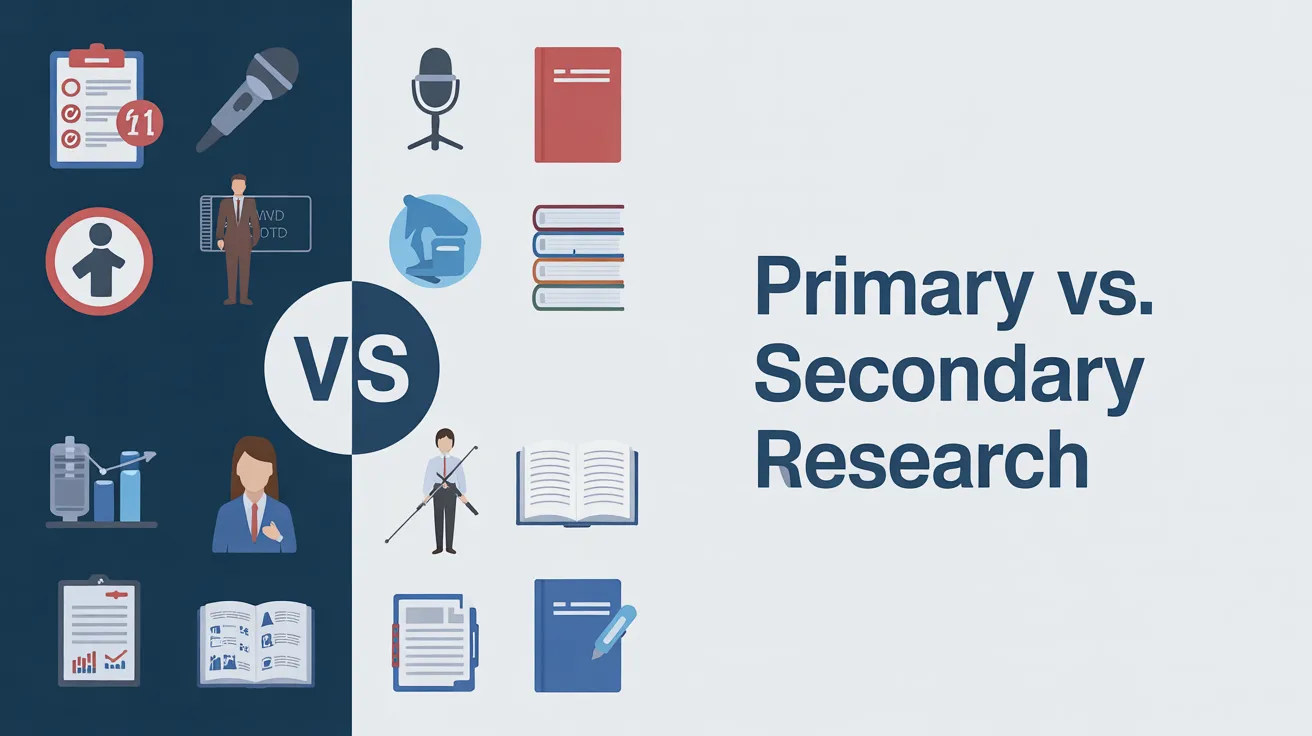
When we talk about primary vs secondary research, we are really talking about the distance between you and the source of the information. Primary research is when you are the one holding the clipboard, the microphone, or the stopwatch. You are generating original data that has never been seen before. It is firsthand, it is raw, and it is specifically tailored to your particular business or academic goal.
Secondary research, on the other hand, is when you are essentially a curator. You are involved in analyzing existing data that someone else, a government agency, a marketing firm, or an academic expert, already gathered. You are taking their hard work and looking at it through a new lens to find relevant information for your own research project.
Here is how the differences usually play out in the real world:
- Origin: Primary data collection happens directly from sources, while secondary research relies on secondary data sources like books or a database.
- Purpose: Primary research involves answering specific questions for your study, whereas secondary research involves using available information collected for other purposes.
- Cost: Usually, primary research involves a higher cost and a larger budget, while secondary research is faster and much cheaper.
- Control: You have total control over the sampling and methodology in primary research, but you are at the mercy of the original researcher’s bias in secondary research.
Why Primary Research is Necessary for Your Paper
Sometimes, the existing data just isn’t enough. If you are launching a new product or exploring a niche in social science that nobody has touched yet, primary research is necessary to fill the gaps. You cannot find the answer to a brand-new hypothesis in an old academic journal. You have to go out and find it yourself.
Primary research delivers a level of specificity that secondary market research simply cannot match. You get to define the target market, control the response bias, and ensure the data is information directly relevant to your business objective. It is about getting the ground-truth evidence that makes your argument bulletproof.
Methodology Meltdown?
Our expert writers can handle the heavy lifting of primary and secondary data collection while you catch up on sleep. From surveys to literature reviews, we deliver polished results that meet your 2026 academic standards. Get the professional edge your thesis deserves.
When you decide to conduct primary research, you have several tools at your disposal to gather information directly from the source. These primary methods include:
- Survey methodology: Using a questionnaire to collect quantitative research data from a large group.
- Interview: A qualitative approach where you have a conversation with an expert or a customer to get deep insight into their motivation.
- Focus group: Bringing a small group together to discuss their behavior or beliefs regarding a brand.
- Observation: Watching how people act in a specific context without interfering.
- Experiment: Following the scientific method to test a hypothesis in a controlled environment.
Sometimes, the sheer volume of available information feels like a trap, and learning how to overcome thesis dead ends is the only way to keep your project moving forward when your primary data doesn’t behave as expected.
The Perks of Secondary Research Methods
Let’s be honest: primary research takes forever. If you are on a tight schedule, secondary research is faster and often provides a broader grasp of the particular topic you are studying. Secondary research relies on information already collected by others, which means you can skip the data collection phase and go straight to data analysis.
Secondary research provides a foundation. It tells you what has already been discovered and where the experts disagree. It is about using critical thinking to connect the dots between a diary from the 19th century and a modern statistics report. Sources include everything from market research reports to a government document or a digital database.
Common Secondary Data Sources
Common secondary data sources you will likely use include:
- Academic journal articles: Peer-reviewed papers that provide empirical research and theoretical context.
- Books: Detailed information on history or foundational theories.
- Business intelligence: Reports on market trends and customer preferences.
- Big data: Massive datasets often harvested from the Internet of Things or social media.
- Government records: Statistics on education, crime, or public health.
Mining a massive database comes with its own baggage, specifically the Ethical Considerations of Big Data that most students overlook in their first draft when they are rushing to find evidence.
Balancing Your Research Project Budget and Time
In real life, your choice between whether primary or secondary methods are used is often dictated by your resources. If you have a zero-dollar budget and three days until your deadline, you are doing secondary research. But if you have a research team and a specific business need, you might combine both.
Using both types of research is actually the gold standard. We often suggest starting with secondary research to see what is already out there. This helps you refine your research question and ensures you aren’t reinventing the wheel. Once you have a broader understanding of the field, you can use primary research to answer the specific questions that the existing literature missed.
Consider these factors when planning your research strategy:
- Cost: Primary research gathers data from scratch, which requires more money for sampling and incentives.
- Time: Secondary research is faster because the data is already sitting in a library or online.
- Accuracy: Primary data is information tailored to your needs, but secondary data might be outdated or irrelevant to your specific business.
- Skills: You need strong research skills to conduct an interview or an experiment without introducing bias.
Stuck on Your Research?
Whether you need a full literature review or a custom survey design, our academic pros are here to help you navigate the 2026 research landscape. Save time and money while getting the grade you deserve. Our experts ensure your data meets rigorous standards.
When you conduct primary research via an experiment, you have to worry about the external validity of laboratory experiments to make sure your results actually apply to the real world beyond your small sample size.
Market Research and Business Decisions
In the corporate world, the primary vs secondary research choice is usually about risk management. If a company is launching a new product, it cannot rely solely on market trends from three years ago. They need primary market research to understand current customer service expectations and consumer behaviour.
However, they will likely start with market analyses found in secondary market research to perform market segmentation. This helps them identify which customers to talk to in the first place. It is a sequence: secondary research offers the map, and primary research offers the deep dive into the specific territory.
For businesses looking at Brand Repositioning Strategies, secondary market research often acts as the foundation before they invest in expensive focus groups or extensive surveys.
Primary vs Secondary Sources in Social Science
If you are a student in history or sociology, the definition of these terms shifts slightly. A primary source might be a historical document, a diary, or a transcript of a conversation. It is a record from the time period under study. A secondary source is a book or article written by a scholar who analyzed those primary sources.
In the world of social science, you might be looking for social work research topics that require a mix of both qualitative and quantitative approaches to truly grasp human behavior. You might use secondary analysis of existing census statistics while also conducting an original interview with a community leader.
Remember, whether primary or secondary research is the focus, your goal is always the same: to provide evidence that supports your conclusion. You are trying to turn raw information into actual knowledge.
Expert Data Analysis?
Master the nuances of original data collection and secondary analysis with the help of our dedicated writing team. We provide custom research tailored to your specific 2026 academic or business requirements. Secure your success with verified data today.
Pros and Cons of Primary Research
Let me be honest, primary research is the most rewarding type of research, but it is also the most exhausting. You get to see the data emerge in real-time. You are the expert on your own dataset. But here is the weird part: sometimes the data doesn’t say what you want it to say.
Pros:
- Targeted: The primary research data is information directly relevant to your specific hypothesis.
- Exclusive: You have information that your competitors or peers do not have.
- Current: You are capturing the latest opinions and trends in 2026.
Cons:
- Expensive: You have to pay for the survey platform, the participants, or the travel for field research.
- Time-consuming: Recruitment and data collection can take months.
- Bias: You have to be extremely careful about how you word questions to avoid leading your participants.
Pros and Cons of Secondary Research
Secondary research relies on the quality of the work that came before you. If the original researcher had a small sample size or a massive bias, your analysis will inherit those flaws. But it is still the most efficient way to gather a lot of information in a short amount of time.
Pros:
- Cost-effective: Most of the time, it costs nothing but your library card or an internet connection.
- Accessible: You can find secondary data sources from anywhere in the world.
- Context: It allows you to see the history of a topic and how forecasting has changed over time.
Cons:
- Incomplete: The existing data might not answer your specific research question.
- Outdated: Market trends move fast, and a report from two years ago might be irrelevant today.
- Lack of control: You cannot verify exactly how the data collection was handled.
At the end of the day, the primary vs secondary research struggle is about finding the right tools for the job. You wouldn’t use a sledgehammer to hang a picture, and you wouldn’t use a 500-person survey to find out what happened in the Truman Doctrine. You use what works for your specific research needs and your current budget.
So yeah, if you have the time and the curiosity, go out there and conduct primary research. Opportunities like the CERN summer student programme offer invaluable hands-on experience. There is nothing quite like seeing your own hypothesis come to life through a well-designed experiment or a thoughtful interview. It gives you a level of authority that no amount of reading can replace. You become the expert that
But if you are drowning in work and the existing literature is already rich with relevant information, don’t feel guilty about relying on secondary research methods. Your job is to synthesize that available information and apply your own critical thinking to it. Sometimes the most groundbreaking work doesn’t come from new data, but from looking at old data in a way nobody else has before.
Pick your strategy, define your research question, and just start writing. Whether you are mining a database or talking to customers directly, the goal is the same: find the truth and present it clearly. This vital pursuit applies across all academic stages, from foundational coursework to students exploring research programs for high school students. You’ve got this, and if you don’t, you know where to find us for some extra help.
Primary vs Secondary Research FAQs

With a student-centered approach, I create engaging and informative blog posts that tackle relevant topics for students. My content aims to equip students with the knowledge and tools they need to succeed academically and beyond.