
Key Takeaways
- APA style serves as a traceable research system where every in-text citation acts as a pointer to a specific map entry in the final reference list.
- To cite correctly you must identify the author's last name, the year, the title, and specific source information like a publisher or URL.
- Standard formatting requires placing citations at the end of sentences before the period and using "et al." for sources with three or more authors starting from the very first mention.
- The final reference list must begin on a new page with centered headings and double-spacing while using a 0.5-inch hanging indent and sentence case for most titles.
- Specific rules require italicizing book titles and journal names while ensuring direct quotes always include quotation marks and a mandatory page or paragraph number.
Referencing might seem like the boring part of writing an essay, but neglecting it can cost you valuable points. Worse yet, you could end up with a citation issue that you didn’t even see coming.
This guide provides a practical walkthrough on how to reference an essay in APA style, specifically adhering to the rules set by the American Psychological Association’s 7th edition. This is crucial as it’s the standard most schools and instructors expect now. It’s important to be wary of older rules floating around on random blogs, as they can often be subtly incorrect in frustrating ways.
By the end of this guide, you’ll have a firm understanding of how to cite in the text, construct a reference list, and manage common source type situations such as citing a book, journal article, or web page.
What “APA” actually wants you to do
APA is more than just punctuation; it’s a comprehensive system designed to make your research traceable through a set of citation formats. The basic idea is straightforward:
- Use an in-text citation in your paper whenever you use information from a source.
- Add the corresponding full reference entry in the reference list at the end of your paper.
However, it’s the details that truly matter: page number rules, APA punctuation specifics, italics usage, capitalization rules guidelines, when to use parentheses versus quotation marks, and how to format the hanging indent.
If you’re looking for an external citation guide for comparison purposes, Purdue University’s well-known APA section could be helpful. For official rules, though, the publication manual from the American Psychological Association remains the authoritative source.
In addition to APA referencing, there are other citation styles such as RGU Harvard referencing, MMU Harvard referencing, and De Montfort University DMU Harvard referencing, which you may also find useful depending on your academic requirements. If you’re interested in mastering APA citation, this article provides a comprehensive guide.
Stop losing points over minor formatting errors. Our academic experts provide precision-perfect essays tailored to your specific rubric. Get the grade you deserve by hiring a pro today.
Get Writing HelpStep 1. Know the two parts: in-text + reference list
In APA, you do parenthetical referencing inside your writing. That usually looks like:
- (Last name, Year)
- or (Last name, Year, p. page number)
Then the reference list at the end contains the full details so someone can locate the exact source. Think of it like this. The in-text citation is the pointer. The reference entry is the map.
What you always need to include
Most APA citations require:
- author’s last name
- year
- title
- source information (publisher for a book, journal details for a journal article, URL for a web page)
If you are missing an author or a date, there are rules for that, too, but do not guess.
Step 2. In-text citation rules you will actually use
1) Paraphrase (most common)
A paraphrase is when you restate a source in your own words. Still needs a citation. Always.
Parenthetical form:
- (Last name, Year)
Narrative form:
- Last name (Year) argues that…
Example:
- Students often misunderstand fair use when reusing media in academic writing (Nguyen, 2022).
- Nguyen (2022) explains how fair use is frequently misapplied in student essays.
Notice the use. It is part of APA punctuation. Also, page number is not required for a paraphrase in APA, but they can be helpful if your instructor wants them or if the information is hard to find.
2) Direct quote (word for word)
A direct quote must use quotation marks and an in-text citation with a page number.
Example:
- “APA style is designed to support clear communication” (Harris, 2020, p. 41).
Here you used a quotation, a quotation mark, and a page number. That page number is required for a direct quote in APA. If there is no page number (common with a web page), you can cite a paragraph number instead, like:
- (Last name, Year, para. 4)
Yes, para. stands for paragraph.
3) Short vs long quotes
In APA, short quotes go in quotation marks. Long quotes (40 words or more) become a block quotation, which is formatted differently. You indent the whole block. And you usually do not use quotation marks because the block format signals it is a quotation. Even then, you still include the in-text citation with the page number.
Complex citations shouldn’t stand between you and graduation. Our specialized writers master every nuance of APA 7th edition so you don’t have to. Place your order now for flawless academic writing.
Order Now4) Multiple authors
This one trips people up because APA changes depending on how many names there are.
Two authors
Cite both last name values every time. Example: (Garcia & Patel, 2021)
Three or more authors
Use the first author’s last name + et al. from the first citation onward. Example: (Kim et al., 2019)
If your source has multiple authors, do not list them all in the in-text citation unless there are only two.
5) Where the citation goes in the sentence
Most of the time, the citation goes at the end of the sentence, before the period.
Example:
- This pattern shows up across psychology research methods courses (Lopez, 2018).
If you place the author in the sentence, the year goes in parentheses right after their name. Lopez (2018) notes that…
Step 3. Build the reference list at the end (and format it correctly)
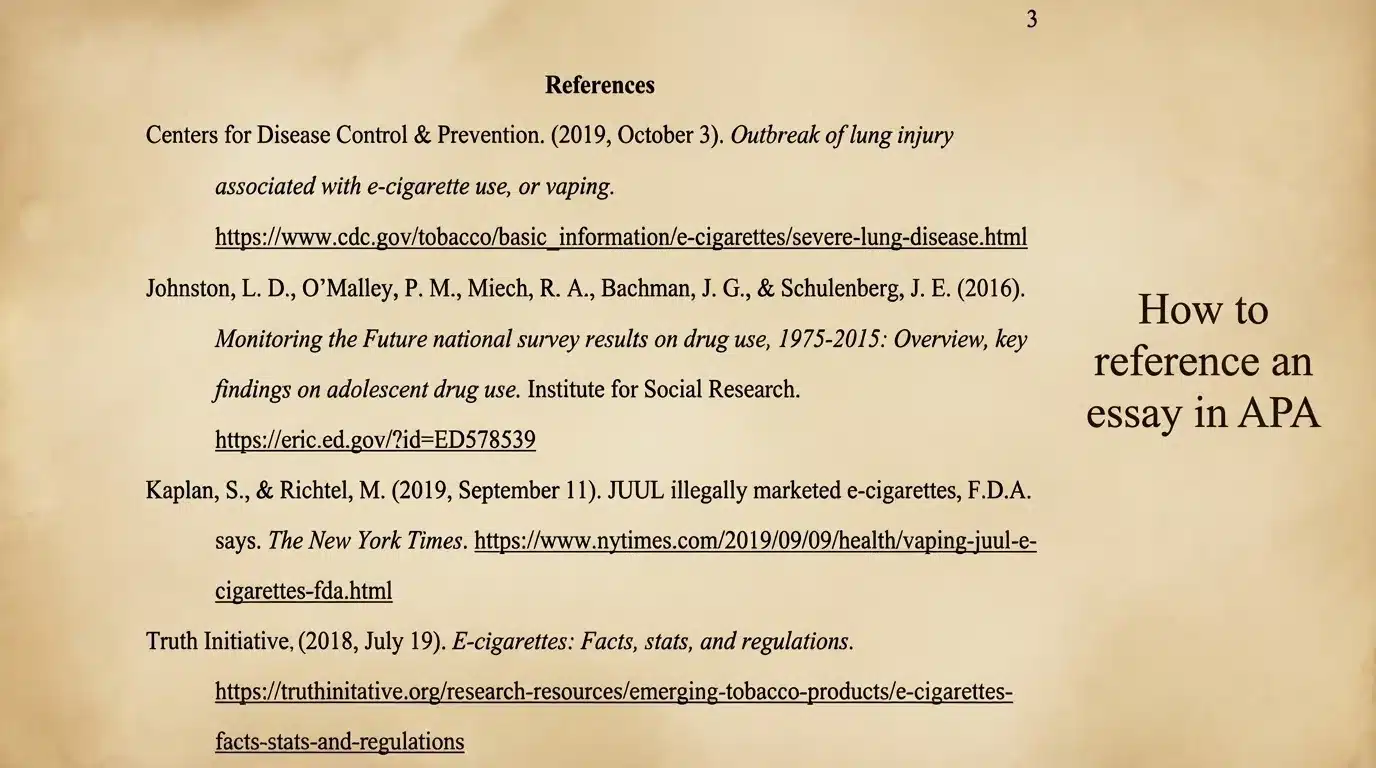
The reference list at the end starts on a new page.
Basic rules:
- Put it at the top of the page, typically with the heading “References” centered.
- Double-space everything.
- Alphabetize by author’s last name.
- Use a hanging indent. Meaning the first line is flush left, and every line after that is indented.
Some instructors will phrase this as “indent the first line,” but in APA, it is the opposite: do not indent the first line, indent the lines after the first line. A common setting is a 0.5-inch hanging indent. So if you are staring at Word settings, set hanging indent to 0.5 inch. If you are doing it manually, do not. You will hate your life.
Also, APA has very specific capitalization rules for titles in references. You do not use title case for most titles. You use sentence case for the title.
That means:
- Capitalize the first word
- Capitalize the first word of the title
- Capitalize the first word of the title after a colon
- and capitalize proper nouns
But you do not capitalize every word like a headline. So “Effects of sleep on memory in psychology students” is a correct sentence case, not “Effects Of Sleep On Memory In Psychology Students.” You will also italicize certain elements depending on source type, like the title of a book or the name of a journal.
Reference examples by source type
Below are clean, copyable reference example templates. Replace the bracket items with your own information. The bracket is just a placeholder.
1) Book (print or ebook)
Format
Author last name, Initials. (Year). Title of the book: Subtitle if any. Publisher.
Reference example
Harris, J. T. (2020). Writing with sources in APA style. Meridian Press.
Notes:
- Italicize the book title.
- Use sentence case for the title. Only the first word of the title and proper nouns get caps.
- Do not write all rights reserved. That is copyright language you might see inside the book, but it does not go in a reference entry.
2) Journal article
Format
Author last name, Initials. (Year). Title of the article. Title of the Journal, volume number(issue number), page range. https://doi.org/xxxxx
Reference example
Kim, R. S., Ahmed, L., & Torres, P. (2019). Paraphrase strategies and citation accuracy in undergraduate writing. Journal of Academic Research, 14(2), 33–49. https://doi.org/10.0000/jar.2019.14.2.33
Notes:
- Italicize the journal title and the volume number.
- The issue number is not italicized.
- Use sentence case for the article title, but the journal title uses title case. Meaning major words are capitalized in the journal name itself.
- If you do not have a DOI, you may not need a URL, depending on how you accessed it. Many instructors still like the DOI when available.
3) Web page
Format
Author last name, Initials. (Year, Month, Day). Title of the page. Site Name. URL
Reference example
Patel, S. (2022, March 8). How to cite sources in APA format. Open Study Lab. https://www.openstudylab.org/apa-citation
Notes:
- A web page title is in sentence case.
- The site name is in title case as a proper name.
- If the author is the same as the site, you may omit the site name in some cases, but do it carefully.
4) Essay in a class or an unpublished student paper
A lot of students ask “how do I reference an essay in apa” and what they really mean is. They used a classmate’s essay, or they are citing an essay from a course pack, or some unpublished writing.
Here is the reality: you usually should not cite a classmate’s essay unless your instructor explicitly allows it. It is not a stable source. And it can raise privacy and copyright concerns. If you are citing an unpublished manuscript, APA has formats for that, but you will need the exact context. If it is your own essay, you do not cite yourself like it is an external source unless you are reusing your prior work and your instructor requires a citation. When in doubt, cite the original sources your classmate used, not the classmate.
Your time is valuable, so spend it on what matters most while we handle the research. Our team delivers high-quality, fully referenced papers on any subject in record time. Let us help you succeed effortlessly.
Get Help NowAPA Format Details People Lose Points For
Title Page and Overall Paper Format
If your instructor requests full APA format, your paper often needs a title page. That includes items like the title, your name, institution, course, instructor, and date. Many courses follow the student paper version from the 7th edition. The title is typically centered in the upper half of the page. And yes, it begins near the top of the page, but not literally on the first line. Your thesis should appear in the body, not on the title page.
Capitalization Rules in Reference Titles
For a reference entry title, remember:
- Capitalize the first word
- Capitalize the first word of the title
- Capitalize the first word of the title after a colon
Example:
- Understanding citation: A practical guide for student writing
Not:
- Understanding Citation: A Practical Guide For Student Writing
Also, “word of the title” rules matter when you are deciding what gets capped. If it is not the first word and not a proper noun, it usually stays lowercase. You can find more about these capitalization rules in titles on various online resources or follow specific capitalization guidelines.
Punctuation and The Dreaded Dash
APA punctuation can feel picky. Periods separate major parts. Commas separate elements inside the same part. A dash is not really your citation tool in APA. Do not use a dash where a comma belongs in (Author, Year). And do not improvise. Same with quotation marks. Use quotation marks for short direct quote text. Use block format for long quotes.
If you’re interested in exploring other formatting styles, such as IEEE format or ASA format, there are numerous resources available online to guide you through those processes.
Parenthesis vs parentheses
In APA writing, you will hear both. Practically, you will be using parentheses constantly for in-text citation. Just be consistent in your writing and do not mix weird punctuation like this (Lopez, 2018).
Indent rules in the reference list
Again, because it matters. Hanging indent.
- First line: flush left
- lines after the first line: indented 0.5 inch
Do not indent the first line. If someone tells you “indent the first line,” they probably mean “indent the first line after the first,” basically the hanging indent effect.
Copyright, fair use, and “all rights reserved.”
This comes up when students quote, screenshot, or reuse tables and figures. Copyright exists automatically when something is created. “All rights reserved” is a common phrase you might see, but you do not add it to your citation.
Fair use is a legal doctrine that can allow limited use for things like education, commentary, and research. But it is not a magic shield. If you are lifting large chunks, reproducing images, or using a lot of someone else’s work, you may need permission even if you cited it. Citing sources is about academic honesty. It does not automatically grant permission to reproduce copyrighted content.
Quick checklist you can use while editing your essay
Before you submit your paper, scan it fast like this:
- Every paraphrase has an in-text citation.
- Every direct quote has quotation marks and a page number.
- Every in-text citation has a matching reference entry.
- The reference list at the end is alphabetized and uses hanging indent (0.5 inch).
- Titles in references use sentence case, not title case, except for journal names.
- You italicize the right things: book titles, journal names, volume numbers.
- You did not invent citation formats. You followed APA.
If you want a sanity check, compare one or two tricky sources using a trusted citation guide, and then match the punctuation exactly. APA is weirdly strict about commas, periods, and parentheses. Small stuff, but it is how graders spot mistakes fast. For those who find citing sources challenging or time-consuming, utilizing a citation machine can significantly streamline the process.
A few final reference examples (copy and tweak)
Here are extra templates you can paste and fill in. Keep the bracket placeholders.
Book
[Last name], [Initials]. ([Year]). [Title of the book]. [Publisher].
Journal article
[Last name], [Initials]. ([Year]). [Title of article]. [Journal Title, Volume]([Issue]), [pages]. [DOI or URL]
Web page
[Last name], [Initials]. ([Year, Month Day]). [Title of page]. [Site Name]. [URL]
If you take nothing else from this. In APA, your citation is not decoration. It is a trail. Make it clean, make it consistent, and make it easy for someone else to follow. That is the whole point.
How to Reference an Essay in APA FAQs
Why is referencing important when writing an essay in APA style?
Referencing is crucial because neglecting it can cost you valuable points and lead to citation issues. Proper referencing in APA style ensures your research is traceable and credits the sources accurately, which is essential for academic integrity.
What are the two main parts of APA referencing I need to know?
APA referencing consists of two key parts: the in-text citation, which appears within your paper whenever you use information from a source, and the reference list at the end of your paper that contains full details of each source for readers to locate them.
How do I format in-text citations for paraphrasing and direct quotes in APA 7th edition?
For paraphrasing, use parenthetical form like (Last name, Year) or narrative form like Last name (Year). Page numbers are optional but helpful. For direct quotes, include quotation marks and an in-text citation with page number, e.g., “quote” (Last name, Year, p. X). If no page number exists, use paragraph number instead (para. X).
How should I cite sources with multiple authors in APA style?
For two authors, cite both last names every time, e.g., (Garcia & Patel, 2021). For three or more authors, use the first author’s last name followed by et al., e.g., (Kim et al., 2019), from the first citation onward.
What are the formatting rules for long quotes in the APA 7th edition?
Long quotes of 40 words or more should be formatted as block quotations: indented as a separate block without quotation marks. The in-text citation with page number still follows the quote to indicate the source clearly.
Where should I place in-text citations within my sentences according to APA style?
Most of the time, place the in-text citation at the end of the sentence before the period, e.g., (Lopez, 2018). If you mention the author in your sentence, put the year in parentheses immediately after their name, e.g., Lopez (2018) notes that…

With a passion for education and student empowerment, I create blog content that speaks directly to the needs and interests of students. From study hacks and productivity tips to career exploration and personal development