

What makes a topic controversial:
A topic is controversial when reasonable people disagree about the right conclusion, policy, or moral judgment, and when that disagreement is sustained by different values, priorities, or readings of the evidence rather than by simple misunderstanding of facts.Why these topics are useful academically:
They push students to research deeply, evaluate competing arguments, build a precise thesis, and practice fair engagement with opposing views. That process strengthens critical thinking and produces more substantial papers than topics with little real debate.How to choose a good topic:
Select an issue with genuine disagreement, available credible sources, and a scope narrow enough for the assignment. Prefer focused questions over broad labels, and choose subjects that can support evidence-based argumentation rather than pure provocation.Research approach:
Use a range of reputable sources, represent opposing views accurately, and separate evidence from opinion. Strong papers show awareness of complexity and avoid one-sided or purely emotional framing.Writing approach:
Structure the essay around a clear thesis, support claims with evidence and analysis, dedicate space to counterarguments, and maintain a reasoned academic tone. The goal is persuasion through logic and research, not escalation.A topic is controversial when reasonable people disagree about the right conclusion, policy, or moral judgment, and when that disagreement is sustained by different values, priorities, or readings of the evidence rather than by simple misunderstanding of facts.
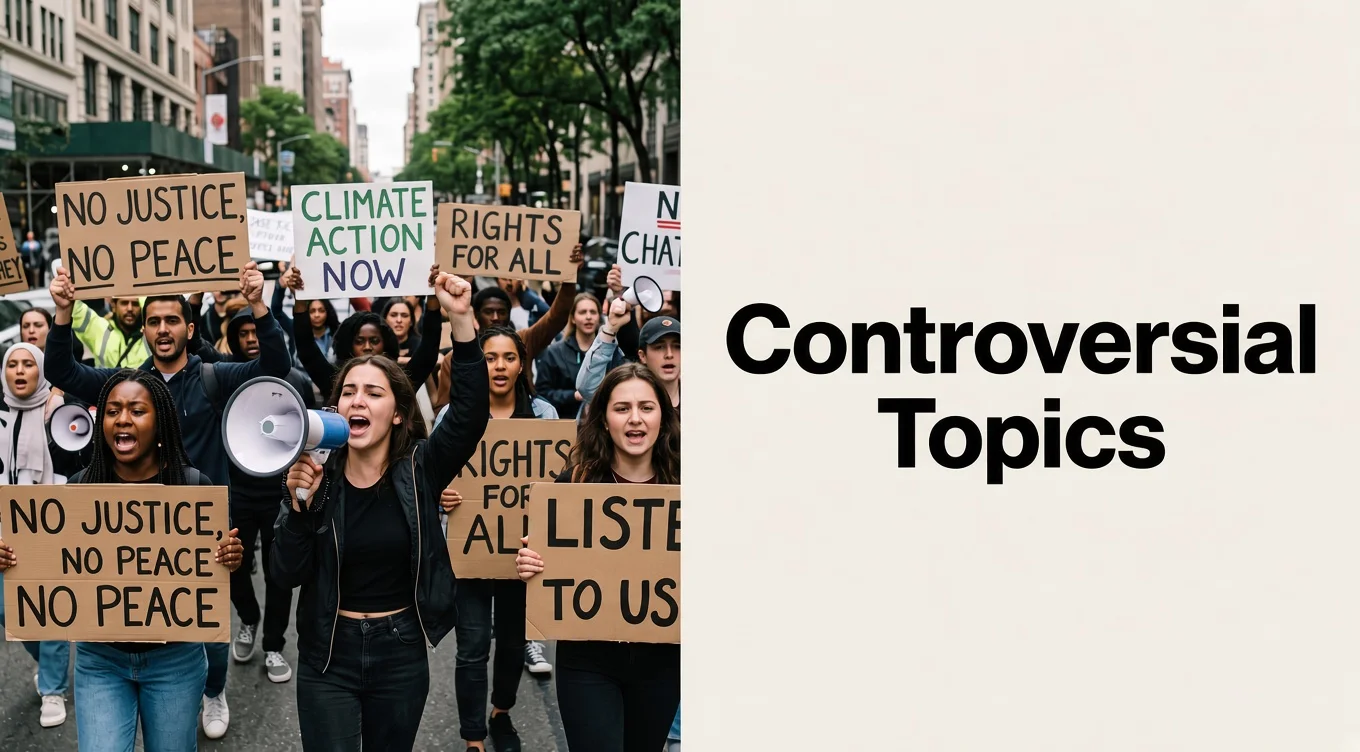
Controversial Topics are subjects with significant public or scholarly disagreement, often rooted in competing values, ethics, or interpretations of evidence. For essays and debates, the best topics are focused, researchable, and open to more than one well-supported position. Many compelling controversial issues, such as civil disobedience topics, offer rich ground for exploring complex ethical dilemmas and historical precedents.
Choosing a topic that is both debatable and manageable can feel difficult, especially when many issues seem either too broad or too charged.
That’s precisely why we’ve put together this comprehensive guide. We’re going to walk through what makes a topic truly controversial, why they’re so valuable for academic work, and provide you with a significant list of options. Our goal is to give you not just ideas, but the confidence to tackle these hot-button issues in your essays and debates, turning that initial groan into a productive, even exciting, research journey.
Key Takeaways
- Selecting a strong, research-ready topic involves identifying subjects with genuine debate and ethical dilemmas.
- Effective controversial topics prompt critical thinking and require balanced, evidence-based argumentation from multiple perspectives.
- Choosing current events or societal issues ensures relevance and often provides ample source material for research.
- Good topics challenge prevailing opinions and allow for nuanced discussion rather than simple right-or-wrong answers.
- Researching a controversial topic demands careful consideration of sources and a commitment to presenting a well-reasoned argument.
What Makes a Topic Controversial?
So, what actually qualifies as a controversial topic? It’s not just anything that makes people argue. True controversial topics are subjects on which there is significant public disagreement, often rooted in differing values, moral issues, or interpretations of facts. They typically lack a universally accepted solution or viewpoint, making them ripe for argumentative essay topics and deep research.
These are often current controversial topics, reflecting ongoing societal debates. They require more than just stating an opinion; they demand research, analysis, and the ability to articulate why your stance, or an opposing one, is valid. Engaging with these topics can feel intimidating, but they offer incredible opportunities for intellectual growth and demonstrating sophisticated critical thinking.
Why Choose Controversial Topics for Your Assignments?
Choosing controversial topics for your academic assignments offers several distinct advantages. First, they force you to engage deeply with complex material. You can’t just skim the surface; you have to understand the nuances, the historical context, and the various arguments put forth by different sides. This is how you develop strong analytical skills.
Second, they often lead to more engaging and memorable papers. Think about it: a topic that sparks discussion is inherently more interesting to read and write about than one where everyone already agrees. This engagement can translate into better grades because your passion and effort shine through. Moreover, exploring these subjects helps you develop a strong voice for a persuasive speech or a robust evaluation essay that critically assesses different viewpoints.
Finally, tackling controversial issues in society prepares you for real-world discussions. Academic settings are safe spaces to practice debating, researching, and presenting complex ideas responsibly. It’s a skill that will serve you well, no matter your future career path. Learning to handle such topics also significantly hones your ability to write an argumentative essay about an ethical issue, which is a core academic skill.
Controversial Topics in Society and Politics
When we talk about current controversial topics, the political and social arenas are usually the first places our minds go. These are the highly controversial topics that dominate news cycles and dinner table discussions, representing deep divisions in public opinion. They often touch on fundamental rights, societal structures, and the role of government.
- Should all citizens have a universal basic income, regardless of employment status?
- Is social media primarily a force for good or harm in modern democratic processes?
- Should voting be mandatory for all eligible citizens in national elections?
- Does affirmative action still serve its intended purpose in promoting equality?
- Should governments impose limits on individual carbon footprints for environmental protection?
- Is censorship on internet platforms justifiable to combat misinformation?
- Should non-violent drug offenses be decriminalized or fully legalized?
- Are current global refugee policies adequate for addressing humanitarian crises?
- Should the age for social media use be legally raised to protect minors?
- Does critical race theory contribute to division or provide essential historical context in education?
- Should felons who have served their time regain all voting rights?
- Is it ethical for private companies to collect and monetize personal data without explicit consent?
- Should public monuments and historical symbols with controversial pasts be removed or recontextualized?
- Are current gun control laws effective in preventing violence?
- Should religious exemptions be granted for laws that conflict with personal beliefs?
Controversial Topics in Technology and Ethics
The rapid pace of technological advancement continually introduces new ethical dilemmas and societal challenges. These are fascinating areas for a controversial research paper, as the answers are often still being debated and shaped. From artificial intelligence to genetic engineering, technology consistently pushes the boundaries of what we consider acceptable or safe.
- Are AI-generated artworks truly art, and should they be protected by copyright?
- Should there be stricter international regulations on the development of autonomous weapon systems?
- Is it ethical to use CRISPR gene editing technology to enhance human traits?
- Should driverless cars be programmed to prioritize passenger safety over pedestrian safety in unavoidable accidents?
- Does widespread surveillance technology compromise individual privacy more than it enhances security?
- Should social media algorithms be legally mandated to be transparent and auditable?
- Is the energy consumption of cryptocurrencies, like Bitcoin, an acceptable environmental cost for their benefits, especially given the rising demands of AI?
- Are virtual reality environments and the metaverse creating healthy or unhealthy societal engagement?
- Should personal biometric data (e.g., DNA, fingerprints) be considered personal property with full ownership rights?
- Is the development of brain-computer interfaces an ethical pursuit, given the potential for misuse?
- Should governments invest heavily in space colonization efforts given pressing terrestrial issues?
- Is it ethical to use deepfake technology for satire or artistic expression without clear disclosure?
- Should there be a universal right to internet access, provided by governments?
- Are wearable health trackers creating a privacy risk with sensitive medical data?
- Should children have the right to “digital detox” periods mandated by parents or schools?
Need Expert Writing Help?
Don’t let tough assignments weigh you down. Our academic writing experts are here to help you craft compelling arguments and perfectly structured papers.
Controversial Topics in Education and Culture
Education and culture are deeply intertwined with societal values, making them fertile ground for highly controversial topics. Discussions in these areas often reflect our aspirations for future generations and our reflections on our past. These range from what should be taught in schools to how we define cultural heritage and identity.
- Should standardized testing be abolished in favor of alternative assessment methods?
- Is college education still worth the cost in 2026, or are vocational alternatives better?
- Should schools have the right to restrict student expression on social media outside of school hours?
- Does the focus on STEM education diminish the importance of humanities and arts?
- Should parents have the right to opt their children out of certain curriculum topics based on personal beliefs?
- Is the emphasis on mental health awareness in schools genuinely helpful or overly pathologizing?
- Should classical literature remain central to the curriculum, or should it be diversified with contemporary voices?
- Are single-sex schools beneficial for student development compared to co-educational institutions?
- Should universities revoke degrees from individuals who commit serious ethical transgressions post-graduation?
- Is cultural appropriation a legitimate concern, or does it stifle artistic freedom and exchange?
- Should academic institutions divest from companies with controversial ethical records?
- Does grade inflation undermine the value of academic achievement?
- Should all public schools offer free breakfast and lunch programs regardless of family income?
- Is the tenure system for university professors still relevant and effective?
- Should educational institutions actively promote certain political ideologies or remain strictly neutral?
Unlock Your Academic Potential
Struggling to articulate complex ideas? Our expert writers craft clear, compelling essays that secure top grades. Experience personalized support designed for your success.
Controversial Topics in Science and Health
Science and health are fields where breakthroughs constantly challenge our understanding of life, morality, and well-being. These areas often present complex ethical dilemmas that require careful consideration of scientific fact, individual rights, and societal benefit. Many of these issues are truly life-and-death questions, making them profoundly impactful for discussion.
- Should there be universal, free healthcare for all citizens, funded by increased taxation?
- Is mandatory vaccination an infringement on personal liberty, or a public health necessity?
- Should human cloning for therapeutic purposes be legally permissible?
- Are pharmaceutical companies ethically obligated to lower drug prices globally, even if it impacts profits?
- Should physician-assisted suicide be legalized for terminally ill patients?
- Is it ethical to conduct medical research on animals when alternatives exist?
- Should public health policies prioritize individual freedom or collective well-being during pandemics?
- Is the commercialization of human organs for transplant morally justifiable under strict regulation?
- Should genetic predispositions to diseases be disclosed to employers or insurance companies?
- Are climate change denialism and misinformation campaigns a threat to global health and safety?
- Should government funding for scientific research be biased towards projects with immediate practical applications?
- Is it ethical to modify organisms for food production if there are unknown long-term ecological impacts?
- Should individuals have the right to refuse life-saving medical treatment, even if it impacts dependents?
- Are current mental health services adequate, and should they be fully integrated into primary care?
- Does the use of performance-enhancing drugs in sports reflect a fundamental moral failing or a natural progression of human competition?
Controversial Topics in Economics and Business
The world of economics and business is rife with highly controversial topics, often revolving around fairness, equity, and the balance between profit and social responsibility. These discussions explore the ethical frameworks that govern our financial systems, the impact of globalization, and the future of work. Thinking about these issues often involves grappling with complex financial models and societal impacts, similar to researching psychology research proposal topics, which also require a deep dive into human behavior and societal structures.
- Should corporations be legally required to prioritize social and environmental impact over shareholder profit?
- Is a global minimum corporate tax rate necessary to prevent tax evasion and promote economic equity?
- Should gig economy workers be classified as employees with full benefits and labor protections?
- Does unrestricted capitalism lead to inevitable wealth inequality, and if so, how should it be addressed?
- Are sanctions against specific nations effective and ethical tools for international policy?
- Should executive compensation be capped relative to average employee wages within a company?
- Is the increasing automation of jobs a net positive for society, or will it lead to mass unemployment?
- Should financial markets be more heavily regulated to prevent crises?
- Is it ethical for companies to engage in planned obsolescence to drive consumer purchasing?
- Should developing countries be allowed to pollute more than developed countries to foster economic growth?
- Are luxury taxes an effective and fair way to redistribute wealth?
- Should companies be held responsible for the ethical practices of their entire supply chain?
- Is the concept of intellectual property a barrier to innovation in certain sectors?
- Should governments subsidize failing industries to protect jobs?
- Is free trade always beneficial, or does it harm local economies and industries?
Stuck on a Specific Aspect?
Our seasoned writers can provide tailored support, from outlining complex arguments to refining your thesis.
Historical Controversial Topics
History is never just a collection of facts; it’s an interpretation, and those interpretations can be highly contentious. Exploring historically controversial topics allows for fascinating analysis of past events through a modern lens, challenging established narratives and understanding their long-term impact on current controversial topics. These topics often intersect with conflict essay topics as they involve differing perspectives on past struggles and their legacies.
- Was the dropping of the atomic bombs on Hiroshima and Nagasaki militarily justified?
- To what extent were colonial powers responsible for the underdevelopment of former colonies?
- Should historical figures with controversial pasts be celebrated or condemned?
- Was the Cold War primarily an ideological conflict or a struggle for global dominance?
- Did the Treaty of Versailles directly lead to the outbreak of World War II?
- To what degree was the American Revolution truly revolutionary for all segments of society?
- Were the benefits of the Industrial Revolution outweighed by its social and environmental costs?
- Should nations pay reparations for historical injustices like slavery or genocides?
- Was the Roman Empire’s expansion primarily a civilizing mission or an act of brutal conquest?
- How much influence did individual leaders versus broader social forces have on major historical turning points?
- Was the historical portrayal of indigenous peoples in academic texts accurate or biased?
- Should historical narratives in textbooks be primarily nationalistic or globally inclusive?
- Was the Space Race a triumph of human ingenuity or a wasteful Cold War proxy battle?
- Did ancient civilizations like Egypt or Greece benefit from or exploit their labor forces?
- To what extent does the legacy of the Spanish Inquisition still influence modern religious and cultural tensions?
So what now?
Choosing one of these controversial topics for your next assignment might feel like stepping onto a tightrope. It requires balance, careful footing, and a good sense of direction. But honestly, it’s also where the most interesting academic work happens. These are the issues that truly make you think, that challenge your assumptions, and that ultimately sharpen your argumentative skills.
Don’t let the “controversial” part scare you away. Instead, see it as an opportunity to dig deep, to understand different perspectives, and to articulate your own informed position with clarity and evidence. The world isn’t black and white, and neither are the best academic papers. Embrace the gray areas, pick a topic that genuinely intrigues you, and remember that we’re here to help you navigate the complexities of these compelling discussions.
Controversial Topics FAQs

With a passion for helping students navigate their educational journey, I strive to create informative and relatable blog content. Whether it’s tackling exam stress, offering career guidance, or sharing effective study techniques