
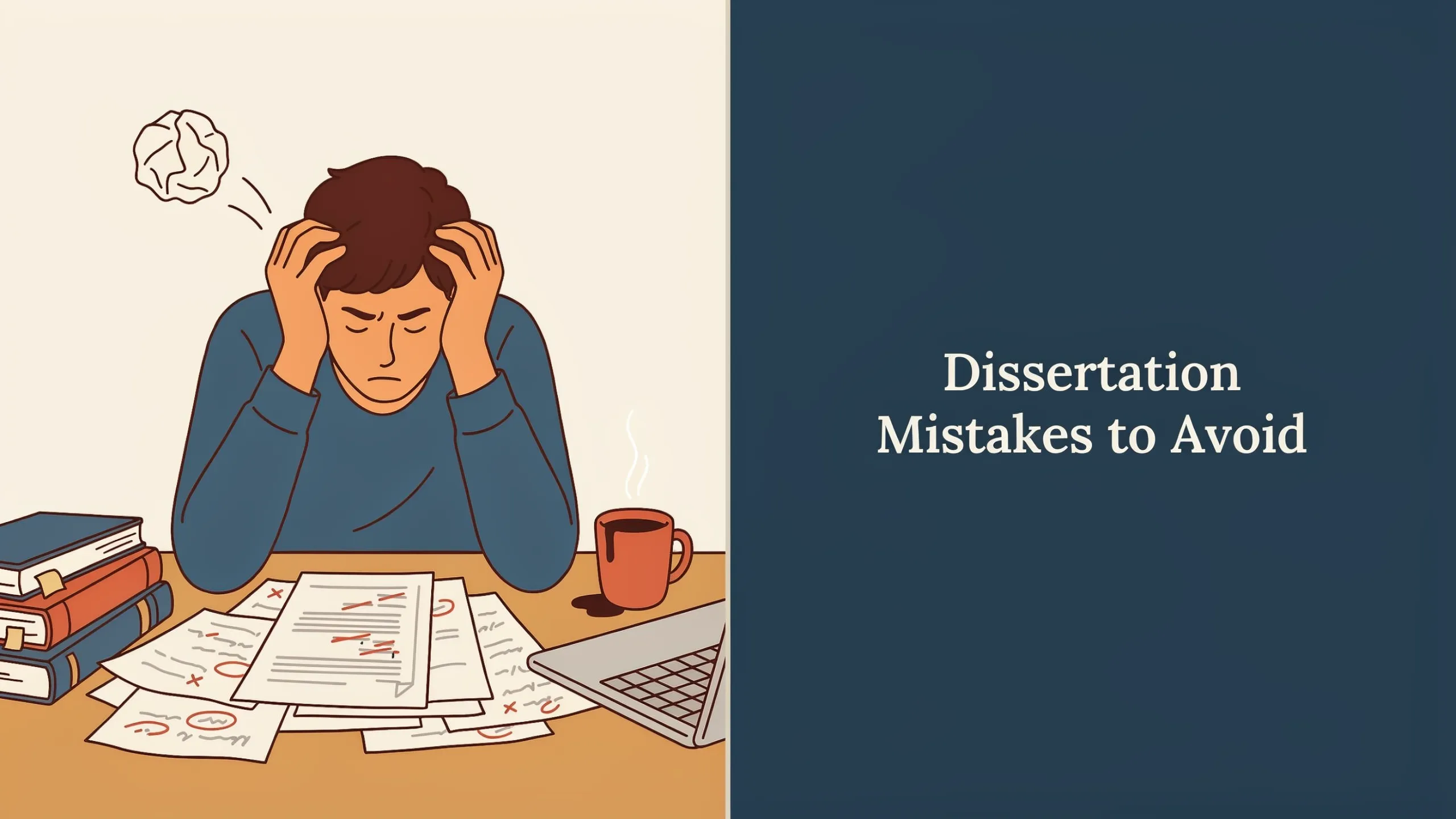
You are staring at your screen in the middle of a Tuesday night, and the blinking cursor feels like a personal insult. It is 2026, and you thought that by now the dissertation process would be automated by some genius software, but instead, here you are manually checking every single reference. The weight of becoming a Doctor of Philosophy is heavy, and the path is littered with subtle traps that can derail months of hard work. And I get it because I have seen brilliant doctoral candidates lose their minds over things that could have been fixed in the first week.
Let me be honest about how this usually goes for most people. You start with a huge amount of energy and a massive research project that looks great on paper but becomes a monster in real life. Then you hit a wall because you realize you did not actually talk to your advisor for three months, and now they want a total rewrite. This is not because you are not smart enough. It is because the system is designed to test your endurance as much as your knowledge.
But here is the thing about writing a doctoral dissertation in the current academic climate. The standards for clarity and methodological rigor are higher than ever, even as the time you have to finish seems to shrink. If you can identify the dissertation mistakes to avoid before you fall into them, you might actually finish this year without needing a permanent vacation in the mountains. We are going to look at the social, technical, and structural errors that turn a PhD thesis into a never-ending nightmare.
So yeah, we are going to get into the weeds of why your outline might be failing you and why your committee member might be giving you conflicting advice. This is about making the whole ordeal less stressful and making sure you actually submit a document you are proud of. Let’s look at how to stop self-sabotaging your academic career before you even get to the defense.
Key Takeaways
- Effective dissertation management requires setting realistic internal deadlines well before the university’s official submission dates to prevent last-minute quality drops.
- Maintaining proactive and honest communication with the dissertation committee prevents sudden rejections and ensures alignment with the advisor’s expectations during the final defense.
- Selecting a research topic with a manageable scope is more critical for successful completion than attempting to solve every problem within a single academic field.
- Consistency in formatting and citation styles throughout the entire manuscript reduces the likelihood of multiple revisions and delayed graduation dates.
- Prioritizing clear and concise language over complex academic jargon makes the doctoral research more accessible and acceptable to potential committee members.
The Timing Trap and Starting Too Late
One of the most common mistakes that students make is assuming they have more time than they actually do. You look at the calendar and think a year is plenty of time to finish a few chapters,s but you forget that life has a way of interrupting your flow. In real li,fe the dissertation process involves dozens of micro-deadlines that you usually ignore until it is too late.
Many doctoral candidates underestimate the amount of time required for data collection and analysis. If your research involves human subjects or complex statistics, you cannot just rush the process over a weekend. You might find that your data is messy or that your original methodology does not hold up under scrutiny, which means you need a buffer for unexpected delays.
Need Topic Inspiration?
Finding the right focus is the first step toward avoiding a timeline disaster. Explore our curated lists for academic success and ensure your project stays within a manageable scope. Get the creative spark you need from experts who understand doctoral rigor.
When you start too late, you are forced to rush the writing phase, which leads to poor presentation and inconsistency. This often results in overlooking crucial aspects of the final document, including how to write a dissertation conclusion. A rushed draft is almost always a rejected draft because professors can smell desperation from a mile away. It is better to have a rough but complete document early than a perfect introduction that lea
Choosing a Research Topic That Is Too Broad
I have seen so many students try to save the world with their dissertations, and it almost always ends in tears. Your research topic should be a narrow laser beam, not a floodlight that covers everything. When you try to cover too much ground,d you end up with a shallow paper that lacks the analytical depth expected at the doctoral level.
If you are looking at something like business dissertation topics, you need to drill down into a specific niche. Not because the broad stuff isn’t interesting. Because you only have so many pages and so much time to prove you are an expert in a specific area.
- Narrow down your geographical focus to a specific city or region.
- Limit your time period to a single decade or a specific event.
- Focus on a specific demographic rather than the general population.
- Use one or two theoretical frameworks instead of five.
- Ensure you have direct access to the information required for your specific angle.
A common dissertation mistake is thinking that a broad topic makes you look smarter. In reality, a narrow topic allows you to showcase your Critical Thinking Skills by exploring the intricacies of a specific problem. Your committee wants to see that you can handle complex details, not that you can summarize a whole field of study.
Failing to Manage the Dissertation Committee
Your advisor and committee members are the gatekeepers of your future, and treating them as an afterthought is a massive mistake. I have seen students go dark for six months and then send a three-hundred-page manuscript out of the blue. That is the fastest way to get a rejection or a request for a massive rewrite that takes another year.
Communication is the core of a successful PhD journey. You need to send a regular email or message to your advisor to keep them in the loop about your progress, even if you have nothing major to report. This builds trust and ensures that when you do hit a snag, they are more likely to help you find a way out, which is greatly aided by learning to effectively take notes in class and during meetings to retain key feedback.
Professional Academic Support
Let our experts help you polish your manuscript and meet your committee’s highest standards. We provide the detailed structural and stylistic reviews that professors demand for doctoral approval. Secure your academic future with our professional consultation today.
Dissertation committees often have conflicting opinions, which can be incredibly frustrating for the student. If one committee member wants X and another wants Y you need to act as a mediator rather than a victim. Ask your advisor to help you resolve these contradictions early so you don’t end up with a fragmented document that pleases nobody. Remember that potential committee members have their own research interests and academic biases that you need to account for.
The Literature Review and Citation Chaos
Here is the weird part about the literature review. Many students think it is just a summary of what they read, but it is actually a map of why your research matters. One of the dissertation mistakes to avoid is simply listing books and articles without showing how they connect to your specific thesis. You are not writing a book report, you are building a case for your own existence in academia.
If you don’t keep track of your citations from day one you will spend your final week in a state of pure panic. Using the wrong format or having an incomplete reference list can cause problems during the final review. Even small mistakes in your bibliography can lead to a request to resubmit the entire thing because it looks like you lack attention to detail.
- Organize your sources by theme rather than author.
- Use a citation manager like Zotero or Mendeley from the very beginning.
- Check your university’s specific formatting guidelines every single month.
- Ensure every sentence that contains an idea not your own has a proper citation.
- Avoid over-relying on a single expert or a small group of research papers.
When you are synthesizing the Value of Knowledge, you must show how different voices in the field disagree. A good literature review highlights gaps in the existing research which you then fill with your own work. If you just agree with everyone you aren’t actually contributing anything new to the academic journal world.
Methodology and Data Mismanagement
Your methodology is the heart of your research project and if it is weak the whole thing falls apart. Many students choose a methodology because it seems easy rather than because it fits the research question. This often leads to statistical results that don’t actually prove anything or data that is so thin you can’t draw a conclusion.
Underestimating the difficulty of data analysis is a common mistake that can lead to a rewrite late in the game. If you are not an expert in statistics you need to find a tutor or a mentor early on. Don’t wait until you have all your data to realize you don’t know how to run the tests required by your committee.
Stuck on Your Analysis?
Our academic consultants can help you refine your methodology and clarify your results. Don’t let statistical hurdles stall your progress toward graduation. Get the expert guidance needed to transform raw data into a compelling academic argument.
Poor presentation of data is another one of those common dissertation mistakes that are easily avoided. Use clear tables and charts and make sure they are discussed in the main text of your paper. If your data is too large for the main body move the raw figures to an appendix so the narrative remains smooth and easy to follow. Clarity is always more important than complexity when you are presenting your findings.
Overusing Jargon and Ignoring Clarity
There is a common misconception that academic writing has to be difficult to read. Let me be honest with you. If a professor has to read a paragraph three times to understand what you mean they are going to get annoyed. Using heavy jargon might make you feel like you belong in academia but it often hides a lack of clear thinking.
When you are, focus on making your argument as concise as possible. Every word should serve a purpose in your doctoral dissertation. If you can explain a complex concept in simple terms it actually shows that you have a deeper knowledge of the subject than someone who hides behind big words.
- Read your chapters out loud to check for flow and tone.
- Avoid long sentences that contain multiple conflicting ideas.
- Use active voice whenever possible to keep the narrative moving.
- Define any technical terms the first time you use them.
- Keep your abstract simple and focused on the core contribution of your work.
A good proofreader can help you catch grammatical errors and inconsistency that you are too tired to see yourself. Sometimes you are so close to the manuscript that you can’t see the forest for the trees. Having an outside perspective is the best way to ensure your message is actually getting across to the reviewer.
Ignoring Formatting and Final Polish
It sounds like a small thing but formatting can be the difference between finishing on time and waiting another semester. Universities have incredibly strict formatting guidelines and they will reject a document for the smallest margins or font errors. These small mistakes suggest that you didn’t take the final submission seriously which can irritate your committee.
Need a Professional Eye?
Don’t let typos ruin years of hard work. Our proofreaders specialize in doctoral-level academic standards and precise citation auditing. Ensure your final submission is flawless and ready for official university archiving today.
Before you submit your final draft you need to do a thorough check for grammatical errors and plagiarism. Even accidental plagiarism can lead to a complete dismissal from your ph.d program which is a disaster you cannot afford. Using a plagiarism checker is not just about catching cheats. It is about making sure you didn’t forget a citation in a late-night writing session.
If you are feeling overwhelmed by the final polish you might consider looking for the top 11 websites to find a blog writer in 2026 for some editorial assistance. While you have to do the research yourself a professional editor can help with the correction of sentence structure and flow. This makes the final document much more professional and ready for the university’s archives.
Conclusion
The real ending, I guess. At the end of the day avoiding these common mistakes is not about being perfect. It is about being smart with your time and effort so you don’t burn out before the finish line. I have seen so many people let dissertation mistakes to avoid become their whole personality for three years and it doesn’t have to be that way. You are more than just a research project and your doctorate should be a milestone not a life-sentence.
Take it one paragraph at a time and keep your committee close even when you feel like hiding from them. If you manage your timeline and keep your scope tight you will find that the process becomes much more manageable. The defense will come sooner than you think and once you are on the other side all this stress will start to feel like a distant memory. Just remember to back up your data and double-check those citations one last time before you hit the submit button for good.
Dissertation Mistakes FAQs

With a student-centered approach, I create engaging and informative blog posts that tackle relevant topics for students. My content aims to equip students with the knowledge and tools they need to succeed academically and beyond.