

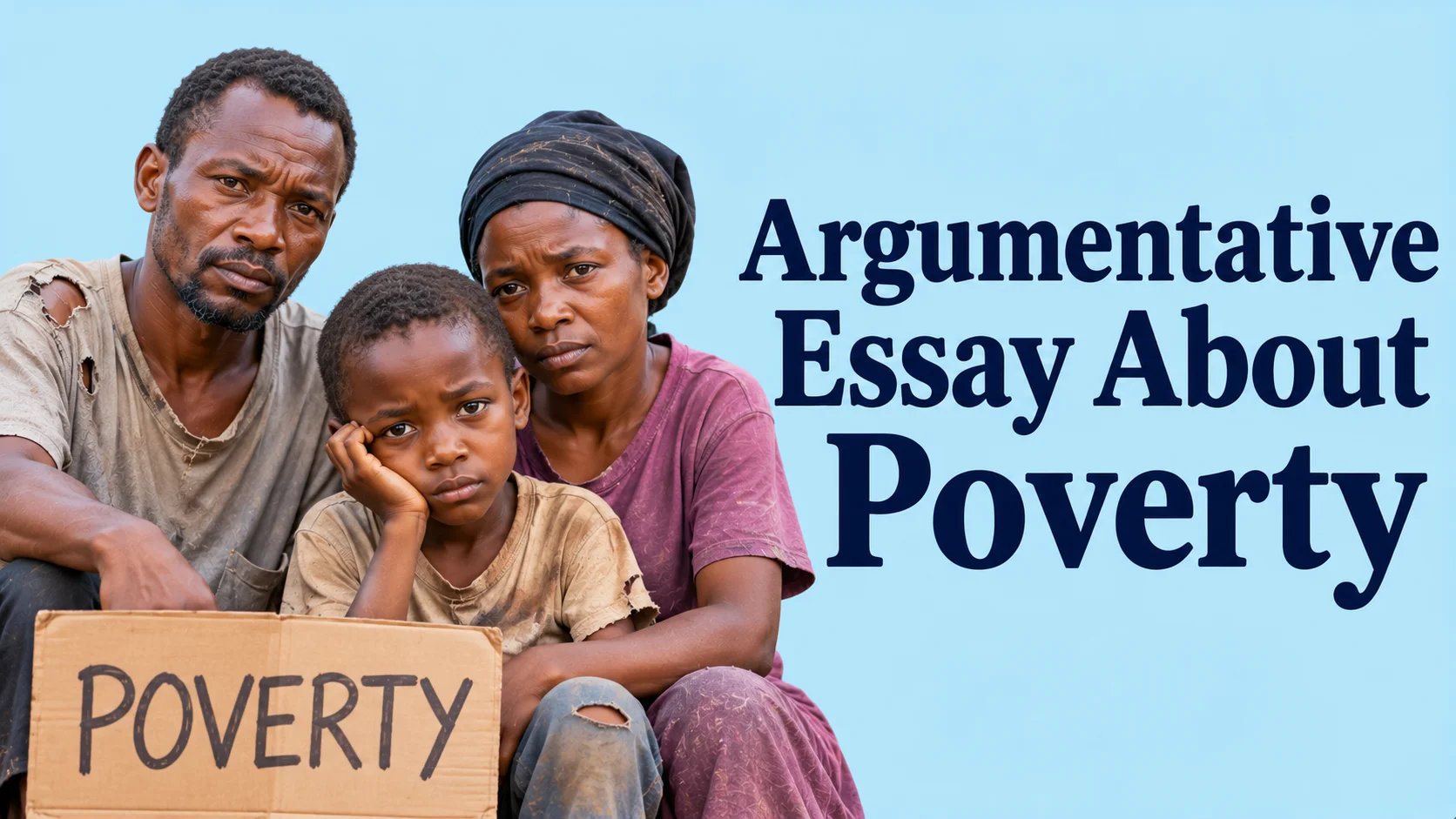
“Poverty is bad” is true, but it is not an argument. That is why so many students get stuck on an argumentative essay about poverty: the topic is so large that every claim either sounds obvious or cannot be proven in a few pages. The fix is to narrow. Instead of arguing about poverty as a whole, argue about one cause, one policy, or one group, such as whether cash transfers beat in-kind aid, or whether raising the minimum wage helps or hurts low-income workers.
This guide shows you how to make that move. You will get a step-by-step way to narrow your topic, weak and strong thesis examples side by side, a list of credible data sources, and a worked example that runs from claim to rebuttal. By the end, you will know how to write an Argumentative Essay About Poverty that is focused, evidence-based, and fair to opposing views.
Key Takeaways
- Effective argumentative essays on poverty require a clear, defensible stance backed by credible research and logical reasoning.
- Selecting a focused topic is crucial, moving beyond broad statements to specific angles like policy failures, educational disparities, or healthcare access.
- A strong thesis statement acts as the foundation, clearly presenting your argument and outlining the main points you will defend.
- Structuring your essay with an introduction, body paragraphs supporting claims and addressing counterarguments, and a robust conclusion ensures coherence and impact.
- Thorough research using diverse academic sources is essential for evidence, while proper citation avoids plagiarism and boosts credibility.
Why Writing an Argumentative Essay About Poverty Feels So Hard
Let’s be honest, few topics come with the emotional baggage and sheer complexity of poverty. It’s not just a statistic; it represents real people, real struggles, and real inequalities. You might feel a responsibility to do the topic justice, to avoid oversimplification, or to speak for those whose voices often go unheard. This inherent weight can make approaching an argumentative essay about poverty particularly daunting.
Beyond the emotional aspect, the subject is inherently interdisciplinary. You’re likely to encounter discussions about economics, sociology, political science, public health, and even philosophy. Synthesizing all this information into a coherent argument without getting lost in the weeds is a skill in itself. The sheer volume of data, theories, and policy proposals related to poverty can be paralyzing, making it tough to pinpoint a single, arguable stance that feels substantial enough for an academic paper.
Picking Your Battlefield: Choosing a Focused Topic for Your Argumentative Essay About Poverty
“Poverty is bad” isn’t an argument; it’s a universal truth. Your essay needs more specificity. The biggest mistake students make is trying to tackle the entirety of global poverty in 1500 words. You simply can’t. Instead, you need to find a sharp, narrow focus that allows for in-depth analysis and a clear argumentative path. Think of it like zooming in on a map – you start with the continent, then the country, then the city, until you’re looking at a single street.
To find your specific angle, consider what aspects of poverty genuinely interest you or what policy areas you feel strongly about. Do you believe government intervention is the primary solution, or do you see more efficacy in grassroots movements? Perhaps you’re more interested in the causes rather than the solutions, or a specific demographic’s experience with economic deprivation. This early decision is crucial, as it will dictate your research and the scope of your argument.
Brainstorming for Specificity
Start by asking questions. What policies have been proposed to alleviate poverty? Do they work? Why or why not? How does poverty affect a particular group, like single mothers or rural communities? What role does education play in either perpetuating or breaking cycles of poverty? Thinking about these questions can help you uncover potential angles for your argumentative essay about poverty that move beyond the obvious.
Consider local issues, national policies, or even global trends, but always aim to narrow it down. For instance, instead of “The causes of poverty,” you could explore “The impact of inadequate public transportation on employment rates in low-income urban areas.” Or, instead of “Solutions to poverty,” you might investigate “The effectiveness of universal basic income programs in reducing child poverty rates in developed nations.”
Need Topic Ideas?
Explore hundreds of essay and research topics across diverse subjects. Find your perfect starting point today!
Forging Your Sword: Developing a Powerful Thesis Statement
Your thesis statement is the backbone of your entire argumentative essay about poverty. It’s not just a statement of fact or a general observation; it’s your main argument, the central claim you’re going to defend throughout your paper. Think of it as a promise to your reader: “In this essay, I will convince you of X by demonstrating Y and Z.”
It needs to be debatable, specific, and clearly articulate your position. A weak thesis might be, “Poverty is a complex problem.” While true, it offers no argument. A stronger thesis takes a stand: “Government investment in early childhood education programs is the most effective long-term strategy for breaking the cycle of intergenerational poverty in economically disadvantaged communities.” This statement is clear, takes a position, and gives a preview of the arguments to follow.
Developing this takes time. You’ll likely start with a working thesis and refine it as your research deepens. It should appear, typically, at the end of your introduction, signaling exactly what your reader should expect. It acts as your north star, guiding every paragraph, every piece of evidence, and every point you make. If a paragraph doesn’t directly support your thesis, it probably doesn’t belong in your essay.
Gathering Your Ammunition: Researching and Citing Academic Sources
An argument is only as strong as the evidence supporting it. For an argumentative essay about poverty, relying on anecdotal evidence or unreliable sources simply won’t cut it. You need to seek out credible, scholarly information to substantiate your claims. This means diving into academic journals, reputable government reports, studies from well-known research institutions, and books by experts in the field.
When looking for your academic sources, don’t just grab the first few results from a Google search. Use your university library’s databases, Google Scholar, and government websites (.gov) to find peer-reviewed articles and robust data. Look for statistics, longitudinal studies, expert analyses, and case studies that directly relate to your specific argument. The goal is to build an unshakeable foundation of facts and expert opinion that makes your argument hard to dispute.
And let’s not forget the crucial step of proper citation. Whether you’re using APA citation, MLA, Chicago, or another style, correctly attributing your sources is non-negotiable. It not only avoids plagiarism but also lends immense credibility to your work. Showing that you’ve engaged with existing scholarship strengthens your own authority on the topic.
Evaluating Your Evidence
Not all sources are created equal. As you research, critically evaluate each piece of evidence. Ask yourself: Who created this information? What are their qualifications? When was it published – is it current? Is there any apparent bias? Does the evidence directly support your point, or are you stretching its relevance? Strong arguments rely on robust, unbiased, and relevant data.
Get Research Help
Struggling to find credible sources or organize your research? Our experts can help you build a strong foundation for your paper.
Structuring Your Argument: The Blueprint of Your Essay
Once you have your topic, thesis, and evidence, you need a clear structure to present your argument effectively. Think of your essay as a legal case: you need to set the scene, present your evidence logically, anticipate counterarguments, and deliver a powerful closing statement. Without a solid blueprint, even the best ideas can get lost in the shuffle. A well-structured paper allows your reader to follow your reasoning effortlessly.
Every argumentative essay, including an argumentative essay about poverty, generally follows a similar, time-tested framework: an introduction, several body paragraphs, and a conclusion. Each part plays a specific role in developing and defending your thesis. Paying attention to transitions between paragraphs and ideas is also vital; they act as signposts, guiding your reader through your intellectual journey.
Crafting a Compelling Introduction
Your introduction is your first impression, and it needs to grab your reader’s attention. Start with a hook – a striking statistic, a brief anecdote, a rhetorical question, or a strong declarative statement related to poverty. Provide just enough background information to contextualize your issue for the reader without giving everything away. Finally, end with your meticulously crafted thesis statement, which clearly signals your essay’s purpose and argument. This is how to start an essay effectively, setting the stage for what’s to come.
Building Strong Body Paragraphs
Each body paragraph should focus on a single main point that supports your overall thesis. Start with a clear topic sentence that introduces the paragraph’s specific argument. Follow this with your carefully selected evidence – statistics, expert quotes, case studies – and then, crucially, your analysis. Don’t just drop evidence and expect it to speak for itself; explain how the evidence supports your topic sentence and, by extension, your main thesis. This is where you connect the dots for your reader. Think of every body paragraph as a mini-argument within your larger essay.
Delivering a Powerful Conclusion
Your conclusion is more than just a summary; it’s your final opportunity to persuade and leave a lasting impression. Start by restating your thesis in new words – don’t just copy and paste from the introduction. Briefly summarize your main supporting points, reminding the reader of the strong evidence you’ve presented. Finally, offer a broader implication or a call to action. What does your argument mean for the larger conversation about poverty? What should the reader take away from your essay? A powerful thesis conclusion reinforces your argument and provides a sense of closure.
Countering the Opposition: Addressing Counterarguments
A truly strong argumentative essay doesn’t shy away from opposing viewpoints; it confronts them head-on. Acknowledging and refuting counterarguments shows that you’ve considered the issue from all sides and understand the complexities involved. This isn’t about tearing down other people’s ideas; it’s about demonstrating that your argument, even in light of those counterpoints, remains the most logical and well-supported.
Choose the most prominent or compelling counterarguments related to your specific thesis. Present them fairly and objectively, showing that you understand their basis. Then, meticulously explain why these counterarguments are flawed, less impactful, or outweighed by your own evidence. You might point out limitations in their data, logical fallacies, or simply present stronger, more current evidence to bolster your position. This strategic move adds significant depth and credibility to your argumentative essay about poverty.
Refining Your Voice: Style, Tone, and Language
Your voice in an academic essay, especially one on a sensitive topic like poverty, needs to be authoritative yet empathetic. Avoid overly emotional language that might undermine your credibility, but don’t be so detached that your writing feels cold. Strive for an objective tone backed by strong evidence, but allow your passion for the subject to shine through in the precision and conviction of your arguments. This is persuasive writing, not a rant.
Clarity and precision are paramount. Choose your words carefully to convey your meaning exactly. Avoid jargon where simpler terms suffice, but use appropriate academic vocabulary when necessary. Strong, active verbs will make your prose more engaging and direct. Remember, you’re trying to educate and persuade, so your language should facilitate understanding, not obscure it. The goal is to present your arguments in a way that is both intellectually rigorous and accessible.
Polish Your Prose
Ensure your essay is clear, concise, and compelling with our professional editing and proofreading services.
The Final Polish: Editing and Proofreading
You’ve done the hard work of research, outlining, and drafting your argumentative essay about poverty. Now comes the crucial final step: refining your work. This isn’t just about fixing typos; it’s about ensuring your argument flows logically, your evidence is presented clearly, and your language is as precise and impactful as possible. Many students skip this step or rush through it, and it shows.
Read your essay aloud – this often helps catch awkward phrasing or grammatical errors your eyes might miss. Check for consistency in your argument: does every paragraph support your thesis? Are there any logical leaps or unsubstantiated claims? Pay close attention to grammar, spelling, punctuation, and sentence structure. Even minor errors can distract your reader and detract from the professionalism of your work. Consider having a peer or a writing center tutor review your essay; a fresh pair of eyes can spot issues you’ve overlooked after staring at the same words for hours. Remember, these general essay writing tips apply to every assignment, not just this one. This final check ensures your well-researched and carefully constructed argument shines through without any unnecessary blemishes.
So what now?
You’ve navigated the complexities, wrestled with the data, and constructed your argumentative essay about poverty. It was a challenging journey, I know, but look what you’ve accomplished. You’ve moved past the intimidating broadness of the topic and honed in on a specific, defensible argument. You’ve learned to marshal evidence, counter opposing views, and present your ideas with academic rigor. This isn’t just about a grade; it’s about developing critical thinking and persuasive writing skills that will serve you well, no matter what you pursue.
Take a moment to appreciate the depth of your work. You’ve tackled a significant social issue, not shied away from its difficulties, and made a coherent argument. That’s no small feat. Now, take a deep breath, give your essay one last thoughtful read-through, and submit it with confidence. You’ve done the work, and you’re ready.
Argumentative Essay About Poverty FAQs

With a passion for helping students navigate their educational journey, I strive to create informative and relatable blog content. Whether it’s tackling exam stress, offering career guidance, or sharing effective study techniques