Crafting a compelling Exemplification Essay involves skillfully incorporating specific and relevant examples to support the thesis statement. An Exemplification Essay is a type of argumentative essay where the author aims to provide examples that effectively illustrate their point.
This article will delve into the nuances of writing a good exemplification essay, emphasizing the importance of using concrete and pertinent examples throughout the body paragraphs.
By understanding how to choose and present examples, writers can effectively communicate their ideas and bolster their arguments, thereby creating a persuasive and well-supported piece of writing.
Not all students can withstand this test successfully. Some of them even require professional help and ask someone: Which academic writing service can write me an essay from scratch? They ask to write this particular type.
Fortunately, we know how to write an exemplification essay without the help of professional writers. Our blog was created exactly for this purpose.
An Exemplification Essay is an essay where the writer uses examples to elaborate on a topic sentence or thesis statement. This type of essay uses specific examples to prove a point or support an argument.
Its essay structure typically starts with an introduction, followed by body paragraphs that each focus on many examples to illustrate the main idea. Writers often conclude by summarizing the examples and reinforcing the overall argument.
When writing an Exemplification Essay, it’s crucial to carefully select and present clear, relevant, and persuasive examples to convey the intended message effectively.
Purpose of an exemplification essay outline
An exemplification essay outline aims to streamline the writing process and aid in organizing thoughts. For this essay type, the outline guides the writer in choosing a topic and ensuring a coherent flow of ideas.
It incorporates transition words to facilitate smooth transitions between specific examples, thereby helping to prove the point effectively.
Additionally, the outline structure assists in crafting a well-rounded argument, culminating in a strong concluding sentence that reinforces the essay’s central message.
Here is a basic exemplification essay outline:
I. Introduction A. Hook or attention grabber B. Background information on the topic C. Thesis statement II. Body Paragraphs A. Topic sentence for the first point 1. Specific example 1 2. Specific example 2 3. Analysis of the examples B. Topic sentence for the second point 1. Specific example 1 2. Specific example 2 3. Analysis of the examples III. Body Paragraphs (continued) A. Topic sentence for the third point 1. Specific example 1 2. Specific example 2 3. Analysis of the examples B. Topic sentence for the fourth point 1. Specific example 1 2. Specific example 2 3. Analysis of the examples IV. Conclusion A. Summary of main points B. Restate the thesis statement C. Concluding sentence or final thoughts
Things to Remember About Writing Exemplification Essay Outline
When creating an exemplification essay outline, remember several key points to ensure a well-structured and effective framework for your writing. Here are some essential things to remember:
Thesis Statement Clarity: Ensure your thesis statement is clear and concise, encapsulating the main argument or point you intend to prove with the examples in your essay.
Organize Examples: Arrange your examples logically within the outline, ensuring they directly support and contribute to the thesis statement.
Introduction Significance: Recognize the importance of a strong introduction, setting the stage for the following examples and providing the necessary context for the reader.
Body Paragraph Cohesion: Focus on maintaining cohesion and coherence between each body paragraph, allowing for a smooth transition from one example to the next.
Supporting Evidence Relevance: Ensure that each example you include is relevant and directly supports the overarching argument of your essay.
Conclusion Recap: Plan a comprehensive conclusion that effectively summarizes the key points and reinforces the significance of the examples used throughout the essay.
10 Simple Steps To Writing An Exemplification Essay
1. Choose the right topic.
Choosing the right topic for your exemplification essay is a pivotal part of writing. It is essential to select a topic for your exemplification essay that strikes a balance between being specific enough to allow for in-depth exploration and broad enough to incorporate various examples used in the paper.
Look for topics that resonate with your interests and offer ample room for illustrating different perspectives.
A well-chosen topic for your exemplification essay will pique your curiosity and provide you with a wealth of material to draw from, ensuring that you can effectively demonstrate your point with relevant and compelling examples.
2. Gather examples before you start
Before embarking on your exemplification essay, gathering examples before you start to ensure a smooth and organized writing process is crucial.
Collecting a diverse array of brief examples related to your topic for your exemplification essay in advance lays the groundwork for a well-supported and coherent argument.
This practice enables you to assess the availability and relevance of examples, allowing you to choose the most compelling and fitting ones for your essay.
By having a repository of examples at your disposal from the outset, you can streamline your writing process, focusing on crafting a well-structured and persuasive essay that effectively illustrates your chosen topic.
3. Craft a strong thesis statement.
A strong thesis statement is pivotal when writing an exemplification essay. Your thesis statement should clearly and concisely convey the main argument or point you intend to prove through the examples used in the paper.
It serves as a roadmap for your essay, guiding your writing and the reader’s understanding of your central message. A strong thesis statement provides a clear direction for your writing.
It helps you maintain focus throughout the essay, ensuring that each example you use directly supports and reinforces your main argument.
It is essential to take the time to refine and articulate your thesis statement, as it lays the foundation for the entire essay, shaping the perspective from which your examples will be examined.
4. Outline your essay
Creating a well-structured outline is a crucial step in writing an exemplification essay. An outline serves as a roadmap for organizing your ideas and the examples you intend to use in your essay.
It provides a clear framework that delineates the flow of your arguments and helps you maintain a coherent and logical progression of thought throughout the writing process.
By outlining your essay, you can effectively plan the structure of your introduction, body paragraphs, and conclusion, ensuring that each section seamlessly connects to the overarching thesis statement.
This process allows you to strategically arrange the examples to be used, providing a comprehensive and systematic approach to presenting your evidence and reinforcing the central message of your essay.
5. Introduction
The introduction of an exemplification essay serves as a crucial opening that sets the tone for the entire piece. It should engage the reader’s interest and provide essential background information on the topic, laying the groundwork for the subsequent discussion of examples.
The introduction should culminate in a clear and concise thesis statement encapsulating the main argument or point you intend to prove throughout the essay.
By effectively framing the context and significance of the topic, the introduction paves the way for a coherent and compelling exploration of the examples that will be used to support your thesis in the subsequent body paragraphs.
6. Body paragraphs
The body paragraphs of an exemplification essay constitute the core of the argument, where each paragraph focuses on a specific example that supports the thesis statement.
Within these paragraphs, it is crucial to provide detailed explanations and analyses of the examples used, elucidating their relevance and significance to the central argument.
Effective body paragraphs should employ transition words to ensure a smooth flow between different examples and ideas, thereby enhancing the overall coherence and readability of the essay.
By presenting a well-structured series of body paragraphs, each centered around compelling examples; writers can effectively strengthen their argument and demonstrate the validity of their thesis, fostering a deeper understanding of the topic among their readers.
7. Use transition words
Utilizing transition words is crucial in constructing a coherent and well-organized exemplification essay. These words serve as bridges that connect different ideas and examples within the essay, facilitating a seamless flow of thought and enhancing the overall readability of the text.
Transition words help to create a logical progression between paragraphs, guiding the reader through the various stages of the argument and allowing for a smooth transition from one example to another.
By employing transitional phrases such as “moreover,” “furthermore,” “in addition,” or “conversely,” writers can effectively signal the relationship between different examples, contrasting viewpoints, or complementary ideas, thereby reinforcing the coherence and persuasiveness of the essay as a whole.
8. Write clear and concise sentences
Writing clear and concise sentences is fundamental to crafting an effective exemplification essay. Clear and concise sentences ensure that the ideas and examples presented are communicated to the reader in a straightforward and easily understandable manner.
By using simple language and avoiding unnecessary complexity, writers can convey their arguments with clarity and precision, enabling the audience to grasp the main points without confusion.
This writing style also fosters a more engaging reading experience, allowing readers to stay focused on the substance of the examples and the overall argument rather than grappling with convoluted or ambiguous language.
Moreover, clear and concise sentences contribute to the overall coherence of the essay, reinforcing the strength and persuasiveness of the examples used and solidifying the author’s position on the chosen topic.
9. Conclusion
The conclusion of an exemplification essay is a crucial component that reinforces the main points and solidifies the significance of the examples used throughout the essay.
It should effectively summarize the key arguments and examples in the body paragraphs, emphasizing their collective contribution to the thesis statement.
A well-crafted conclusion reiterates the central message of the essay, emphasizing the relevance and implications of the examples in supporting the main argument.
By providing a brief synthesis of the key points and demonstrating the broader significance of the examples about the topic, the conclusion leaves a lasting impression on the reader, underscoring the importance of the evidence presented and leaving them with a sense of the essay’s broader implications or applications.
10. Revise and edit
The process of revising and editing is a critical stage in the creation of a polished and refined exemplification essay.
During this phase, it is essential to thoroughly review the entire essay, focusing on aspects such as coherence, organization, and the effectiveness of the examples supporting the arguments.
Revision involves assessing the logical flow of ideas and ensuring that each paragraph contributes to the overall coherence and persuasiveness of the essay.
Editing, on the other hand, entails scrutinizing the essay for grammatical errors, punctuation inconsistencies, and spelling mistakes, thereby refining the clarity and professionalism of the writing.
By dedicating sufficient time to the revision and editing process, writers can enhance the overall quality of their exemplification essay, strengthening the impact of their arguments and ensuring that the examples effectively reinforce the central thesis statement.
Choosing an Exemplification Essay Topic
Choosing an Exemplification Essay topic is a crucial part of your essay-writing journey. You’ll want to select a topic that allows you to use as many examples as possible to prove your point effectively.
Before you start, brainstorm potential ideas and consider your areas of interest or expertise. Additionally, assess the availability of examples for each potential topic to ensure you have enough material to work with.
It’s beneficial to opt for a topic that resonates with you, making finding and using examples to support your argument more enjoyable and manageable. Suppose you encounter challenges in selecting a topic or require assistance.
In that case, an essay writing service, like a custom essay or exemplification paper service, can provide expert guidance and support in choosing a compelling and appropriate topic for your essay.
Good Exemplification Essay Topics
Benefits of a Healthy Diet
Effective Time Management Strategies
Importance of Community Service
Impact of Social Media on Relationships
Role of Education in Society
Dangers of Substance Abuse
Environmental Conservation Practices
Significance of Cultural Diversity
Strategies for Conflict Resolution
Impacts of Technology on Human Communication
The Power of Positive Thinking
Effective Parenting Techniques
Workplace Diversity and Inclusion
The Role of Sports in Education
Strategies for Financial Management
Benefits of Traveling for Personal Growth
Importance of Emotional Intelligence in Leadership
How To Get Help With Exemplification Essay Writing
When getting assistance with your exemplification essay paper, look no further than Essay Freelance Writers, the leading service in the industry.
Our team of experienced professionals is dedicated to delivering top-notch, customized content that meets your specific requirements.
With a focus on quality and timely delivery, we ensure that your essay is in the hands of experts who understand the intricacies of the genre. Place your order today by clicking the ORDER NOW button above to access our expert writing help and experience a seamless, stress-free writing process.
FAQs
What is exemplification in an essay?
Exemplification in an essay refers to using specific examples to support or illustrate a point or argument.
What are exemplification examples?
Exemplification examples are specific instances or cases used to clarify or support an essay’s main idea or argument.
How many examples should be in an exemplification essay?
The number of examples in an exemplification essay may vary, but it’s generally advisable to include enough varied and relevant examples to illustrate and support the main points effectively.
How do you start an exemplification essay?
To create an exemplification essay, begin with an engaging introduction that provides background information on the topic, introduces the thesis statement, and sets the stage for the examples to be discussed in the body paragraphs.
With a deep understanding of the student experience, I craft blog content that resonates with young learners. My articles offer practical advice and actionable strategies to help students achieve a healthy and successful academic life.
Middle school is a critical time for students to develop their critical thinking skills and learn how to construct persuasive arguments. Writing argumentative essays on various topics is one effective way to enhance these skills.
Argumentative essay topics for middle school cover a wide range of subjects, from history and science to controversial issues like homosexuality and the treatment of Native Americans in the United States.
When writing an argumentative essay, students must carefully consider their reasoning and be prepared to address counterarguments from opposing viewpoints. Through persuasive writing, students can learn how to effectively present their arguments and support them with evidence and reasoning. This enhances their writing skills and helps them develop their ability to think critically and express their opinions coherently and convincingly.
This article will explore engaging argumentative essay topics for middle school students to help them hone their persuasive writing skills and expand their understanding of complex issues.
How to Choose a Good Argumentative Essay Topic?
Choosing a good argumentative essay topic is crucial for crafting a compelling argumentative essay. The right topic can make the writing process more enjoyable and engaging for middle school students. A well-chosen topic allows students to develop critical thinking skills and effectively persuade the reader. Here’s how to select an appropriate topic for your argumentative essay writing:
1. Consider relevance and interest
The topic should be relevant to current events or issues that students can passionately argue about. Look for topics that spark curiosity and debate among your peers. Interesting topics often relate to technology, social issues, or school policies. For example, discussing the impact of technology in the classroom can be a thought-provoking subject for many students.
2. Ensure balance
Choose a topic that has clear sides of the argument. A good argumentative essay presents both perspectives fairly before taking a stance. This balance allows you to create an argumentative essay thoroughly examining the issue. For instance, debating the pros and cons of social media use among teenagers provides ample material for both viewpoints.
3. Consider your audience
When selecting argumentative essay topics, think about who will read your essay. If you’re writing for your English teacher or classmates, choose appropriate and relevant topics for your age group. Topics like school uniforms, homework policies, or extracurricular activities are often suitable for middle school students.
4. Evaluate available resources
Before finalizing your topic, ensure credible sources are available to support your arguments. A strong argumentative essay requires evidence to back up claims. Read relevant articles, books, or studies related to your chosen topic. This research will help you develop a solid thesis statement and body paragraphs.
5. Align with assignment requirements
Pay attention to any specific guidelines provided by your teacher. Some essay assignments may require you to focus on certain themes or use particular essay formats. Ensure your chosen topic aligns with these requirements. If you’re unsure, don’t hesitate to ask your teacher for clarification on the essay structure or argumentative essay outline.
Argumentative Essay Writing Service
Discover the secret weapon to crafting compelling arguments and winning essays – try our Argumentative Essay Writing Service today!
Discover unparalleled expertise and precision in our Medical Thesis Writing Service, where your academic aspirations meet exceptional quality and reliability.
What is a good topic for an argumentative essay for middle school?
✓
A good topic for an argumentative essay for middle school should be engaging, relevant, and age-appropriate. Some suggested topics could be the impact of social media on teenagers, the importance of environmental conservation, or the pros and cons of school uniforms.
A great topic for an argumentative essay sparks debate and allows for different viewpoints. Consider exploring topics such as the benefits of exercise, the influence of technology on society, or the role of government in healthcare.
Some good essay topics for grade 8 could include the impact of music on emotions, the ethics of animal testing, or the effects of climate change. These topics can help students develop critical thinking and research skills.
Writing a 7th-grade argumentative essay involves choosing a compelling topic, conducting research to support your argument, outlining your main points, and providing evidence to support your claims. Make sure to address potential counterarguments and use logic to strengthen your position.
jQuery(document).ready(function($) {
var text_max = parseInt(“1”); // Parse contentCount as an integer
$(“.expand .aagb__accordion_component p”).hide();
$(“.expand .aagb__accordion_component p”).slice(0, text_max).show();
$(“.expand .aagb_button_toggle”).click(function(e) {
e.preventDefault();
$(“.expand .aagb__accordion_component p:hidden”).slice(0, text_max).fadeIn(“slow”);
if ($(“.expand .aagb__accordion_component p:hidden”).length === 0) {
$(“.aagb_button_toggle”).fadeOut(“slow”);
$(“.aagb_overlay”).fadeOut(“slow”);
}
});
});
With a deep understanding of the student experience, I craft blog content that resonates with young learners. My articles offer practical advice and actionable strategies to help students achieve a healthy and successful academic life.
Debate topics for high school students are crucial in shaping their critical thinking skills and ability to express their opinions effectively. These topics cover various issues, from politics and social issues to ethics and popular culture. Engaging in debates allows students to research and analyze complex topics and strengthen their public speaking and persuasion skills.
Debates provide a platform for students to learn how to construct and defend arguments and effectively counter opposing viewpoints. They also help them develop empathy and understanding for different perspectives, promoting a culture of respectful dialogue and open-mindedness.
High school debate topics can vary from current events, such as climate change and gun control, to philosophical concepts, like the ethics of artificial intelligence and the role of government in society. With such a diverse range of topics, students are encouraged to think critically, communicate effectively, and engage in meaningful discussions.
Education debate topics for high school students
Free Tuition for Public Universities
Mandatory Community Service for Graduation
Banning Phones in Classrooms
Extending the School Day
Incorporating Mindfulness Practices in Schools
Standardized Testing Effectiveness
Increasing Funding for Arts and Music Programs
Gamification of the Learning Experience
Importance of Foreign Language Education
Merits of Single-Gender Schools
We’ve previously listed similar topics this in our article on High School Senior Thesis Topics – give it a read for more insights.
Science and Technology Debate Topics for High School
Navigating the Responsibilities of Digital Citizenship
Adapting the Lincoln-Douglas Debate Format for STEM Topics
Ethical Considerations of Emerging Technologies
Impact of Artificial Intelligence on the Future of Education
Regulating Genetic Engineering and Biotechnology Advancements
Cybersecurity and Privacy Concerns in the United States
Renewable Energy Solutions: Potential and Limitations
Space Exploration: Necessary Investment or Harmful Distraction?
Parental Control over Children’s Technology Use
Integrating Robotics and Automation in the Classroom
School Application Essay Writing Help
Feeling overwhelmed by the task of writing a standout school application essay that highlights your leadership abilities? Our proven step-by-step guide and personalized essay writing assistance will help you craft a compelling narrative that leaves a lasting impression on admissions committees.
Navigating Digital Citizenship in the Age of Social Media
Preserving the Humanities in STEM-Focused Curriculums
Regulating the Flow of Information in the Digital Age
Intellectual Property Rights in the Online Landscape
Investment in Vocational and Technical Education
School and Education Debate Topics for High School
Moral Implications of Standardized Testing Practices
Merits of Open Discussion in the Classroom Environment
Adapting Education Curriculums for the Year 2024 and Beyond
Admission Criteria: Ensuring Fairness and Accessibility
Limiting Homework Load: Balancing Workload and Well-being
School Uniforms: Beneficial Imposition or Harmful Constraint?
Incorporating Practical Life Skills in the Academic Curriculum
Promoting Diversity and Inclusion in Secondary Education
Extracurricular Activities: Necessary for Student Development
Parental Involvement in School Decision-Making: Pros and Cons
To dive deeper into this subject, explore our in-depth analysis in Education Essay Topics.
Civics debate topics for high school students
Voter Suppression: Examining the Harm than Good and Impact on Democracy
Balancing Individual Liberties and Public Safety in Policymaking
Gerrymandering: Unethical Manipulation or Necessary Redistricting?
Compulsory Voting: Improving Civic Engagement or Imposing Undue Burden?
Taxation and Government Spending: Priorities and Resource Allocation
Immigration Reform: Securing Borders or Hindering Opportunity?
Affirmative Action: Promoting Equity or Perpetuating Discrimination?
Hate Speech Regulations: Protecting Free Expression or Limiting Harm?
Environmental Regulations: Safeguarding the Planet or Impeding Progress?
Policing Reforms: Improving Accountability or Undermining Law Enforcement?
Philosophy debate topics for high school students
Morality and Ethics: Absolute Principles or Relative Constructs?
Free Will and Determinism: Reconciling Choice and Causality
Existentialism and the Search for Meaning in Life
Utilitarianism: Maximizing Happiness or Overlooking Individual Rights?
Epistemology: The Pursuit of Truth and Knowledge
Metaphysical Debates: The Nature of Reality and Existence
Political Philosophy: Justifying Systems of Governance
Aesthetics and the Subjective Experience of Art
Philosophical Perspectives on the Mind-Body Problem
Ethical Dilemmas: Navigating Moral Complexities
College Application Essay Writing Help
Are you struggling to craft a leadership essay that truly captures your unique experiences and qualifications? Our step-by-step guide and expert college application essay writing help will transform your leadership narrative and propel you towards your dreams!
Federalism and the Balance of Power Between States and Federal Government
Privatization of Public Services: Benefits and Drawbacks
Gerrymandering and Its Impact on Democratic Representation
Voter Suppression and Protecting the Right to Vote
Government Surveillance and the Trade-off Between Security and Privacy
Regulation of the Tech Industry and Online Content Moderation
Immigration Reform and the Debate over Border Security
Campaign Finance Laws and the Influence of Money in Politics
Government Intervention in the Economy: Necessary or Overreach?
Narrative Essay Writing Help
If you\'re looking to take your storytelling abilities to new heights, be sure to check out our comprehensive Narrative Essay Writing help – your ultimate guide to crafting captivating tales that will leave readers hungering for more!
Health and Bioethics Debate Topics for High School
Mandatory Vaccination Policies and the Right to Bodily Autonomy
Genetic Screening and the Ethics of Selective Reproduction
Organ Donation and the Question of Informed Consent
Pharmaceutical Pricing and Access to Essential Medications
Palliative Care and the Debate over Euthanasia
Mental Health Stigma and the Importance of Destigmatization
Stem Cell Research and the Moral Status of Embryos
Telemedicine and the Equitable Provision of Healthcare
Opioid Epidemic and the Role of Harm Reduction Strategies
Clinical Trials and the Representation of Diverse Populations
Business Debate Topics for High School
Corporate Social Responsibility and Stakeholder Interests
Automation and Job Displacement in the Future of Work
Entrepreneurship and the Role of Government Support
Intellectual Property Rights and Their Impact on Innovation
Gig Economy and the Changing Nature of Employment
Sustainability and the Shift Toward Green Business Practices
Mergers and Acquisitions: Benefits and Antitrust Concerns
Cryptocurrency and the Disruption of Traditional Finance
Monopolies and the Challenges of Regulating Big Tech
Globalization and the Debate over Free Trade Agreements
Pop Culture Debate Topics for High School
The Influence of Social Media on Youth Culture and Identity
Representation and Diversity in the Entertainment Industry
Video Games as Art: Exploring the Artistic Merit of Gaming
The Rise of Streaming Platforms and the Future of Traditional Media
Cancel Culture and the Limits of Accountability in Celebrity Scandals
The Impact of Influencer Marketing on Consumerism and Materialism
Appropriation vs. Appreciation: Cultural Borrowing in Popular Music
The Ethical Considerations of Deepfakes and Synthetic Media
The Intersection of Sports, Politics, and Social Justice Movements
The Moral Implications of Reality TV Shows and Their Portrayal of Humanity
Entertainment and Technology Debate Topics
Algorithmic Bias and the Personalization of Social Media Feeds
Virtual Reality and the Blurring of the Line Between Reality and Simulation
Artificial Intelligence in the Creative Industries: Threat or Artistic Tool?
Video Game Addiction and the Need for Regulation and Parental Controls
Streaming Platforms and the Disruption of Traditional Television and Film
Online Piracy and the Debate Over Digital Content Ownership and Access
Monetization of User-Generated Content and the Rights of Content Creators
Autonomous Vehicles and the Ethical Dilemmas of Programmed Decision-Making
Deepfakes and the Spread of Misinformation in the Digital Age
Cryptocurrency and Blockchain Technology: Transformative or Speculative?
Descriptive Essay Writing Help
\"Unlock the power of vivid imagery and captivate your readers with our Descriptive Essay Writing Help—guaranteed to elevate your writing to new heights!\"
Emojis: Enhancing or Hindering Written Expression?
Competitive Gaming: Sport or Just Entertainment?
Astrology and Its Relevance in the 21st Century
Disneyland versus Universal Studios: The Superior Theme Park
Sustainability of the Keto Diet Trend and Its Health Benefits
Banning Phones in Classrooms: Necessary or Overly Restrictive?
Life and Ethics Debate Topics
Genetic Engineering and the Moral Boundaries of Science
Animal Welfare and the Ethics of Meat Consumption
Workplace Diversity and Inclusion: Policies and Practices
Social Media and the Impact on Mental Health and Well-being
Affirmative Action and the Pursuit of Equity in Education
Wealth Inequality and the Moral Obligation to Help Others
Abortion Rights and the Debate over the Status of the Fetus
Cybersecurity and the Ethics of Government Surveillance
Social Debate Topics for Teens
Gender Equality and the Fight for Women’s Rights
Racial Discrimination and the Pursuit of Racial Justice
LGBTQ+ Representation and the Struggle for Inclusion
Income Inequality and the Challenge of Wealth Distribution
Social Media and Its Impact on Mental Health and Relationships
Environmental Activism and the Urgency of Climate Action
Gun Violence and the Debate over Firearm Regulations
Education Reform and the Pursuit of Equitable Opportunities
Criminal Justice System and the Need for Reform
Political and Controversial Debate Topics
Voter Suppression and the Preservation of Voting Rights
Affirmative Action and the Debate over Equity in Education
Immigration Reform and the Balancing of Border Security
Regulation of Social Media and the Freedom of Expression
Wealth Inequality and the Ethical Obligations of the Wealthy
Police Brutality and the Calls for Accountability and Reform
Populism and the Challenges to Liberal Democratic Norms
Cheap Essay Writing Services
Discover the secret to top grades without breaking the bank – try our Affordable Essay Writing Services today for unbeatable quality at an unbeatable price!
Kialo: Exploring the Merits of Online Debate Platforms
Upholding the Rule of Law in Secondary Education
Adapting the Lincoln-Douglas Debate Format for Teens
Moral Implications of Social Media Trends and Challenges
Harnessing Student Motivation for Academic Excellence
Importance of Reason and Critical Thinking in Education
Advancing Research Skills in the 21st Century Classroom
Regulating TikTok and YouTube Use in Secondary Schools
Dress Code Policies: Affirmative or Harmful Impositions?
High school debate topics you can use in your lessons
Mandatory Voting: Strengthening Democracy or Limiting Individual Freedom?
Artificial Intelligence and the Future of Employment: Automation or Job Creation?
Standardized Testing: Reliable Measure of Student Achievement or Flawed Evaluation?
Universal Basic Income: Alleviating Poverty or Discouraging Workforce Participation?
Internet Censorship: Protecting National Security or Infringing on Free Speech?
Renewable Energy: Sustainability or Economic Burden?
Criminal Justice Reform: Rehabilitation or Punitive Measures?
Euthanasia: Right to Die with Dignity or Violation of the Sanctity of Life?
Immigration Policy: Border Security or Humanitarian Approach?
Genetic Engineering: Medical Advancement or Ethical Minefield?
Good Debate Topics for Middle School
Homework: Necessary Learning Tool or Undue Burden?
School Uniforms: Promoting Discipline or Limiting Self-Expression?
Social Media Usage: Educational Benefits or Distracting Influence?
Recycling Programs: Environmental Responsibility or Inconvenient Hassle?
Healthy School Lunches: Nutritional Value or Student Dissatisfaction?
Field Trips: Educational Merit or Disruptive to Classroom Learning?
Extracurricular Activities: Developing Well-Rounded Students or Overscheduling?
Allowances: Teaching Financial Responsibility or Promoting Materialism?
Bullying Policies: Effective Deterrents or Overreach of School Authority?
Standardized Testing: Measuring Academic Progress or Causing Unnecessary Stress?
Curious about more debate topics related to the middle school? Our article on Debate Topics For Middle School explains it in detail.
Science Debate Topics for High Schoolers
Genetic Engineering and Its Ethical Implications
Climate Change: Human-Caused or Natural Phenomenon?
Vaccination Policies: Public Health Benefits or Individual Rights?
Artificial Intelligence: Technological Advancement or Existential Threat?
Alternative Medicine: Complementary Treatments or Pseudoscience?
Renewable Energy Sources: Sustainable Future or Economic Tradeoffs?
Evolution Theory: Scientific Fact or Religious Controversy?
Geoengineering: Viable Solution to Climate Change or Risky Intervention?
Stem Cell Research: Medical Breakthroughs or Moral Dilemmas?
Neuroscience and the Debate over Free Will and Determinism
Analytical Essay Writing Service
Unleash your academic potential with our Analytical Essay Writing Service, where top-notch analysis meets impeccable writing—guaranteed to elevate your grades and impress your professors!
Debate Topics About Parenting and Family for High Schoolers
Work-Life Balance: Prioritizing Career or Parental Responsibilities?
Corporal Punishment: Effective Disciplinary Measure or Harmful to Children?
Single-Parent Households: Challenges and Advantages Compared to Two-Parent Families
Adoption vs. Biological Children: Ethical Considerations and Societal Perceptions
Screen Time Limits: Necessary for Healthy Child Development or Overly Restrictive?
Homeschooling: Superior Education or Socialization Deficit?
Blended Families: Navigating Stepparent Roles and Sibling Dynamics
Helicopter Parenting: Protecting or Hindering Child Independence?
LGBTQ+ Parenting: Equal Rights and Normalization or Moral Controversy?
Family Leave Policies: Adequate Support for New Parents or Burdensome for Employers?
Health and Health Care Related Topics for Teen Debates
Vaping and E-Cigarettes: Public Health Threat or Smoking Cessation Tool?
Childhood Obesity: Dietary Education or Personal Responsibility?
Sex Education in Schools: Comprehensive Curriculum or Abstinence-Only Approach?
Eating Disorders and the Influence of Media on Body Image
Legalization of Recreational Marijuana: Public Health Benefits or Risks?
Current Topics for Teen Debates
Climate Change: Urgent Action or Exaggerated Concern?
Racial Equity and the Black Lives Matter Movement
LGBTQ+ Rights and the Fight for Equality
Social Media’s Impact on Mental Health and Well-being
Sustainability and the Shift Towards Green Business Practices
Artificial Intelligence and the Ethical Use of Emerging Technologies
Fun and Funny Debate Topics
Pineapple on Pizza: Delicious or Blasphemous?
Socks and Sandals: Fashionable or Fashion Faux Pas?
Pluto’s Planetary Status: Planet or Glorified Space Rock?
Dad Jokes: Cringeworthy or Comedy Gold?
Emojis: Enhancing or Hindering Written Communication?
Superheroes: Marvel or DC Universe Supremacy?
Cereal: Milk First or Cereal First?
Podcasts: Educational Enlightenment or Auditory Indulgence?
Binge-watching: Efficient or Excessive?
Selfie Sticks: Practical Tool or Social Nuisance?
Project Management Assignment Help
Unlock the secrets to successful project management with our exclusive Project Management Assignment Help – click now for expert guidance and ace your projects effortlessly!
A good debate topic for high school students should be engaging and relevant to their lives and society. It should encourage critical thinking, research, and the development of well-supported arguments.
Debating allows high school students to develop essential life skills such as critical thinking, public speaking, and effectively articulating their ideas. It also promotesconfidence and tolerance towards differing viewpoints.
Feedback on your debate arguments can be obtained from your debate team coach, fellow high school students in your debate activities, or through online forums dedicated to high school debate topics.
The best debate topic is subjective and can vary based on the student’s interests and knowledge. Topics that spark engaging discussions and allow in-depth analysis are often considered ideal.
Why Do High School Students Need to Practice Debate?
✓
Debate activities allow high school students to takepublic forumdebate seriously and teach them the skills required for public speaking. They also allow students to develop their ability to outweigh opposing arguments and to take precedence in arguments.
jQuery(document).ready(function($) {
var text_max = parseInt(“1”); // Parse contentCount as an integer
$(“.expand .aagb__accordion_component p”).hide();
$(“.expand .aagb__accordion_component p”).slice(0, text_max).show();
$(“.expand .aagb_button_toggle”).click(function(e) {
e.preventDefault();
$(“.expand .aagb__accordion_component p:hidden”).slice(0, text_max).fadeIn(“slow”);
if ($(“.expand .aagb__accordion_component p:hidden”).length === 0) {
$(“.aagb_button_toggle”).fadeOut(“slow”);
$(“.aagb_overlay”).fadeOut(“slow”);
}
});
});
With a deep understanding of the student experience, I craft blog content that resonates with young learners. My articles offer practical advice and actionable strategies to help students achieve a healthy and successful academic life.
In an age where misinformation runs rampant on social media and fake news spreads like wildfire, it has become increasingly important to hone our skills in evaluating the reliability of digital media sources.
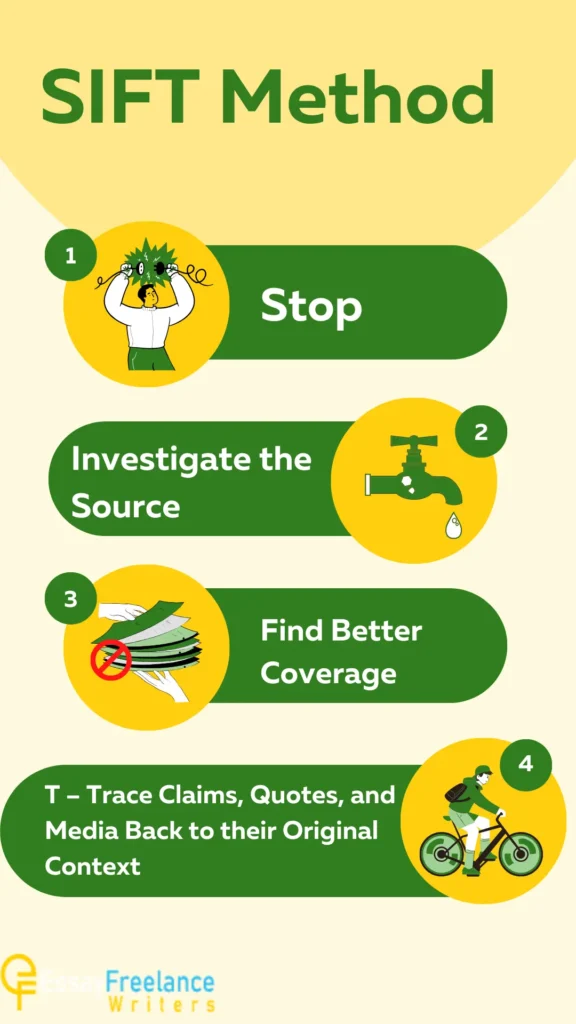
The SIFT Method, developed by fact-checkers and media literacy experts, offers a comprehensive guide to detecting misinformation and evaluating resources effectively. This method, which stands for Stop, Investigate the source, Find trusted coverage, and Trace claims back to their original context, emphasizes the importance of critical thinking and research when consuming information online. From analyzing news articles to scrutinizing social media posts, the SIFT Method equips individuals with the necessary tools to navigate the vast landscape of digital media with caution and scrutiny.
This method is designed to help you evaluate the reliability and credibility of sources, especially in the online realm.
Licensed under a Creative Commons Attribution 4.0 International License, the SIFT Method is a valuable resource for individuals seeking to improve their media literacy skills. By utilizing lateral reading techniques and conducting thorough research, readers can better discern fact from fiction in today’s information-saturated world.
Let’s dive into each step of the SIFT method to enhance your information literacy skills.
Stop
The “Stop” step in the SIFT method is crucial for critical thinking and information literacy. It encourages you to pause and reflect before accepting or sharing information. This step is particularly important in today’s fast-paced digital world, where misinformation can spread rapidly. Here’s a deeper look at what the “Stop” step entails:
SIFT Method infographic
Pause and reflect: When you encounter new information, especially online, take a moment to pause. This brief pause allows you to shift from passive consumption to active evaluation. It’s a simple yet powerful way to engage your critical thinking skills before reacting to or sharing content.
Assess your initial reaction: Pay attention to your emotional response to the information. Strong emotional reactions, whether positive or negative, can cloud judgment. If you find yourself having a particularly strong reaction, it’s even more important to step back and evaluate the information objectively.
Consider the source: Ask yourself if you’re familiar with the author, publisher, or website presenting the information. If it’s a source you don’t recognize or haven’t verified before, that’s a sign to proceed with caution and apply the other SIFT steps. Even if it’s a source you think you trust, it’s worth periodically reassessing its credibility.
Check for red flags: Look for obvious signs that might indicate unreliable information. These could include sensational headlines, excessive use of capital letters or exclamation points, or claims that seem too good (or bad) to be true. While these don’t automatically mean the information is false, they warrant extra scrutiny.
Be aware of your biases: We all have cognitive biases that can influence how we perceive information. Be conscious of confirmation bias, where we tend to accept information that aligns with our existing beliefs more readily. Strive to approach all information with an open, yet critical mind.
Avoid going down rabbit holes: It’s easy to get sidetracked by tangential information or compelling but irrelevant details. Stay focused on your original purpose for seeking information and avoid getting lost in potentially distracting content.
Consider the medium: Different types of media require different evaluation strategies. A blog post, a scientific paper, and a news article should all be approached with appropriate expectations and evaluation criteria.
The “Stop” step, as developed by Mike Caulfield as part of his “Four Moves” approach, is the foundation of the SIFT method. It sets the stage for a more thorough evaluation of information sources. By mastering this step, you’ll be better equipped to navigate the complex information landscape of the United States and beyond, improving your ability to assess the reliability of various sources.
Investigate the Source
Investigating the source is a critical step in the SIFT method for evaluating online information. This step helps you understand the expertise, credibility, and potential biases of the information source. By investigating the source, you can make more informed decisions about the reliability of the information presented. Here’s a deeper look at how to effectively investigate sources:
Identify the source: Before diving into the content, take a moment to identify who or what is providing the information. This could be an individual author, an organization, a news outlet, or a website. If you’re reading a piece or you’re watching a video, make sure you know who created it.
Use quick reference tools: Utilize easily accessible resources like Wikipedia to get a quick overview of the source. While Wikipedia itself isn’t always a reliable source for in-depth information, it can provide a good starting point for learning about an author, organization, or publication’s background and reputation.
Check social media profiles: On platforms like Twitter, you can often hover over a user’s name to get a quick snapshot of their profile. This can give you instant insights into their background, credentials, and potential biases.
Assess expertise and authority:Ask yourself whether you know anything about the source’s qualifications or expertise in the subject matter. For example, if you’re reading a piece on economics by a Nobel prize-winning economist, that lends credibility to the information. However, remember that even experts can be biased or mistaken, so it does not mean the Nobel economist is always right.
Look for potential biases: Consider if the source might have a particular agenda or bias. For instance, if you’re reading about the health benefits of milk from a dairy industry website, be aware that they have a vested interest in promoting dairy consumption. This doesn’t mean the dairy industry can’t provide accurate information, but it’s important to be aware of potential biases.
Trace the claim to its origin: If you’re dealing with a claim that’s been shared or reposted, try to trace the claim back to its source. Information can often become distorted or stripped of context as it’s shared across different platforms.
Consider the publication or platform: If the information is from a news outlet or other media organization, research their reputation. Do they have a record of fairness or accuracy? Are they known for trusted reporting or analysis in the field they’re discussing?
Use fact-checking websites: Utilize reputable fact-checking websites to see if the source or specific claims have been previously evaluated. These sites can provide valuable insights into a source’s reliability over time.
Consult academic resources: If you’re evaluating more scholarly sources, consider using academic databases or research guides to verify the credibility of authors or publications.
Finding better coverage is about seeking additional, more reliable sources to verify or contextualize information. This step is crucial when you’re not certain about the credibility of your initial source. Here’s how to approach it:
Seek alternative sources: Look for other reputable sources covering the same topic. This can help you corroborate information or identify discrepancies.
Use fact-checking websites: Utilize trusted fact-checking sites to verify claims. These sites often provide in-depth analysis and links to primary sources.
Consult expert sources: Look for information from recognized experts or authoritative organizations in the relevant field.
Compare multiple perspectives: Scan multiple sources and see how different outlets are reporting on the same issue. This can help you identify potential biases or gaps in coverage.
Build a trusted source library: Over time, develop a collection of reliable sources that you can turn to for accurate information on various topics.
Trace Claims, Quotes, and Media Back to their Original Context
T – Trace Claims, Quotes, and Media Back to their Original Context
This step involves verifying the accuracy of information by tracing it back to its source. It’s particularly important when dealing with claims, quotes, or media that have been shared or reposted. Here’s how to do it:
Follow the trail: Click through the links provided in the article to reach the source. If maybe a claim is made about a new medical treatment based on research, try to find the cited research paper.
Check bibliographies: If a bibliography is provided, use it to locate and review the sources.
Use reverse image search: For images or videos, use reverse image search tools to find their original context.
Verify quotes: For quotes, try to find the original speech, interview, or document they came from to ensure they haven’t been taken out of context.
Consider the full context: Once you’ve found the source, take time to understand the full context. Ask yourself if the version you saw was accurately presented or if important details were omitted.
Applying the SIFT Method
The SIFT method is designed to be a quick, practical approach to evaluating information. Here are some tips for effective application:
Practice regularly: The more you use SIFT, the more natural it will become. Apply it to various types of online content, from news articles to social media platforms.
Be time-efficient: SIFT is meant to be a quick process. If you feel yourself getting overwhelmed in your fact-checking efforts, remember to stop and take a second to refocus.
Use it flexibly: While the steps are presented in a specific order, you can apply them flexibly as needed. Sometimes you might need to use the other moves in a different sequence.
Stay skeptical but open-minded: Approach information with a healthy skepticism, but remain open to changing your views based on credible evidence.
Seek help when needed: If you’re struggling to evaluate a particular piece of information, don’t hesitate to ask for help from a librarian or other information professional.
The SIFT method is a practical framework for evaluating online sources and detecting misinformation. By following these steps, you can enhance your media literacy skills and make more informed judgments about the information you encounter. Remember, it’s important to ask for help when needed, whether from a librarian or other information professional. Happy SIFTing!
With a deep understanding of the student experience, I craft blog content that resonates with young learners. My articles offer practical advice and actionable strategies to help students achieve a healthy and successful academic life.
An annotated bibliography is valuable for researchers, students, and professionals.
It provides a summary and evaluation of each source used in a research project, helping to organize and analyze the vast amount of information available.
In this comprehensive guide, we’ll explore the purpose of an annotated bibliography and the different types of annotated bibliography. We’ll also provide a step-by-step guide on how to write an annotated bibliography, using proper citation style guides such as those from Purdue University, and understand the concept of fair use. Whether working in psychology, seeking employment in a library setting, or simply searching for knowledge, mastering the art of annotated bibliographies can be a valuable skill.
With 22 examples, this guide will help you navigate the complex world of bibliographic research and create a pathfinder for your research journey.
So, sharpen your mind and prepare to explore the world of annotated bibliographies in the United States.
An annotated bibliography has two main purposes: summarizing the sources and assessing their relevance and value.
Firstly, it concisely summarizes each source, including key information such as the author, title, publication details, and main arguments or findings. This summary helps readers understand the scope and focus of each source at a glance.
Secondly, the annotation involves critically evaluating the source’s relevance, quality, and potential contribution to your research. This evaluation helps you and other researchers determine the source’s usefulness and applicability to your topic or field of study.
College Entrance Essay Writing Services
Explore our college entrance essay writing services for expert assistance in crafting a compelling and unique essay that showcases your strengths and aspirations.
There are two main types of annotated bibliographies: descriptive and evaluative.
Descriptive Annotated Bibliography: This type summarizes the source’s content and key points. It overviews the source’s main arguments, methods, and findings without delving into critical analysis or evaluation. This type is often used when you want to give a neutral summary of the source’s contents.
Evaluative Annotated Bibliography: This type goes beyond summary by critically evaluating the source’s quality, relevance, and potential limitations. It assesses the source’s strengths and weaknesses, contribution to the field, and potential applicability to your research. This type is useful when you want to analyze and reflect on the sources you’ve gathered critically.
Difference Between Abstract, Annotation, and Literature Review
The abstract, literature review and annotated bibliography are distinct components of academic writing, each serving a unique purpose.
The abstract (summary) concisely summarizes a research paper, thesis, or other academic document. It provides a quick overview of the document’s purpose, main arguments, and conclusions. Abstracts are typically included at the beginning of the work, allowing readers to understand the nature and scope of the research. They are often written in past tense and aim to be concise, clear, and coherent.
The literature review is a comprehensive overview of existing literature on a specific topic. It involves analyzing, evaluating, and synthesizing multiple sources to identify gaps, contradictions, and areas for further research. Literature reviews are often included in academic papers to provide context, demonstrate the author’s understanding of the field, and highlight the relevance of the research topic. They are commonly used in theses, dissertations, and research papers.
The annotated bibliography is a list of sources used in the research process, accompanied by a summary, evaluation, or reflection on each source. It serves as a reference guide for the reader and provides insights into the relevance and quality of the sources. Annotated bibliographies are often assigned to students to develop their critical thinking and research skills. They help students evaluate and reflect on the sources they gather during the research process.
Read Also: How to Write a Bachelor Thesis – Comprehensive Guide
How to Write an Annotated Bibliography Step-by-Step
Here’s a step-by-step process to help you craft an effective annotated bibliography:
Choose Your Sources: Start by selecting a topic and conducting thorough research. Identify various sources, including books, journal articles, websites, and other relevant materials. Evaluate the quality and relevance of each source to ensure they are credible and suitable for your bibliography.
Format the Citations: Use a consistent citation style throughout your bibliography. Common styles include APA, MLA, and Chicago. Follow the specific guidelines for your chosen style, including in-text citations and reference list formatting.
Provide a Concise Summary: For each source, write a concise summary that includes the author, title, publication details, and main points or arguments. Focus on the scope and purpose of the source rather than simply listing its contents.
Evaluate and Reflect: Go beyond summary by critically assessing the source’s relevance, quality, and potential contribution to your research. Consider the following questions:
What are the strengths and weaknesses of the source?
How does it compare to other sources on the same topic?
What unique insights or perspectives does it offer?
How does it relate to your research question or topic?
What are the limitations or biases of the source?
How might it influence your research or thinking?
Organize and Format Consistently: Ensure that your annotated bibliography is organized clearly and consistently. Use hanging indents for each entry, with the citation in one line and the annotation in the line below. Maintain a consistent font and formatting throughout.
Edit and Proofread: Once you’ve drafted your annotated bibliography, review and edit it. Check for accuracy, consistency, and clarity. Ensure that your annotations are concise, focused, and free from unnecessary details.
Custom Essay Help
Don\'t forget to explore our Custom Essay Help services for personalized assistance tailored to your specific needs.
Here’s an example of an annotated bibliography entry in the American Psychological Association (APA) format:
Lastname, F.M. (Year). Title of the source: Subtitle, if any (Edition). Place of publication: Publisher. [https://doi.org/xxxxx]
This paragraph is the annotation, where you provide a concise summary of the source’s main points, arguments, and conclusions. You can also include your evaluation of the source’s relevance, strengths, and potential limitations. The annotation should be complete sentences and between 100-200 words. Here’s an example:
Smith, J., & Johnson, R. (2023). The Impact of Climate Change on Global Food Security. Journal of Environmental Studies, 6(1), 1-20. [https://doi.org/10.1037/jes.abc123]
Smith and Johnson explore the complex relationship between climate change and global food security in this article. They analyze the potential impacts of rising temperatures, extreme weather events, and changing precipitation patterns on agricultural productivity and food systems. The authors draw on various scientific studies and present their findings clearly and concisely. This article is particularly valuable for understanding the immediate and long-term challenges climate change poses to global food security and offers insights into potential adaptation strategies. The authors’ expertise in environmental science and their use of robust scientific data lend credibility to their arguments. However, the article could have benefited from a broader consideration of socioeconomic factors influencing food security, such as economic policies and trade agreements. This article comprehensively overviews the climate-food security nexus and offers valuable insights for policymakers and researchers.
Annotated Bibliography Examples in MLA Format
Here are some examples of annotated bibliographies in MLA format:
Example 1: Book with One Author
Lastname, Firstname. Title of Book in Title Case and Sentence Case. Publisher, Year Published.
This is the citation for a book with one author. The author’s last name comes first, followed by a comma and the author’s first name. The book title is in title case and sentence case, with a period at the end. The publisher and publication year come next, followed by a period.
Here’s an example:
Smith, John. The Sample Book. Publisher, 2024.
Example 2: Book with Two Authors
Lastname, Firstname, and Firstname Lastname. Title of Book in Title Case and Sentence Case. Publisher, Year Published.
For a book with two authors, list their authors’ names in the order they appear on the title page, separated by a comma and a period. The book title and publication information follow the same format as a book with one author.
Here’s an example:
Smith, John, and Jane Doe. The Sample Book. Publisher, 2024.
Example 3: Book with Three or More Authors
Lastname, Firstname, et al. Title of Book in Title Case and Sentence Case. Publisher, Year Published.
For a book with three or more authors, list the first author’s name followed by “et al..”. The book title and publication information follow the same format as books with one or two authors.
Here’s an example:
Smith, John, et al. The Sample Book. Publisher, 2024.
Example 4: Edition Other Than the First
Lastname, Firstname. Title of Book: Subtitle in Title Case and Sentence Case, Edition Number, Publisher, Year Published.
When citing a book with an edition other than the first, include the edition number in the citation. The edition number is typically placed after the title and followed by a period.
Here’s an example:
Smith, John. The Sample Book: A Comprehensive Guide, 2nd ed. Publisher, 2024.
Example 5: Book with No Author
Title of Book in Title Case and Sentence Case. Edition Number, Publisher, Year Published.
When a book has no identifiable author, omit the author’s name and begin the citation with the title. The title is in title and sentence case, with a period at the end.
Here’s an example:
The Sample Book. 2nd ed., Publisher, 2024.
Example 6: Book with a Corporate or Group Author
Corporate or group authors are treated as author names. Begin the citation with the author’s name, followed by a period. The book title and publication information follow the same format as books with one or two authors.
Here’s an example:
American Psychological Association. The Publication Manual of the American Psychological Association. 7th ed., APA, 2020.
Example 7: Book with a Title That Differs From the Book’s Title Page
If the book’s title on the title page differs from the title on the cover or spine, use the title from the title page. Place the title in quotation marks and include the title from the cover or spine in square brackets.
Here’s an example:
Smith, John. [“The Sample Book.” The Sample Book: A Comprehensive Guide]. Publisher, 2024.
Example 8: Book with a Subtitle
Lastname, Firstname. Title of Book: Subtitle in Title Case and Sentence Case. Publisher, Year Published.
For a book with a subtitle, include a colon after the title and before the subtitle. The subtitles are in the title and sentence cases, with a period at the end.
Here’s an example:
Smith, John. The Sample Book: A Comprehensive Guide. Publisher, 2024.
Example 9: Book with a Volume or Edition Number
Lastname, Firstname. Title of Book: Subtitle in Title Case and Sentence Case, Volume or Edition Number. Publisher, Year Published.
When citing a book with a volume or edition number, include the volume or edition number in the citation. The volume or edition number is placed after the title and before the publication information.
Here’s an example:
Smith, John. The Sample Book, Vol. 2. Publisher, 2024.
Example 10: Book with a Translator
Lastname, Firstname. Title of Book: Subtitle in Title Case and Sentence Case, translated by Firstname Lastname, Publisher, Year Published.
When citing a book that has been translated, include the translator’s name after the book title. The translator’s name is followed by the label “translated by.”
Here’s an example:
Smith, John. The Sample Book. Translated by Jane Doe, Publisher, 2024.
College Essay Writing Help
Make sure to explore our college essay writing help services for expert guidance and support in crafting your standout admissions essays.
Lastname, Firstname. Title of Book in Title Case and Sentence Case. Publisher, Year Published.
This example shows the citation for a book with one author in Chicago style. The author’s last name comes first, followed by a comma and the author’s first name. The book title is in title case and sentence case, with a period at the end. The publisher and publication year come next, followed by a period.
Here’s an example:
Smith, John. The Sample Book. Publisher, 2024.
Example 2: Book with Two Authors
Lastname, Firstname, and Firstname Lastname. Title of Book in Title Case and Sentence Case. Publisher, Year Published.
For a book with two authors, list their names in the order they appear on the title page, separated by a comma and a period. The book title and publication information follow the same format as a book with one or two authors.
Here’s an example:
Smith, John, and Jane Doe. The Sample Book. Publisher, 2024.
Example 3: Book with Three or More Authors
Lastname, Firstname, et al. Title of Book in Title Case and Sentence Case. Publisher, Year Published.
When citing a book with three or more authors, list the first author’s name followed by “et al..”. The book title and publication information follow the same format as books with one or two authors.
Here’s an example:
Smith, John, et al. The Sample Book. Publisher, 2024.
Example 4: Edition Other Than the First
Lastname, Firstname. Title of Book: Subtitle in Title Case and Sentence Case, Edition Number, Publisher, Year Published.
When citing a book with an edition other than the first, include the edition number in the citation. The edition number is typically placed after the title and publication information.
Here’s an example:
Smith, John. The Sample Book: A Comprehensive Guide, 2nd ed. Publisher, 2024.
Example 5: Book with No Author
Title of Book in Title Case and Sentence Case. Edition Number, Publisher, Year Published.
When a book has no identifiable author, omit the author’s name and begin the citation with the title. The title is in title and sentence case, with a period at the end.
Here’s an example:
The Sample Book. 2nd ed., Publisher, 2024.
Example 6: Book with a Corporate or Group Author
Corporate or group authors are treated as author names. Begin the citation with the author’s name, followed by a period. The book title and publication information follow the same format as books with one or two authors.
Here’s an example:
American Psychological Association. The Publication Manual of the American Psychological Association. 7th ed., APA, 2020.
Example 7: Book with a Title That Differs From the Book’s Title Page
If the book’s title on the title page differs from the title on the cover or spine, use the title from the title page. Place the title in quotation marks and include the title from the cover or spine in square brackets.
Here’s an example:
Smith, John. [“The Sample Book.” The Sample Book: A Comprehensive Guide]. Publisher, 2024.
Example 8: Book with a Subtitle
Lastname, Firstname. Title of Book: Subtitle in Title Case and Sentence Case. Publisher, Year Published.
For a book with a subtitle, include a colon after the title and before the subtitle. The subtitle is in the title and sentence cases, with a period at the end.
Here’s an example:
Smith, John. The Sample Book: A Comprehensive Guide. Publisher, 2024.
Example 9: Book with a Volume or Edition Number
Lastname, Firstname. Title of Book: Subtitle in Title Case and Sentence Case, Volume or Edition Number. Publisher, Year Published.
When citing a book with a volume or edition number, include the volume or edition number in the citation. The volume or edition number is placed after the title and before the publication information.
Here’s an example:
Smith, John. The Sample Book, Vol. 2. Publisher, 2024.
Example 10: Book with a Translator
Lastname, Firstname. Title of Book: Subtitle in Title Case and Sentence Case, translated by Firstname Lastname, Publisher, Year Published.
When citing a book that has been translated, include the translator’s name after the book title. The translator’s name is followed by the “translated by.”.
Here’s an example:
Smith, John. The Sample Book. Translated by Jane Doe, Publisher, 2024.
Conclusion
An annotated bibliography is a powerful tool for researchers to summarize and evaluate their sources effectively. Utilizing an annotated bibliography writing service can enhance the quality of a research project by ensuring that each source is critically assessed and accurately represented. This professional assistance allows scholars to focus on their analysis rather than getting bogged down by formatting and citation details. As a result, researchers can present their findings more confidently and efficiently.
Following the steps outlined above, you can create a comprehensive and critical guide to the literature on your chosen topic.
Remember to select your sources carefully, format your citations correctly, provide concise and insightful summaries, and critically evaluate each source’s relevance and potential contribution.
Frequently Asked Questions about Writing Annotated Bibliographies
What are the 3 parts of an annotated bibliography APA?
An annotated bibliography in APA style typically consists of three main parts: the citation of the source, a summary or abstract of the source, and an evaluation or analysis of the source’s relevance to your research.
How to write a 500 word annotated bibliography?
When writing a 500-word annotated bibliography, include concise summaries and evaluations of each source. Focus on the most relevant information to your research topic within the word limit.
How long is an annotated bibliography example?
The length of an annotated bibliography example can vary depending on the number of sources included. A typical example may range from 150 to 200 words per annotation, but it can be shorter or longer based on the specific requirements.
How do you write an annotated bibliography assessment?
When writing an annotated bibliography assessment, carefully evaluate each source’s reliability, credibility, and relevance to your research. Provide a critical analysis of the source’s strengths and weaknesses in relation to your research topic.
With a deep understanding of the student experience, I craft blog content that resonates with young learners. My articles offer practical advice and actionable strategies to help students achieve a healthy and successful academic life.
This website uses cookies to improve your experience. We'll assume you're ok with this, but you can opt-out if you wish. ACCEPTPrivacy Policy
Privacy & Cookies Policy
Privacy Overview
This website uses cookies to improve your experience while you navigate through the website. Out of these cookies, the cookies that are categorized as necessary are stored on your browser as they are essential for the working of basic functionalities of the website. We also use third-party cookies that help us analyze and understand how you use this website. These cookies will be stored in your browser only with your consent. You also have the option to opt-out of these cookies. But opting out of some of these cookies may have an effect on your browsing experience.
Necessary cookies are absolutely essential for the website to function properly. This category only includes cookies that ensures basic functionalities and security features of the website. These cookies do not store any personal information.
Any cookies that may not be particularly necessary for the website to function and is used specifically to collect user personal data via analytics, ads, other embedded contents are termed as non-necessary cookies. It is mandatory to procure user consent prior to running these cookies on your website.

![How to Write an Exemplification Essay | Tips and Examples [2026]](https://essayfreelancewriters.com/wp-content/uploads/How-to-Write-an-Exemplification-Essay-Tips-and-Examples-1080x675.webp)

![193+ Engaging Argumentative Essay Topics for Middle School Students [2026]](https://essayfreelancewriters.com/wp-content/uploads/Argumentative-Essay-Topics-for-Middle-School-1080x675.webp)
![245+ Debate Topics for High School | Foster Critical Thinking Skills [2026]](https://essayfreelancewriters.com/wp-content/uploads/Debate-Topics-for-High-School-to-Explore-and-Discuss-1080x675.webp)