

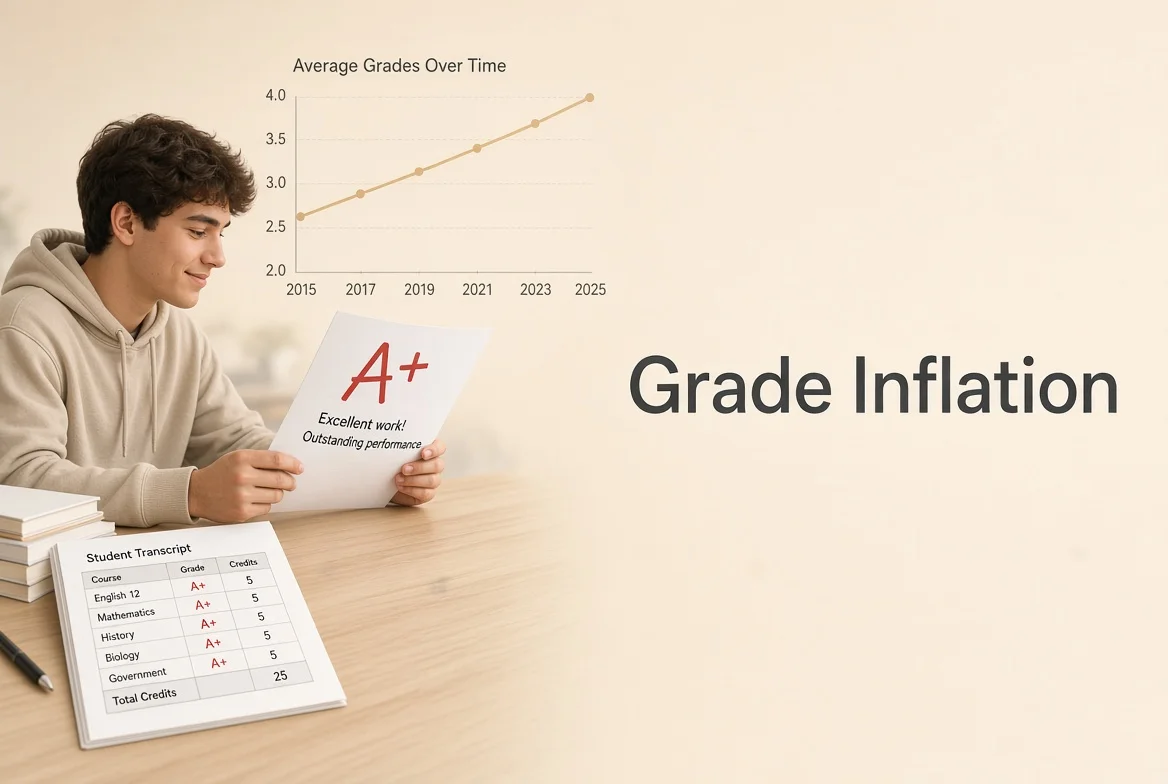
Evidence and trends:
Data show average U.S. college GPAs have risen from roughly 2.5 in the mid-20th century to approximately 3.15–3.3 in recent years, with A becoming the most common grade at many universities. High school grades have also increased substantially while national assessments such as NAEP continue to show relatively low proficiency rates in reading and math.Main causes:
Key drivers of grade inflation include pressure on instructors linked to student evaluations, a consumer-oriented view of education in which higher grades are expected as part of the value received, competition among high schools to improve college admission prospects, and institutional incentives related to retention and graduation rates.Consequences:
Grade inflation reduces the signaling power of grades, making it harder for colleges and employers to distinguish levels of achievement. It can also leave some students underprepared for subsequent coursework and contribute to greater reliance on standardized tests, extracurriculars, and portfolios in admissions and hiring decisions.High school vs. college:
In high schools, grade inflation is often driven by college-admissions pressure and accountability metrics. In higher education, additional factors include student course evaluations, competition for enrollment, and efforts to support retention and completion rates. The result in both settings is a higher proportion of A’s relative to measured learning outcomes.What students can do:
Students can respond to grade inflation by focusing on genuine mastery rather than the letter grade alone, seeking rigorous courses and constructive feedback, building tangible portfolios of projects and skills, and developing strong research, writing, and critical-thinking abilities that remain valuable regardless of grading trends.Institutional responses:
Some colleges and departments are reviewing grading policies, experimenting with contextual transcript information (such as course averages or percentile ranks), and exploring competency-based assessment. Reform remains a collective-action challenge because individual instructors and institutions face incentives that favor higher grades.Grade Inflation is the long-term rise in average grades awarded to students without a corresponding increase in actual academic achievement or learning. In practice, this means A’s and high GPAs have become more common over decades even as objective measures such as standardized test scores have remained flat or declined in many areas.
You’re working hard for every assignment and still hearing that grades today don’t carry the same weight they once did. That tension is real. Grade inflation affects how colleges evaluate applicants, how employers read transcripts, and how students interpret their own progress.
We’re going to look at what grade inflation truly is, why it’s happening, and crucially, what you can do about it to ensure your hard work stands out, not just gets lost in a sea of inflated grades.
Key Takeaways
- Grade inflation refers to the consistent rise in average grades over time without a corresponding increase in student achievement.
- This trend impacts both high schools and higher education, affecting the signaling power of grades for college admissions and future employers.
- Factors contributing to grade inflation include pressure on educators, student consumerism, and the shift from standardized test scores to GPA in evaluations.
- Students can mitigate the effects by focusing on true learning, building strong portfolios, and actively seeking feedback to earn their higher grade.
- Addressing grade inflation requires rethinking grading standards, promoting rigorous grading, and considering alternatives to traditional evaluation methods.
What Exactly Is Grade Inflation?
So, let’s talk about what grade inflation actually is. It’s not just you imagining that your peers seem to be getting a higher grade more often. At its core, grade inflation describes the long-term upward shift in average grades awarded to students without a corresponding increase in their actual academic achievement or learning. Essentially, the common grade on a transcript—especially A’s—has become more prevalent over time, even as objective measures like standardized test scores might not show similar gains.
This phenomenon impacts the entire education system, from secondary school to higher education. For example, a study finds that the proportion of A’s awarded at American colleges and universities has significantly increased over the past few decades. This means that a student’s high school grade, and later their undergraduate grades, might look better on paper than a comparable student’s GPA from a generation ago, without necessarily indicating greater mastery.
When we see an increase in the proportion of A’s, it causes a concern about the overall evaluation system. Are we truly measuring learning effectively, or are we just inflating the numbers? This trend of grade inflation affects how colleges and universities assess applicants and how employers view college graduates.
The Numbers Don’t Lie: Evidence and Trends
When we talk about grade inflation, U.S. education statistics paint a pretty clear picture. Data from institutions like the National Center for Education Statistics consistently show a rising average grade across school levels, both in high schools and four-year college programs. It’s not just anecdotal; it’s a measurable shift.
Consider the contrast between grade point averages (GPA) and standardized test scores, like the SAT and ACT. While average GPA has climbed steadily over decades, scores on these national assessments of educational progress have remained relatively flat or even declined in some areas. This disparity is often cited as key evidence of grade inflation. You’d expect a rising average grade to correlate with rising test scores if student achievement were truly improving at the same pace.
Many studies, including analyses published in the Teachers College Record, highlight these trends in grade inflation, noting how the prevalence of grade inflation has become a significant topic of discussion among educators. For instance, some research points to significant grade inflation at American universities like Harvard University, Wellesley College, and the University of Texas at Austin, where the average grade for undergraduate grade has seen a substantial bump over time. These patterns suggest that grading standards have loosened, making it easier for students to get high marks.
Why Are Grades Inflating? The Root Causes
So, why is this happening? It’s rarely one single thing, but a mix of pressures and incentives. One big factor is the desire to motivate students. Educators often feel immense pressure to award a higher grade in the hope that it will encourage students and keep them engaged, or perhaps in some cases, simply to avoid conflict. There’s a fine line between encouragement and simply giving high marks when they haven’t been truly earned.
Another significant cause is the rise of student consumerism, especially in higher education. With the escalating cost of college, students (and their parents) often view themselves as consumers expecting a good ‘return on investment,’ which sometimes translates into an expectation of better grades. This can subtly—or not so subtly—influence grading practices, making rigorous grading seem less desirable for institutions concerned about student satisfaction and retention. School districts in secondary school settings also face similar pressures.
Then there’s the intense competition for admission to top-tier colleges. High school students and their parents push for the highest grade possible, leading some high schools to inflate grades to improve their students’ chances of getting into college. This creates a cycle where if some schools inflate grades, others feel compelled to follow suit to keep their students competitive. The Los Angeles Unified School District, for example, has faced scrutiny over its grading practices and concerns about grade inflation in secondary schools. It’s a systemic problem, not just individual teachers deciding to be “nice.”
Need Help with Academic Papers?
Our expert writers can help you achieve the grades you deserve without the stress. Get personalized support today.
The Cascade Effect: Where Grade Inflation Hurts
The consequences of grade inflation ripple through the entire academic and professional landscape. One of the most critical impacts is on the signaling power of grades. Historically, your GPA and individual college grades on your college transcripts were strong indicators of your academic ability and work ethic. If A’s and B’s are sometimes given for work that might have previously earned a C, then what do those grades truly tell future employers or graduate school admissions committees? The currency of academic achievement gets devalued.
This dilution profoundly affects college admissions. When everyone graduates from high school with a 4.0 GPA, it becomes incredibly difficult for admissions officers at four-year college institutions to differentiate between applicants. They then have to rely more heavily on other factors, like standardized test scores (which can be problematic in their own ways) or extracurriculars, to get into college. This makes the college entrance process even more opaque and stressful for high school students.
Beyond admissions, there’s a genuine concern about student preparedness. If students are consistently awarded high merit without mastering the material, they might be less likely to pass subsequent courses, creating academic gaps. Research has shown that in some cases, inflated grades lead to worse outcomes, as students may not possess the foundational knowledge expected for advanced work. This is a real problem, impacting not just individual students but the overall quality of college completion and the readiness of college graduates for the workforce. The Department of Education and various university studies often highlight this discrepancy.
Grade Inflation in High Schools vs. Higher Education
While the concept of grade inflation is similar across the board, its manifestations and implications can differ slightly between high school and college. In high school, the pressure to get a high school grade point average often stems from college admissions. Parents, counselors, and the students attending these schools want to see those high marks on college board applications to ensure they can secure a spot in a competitive four-year college.
Grade inflation in secondary schools can also be influenced by state accountability measures and graduation rates. School districts may feel pressure to boost grades to meet certain performance metrics, which, while well-intentioned, can inadvertently contribute to grade inflation. The prevalence of grade 12 students receiving A’s has notably increased, sometimes leading to situations where students are not truly prepared for college-level rigor, despite their excellent high school grade.
In higher education, specifically within American colleges and universities, the drivers can be a bit more nuanced. Here, factors like student evaluations of instructors, departmental competition for enrollment, and a desire to improve college completion rates can all play a role in college grade inflation. The “grade B for work” phenomenon—where a B is now seen as an average rather than a good grade—is a clear symptom of this shift in undergraduate grades. This means an average school’s grading standards might evolve in different ways compared to a high school.
Master Your Next Research Project
Learn the secrets to top-tier academic writing and boost your grades. Get our comprehensive guides.
So, What Can You Do About It? Student Strategies
Alright, so given all this, what’s your game plan? You can’t control the overall trend of grade inflation, but you absolutely can control your response to it. The goal is not just to get grade, but to truly learn, to earn a higher grade that reflects genuine mastery.
-
Focus on True Learning, Not Just the Letter: Shift your mindset. Instead of aiming for an A as the endpoint, aim for deep understanding. When you genuinely grasp the material, the high marks often follow naturally. This means engaging with the material, asking questions, and seeking clarification when you don’t understand.
-
Seek Out Challenge: Don’t shy away from rigorous courses or demanding professors, even if you fear they might give a lower grade. These are often the environments where you’ll learn the most and develop critical skills. Sometimes, a hard-earned B from a tough class carries more weight than an easy A from a less challenging one. To excel, you might even find yourself diving into complex subjects, which demand genuine intellectual effort.
-
Build a Strong Portfolio and Skills: With the signaling power of grades potentially diluted, demonstrating tangible skills and achievements becomes even more crucial. Work on projects, pursue internships, volunteer, or engage in research. A robust portfolio—be it coding projects, creative writing, or leadership roles—can speak volumes more than a simple GPA
-
Actively Engage with Feedback: Don’t just look at the letter grade; scrutinize the feedback. Ask your instructors specific questions about how you can improve your work. This proactive approach shows initiative and commitment to learning.
-
Develop Excellent Academic Skills: This one’s a no-brainer. Strong research, writing, and critical thinking skills are your secret weapon. If you’re struggling with specific types of assignments, like comparative essays, actively seek resources to improve. These fundamental abilities will serve you far better than any inflated grade ever could.
The Academic Community’s Response: Addressing the Problem
Concerns about grade inflation aren’t new, and the academic community is actively discussing ways to address this grade inflation problem. Many institutions are grappling with how to standardize grading and restore the integrity of academic evaluation. It’s not just about lamenting the situation; it’s about finding practical solutions.
One approach involves rethinking grading standards and promoting more rigorous grading. Some departments and entire universities are reviewing their policies to ensure consistency and prevent arbitrary grade increases. This might include calibrating grading across different sections of the same course or providing clearer rubrics that leave less room for subjective inflation. The goal is to ensure that a common grade truly reflects a common level of achievement.
Another idea gaining traction is to report grades differently on college transcripts. Instead of just listing the GPA, some universities are considering adding context, such as the average grade given in a particular course, or the student’s percentile rank within their class. This allows graduate schools and employers to better contextualize a student’s undergraduate grades, offering a more nuanced view than just a letter grade. For fields requiring intensive academic work, like preparing a dissertation, these measures are crucial.
Some educators also advocate for a greater emphasis on competency-based assessment, where students demonstrate mastery of specific skills rather than simply accumulating points. While complex to implement, this could offer a more accurate picture of what a college graduate truly knows and can do. The National Assessment of Educational Progress provides some frameworks for thinking about competency across different school levels. This would ideally motivate students through genuine achievement rather than simply chasing a higher average.
Improve Your Grades Today
Don’t let academic challenges hold you back. Our professional writers can help you succeed.
The Future of Grades and Evaluation
Where do we go from here with grade inflation? The truth is, the trend of grade inflation may continue in some form, but there’s also a strong push for reform. The conversation around grade averages, undergraduate grades, and the overall signaling power of grades and test scores is ongoing. Institutions like the American College Testing (ACT) and the College Board are constantly evaluating how their assessments fit into this evolving landscape.
We might see an increased reliance on alternative forms of evaluation. This could include portfolios, capstone projects, or even digital badges that certify specific skills and competencies, moving beyond the traditional letter grade. The hope is to create an evaluation system that is more robust, equitable, and accurately reflects what students attending higher education truly know and are able to do.
Ultimately, the goal is to standardize academic achievement in a way that serves everyone: students, universities, and future employers. This means ensuring that a high grade genuinely signifies high merit and that students are prepared for college and beyond. The concerns about grade inflation at American institutions are pushing us all to think more critically about how we measure success and learning.
So what now?
Look, the whole conversation around grade inflation can feel a bit demoralizing, can’t it? You’re already working incredibly hard, and now you have to worry if your accomplishments are being accurately valued. But here’s the thing: you have more power than you think. You can’t single-handedly reverse the trend of grade inflation, but you can absolutely ensure that your education, your effort, and your achievements are solid.
Focus on becoming genuinely proficient, on mastering subjects because they’re interesting and useful, not just for the letter on your transcript. Build a compelling story of your learning and growth through real skills and experiences. That’s the real antidote. When you truly earn that knowledge, no amount of grade inflation can diminish your personal value. And that, my friend, is what truly matters in the long run.
Grade Inflation FAQs

Experienced writer and dedicated professor with a passion for crafting compelling narratives and nurturing the next generation of critical thinkers

