

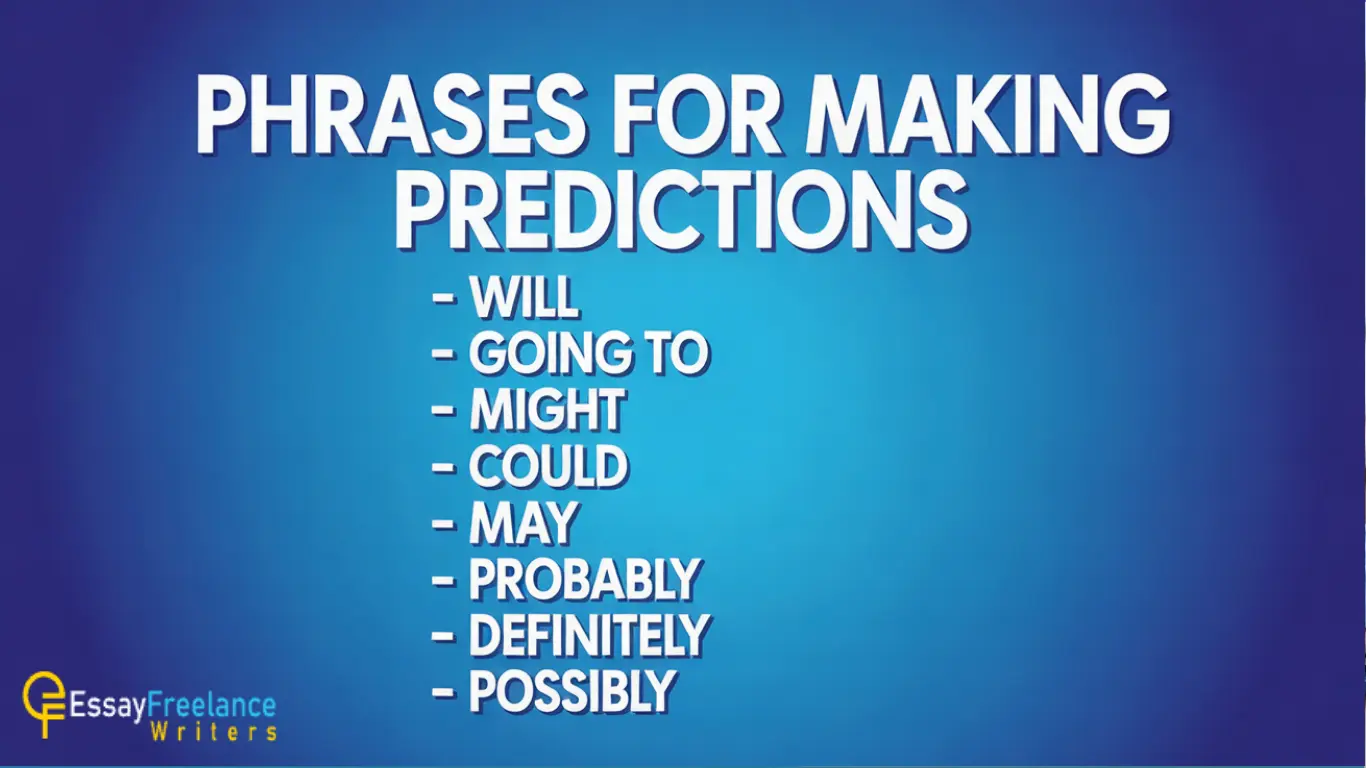
Every day, we talk about what might happen next, whether it’s the weather, our plans, or even global trends. That’s why learning Phrases for Making Predictions is so useful in the English language. Making predictions helps us connect with others, express beliefs, and discuss the likelihood of future events. We often rely on these expressions in casual conversations, business meetings, and even when sharing opinions on a podcast episode or a social media post.
When you use prediction phrases correctly, you not only sound natural but also improve your effective communication skills. These expressions allow us to express certainty or uncertainty, show logical reasoning, and convey what we think might happen in the future. So, let’s explore how we can make predictions in English and use them naturally in everyday dialogue.
Key Takeaways
- Learning Phrases for Making Predictions strengthens communication by allowing speakers to clearly express beliefs, certainty, and probability about future events in both casual and formal contexts.
- Making accurate predictions relies on specific English modal auxiliary verbs such as will, going to, might, could, and may, each showing different levels of confidence based on evidence, intention, or uncertainty.
- The article outlines four main steps to make predictions effectively: using “will” for definite outcomes, “going to” for logical or planned situations, “might/could/may” for uncertain ones, and adverbs like “probably” or “definitely” to show degrees of certainty.
- Common mistakes, such as confusing “will” with “going to” or misusing verb forms, can make predictions unclear, while using clear sentence links and avoiding repetition helps improve effective communication and fluency.
- Predictions not only aid decision-making and logical reasoning but also connect with how AI and technology forecast future trends, showing that expressing what might happen is an essential skill for confident communication in the English language.
Why Predictions Matter in Communication
Predictions are more than just educated guesses; they’re part of human thought and communication. They help us make decisions, prepare for possibilities, and express beliefs about what could happen next. In English, we use specific phrases and verbs to make our speech clearer and more confident.
For example:
- “It will probably rain tomorrow.”
- “I think it’s going to be a great day.”
- “It might not happen, but there’s a chance.”
These simple sentences rely on prediction phrases that help the listener grasp the probability of a future event. Moreover, making predictions based on evidence or reasoning is something that has shaped decision-making throughout history.
To make your spoken and written predictions smoother, learning to use proper Transition Words and Phrases can help connect your thoughts naturally and improve sentence flow.
How to Make Predictions in English
Before we get into the details, it’s worth noting that Phrases for Making Predictions are among the most practical tools for learners. They help us express what we think or anticipate might happen in the future, and we shall go through them in detail below.
Predictions in English are often made using modal verbs, expressions of likelihood, and specific phrases that signal our confidence levels. Let’s explore these step by step.
1. Using “Will” for Definite Predictions
When you use “will,” you’re talking about something you believe is sure to happen. It expresses certainty. For instance:
- “It will rain tomorrow.”
- “We’ll see a rise in AI technology in the next few years.”
This form shows belief and certainty. The verb “will” implies a definite outcome and is commonly used in forecasts or confident statements. For example, weather reports often say, “It will be sunny tomorrow,” showing that the prediction is based on evidence and data. You can also review our guide on how to use shall and will to see how these specific modal verbs function in different contexts.
You can make your sentences more natural by starting with clear expressions, and the tips in Sentence Starters for Essays offer useful examples to get your thoughts flowing effectively.
2. Using “Going to” for Planned or Logical Predictions
The phrase “going to” is used for predictions that are based on present evidence or logical reasoning. You might look at dark clouds and say, “It’s going to rain.” Here, your prediction is based on visible clues.
“Going to” is also used when plans or intentions influence the future. For example:
- “I’m going to start a podcast about technology next month.”
- “They’re going to release a new phone model soon.”
This expression helps the speaker sound natural in everyday English conversations and is a key verb phrase used for making predictions.
3. Using “Might,” “Could,” and “May” for Uncertain Predictions
Sometimes, we aren’t sure what will happen, so we use words like “might,” “could,” or “may.” These verbs express possibility or uncertainty. For example:
- “It might snow tonight.”
- “She could pass the exam if she studies.”
They reflect a lower degree of certainty but still keep the conversation realistic. Using these words allows the speaker to acknowledge unpredictability without sounding too definite.
4. Using “Probably,” “Definitely,” and “Possibly” to Show Degrees of Certainty
Adverbs such as “probably,” “definitely,” and “possibly” indicate how sure we are about an outcome. They modify the verb to show varying levels of confidence:
- “It will probably rain.”
- “It definitely won’t happen.”
- “He possibly forgot the meeting.”
By using these, we can show subtle differences in confidence or belief. The key is balance; don’t overuse them, or your dialogue might sound repetitive.
Useful English Phrases for Making Predictions
Here are some commonly used English phrases and expressions to make a prediction naturally:
- “I think it’s going to happen.”
- “There’s a good chance that…”
- “It seems likely that…”
- “I wouldn’t be surprised if…”
- “It looks like it’s about to…”
These phrases can also be used in informal settings or formal discussions, making them versatile in both speech and writing.
These phrases are widely used in everyday communication if you’d like to improve how you arrange and connect such sentences, check out How to Write a Paragraph, which offers tips on keeping your writing coherent and easy to follow.
Common Mistakes People Make When Predicting
A frequent mistake is confusing “will” and “going to.” While both refer to the future, “will” is for spontaneous decisions or firm beliefs, while “going to” refers to planned actions or visible evidence. Another issue is overusing modal verbs like “might” and “could,” which can make you sound uncertain even when you’re confident.
Learners also tend to mix tenses. Remember, when you make predictions in English, the verb usually stays in its base form after modals. For example, “It will happen,” not “It will happen.”
You can explore similar tricky word pairs and meanings by reading Commonly Confused Words, which breaks down words that often cause misunderstanding in English.
How Predictions Help in Decision-Making and Thought Processes
Predictions help us prepare and make decisions based on available knowledge, evidence, and reasoning. When we predict, we engage in logical reasoning that strengthens our communication and planning skills.
For instance, business leaders use trends and probability models to forecast market outcomes. Similarly, AI systems predict consumer behavior using data-driven evidence. Making predictions also influences thought patterns, helping people evaluate multiple outcomes before making a choice.
Examples of Predictions in Everyday English Conversations
Let’s look at some examples you might hear in daily English conversations:
- “I think it’ll stop raining soon.”
- “We’ll probably finish the project by Friday.”
- “It looks like there’s going to be traffic.”
- “I don’t know if it’ll work, but let’s try.”
These simple statements show how predictions shape everyday dialogue and help us express what we believe or expect will happen. They are especially helpful when speakers engage in deep conversation topics that require reflecting on future possibilities.
If you’re working on improving sentence flow in conversations or essays, you can apply the linking techniques from How to Write Effective Bridge Sentences in an Essay.
The Role of Technology and AI in Modern Predictions
Technology and artificial intelligence (AI) have transformed how we make predictions. From weather forecasts to personalized recommendations, AI systems predict what might happen in the future based on large data sets.
For example, AI can forecast rainfall, analyze consumer behavior, and anticipate global trends. Many researchers use these sophisticated tools to study the impact of ai on future employment across different sectors. As technology advances, our ability to make accurate predictions continues to grow, blending human thought and machine learning for better outcomes.
Tips to Sound Natural When Making Predictions in English
If you want to sound fluent when making predictions in English:
- Use contractions like “we’ll” or “won’t.”
- Vary your vocabulary, don’t repeat the same phrases.
- Add evidence when possible: “It looks like,” “It seems that,” or “There’s a chance.”
- Practice with everyday topics like the weather, sports, or personal plans.
Additionally, if you’re writing about your personal forecast or insights, you might enjoy reading How to Write an Artist Statement to learn how to express personal thoughts in clear, confident English.
Conclusion
Learning and using Phrases for Making Predictions helps you communicate more clearly, express your thoughts confidently, and sound natural in English. Whether you’re talking about what’s going to happen tomorrow or speculating about faraway future events, knowing how to express different degrees of certainty improves both your confidence and communication skills. Predictions help us make sense of the world, and sometimes, even a simple forecast can lead to better decisions and conversations.
Phrases for Making Predictions FAQs
.aagb_accordion_9f8f4e00_0 .aagb__accordion_active .aagb__accordion_body {
border-top: 1px solid #ebebeb;
}
.aagb_accordion_9f8f4e00_0 .aagb__accordion_container.wp-block-aab-accordion-item .aagb__accordion_head {
background-color: #bcb6b638;
border-top: none; border-right: none; border-bottom: none; border-left: none;
}
.aagb_accordion_9f8f4e00_0 .aagb__accordion_container.wp-block-aab-accordion-item .aagb__accordion_body {
border-top: 1px solid #bcb6b638; border-right: none; border-bottom: none; border-left: none;
}
.aagb_accordion_9f8f4e00_0 .wp-block-aab-accordion-item .aagb__accordion_subheading {
margin: 5px 0 0 0;
}
.aagb_accordion_9f8f4e00_0 .wp-block-aab-accordion-item .aagb__accordion_icon {
}
.aagb_accordion_9f8f4e00_0 .wp-block-aab-accordion-item .aagb__icon {
font-size: 23px;
}
.aagb_accordion_9f8f4e00_0 .aagb__accordion_title {
margin: 0;
}
.aagb_accordion_9f8f4e00_0 .aagb__accordion_container {
border: 1px solid #bcb6b638;
margin-top: 0px;
margin-bottom: 15px;
}
.aagb_accordion_9f8f4e00_0 .aagb__accordion_number{
}
.aagb_accordion_9f8f4e00_0 .wp-block-aab-accordion-item .aagb__accordion_subheading{
false
}
.aagb_accordion_9f8f4e00_0 .aab-step-progress{
background-color: #dfd2d2;
}
.aagb_accordion_9f8f4e00_0 .aab-step-progress-bar {
background-color: #1570ec;
}
.aagb_accordion_9f8f4e00_0 .aagb__accordion_number{
}
.aagb_accordion_9f8f4e00_0 .aab-progress-bar-container{
background-color: #f0f0f0;
}
.aagb_accordion_9f8f4e00_0 .aab-progress-bar {
background-color: #0866ff;
}
.aagb__group_accordion_container.has_img {
flex-direction: row;
}
.aagb_accordion_9f8f4e00_0 .aagb__accordion_container {
transition-duration: 0ms !important;
outline: 2px solid #00000000;
}
.aagb_accordion_9f8f4e00_0 .aagb__accordion_container:focus-visible {
outline: 2px solid #C2DBFE;
}
What’s the difference between “will” and “going to”?
“Will” shows certainty or instant decisions, while “going to” suggests a plan or visible evidence that something will happen.
How can I sound more natural when predicting something?
Use contractions, vary your phrases, and include evidence or reasoning in your statements.
Are predictions always about the future?
Mostly, yes, but sometimes they can describe expectations about ongoing or habitual events.
How can learning prediction phrases improve my English skills?
They make your speech more fluid, help you engage in discussions, and enhance your overall fluency in English.

Experienced writer and dedicated professor with a passion for crafting compelling narratives and nurturing the next generation of critical thinkers