

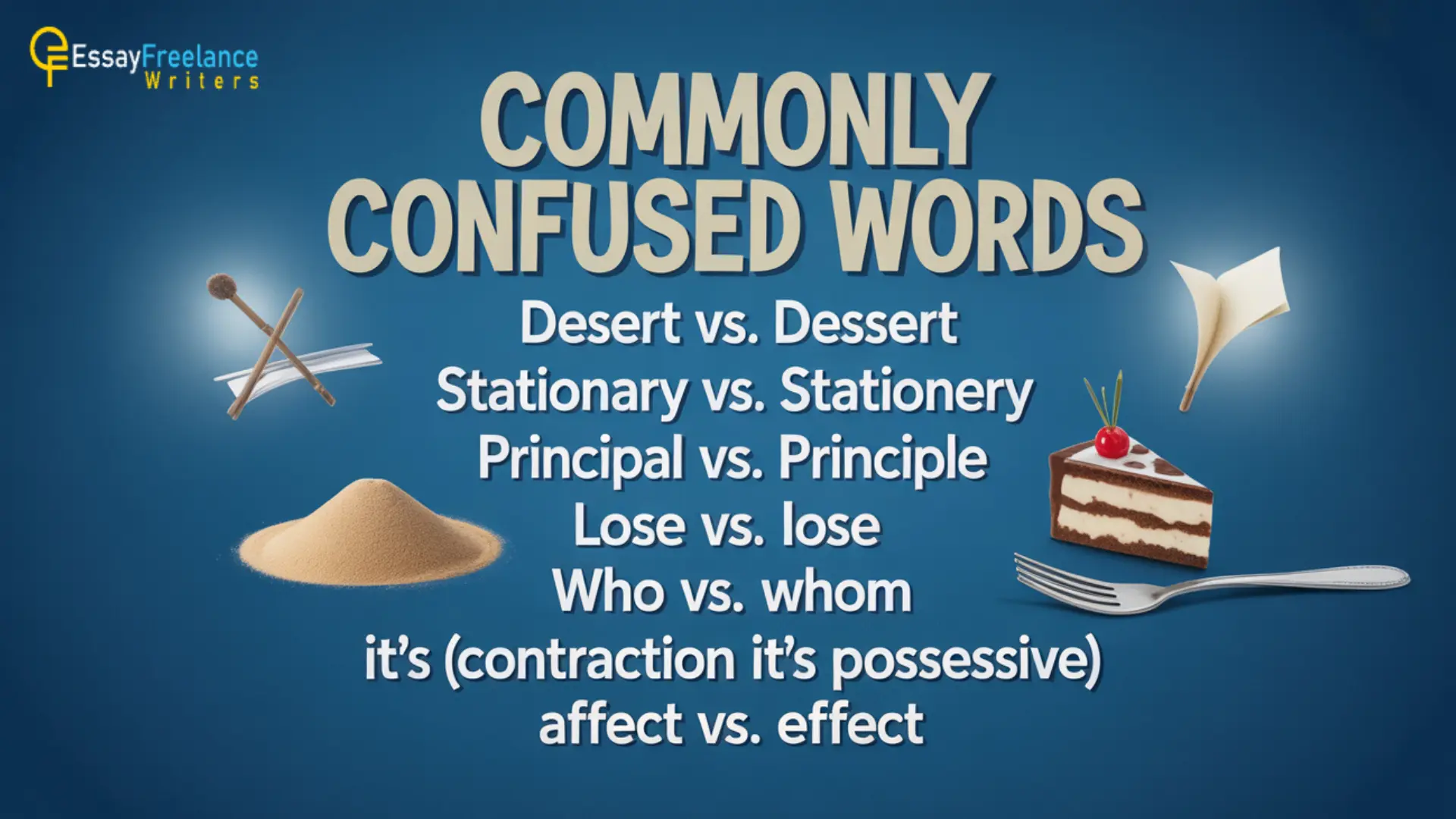
The English language is full of surprises, and one of the biggest challenges learners face is dealing with commonly confused words. These are words that either look alike, sound alike, or share meanings so close that it’s easy to mix them up. Using the wrong word can make your sentence confusing, sometimes even humorous, and it can certainly cause errors in academic or professional writing. If you’ve ever hesitated between “dessert” and “desert” or “principal” and “principle,” you’re not alone.
In this article, we’ll explore why these words often confuse people, go through examples step by step, and share tips to help you know the difference once and for all.
Key Takeaways
- From the start, it’s clear that commonly confused words create real problems in English because they often look alike, sound alike, or share overlapping meanings, which can make writing and speaking less clear.
- Research shows that homophones in particular cause frequent mistakes, but studies also confirm that contrasting similar words and practicing them in context can sharpen vocabulary knowledge and reduce errors.
- Commonly confused word pairs such as desert vs. dessert, stationary vs. stationery, principal vs. principle, loose vs. lose, who vs. whom, its vs. it’s, and affect vs. effect each have simple memory tricks that make their correct use easier to remember.
- Confusing expressions are not limited to single words since phrases like “kick the bucket,” “spill the beans,” or even pairs such as “anymore” and “any more” can mislead learners, while spelling differences between UK and US English add another layer of difficulty that requires consistency.
- The article closes by stressing the importance of correct word choice for clear communication and provides practical steps, using a dictionary or grammar checker, relying on memory tricks, paying attention to context, building vocabulary, using writing resources, and limiting filler words, to steadily improve accuracy and confidence.
Why Words Get Confused
There are many reasons why English words confuse us.
Similar sounds. Words that sound alike, known as homophones, often cause problems. For example, “stationary” and “stationery” sound the same but mean very different things.
Similar spellings. Words that differ by just one or two letters can trick your eyes, such as “lose” and “loose.”
Different meanings depending on context. A single word may act as a noun, verb, or adjective depending on the sentence. For instance, “light” can mean brightness, not heavy, or even to ignite something.
Borrowed words. English borrows heavily from other languages, which adds to its complexity.
Researchers have found that people are especially prone to mistakes with homophones because they sound the same while carrying different meanings. A study published on PubMed showed that readers made significantly more errors when processing homophone pairs compared to other word types, confirming how sound-alike words trip up even skilled readers.
Another useful finding comes from Frontiers in Psychology, where researchers demonstrated that explicitly contrasting similar words helped learners sharpen their vocabulary knowledge. Interestingly, the study noted that stronger readers benefited more from this method, meaning that practice and reading ability influence how easily someone can separate confusing word pairs.
Commonly Confused Words in English
Before we jump into the details, let’s take a quick look at what we mean by commonly confused words. These are English words that either sound alike, look alike, or share meanings that overlap. They are easily confused by writers and readers alike, and they often lead to mistakes in spelling, grammar, or usage.
In fact, a recent study involving Filipino students revealed how context matters when interpreting tricky word types. Comprehension of homophones was rated “Very High,” while comprehension of homographs, words spelled the same but carrying different meanings, was slightly lower. The researchers concluded that context plays a crucial role in resolving confusion, as shown in the findings published on RSIS International.
We’ll go through a comprehensive list of examples below and clear up the confusion.
Desert vs. Dessert
Desert can mean a dry, sandy place (noun) or to abandon someone (verb). Example. “The Sahara is the largest hot desert in the world.”
Dessert refers to the sweet course after a meal. Example. “Chocolate cake is my favorite dessert.”
Tip. Remember that “dessert” has two S’s because you always want more sweets.
Stationary vs. Stationery
Stationary means not moving. Example. “The car remained stationary at the traffic light.”
Stationery refers to writing materials like pens, paper, and envelopes. Example. “She bought new stationery for her writing center.”
Memory trick. Think of the “e” in stationery as standing for “envelope.”
Principal vs. Principle
Principal can be an adjective meaning most important or a noun referring to the head of a school. Example. “The school principal greeted the child with a smile.”
Principle refers to a rule, truth, or belief. Example. “Honesty is a principle worth living by.”
Tip. “Principal” has “pal” in it; the school principal is your pal.
Loose vs. Lose
Loose an adjective meaning not tight. Example. “The horse broke free because the rope was loose.”
Lose a verb meaning to misplace something or not win. Example. “Don’t lose your money while traveling.”
Key difference. “Lose” has one ‘o,’ just like “lost.”
Who vs. Whom
Who used as the subject of a sentence. Example. “Who is going to the party?”
Whom used as the object of a verb or preposition. Example. “To whom should I address this letter?”
Tip. If you can replace it with “he” or “she,” use who. If you can replace it with “him” or “her,” use whom.
Its vs. It’s (Contraction vs. Possessive)
Its a possessive pronoun. Example. “The cat licked its paw.”
It’s a contraction of “it is” or “it has.” Example. “It’s been a long day.”
Tip. If you can replace it with “it is,” then use “it’s.”
Affect vs. Effect
Affect usually a verb meaning to influence. Example. “Lack of sleep can affect your mood.”
Effect usually a noun meaning result. Example. “The medicine had a positive effect on her health.”
Remember. “Affect” = action (verb), “Effect” = end result (noun).
Comparison of Common Phrases in English
One reason the English language can feel tricky is that the same idea can be expressed in different ways depending on who’s speaking or writing. Common phrases often confuse learners, not because they are hard, but because they don’t always follow straightforward rules. For example, when someone says, “kick the bucket,” it doesn’t actually involve a bucket at all; it’s a phrase that refers to death. This shows how meaning isn’t always tied directly to the words themselves.
Another type of confusion comes from everyday sayings that look like two words but are often written as one. Think about “anymore” versus “any more.” The first usually refers to time, as in “I don’t live here anymore,” while the second refers to quantity, as in “I don’t want any more grapes.” Both sound natural in speech, but they are spelled differently, and that difference changes the meaning.
The same applies to parts of grammar. A phrase may include a noun, verb, or even an adverb, and the whole phrase takes on a meaning beyond the definition of each word. For instance, “at large” doesn’t mean someone is big; it means they are free or not caught. Even small function words like prepositions, sometimes called adposition in linguistics, play a key role in shaping the meaning of a phrase. Without the right preposition, the phrase can sound completely wrong.
When you come across phrases like these, don’t try to take them word by word. Instead, learn them as a whole, just like you’d learn how electricity powers a house. Exploring the history of idioms often leads back to famous examples of figurative language by shakespeare which shaped much of our modern speech. Once you see them used in context, they’ll start to make sense.
To make things easier, here are a few examples of commonly confused phrases and what they really mean.
- “Make ends meet” – This has nothing to do with ropes; it means to manage your money so your expenses don’t exceed your income.
- “Spill the beans” – Nobody is actually throwing beans on the floor. It means to reveal a secret.
- “Salt of the earth” – A phrase that refers to someone who is humble, kind, and dependable.
UK vs US Spell Check
Another area where confusion happens is with spelling. English has two dominant styles. British English (UK) and American English (US). They share the same grammar rules for the most part, but many words are spelled differently depending on which side of the Atlantic you’re on.
For example.
- Colour (UK) vs Color (US)
- Centre (UK) vs Center (US)
- Theatre (UK) vs Theater (US)
- Travelling (UK) vs Traveling (US)
The meaning is the same, but the letters change. If you’re using a spell checker in your writing software, it usually defaults to either US or UK spelling. This is why your document might highlight words as “wrong” even when they’re correct in another variety of English.
This isn’t just about spelling rules; sometimes entire words differ. In the UK, people say “lift” for what Americans call an “elevator.” A British person may say “boot” when referring to the back of a car, while an American will call it a “trunk.” Neither is more correct; they’re just regional variations.
Here’s a quick way to keep things consistent.
- Choose one style and stick to it in your writing. Switching between “favourite” and “favorite” in the same essay looks careless.
- Use your software’s spell check tool to match your preferred English variety.
- Remember that formal documents, like a university essay or a research paper on the applications of doubling and halving in mathematics, often require one set standard.
Why Correct Word Choice Matters
Getting word choice right is not just about grammar; it’s about communication, and knowing another word for great can significantly enhance your message. Using the wrong word can.
- Change the meaning of a sentence entirely. For example, confusing “desert” and “dessert” could turn a fun dinner story into a survival tale.
- Cause grammar errors that make your writing unclear.
- Affect your credibility as a writer or speaker.
Using the correct term is especially important when you learn how to write a discursive essay as precision helps maintain a formal tone. Think about how small changes in words and phrases can shift meaning. If you’re trying to improve your writing, resources like Signal Words can help guide readers smoothly through your ideas and reduce confusion.
Tips to Avoid Confusing Words
If you often confuse words, here are practical steps to improve.
- Use a dictionary or grammar checker. Before finalizing your work, run a quick check. It helps spot tricky mistakes.
- Practice memory tricks. Simple associations like “dessert has two S’s because you want seconds” really work.
- Pay attention to context. A word’s meaning often depends on the sentence. For example, “cream” can be an edible dairy product or something applied to the skin.
- Expand your vocabulary. The more English words you know, the less likely you are to mix them up. A great starting point is this guide on How to Memorize New Vocabulary.
- Use writing resources. A Writing Center can be helpful, especially for reviewing how to use transition words and phrases correctly.
- Limit filler words. Keeping your writing simple and clear reduces the chances of confusing word choice. See this resource on How to Avoid Using Filler Words.
Conclusion
English can feel tricky because of so many confusing words, but with a little patience and practice, you can use them correctly. Knowing the difference between commonly confused word pairs like “loose vs. lose” or “its vs. it’s” helps improve your writing and avoids embarrassing mistakes. If you keep in mind the tips, practice with examples, and pay attention to context, you’ll soon find yourself making fewer mistakes and writing with more confidence.
Commonly Confused Words FAQs
.aagb_accordion_3be8d1ca_0 .aagb__accordion_active .aagb__accordion_body {
border-top: 1px solid #ebebeb;
}
.aagb_accordion_3be8d1ca_0 .aagb__accordion_container.wp-block-aab-accordion-item .aagb__accordion_head {
background-color: #bcb6b638;
border-top: none; border-right: none; border-bottom: none; border-left: none;
}
.aagb_accordion_3be8d1ca_0 .aagb__accordion_container.wp-block-aab-accordion-item .aagb__accordion_body {
border-top: 1px solid #bcb6b638; border-right: none; border-bottom: none; border-left: none;
}
.aagb_accordion_3be8d1ca_0 .wp-block-aab-accordion-item .aagb__accordion_subheading {
margin: 5px 0 0 0;
}
.aagb_accordion_3be8d1ca_0 .wp-block-aab-accordion-item .aagb__accordion_icon {
}
.aagb_accordion_3be8d1ca_0 .wp-block-aab-accordion-item .aagb__icon {
font-size: 23px;
}
.aagb_accordion_3be8d1ca_0 .aagb__accordion_title {
margin: 0;
}
.aagb_accordion_3be8d1ca_0 .aagb__accordion_container {
border: 1px solid #bcb6b638;
margin-top: 0px;
margin-bottom: 15px;
}
.aagb_accordion_3be8d1ca_0 .aagb__accordion_number{
}
.aagb_accordion_3be8d1ca_0 .wp-block-aab-accordion-item .aagb__accordion_subheading{
false
}
.aagb_accordion_3be8d1ca_0 .aab-step-progress{
background-color: #dfd2d2;
}
.aagb_accordion_3be8d1ca_0 .aab-step-progress-bar {
background-color: #1570ec;
}
.aagb_accordion_3be8d1ca_0 .aagb__accordion_number{
}
.aagb_accordion_3be8d1ca_0 .aab-progress-bar-container{
background-color: #f0f0f0;
}
.aagb_accordion_3be8d1ca_0 .aab-progress-bar {
background-color: #0866ff;
}
.aagb__group_accordion_container.has_img {
flex-direction: row;
}
.aagb_accordion_3be8d1ca_0 .aagb__accordion_container {
transition-duration: 0ms !important;
outline: 2px solid #00000000;
}
.aagb_accordion_3be8d1ca_0 .aagb__accordion_container:focus-visible {
outline: 2px solid #C2DBFE;
}
Why are there so many confusing words in English?
English borrows heavily from other languages, which means it has many words that sound alike or are spelled similarly but carry different meanings. This overlap makes it easy to confuse them.
What is the best way to remember the difference between similar words?
Memory tricks, repetition, and reading widely help. Associating a word with a visual clue, like remembering “dessert” has two S’s for “sweet stuff,” works well.
Can a word be both a noun and an adjective?
Yes, some English words are flexible. For example, “cream” is used as a noun when you talk about whipped cream, but it can also be an adjective meaning cream-colored.
How can I improve my vocabulary to avoid mistakes?
Regular reading, practicing new word pairs, and using resources like How to Memorize New Vocabulary are excellent ways to expand your vocabulary and reduce confusion.

Experienced writer and dedicated professor with a passion for crafting compelling narratives and nurturing the next generation of critical thinkers