

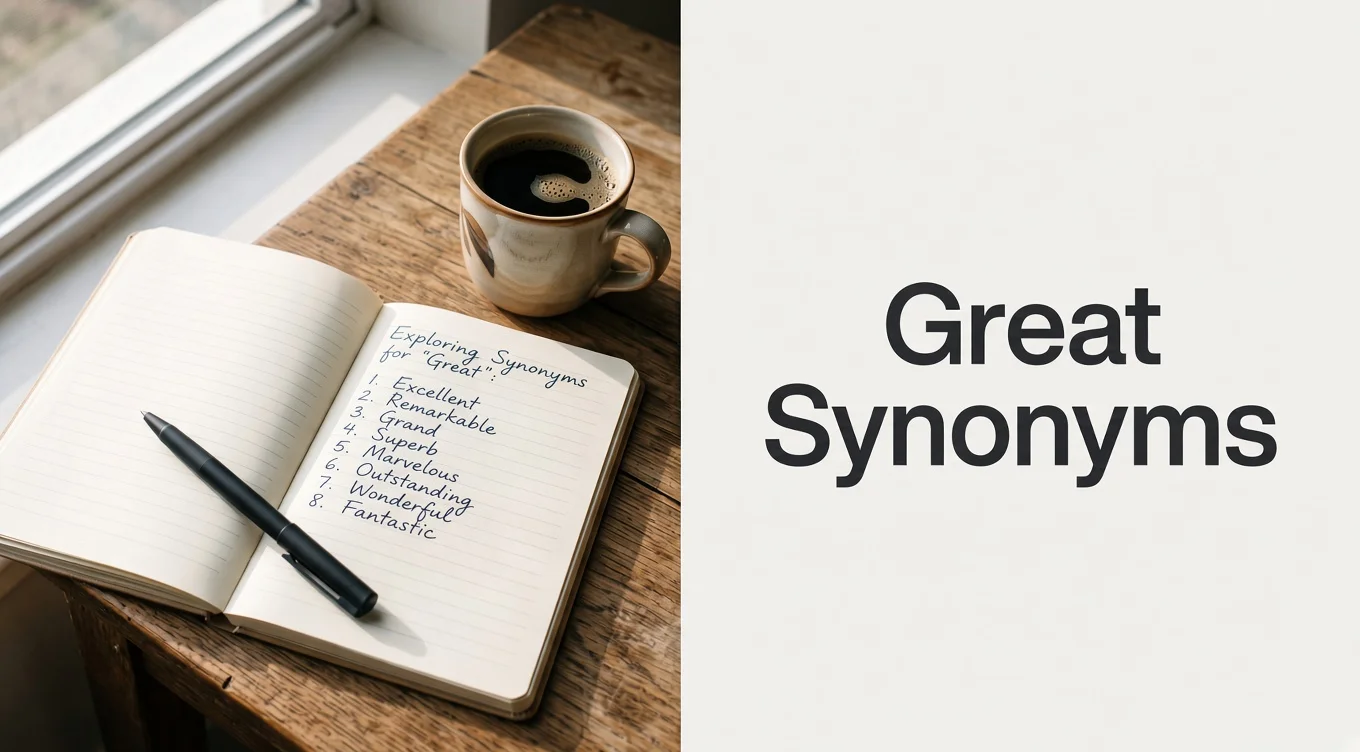
What is a synonym for great?
Common synonyms for "great" include excellent, superb, outstanding, exceptional, fantastic, and remarkable, though the best choice depends on context.What is a formal synonym for great?
Formal alternatives to "great" include exceptional, outstanding, superb, and remarkable, which are preferred in academic and professional writing over casual terms like "awesome."What is a synonym for great meaning large?
When "great" refers to size or amount, strong alternatives include enormous, immense, substantial, vast, and considerable.What is a synonym for great meaning impressive?
For impressiveness or admiration, alternatives include amazing, marvelous, phenomenal, spectacular, and extraordinary.Why avoid overusing “great” in writing?
Repeating "great" makes writing vague and repetitive; more specific synonyms convey precise meaning and make prose sound more sophisticated.“Great” is one of the most overused words in English, and its meaning shifts depending on context. Common great synonyms include excellent, superb, and outstanding for quality; enormous, substantial, and immense for size or scale; and amazing, marvelous, and phenomenal for impressiveness. The best synonym for “great” depends on whether you’re describing quality, magnitude, or impact.
So, if you’re ready to banish the bland and embrace the brilliant, stick with me. We’re going to explore not just another word for great, but a whole arsenal of great synonyms, and learn how to wield them with confidence and accuracy. This isn’t about memorizing a list; it’s about understanding the nuances that will transform your writing from merely good to truly exceptional.
Key Takeaways
- Employing varied vocabulary beyond ‘great’ significantly enhances the clarity and sophistication of academic writing.
- Contextual awareness is paramount for selecting the most appropriate synonym for ‘great’ to convey precise meaning.
- Utilizing a diverse range of powerful adjectives consistently improves academic prose and engages readers more effectively.
- Focusing on specific aspects like quality, size, or impact helps writers narrow down the best alternative words.
- Regular practice through reading and active vocabulary building is essential for naturally integrating synonyms into one’s writing.
Why “Great” Isn’t Always So… Great
Let’s be honest: when you repeatedly use “great” in your academic papers, it can start to feel a little flat. Imagine reading an essay that describes a “great achievement,” a “great impact,” and a “great solution” all within a single paragraph. The word loses its meaning, doesn’t it? It becomes a generic filler, failing to convey the specific quality or intensity you intended.
Your professors are looking for precision in your arguments and clarity in your expression. A vague adjective like “great” often signals a lack of deeper vocabulary or, worse, a lack of thought. It suggests that you haven’t taken the time to pinpoint the exact characteristic you’re trying to highlight. This can undermine the credibility of your analysis, even if your underlying ideas are solid. We want your ideas to be conveyed with the strongest, most appropriate language available.
Choosing the Right Synonym for “Great”: Context is King
Finding the perfect great synonyms isn’t a one-size-fits-all endeavor. The “best” alternative depends entirely on the context of your sentence. A word that works well to describe a scientific discovery might fall flat when describing a historical figure. This is where many students stumble, grabbing a synonym from a thesaurus without considering its specific connotations or common usage.
To truly elevate your writing, you need to think beyond simple substitutions. Ask yourself: What kind of “great” am I trying to express? Am I referring to quality, size, importance, or impact? Each nuance will lead you to a different set of words. This careful consideration of context is what separates truly effective writing from merely adequate prose.
Improve Your Essay
Struggling to make your academic writing stand out? Our expert paper writers can help you refine your arguments and choose the perfect words. Get personalized feedback and elevate your prose to impress your professors.
When “Great” Means High Quality or Excellence
When you’re discussing something of superior standard or exceptional merit, there are plenty of words to use instead of great. These words convey a sense of high achievement, skill, or inherent value.
Here’s a starting point:
- Excellent: This implies a very high standard, often exceeding expectations. (e.g., “The experiment yielded excellent results.”)
- Superb: Suggests outstanding quality, often with a hint of admiration. (e.g., “Her presentation offered a superb analysis of the data.”)
- Outstanding: Highlights that something stands out from the rest, being notably superior. (e.g., “The research presented an outstanding contribution to the field.”)
- Exceptional: Means unusual, uncommon, and therefore remarkable. (e.g., “He demonstrated exceptional problem-solving skills.”)
- Magnificent: Conveys impressiveness, grandeur, or splendor. (e.g., “The architecture of the ancient temple was magnificent.”)
- Stellar: Literally relating to stars, figuratively meaning outstanding or brilliant. (e.g., “The team achieved stellar performance in the competition.”)
- Incredible: Suggests something so unusual or impressive it’s hard to believe. (e.g., “The new software offers incredible processing speed.”)
These words aren’t just swaps; they add a layer of specificity. Saying “superb” results paints a much clearer picture than just “great” results.
When “Great” Means Large in Size or Amount
Sometimes, “great” is used to describe something of considerable scale or quantity. In these cases, you want words that accurately reflect that dimension without being imprecise.
Consider these alternatives:
- Enormous: Emphasizes extreme largeness. (e.g., “The project required an enormous amount of resources.”)
- Substantial: Means considerable in amount, strength, or value. (e.g., “There was a substantial increase in public awareness.”)
- Considerable: Suggests a noticeably large amount or extent. (e.g., “The policy had a considerable impact on the local economy.”)
- Immense: Implies extremely large or vast, often beyond ordinary measure. (e.g., “The challenges facing the industry are immense.”)
- Vast: Denotes a very great extent or size, particularly in area. (e.g., “The study covered a vast range of social factors.”)
Choosing “substantial” over “great” for an amount, for instance, immediately communicates a more precise quantitative idea.
When “Great” Means Impressive or Admirable
If you’re using “great” to express admiration, wonder, or an impressive quality, you’ll need words that carry that emotional weight and vividness.
Here are some strong options:
- Wonderful: Evokes a feeling of delight or admiration. (e.g., “The presentation offered a wonderful insight into the topic.”)
- Amazing: Suggests something that causes surprise and wonder. (e.g., “Researchers made an amazing breakthrough in medicine.”)
- Marvelous: Means extremely good or wonderful, inspiring awe. (e.g., “The historical account provides a marvelous narrative.”)
- Awesome: Implies inspiring awe or wonder, often in a grand or imposing way. (e.g., “The scale of the ancient civilization’s engineering was awesome.”)
- Fantastic: Indicates something extraordinary or excellent. (e.g., “The proposed solution is a fantastic step forward.”)
These terms add color and feeling, making your descriptions more engaging than a simple “great.”
A Detailed Great Synonym List for Every Occasion
Let’s break down a comprehensive great synonym list, grouping words by their primary shades of meaning. This isn’t just another word for great, but a selection tailored for academic rigor.
For General Approval/Quality
When you need to convey overall high quality or general positive assessment without specific emotional overtones, these synonyms for great are ideal. They speak to objective standards of excellence.
- Excellent: Signifies top-tier quality, exceeding typical standards.
- Superb: Implies a very high degree of excellence or proficiency.
- Outstanding: Denotes something remarkably good, standing above others.
- Top-tier: Suggests belonging to the highest category or rank.
- First-rate: Indicates the highest quality or standard.
- Superior: Means higher in rank, status, or quality.
- Prime: Implies the best possible quality or condition.
- Premium: Often used for higher quality or value, often at a higher cost or effort.
- Exceptional: Refers to something unusual and especially good.
For Impressive or Striking Things
These words to use instead of great are perfect when you want to describe something that creates a strong impression, evokes admiration, or is particularly noteworthy due to its impact or spectacle.
- Fantastic: Suggests something extraordinarily good or attractive.
- Amazing: Highlights surprise and wonder; causes astonishment.
- Wonderful: Evokes feelings of delight, pleasure, or admiration.
- Marvelous: Means extremely good, inspiring wonder or admiration.
- Incredible: So extraordinary as to seem impossible or unbelievable.
- Phenomenal: Describes something remarkable or exceptional, often in an almost supernatural way.
- Spectacular: Visually impressive or dramatic.
- Extraordinary: Beyond what is usual, customary, or regular; remarkably good.
- Awesome: Inspiring awe, reverence, or wonder.
For Large Scale or Importance
When “great” refers to magnitude, significance, or scale, these alternatives provide much-needed precision. They help quantify or emphasize the weight of what you’re discussing. For example, when crafting an argumentative essay about education, describing the impact of policy changes as “considerable” or “significant” is far more impactful than just “great.”
- Considerable: Notably large in size, amount, or extent.
- Substantial: Of considerable importance, size, or worth.
- Significant: Sufficiently great or important to be worthy of attention.
- Immense: Extremely large or great, especially in scale or degree.
- Vast: Of very great extent or quantity; immense.
- Enormous: Very large in size, quantity, or extent.
- Extensive: Covering a large area; considerable in amount or effect.
- Major: Important, serious, or significant.
- Profound: Very great or intense; having a deep meaning.
For Skilled Performance
If you’re describing someone’s ability or mastery, using more specific terms helps acknowledge their talent accurately. These words imply a high level of competence.
- Adept: Very skilled or proficient at something.
- Proficient: Competent or skilled in doing or using something.
- Masterful: Executed with great skill and artistry.
- Accomplished: Highly trained or skilled.
- Expert: Having or involving a special skill or knowledge derived from experience.
- Skilled: Having or showing the knowledge, ability, or training to perform a task well.
For Positive Impact or Benefit
When you’re highlighting the positive outcomes or advantages of something, these synonyms clearly communicate that beneficial quality.
- Beneficial: Favorable or advantageous; resulting in good.
- Advantageous: Providing an advantage; favorable; profitable.
- Valuable: Of great worth or importance.
- Constructive: Serving a useful purpose; tending to build up.
- Propitious: Giving or indicating a good chance of success; favorable.
How to Effectively Integrate Synonyms into Your Academic Writing
Knowing a list of words is one thing; using them effectively is another. It’s not about stuffing your essay with obscure vocabulary; it’s about making deliberate, precise choices. Your goal is clarity and impact, not just fanciness. Sometimes, a simpler word is indeed better, but often, a well-chosen synonym can truly elevate your prose.
One of the best ways to get a feel for how these words are used in real academic contexts is to read widely within your field. Pay attention to how published authors use descriptive language. Keep a vocabulary journal where you not only list new words but also write down example sentences from your readings. This active engagement helps solidify your understanding of their nuances.
When you’re drafting, focus on getting your ideas down. Then, during the revision phase, go back and specifically look for overused words like “great.” Challenge yourself to find a more precise alternative. If you’re struggling with how to begin, remember that even the very first words of your paper set the tone. Using a robust essay introduction template can help you structure your opening paragraphs, but the individual word choice within it is equally important for capturing your reader’s attention.
Get Writing Help
Feeling overwhelmed by your writing assignments? Our expert academic writers are here to provide tailored assistance, from crafting compelling introductions to refining your entire paper. Submit your requirements and get professional support today.
Avoiding Common Pitfalls with Synonyms
Merely swapping out a word for one from a great synonym list can lead to awkward phrasing if you’re not careful. Just because a word appears in a thesaurus doesn’t mean it’s an exact fit for your sentence’s context. Here are a few things to watch out for:
- Connotation vs. Denotation: While words might share a similar dictionary definition (denotation), their emotional or cultural associations (connotation) can be vastly different. “Awesome” and “significant” both mean “great” in some contexts, but they carry entirely different weights. Always consider the feeling or implied meaning of a word.
- Formality: Ensure the synonym matches the academic tone of your writing. Words like “groovy” or “super-duper” (yes, I’ve heard students try to get creative!) are definitely not appropriate, even if they convey enthusiasm. Stick to more formal, academic vocabulary.
- Over-reliance on a Thesaurus: A thesaurus is a tool, not a crutch. Don’t just pick the first option listed. Cross-reference with a dictionary to confirm the meaning and usage, and ideally, check examples of the word in context.
- Repetition of Synonyms: The goal is variety, not just swapping one repetitive word for another. If you replace “great” with “fantastic” five times in a paragraph, you’ve only traded one problem for another. Keep a wide range of words at your disposal. This is part of the broader process of editing and proofreading a dissertation—it’s not just about grammar, but about refining every single word choice for maximum impact.
Building Your Vocabulary: A Long-Term Strategy
Improving your vocabulary isn’t a quick fix; it’s an ongoing process. The more you engage with language, the richer your internal lexicon becomes. This continuous learning is also a way to manage the broader pressures of academic life, including dissertation stress, by giving you more confidence and control over your writing. Here are some strategies:
- Read Voraciously: This is perhaps the single most effective method. Read academic journals, classic literature, well-written news articles—anything that exposes you to varied and sophisticated language. Pay attention to how authors use specific words to convey precise meanings.
- Keep a Vocabulary Journal: Don’t just look up words; write them down. Include their definitions, synonyms, antonyms, and, most importantly, example sentences. Try to use the word in your own sentences soon after learning it.
- Use Flashcards or Apps: Digital tools can make learning new vocabulary more engaging. Spaced repetition systems are particularly effective for long-term retention.
- Actively Listen: Pay attention to how articulate speakers use language. Sometimes, hearing a word used in context helps it stick better than just reading it.
- Practice, Practice, Practice: The more you write, the more opportunities you’ll have to put your new vocabulary into action. Don’t be afraid to experiment, but always review to ensure accuracy. If you’re really struggling to hit the mark with your word choices, remember that you don’t have to go it alone. Sometimes, getting a fresh perspective from expert paper writers can make a huge difference, not just in the immediate paper but in learning better writing habits.
Great Synonyms FAQs

With a deep understanding of the student experience, I craft blog content that resonates with young learners. My articles offer practical advice and actionable strategies to help students achieve a healthy and successful academic life.