

What makes a good topic:
A good topic is focused, researchable, and arguable. It may examine a particular campaign, compare leaders or movements, evaluate ethical limits, analyze legal outcomes, or assess modern tactics such as climate protest, digital activism, or whistleblowing.Historical angle:
Historical topics work well when they analyze concrete episodes—such as the Salt March, sit-ins and freedom rides, suffrage militancy, anti-apartheid resistance, or conscientious objection—and ask what made those tactics effective or limited.Philosophical/ethical angle:
Ethical topics often ask when disobedience is justified, how conscience relates to legal obligation, what counts as a “just cause,” and where the boundary lies between nonviolent resistance and unjustifiable disruption.Modern angle:
Contemporary topics can address climate activism, racial-justice protests, digital resistance, indigenous land defense, student movements, or the ethics of tactics that disrupt public services.Legal/political angle:
Legal topics examine necessity or conscience defenses, state responses, protest rights, media effects, and whether civil disobedience leads to policy or constitutional change.Civil disobedience is the deliberate, public, and typically nonviolent refusal to obey certain laws, demands, or commands in order to protest perceived injustice and press for change, while usually accepting the legal consequences of that refusal.
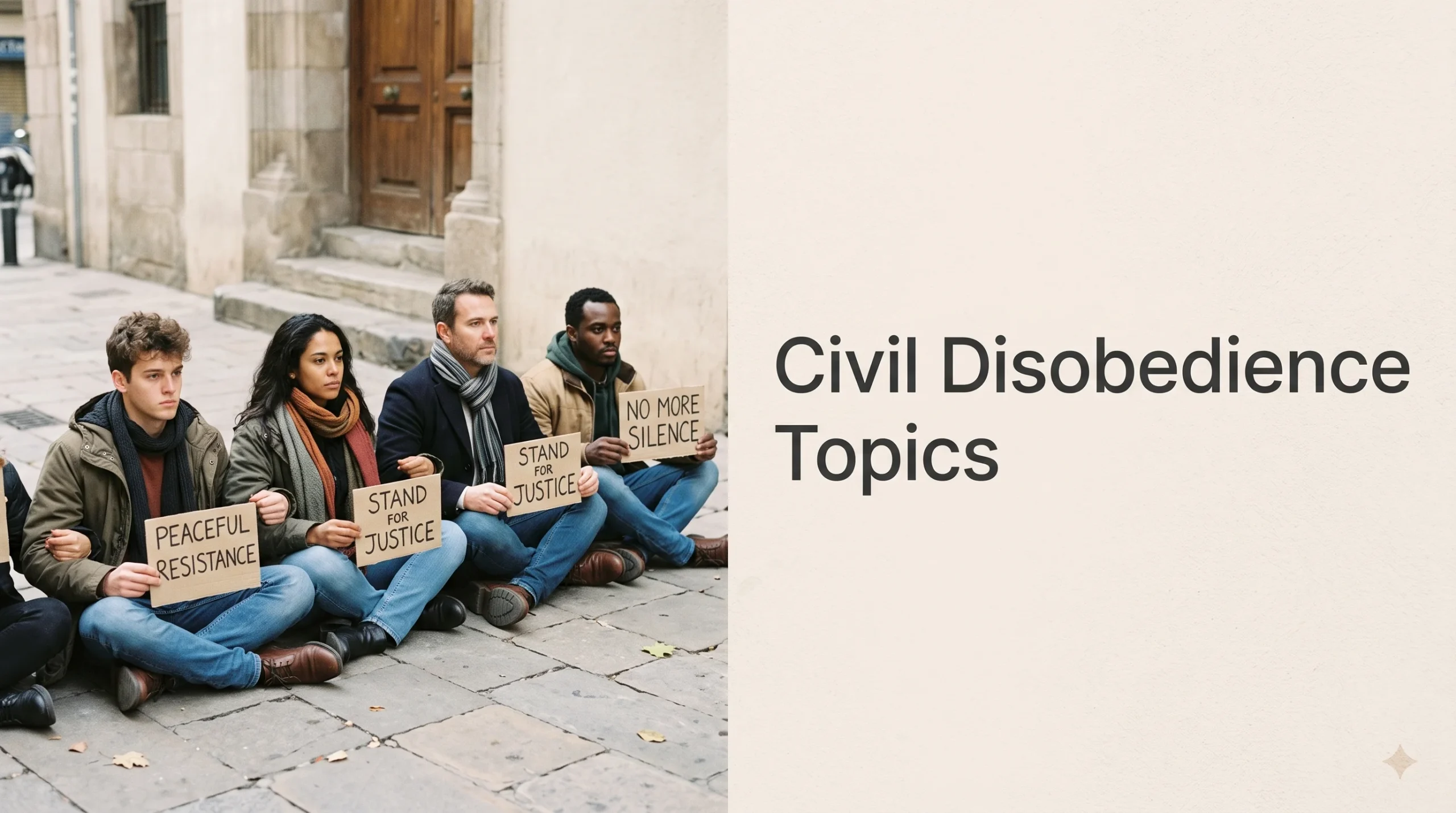
Civil Disobedience Topics work best when they move beyond famous names and focus on a specific movement, ethical question, legal consequence, or modern form of nonviolent resistance. Strong topics are researchable, debatable, and narrow enough to support a clear thesis rather than a broad summary of protest history.
It is easy to default to Gandhi or Martin Luther King Jr. and then get stuck. Finding the right civil disobedience topics can feel like trying to find a needle in a haystack, especially when you need something specific enough to research but broad enough to sustain a full essay. That’s why I’ve pulled together this extensive list of ideas. My goal is to save you the hours of aimless searching and help you pinpoint that perfect argument or historical analysis.
What follows are specific, detailed civil disobedience topics designed to spark your academic curiosity and provide solid ground for your next essay, research paper, or even a compelling persuasive speech. These aren’t just one-liners; they’re prompts crafted to get you thinking deeply about the nuances of dissent and resistance.
Key Takeaways
- Choosing compelling civil disobedience topics requires understanding its historical context and ethical dimensions.
- Effective research questions often focus on specific movements, leaders, or the impact of nonviolent resistance.
- Essays can analyze the philosophical justifications, legal ramifications, or societal changes brought about by acts of defiance.
- Consider exploring the intersection of civil disobedience with modern issues like environmentalism or digital activism.
- Developing a focused thesis from a broad topic enhances the depth and clarity of your academic work.
Historical Perspectives on Civil Disobedience
Civil disobedience isn’t a new concept; its roots run deep through human history. Examining past movements and figures can illuminate enduring principles and evolving strategies of nonviolent resistance. When exploring historical civil disobedience topics, consider the context, the goals, and the ultimate impact of these acts of defiance.
- A comparative analysis of Henry David Thoreau’s philosophical stance on civil disobedience versus its practical application by abolitionists.
- The role of civil disobedience in the Indian independence movement under Mahatma Gandhi, focusing on the Salt March and its global repercussions.
- How acts of civil disobedience in the American Civil Rights Movement, such as sit-ins and freedom rides, catalyzed legislative change.
- Examining the legacy of suffragettes like Alice Paul and the tactics of civil disobedience employed to secure women’s right to vote.
- The anti-apartheid movement in South Africa: analyzing specific instances of civil disobedience and their effectiveness in dismantling institutionalized racism.
- Investigating the impact of Buddhist monks’ self-immolation in Vietnam during the 1960s as a form of extreme civil disobedience.
- The strategies of civil disobedience utilized by workers’ rights movements in the early 20th century, such as strikes and boycotts.
- Comparing the philosophical justifications for civil disobedience in the writings of Martin Luther King Jr. and Nelson Mandela.
- Analyzing the historical precedents of civil disobedience in ancient Rome or Greece, particularly regarding unjust laws.
- The role of civil disobedience during the Cold War era, specifically focusing on peace movements and anti-nuclear protests.
- How the conscientious objector movement during World Wars I and II exemplified civil disobedience against state authority.
- The specific forms of civil disobedience used by early environmental activists to protest pollution or deforestation.
- Examining the impact of civil disobedience during the fall of communism in Eastern Europe, such as the Velvet Revolution.
- The Zoot Suit Riots: Were they acts of civil disobedience or simply unrest, and what does this distinction tell us about the nature of protest?
- A detailed study of Rosa Parks’ act of defiance and its pivotal role in sparking the Montgomery Bus Boycott.
Philosophical and Ethical Dimensions of Civil Disobedience
Beyond the historical events, there’s a deep well of philosophical inquiry surrounding civil disobedience. What makes an act of defiance morally justifiable? What are the limits? These are the kinds of questions that make for truly compelling research, often leading to argumentative research paper topics or a thoughtful analytical essay.
- Exploring the core tenets of nonviolent civil disobedience as articulated by philosophers like John Rawls and Ronald Dworkin.
- Is civil disobedience always an ethical act, or can it be misused to promote unjust causes?
- Analyzing the tension between individual moral conscience and legal obligation in cases of civil disobedience.
- The concept of ‘just cause’ in civil disobedience: who defines it, and what criteria must be met for an act of defiance to be considered legitimate?
- How utilitarianism might justify or condemn acts of civil disobedience based on their outcomes.
- Examining the role of personal sacrifice in civil disobedience and its ethical implications for participants and observers.
- The philosophical debate on whether civil disobedience should target only unjust laws or also policies deemed immoral.
- Does successful civil disobedience legitimize the breaking of laws, or does it merely highlight their injustice?
- Investigating the ethical boundaries of civil disobedience: when does it cross the line into civil disorder or terrorism?
- The responsibility of the state to respond to civil disobedience: an analysis of different governmental approaches.
- How various religious doctrines- Christianity, Islam, Buddhism- provide frameworks for justifying or opposing civil disobedience.
- The concept of ‘political obligation’ and how civil disobedience challenges its assumptions.
- Analyzing the effectiveness of symbolic acts of civil disobedience in conveying a moral message, regardless of immediate policy change.
- Is there a moral imperative for citizens to engage in civil disobedience when faced with systemic injustice?
- The role of empathy and public opinion in shaping the ethical perception of civil disobedience movements.
Need a Deeper Dive into Your Topic?
Our expert writers can help you refine your civil disobedience topics, conduct thorough research, and craft a compelling argument from scratch. Get the support you need to excel.
Modern Applications and Contemporary Debates
Civil disobedience isn’t just history; it’s a living, breathing concept constantly being redefined by current events. From environmental activism to digital protests, these civil disobedience topics reflect the challenges and opportunities of our contemporary world. You might consider how a problem-solution essay could explore current issues and potential responses.
- Analyzing Extinction Rebellion’s tactics of civil disobedience: are they effective in forcing climate action?
- The role of digital activism and online protests as forms of civil disobedience in the age of the internet.
- Investigating the use of civil disobedience in the Black Lives Matter movement and its impact on policing reform.
- The ethical considerations of civil disobedience aimed at disrupting essential services, like road blockades, in environmental protests.
- Examining the phenomenon of whistleblowing as a modern form of civil disobedience against state or corporate secrecy.
- Civil disobedience in response to government surveillance: analyzing the arguments for and against data privacy activism.
- The #MeToo movement: does public shaming and boycotting constitute a form of civil disobedience?
- Analyzing student protests against tuition hikes or budget cuts as instances of civil disobedience.
- The use of civil disobedience by indigenous rights movements to protect ancestral lands or cultural heritage.
- Comparing the tactics of modern animal rights activists, some of whom engage in civil disobedience, with historical movements for social justice. You might even find parallels with debates around an argumentative essay about animal experimentation.
- The ethics and efficacy of civil disobedience in challenging immigration policies or border controls.
- Examining civil disobedience in the context of healthcare access and affordability, such as ‘die-ins’ or protests against pharmaceutical companies.
- The role of artists and cultural figures in employing civil disobedience to protest censorship or political repression.
- Analyzing the impact of cyber civil disobedience, such as DDoS attacks, on corporate or governmental entities.
- The future of civil disobedience: how might technological advancements shape methods of resistance in the coming decades?
Legal and Political Ramifications of Civil Disobedience
When individuals or groups engage in civil disobedience, they knowingly accept the legal consequences. This makes the intersection of law and political action a fascinating area for exploration. Your essay could delve into the legal definitions, judicial responses, and political outcomes. Remember, even a powerful essay needs a strong thesis statement in persuasive essays to guide its argument.
- The legal defense of ‘necessity’ or ‘conscience’ in civil disobedience cases: how effective is it in court?
- Analyzing the legal history of civil disobedience from common law traditions to modern statutory interpretations.
- How judicial rulings on civil disobedience, such as those related to protest rights, have shaped democratic norms.
- The political impact of mass arrests and imprisonment stemming from acts of civil disobedience on public opinion and policy.
- Examining the difference between civil disobedience and criminal acts in a legal framework.
- The state’s response to civil disobedience: comparing punitive measures with attempts at dialogue and policy reform.
- The role of international law and human rights treaties in protecting or limiting acts of civil disobedience globally.
- Analyzing the concept of ‘selective obedience’ to laws and its implications for legal systems.
- How the media portrayal of civil disobedience influences political and legal outcomes.
- The impact of civil disobedience on electoral politics: does it galvanize or alienate voters?
- Examining the legal and ethical challenges faced by lawyers defending participants in civil disobedience.
- The use of injunctions and restraining orders against civil disobedients: legal and political effectiveness.
- How civil disobedience can expose inconsistencies or injustices within a legal system, leading to its reform.
- The political motivations behind governments choosing to prosecute or tolerate acts of civil disobedience.
- Analyzing instances where civil disobedience has led to fundamental changes in constitutional law or civil liberties.
Your Essay, Polished to Perfection
Don’t let intricate legal concepts or historical details overwhelm you. Our editors can review your draft for clarity, argument strength, and academic rigor.
Comparative Studies in Civil Disobedience
Sometimes, the best way to understand a complex phenomenon is to compare it across different cultures, time periods, or contexts. These comparative civil disobedience topics allow you to draw broader conclusions about human rights, political dissent, and the universal drive for justice. You might consider how an argumentative essay about corruption could be explored in different national contexts of civil disobedience.
- Comparing the philosophical underpinnings and tactical approaches of Gandhi’s Satyagraha and King’s nonviolent resistance.
- A cross-cultural study of civil disobedience: examining movements in Eastern versus Western democracies.
- Comparing civil disobedience against colonial rule in Africa with similar movements in Southeast Asia.
- How environmental civil disobedience in the developed world differs from similar movements in developing nations regarding goals and methods.
- Analyzing the role of religious institutions in supporting or opposing civil disobedience across different societies.
- A comparative analysis of state repression in response to civil disobedience in authoritarian regimes versus democratic ones.
- Comparing the long-term effectiveness of civil disobedience versus armed rebellion in achieving political goals.
- How women’s rights movements globally have utilized civil disobedience, highlighting similarities and differences in strategies.
- The use of hunger strikes as a form of civil disobedience: a comparative study across different historical and cultural contexts.
- Comparing civil disobedience movements aimed at social justice (e.g., racial equality) with those focused on political rights (e.g., voting reform).
- Analyzing the role of international media in shaping the perception and success of civil disobedience movements in different countries.
- Comparing the legal consequences for civil disobedients in countries with robust free speech protections versus those with stricter laws.
- The evolution of civil disobedience tactics: comparing 20th-century methods with 21st-century digital forms of protest.
- A comparative study of youth-led civil disobedience movements in different eras, such as the 1960s student protests versus modern climate strikes.
- How the concept of ‘moral injury’ among participants in civil disobedience varies across movements and cultures.
Struggling with Your Essay?
Our professional writers are ready to tackle any topic, ensuring originality and academic excellence for your civil disobedience paper. Achieve your academic goals with ease.
So what now? Hopefully, this extensive list has given you more than a few compelling civil disobedience topics to chew on. The beauty of this subject is its enduring relevance; there’s always a new angle, a fresh perspective, or a contemporary movement to analyze. Remember, a good topic is just the starting point. The real work, and the real learning, comes from diving deep, researching thoroughly, and articulating your argument clearly. It’s about finding that intersection where your intellectual curiosity meets a meaningful issue. Go forth and write something brilliant.
Civil Disobedience FAQs

I am dedicated to creating engaging blog posts that provide valuable insights and advice to help students excel in their studies. From study tips to time management strategies, my goal is to empower students to reach their full potential.

