

Why colleges offer it:
Colleges issue conditional acceptances mainly when final grades are still pending, English proficiency has not yet been proven, required prerequisite courses are missing, or official documentation is incomplete. It allows them to secure strong applicants while ensuring the student is fully prepared for university-level work.Common conditions:
The most frequent conditions are: maintain a specified senior-year GPA or earn certain grades in key courses; submit final official transcripts; achieve a required TOEFL, IELTS, or equivalent English score (especially for international students); complete missing prerequisite coursework; or provide additional documentation such as health forms or financial proof.How to handle it (action steps):
Read the acceptance letter carefully and list every condition and deadline. Create a concrete action plan for each requirement, maintain strong academic performance, communicate proactively with the admissions office if anything is unclear, and submit official documentation as soon as each condition is met. Missing deadlines or failing to meet stated requirements can result in the offer being rescinded.What happens if conditions are not met:
If you do not satisfy the stated conditions by the given deadlines, the university can rescind the offer of admission. In some borderline cases the school may offer alternatives such as a language pathway program, delayed enrollment, or provisional enrollment with extra support, but these options are not guaranteed.International-student note:
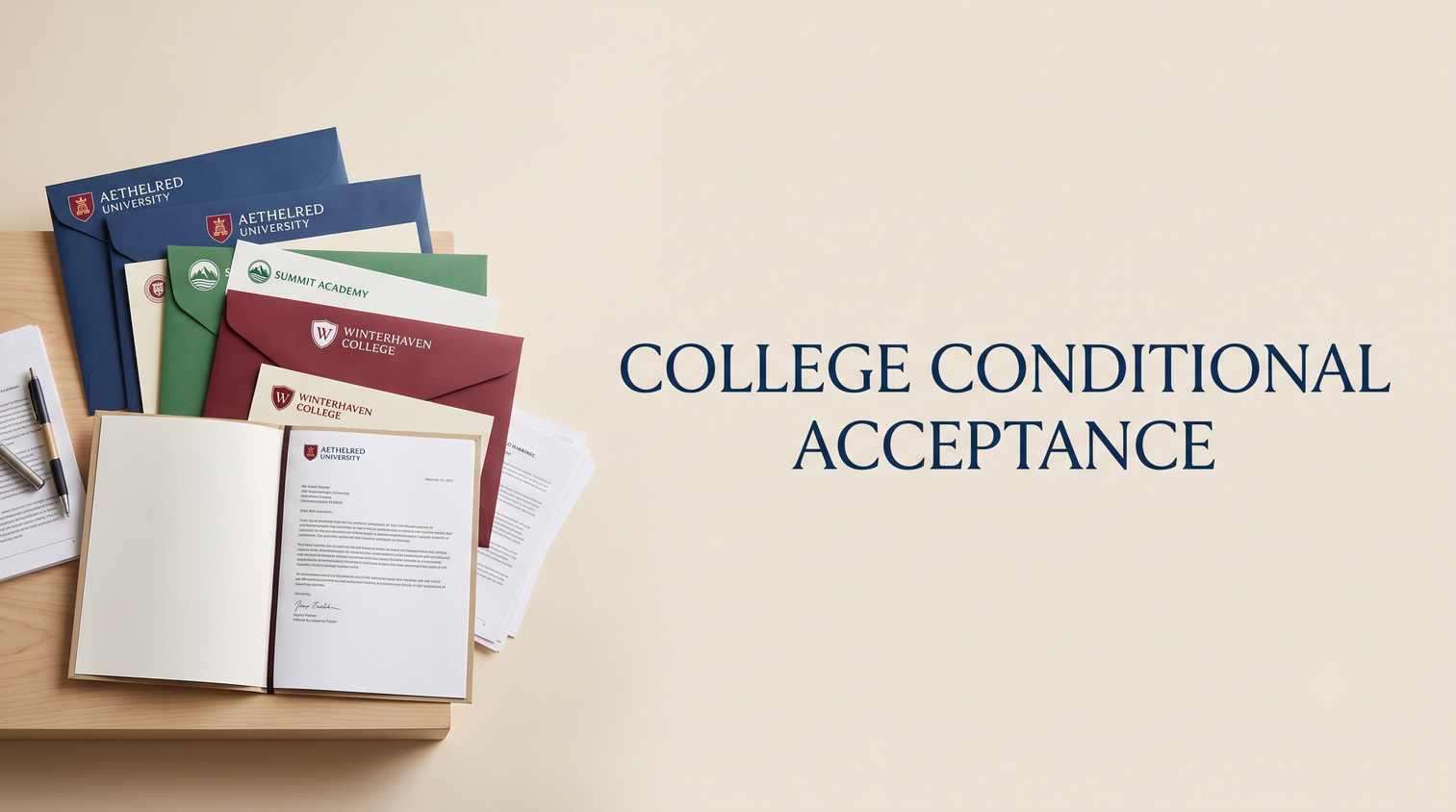
International students most often receive conditions related to English language proficiency (test scores or completion of an intensive English program) and visa or financial documentation. Meeting these is required before full enrollment and, in many cases, before a student visa can be finalized.College Conditional Acceptance is a provisional offer of admission that becomes final only after you meet specific requirements set by the university, such as maintaining a certain GPA, submitting final transcripts, achieving a required English proficiency score, or completing prerequisite courses. It is not a rejection and not yet full unconditional admission.
We’re going to break down exactly what college conditional acceptance means, what kinds of conditions you might encounter, and most importantly, how to confidently meet those requirements to secure your spot. We’ll cover everything from academic performance to English language proficiency and what happens if you don’t quite meet the conditions. So, let’s get that knot out of your stomach and replace it with a clear action plan.
Key Takeaways
- Receiving a college conditional acceptance means a university has provisionally offered you a spot, contingent on meeting specific requirements before full enrollment.
- Common conditions often revolve around maintaining academic performance in your final semester, successfully completing certain prerequisite courses, or achieving specific English language proficiency scores.
- Failing to satisfy the outlined conditions can lead to the rescinding of your offer of admission, so understanding and fulfilling each requirement is crucial for admitted students.
- International students frequently encounter English proficiency requirements, often needing a specific IELTS score or completion of a language proficiency course.
- Proactive communication with the admissions office, careful tracking of deadlines, and seeking support are key strategies for successfully navigating your conditional admission status.
What Exactly is College Conditional Acceptance?
Think of a conditional offer as a provisional ‘yes.’ The university is saying they want you, but your formal acceptance is contingent upon you fulfilling certain requirements. It’s essentially a contract: “We will accept you if you do X, Y, and Z.” This often happens when there are aspects of your academic record or application that are still pending, or when the admissions committee wants to ensure you maintain a certain level of performance before you officially enroll.
It’s a common practice, especially in competitive college admissions in the United States, but also globally. Universities use conditional admission as a way to manage risk and ensure that admitted students are fully prepared for the rigor of higher education. For you, the applicant, it’s a clear pathway forward, but one with specific academic hurdles to clear.
Why Do Colleges Offer Conditional Acceptance?
Colleges extend a conditional acceptance for several valid reasons, reflecting their commitment to admitting students who are truly ready to thrive. They aren’t trying to make things harder; they’re ensuring a successful transition for their incoming class.
Here are some of the main reasons:
- Pending Academic Records: Many students apply for university and college admission while still in their final semester of secondary school. Your grades for that last semester or your senior year are obviously not yet finalized. Colleges will look at your current gpa and transcript but will require you to maintain that academic performance or achieve a specific grade in certain coursework to finalize your offer of admission.
- English Language Proficiency: For international students, this is a big one. If your primary language of instruction hasn’t been English, or you haven’t met the minimum score on standardized tests like the TOEFL or IELTS, the university might offer conditional admission. The condition would be to complete an English language program or achieve the required English proficiency score before or upon arrival. TutorABC, for example, is one of many resources available to help with this, though specific university requirements vary.
- Prerequisite Coursework: Sometimes, an applicant might be missing a specific prerequisite course essential for their chosen major. For instance, if you want to study engineering but haven’t taken advanced calculus, the university might conditionally accept you, requiring you to complete that course before starting your fall semester.
- Transfer Students: If you’re a transfer student, your admission might be conditional on successfully completing your current semester’s coursework with a particular grade point average, or on the official transcript from your previous institution being received and verified.
- Disciplinary or Administrative Issues: While less common, an acceptance could be provisional if there are minor disciplinary issues on your record that need clarification, or if certain documentation is still pending. The university’s admissions office needs to ensure all aspects of your application are in good standing.
Need Help with Academic Writing?
Our expert writers can help you with essays, term papers, and dissertations, ensuring you meet your academic requirements. Don’t let challenging assignments hinder your college admission journey. Get the professional support you need to excel and secure your future.
Common Types of Conditions You Might Face
When you receive that acceptance letter, don’t just glance at the big “Congratulations!” If it’s a conditional acceptance, there will be very specific conditions outlined. These are not suggestions; they are mandatory requirements. Let’s look at the most common ones you’ll encounter.
Academic Performance Requirements
This is perhaps the most frequent condition for high school seniors. Universities want to see that you don’t slack off in your final year. They might require you to:
- Maintain a specific GPA: This means your overall grade point average shouldn’t drop below a certain threshold. For example, your offer might state you need to maintain a 3.0 GPA in your senior year.
- Achieve specific grades in certain courses: If you’re planning to major in a science field, they might require you to earn a ‘B’ or higher in your final biology or chemistry course. This ensures you have the foundational knowledge for your university coursework.
- Successful completion of all pending coursework: You need to pass all your classes. Don’t assume that once you’re accepted, you can just cruise through your last semester. They’re watching that final transcript.
It’s crucial to keep your academic performance high. A dip in grades during your senior year could lead to your conditional offer being rescinded. Sometimes students feel burnt out in their last year of secondary school, but keeping sight of your goal will help you stay focused. If you’re struggling with a particular college term paper or challenging assignment, remember there are resources available.
English Language Proficiency Requirements
For international students, this is a very common condition. Even if you’ve done well in English classes, universities often require a standardized measure of your language skills to ensure you can succeed in an English-speaking academic environment. This condition typically involves:
- Achieving a minimum TOEFL or IELTS score: You might be conditionally admitted but need to submit an official IELTS score of 6.5 or a TOEFL score of 80, for instance, by a specific deadline. These test scores are critical.
- Completion of a language proficiency course or program: Some universities, like West Virginia University, might offer an intensive English language program or a Bridge LLC (Living-Living Community) that you must successfully complete before you can fully enroll in degree-seeking courses. This ensures you have the necessary English language skills.
- Proof of English as the medium of instruction: In some cases, if your previous education was entirely in English, you might be able to waive the test requirement by providing documentation from your school. However, this varies by institution.
Meeting these language requirements is mandatory. Universities want to ensure you can not only understand lectures but also participate in discussions, write academic papers, and fully engage with campus life. Brianna Burrows, an education expert from College Raptor, Inc., often highlights the importance of clear communication and meeting these language requirements for international students.
Prerequisite Course Completion
This condition arises when your intended major requires specific foundation courses that weren’t part of your high school curriculum, or perhaps you didn’t score high enough in them. The university will then mandate that you:
- Complete specific courses before enrollment: For example, if you’re applying for a computer science program but didn’t take AP Computer Science, they might require you to take an introductory programming course at a community college over the summer and pass it with a certain grade.
- Pass a placement test: Sometimes, instead of a course, they might ask you to take a placement test in subjects like math or chemistry to ensure you have the foundational knowledge before jumping into university-level coursework.
Navigating Your Conditional Acceptance: Your Checklist
So you’ve received a conditional offer. Now what? This isn’t the time to panic or relax. It’s time to get organized. Here’s a checklist to help you meet the conditions and transition smoothly to being fully admitted.
- Read Your Acceptance Letter Carefully (Again!): Don’t just skim. Read every single word related to your conditional admission. What are the specific requirements? What are the deadlines? Who should you contact with questions? The devil is in the details here. Make sure you understand every requirement.
- Identify All Conditions: List them out. Is it a GPA requirement? Specific course grades? A language test score? Documentation needed? Have a clear, itemized list of what you need to satisfy.
- Create an Action Plan: For each condition, what steps do you need to take? If it’s a GPA, how will you maintain your academic performance? If it’s an IELTS score, when will you take the test and how will you prepare? If it’s a course, when will you take it? Plan it out, semester by semester, or even week by week.
- Communicate with the Admissions Office: If anything is unclear, or if you anticipate difficulty meeting a condition, contact the admissions office immediately. Don’t wait until the deadline. They are there to help and appreciate proactive communication. Get their contact information.
- Maintain Your Academic Performance: This is non-negotiable for academic conditions. Your final transcript from your secondary school is a critical piece of documentation. Don’t let senioritis jeopardize your college acceptance. Remember your academic year isn’t over until it’s over. If you find yourself needing help to keep up with your coursework, sometimes external support can make a difference. reliable homework help services might be an option if you’re truly in a pinch.
- Submit Required Documentation Promptly: Once you meet a condition (e.g., getting your final grades, your IELTS score), send the official documentation to the university well before the deadline. Don’t assume they’ll magically know. This includes your official transcript.
- Attend Orientation (if required): Some conditional acceptances, especially for language programs, might require mandatory orientation or program participation as part of the successful completion of your conditions.
What Happens If You Don’t Meet the Conditions?
Let’s be honest: this is the part nobody wants to think about. But it’s important to know the potential consequences of not meeting your conditional offer. No sugarcoating it here – if you fail to meet the conditions specified in your acceptance letter, the university has the right to rescind your offer of admission. Yes, that means they can take back your acceptance. It’s a tough reality, but that’s why they call it an offer that’s ‘contingent upon’ successful completion.
Being conditionally admitted isn’t the same as being fully admitted. The university needs to ensure you can handle the academic rigor and language demands. If you fall short, they might conclude you’re not quite ready for university-level studies. This could mean you won’t be able to enroll for that academic year, and you’d have to reapply in the future or seek admission elsewhere. It’s a significant chance to lose, so taking your conditions seriously is paramount for admitted students.
What if I’m Close but Not Quite There?
Sometimes, you might come very close to meeting a condition but miss it by a small margin. In these cases, it’s worth contacting the admissions office. Explain your situation, especially if there were extenuating circumstances. They might offer alternatives, such as:
- Provisional enrollment: Allowing you to enroll but requiring you to take additional support courses or a specific language proficiency course during your first semester.
- Delaying enrollment: Suggesting you complete the missing requirements during a gap year or at a community college, and then reapply or transfer. This might be an option for transfer students too.
- Moving to another program: If your chosen program was very specific, they might suggest another program within the university where your current qualifications are sufficient.
However, don’t count on these options. They are at the university’s discretion. The best approach is always to strive to meet the original conditions fully. Getting accepted under conditions can be stressful, but knowing your options helps.
Struggling with Your Studies?
Don’t let academic challenges jeopardize your admission. Our expert tutors and writers offer personalized support to help you master difficult subjects and ace your assignments. Secure your conditional acceptance by boosting your grades and confidence today.
Special Considerations for International Students
International students often face unique challenges and conditions, primarily centered around English language proficiency and visa requirements. The process of applying to college for international students often involves a few extra layers of scrutiny.
- Visa Documentation: Your enrollment is also contingent upon securing the appropriate student visa. This process requires significant documentation and often relies on your acceptance letter. A conditional acceptance might impact when and how you can apply for your visa, so clarify this with the admissions office and the international student services department.
- Financial Documentation: Many universities require international students to demonstrate proof of funds to cover their academic year expenses. This might be a condition tied to your provisional acceptance.
- Cultural and Academic Transition Programs: Some conditional offers might include mandatory participation in orientation programs specifically designed for international students, helping you adjust to the new academic and cultural environment on campus.
- Understanding Grading in Education Systems: Differences in grading in education systems globally can sometimes lead to conditional offers as universities assess how your previous academic performance translates to their standards. Make sure your official transcript is clearly understood by the admissions staff.
Many institutions, like those in the College Raptor network, or others supported by services like TutorABC for English language learning, have dedicated resources to assist international applicants through these specific requirements. Your chance of successful completion goes up significantly when you use these resources.
Need Expert College Application Advice?
Navigating conditional acceptances and application processes can be overwhelming. Our seasoned consultants provide tailored guidance, helping you understand requirements and optimize your essays. Let us empower your journey to higher education.
The Real Ending, I Guess: Making Your Conditional Acceptance Permanent
So yeah, a college conditional acceptance letter might not be the straightforward ‘You’re In!’ you dreamed of, but it is still an acceptance. It’s a vote of confidence from the university, a promise that if you complete a few more steps, a spot is waiting for you. It’s a test of your responsibility, your ability to follow instructions, and your commitment to your education.
Your job now is to turn that ‘if’ into a definite ‘when.’ Take those conditions seriously. Make that checklist, track your deadlines, and don’t hesitate to contact the admissions office if you have questions or encounter hurdles. This provisional offer is a valuable opportunity, a chance to prove you’re ready for the academic challenges ahead. Meeting those requirements, whether it’s maintaining your GPA, achieving a specific IELTS score, or completing a language proficiency course, is the final step in securing your place. You’ve worked hard to get this far; now just focus on meeting the conditions to fully enroll and make your college conditional acceptance a permanent reality. Good luck!
College Conditional Acceptance FAQs

With a deep understanding of the student experience, I craft blog content that resonates with young learners. My articles offer practical advice and actionable strategies to help students achieve a healthy and successful academic life.