

Key Takeaways
- The process of addressing workplace bullying in 2026 begins by distinguishing repeated patterns of behavior—such as humiliation, exclusion, and sabotage—from single incidents of stress or disagreement.
- The first practical step is to locate and reference specific company policies like a grievance procedure or code of conduct found in the employee handbook or intranet.
- Preparation involves gathering an incident log and evidence pack containing dates, direct quotes, and witnesses before drafting a formal letter that summarizes the issue and identifies key incidents
- An effective grievance letter must clearly detail the impact on work productivity and personal wellbeing while requesting specific resolutions such as formal investigations or interim changes in reporting lines.
- To ensure the complaint is successful and avoid retaliation, the document should remain strictly factual rather than emotional and be followed up with a request for acknowledgment within five business days.
If you are reading this, you are probably tired. Not just annoyed. Not just having a bad week. More like that slow, draining thing where you start second guessing yourself. You replay conversations in your head. You dread checking your inbox. You start changing your behavior just to avoid one person.
And then someone says, casually, “Just raise it with HR.” Sure. But how, exactly. Because the moment you sit down to write a grievance letter about bullying, your brain does this annoying split screen thing. Half of you is emotional, angry, shaky. The other half knows the letter has to be clean, factual, boring even. Names, dates, impact, what you want done. No rambling. No “and then she was just… you know.”
So this post is that bridge. A workplace bullying grievance letter template you can copy and adapt in 2026, plus the bits people forget. What to include, what not to include, and how to keep it strong without making it sound like a courtroom drama. Not legal advice, obviously. But practical. And human.
Before you write anything, get clear on what bullying looks like at work
Workplace bullying is usually a pattern. Repeated behavior. Not a single disagreement, not one tense meeting, not one blunt comment from a stressed manager. Bullying is more like:
- Being regularly humiliated, mocked, or spoken to in a degrading way
- Being shouted at, threatened, or intimidated
- Being excluded on purpose from key meetings, information, or decision making
- Having your work sabotaged, your deadlines set up to fall, or your responsibilities removed to undermine you
- Being singled out for unfair criticism, constant nitpicking, or impossible standards
- Spreading rumors, social isolation, “everyone knows you are difficult”
- Retaliation after you set boundaries or raise concerns
Different countries and employers define this differently, and some focus on “harassment” in a legal sense (protected characteristics) versus “bullying” (general). But even if it is not tied to a protected characteristic, many companies still have bullying policies. That policy matters. Understanding how to write a complaint letter within these frameworks is essential for a successful outcome.
So first step, find the policy. Employee handbook, intranet, HR portal. Search terms: “grievance procedure,” “dignity at work,” “anti bullying,” “respectful workplace,” “code of conduct.” You do not need to quote it like a lawyer. But it helps to reference it.
What a good grievance letter actually does
A good grievance letter is doing a few things at once:
- It creates a formal record that you raised the issue.
- It shows a timeline and a pattern (not just vibes).
- It explains impact on your work and health without over sharing.
- It asks for specific outcomes so they cannot pretend you are “just venting.”
- It makes it hard to dismiss because it is calm, organized, and supported by evidence.
This is key. You are not writing to “convince them you are right.” You are writing to make it easy for them to Investigate properly.
Quick prep (do this before you paste the template)
You will write faster, and your letter will be stronger, if you spend 30 minutes gathering:
1) Incident log
Make a simple list: Date, Time, Location or channel (in person, Teams, email, phone), What was said or done (direct quotes if possible), Witnesses, and Any evidence (screenshots, email thread, calendar invite).
2) Evidence pack
Keep it tidy: Screenshots, Emails, Slack or Teams messages, Performance reviews that contradict unfair claims, Meeting notes, and Any prior reports you made and responses received. Do not attach 300 pages of everything. Attach what matters. Mention the rest exists.
3) Your desired resolution
This is the part people avoid because it feels awkward. But include it. Examples: A formal investigation under the grievance policy, a change in reporting line or supervision, a no contact or limited contact arrangement while it is investigated, mediation (only if you feel safe and it is appropriate), training and behavior expectations for the individual, protection from retaliation, or correction of records if false accusations were added to your file. You can ask for more than one thing.
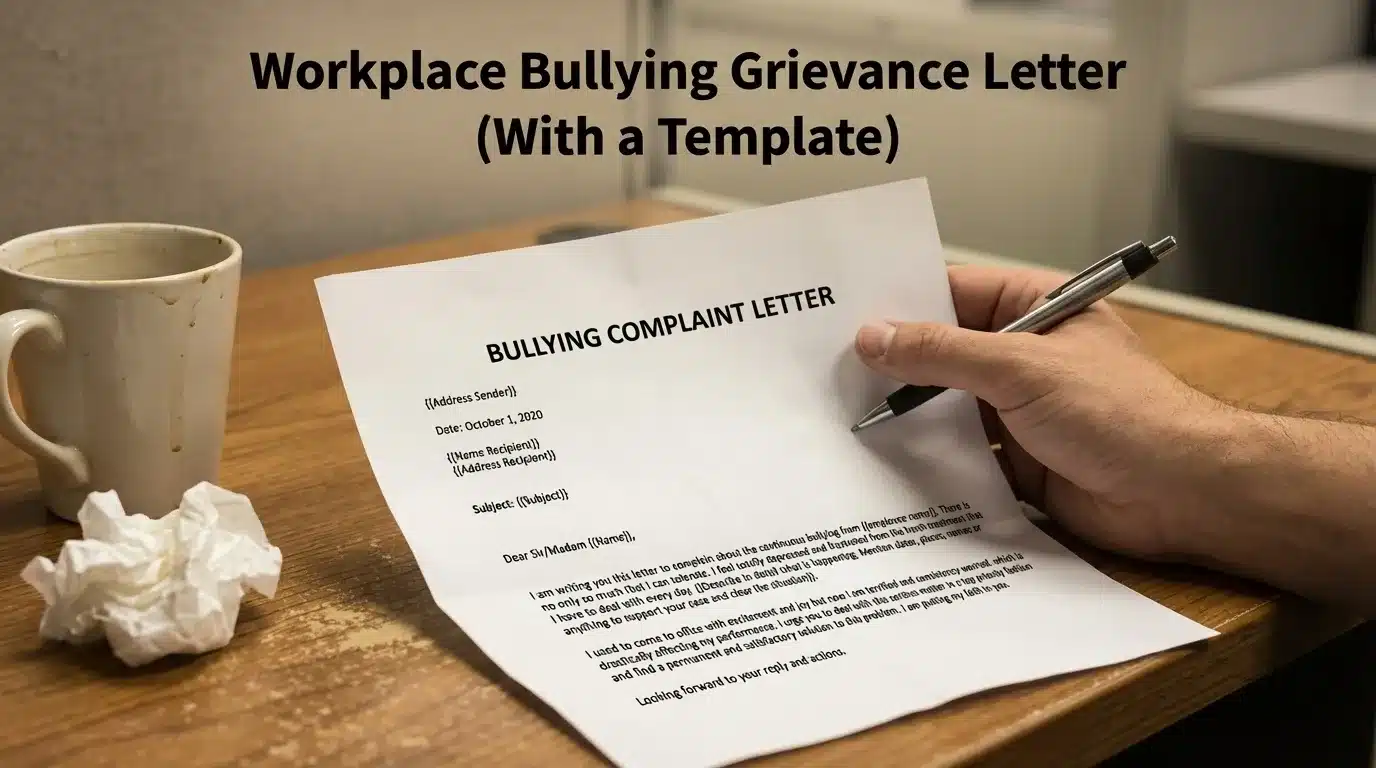
Workplace Bullying Grievance Letter (2026 Template)
Copy this, paste it into a document, and edit the brackets. If your workplace has a required form, you can still use this text inside it.
Notes to make this template actually work (and not backfire)
A few things that sound small, but matter. Keep it factual, even if they were cruel. Instead of: “She is a narcissist and everyone hates her,” say: “On 12 March, in the team meeting, [Name] said ‘You are useless’ in front of [names].” That kind of sentence is hard to ignore.
Use “pattern” language. Bullying is repetition. So use phrases like “repeatedly,” “on multiple occasions,” “a consistent pattern since [date],” and “this behavior escalated after [event].” Do not include every detail of your life. You can mention health impact, but you do not need to submit your soul to prove it was bad. If you do have medical documentation and you want to use it, keep it simple: “I have sought medical support due to stress caused by this situation.” Only attach medical notes if you truly want them in the file.
Ask for interim measures. People skip this. They should not. Because investigations can drag on. And you still have to work with the person. Interim measures are not “punishment.” They are basic risk management. Do not threaten legal action in the first letter. You can. But it often makes workplaces go stiff and defensive instantly. Usually, the first step is to trigger the formal procedure cleanly. If you need legal advice, get it separately.
If you are worried about retaliation (add this paragraph)
If retaliation is likely in your workplace, you can add something like this under “What I am requesting”: “I also request that [Company] reminds all relevant parties that retaliation is not permitted. I would like any changes to my duties, performance management actions, disciplinary processes, or negative treatment during this period to be reviewed to ensure they are not connected to this grievance.” It is direct. It signals you are paying attention.
Mini templates for awkward situations
Sometimes the main template feels too heavy for your scenario, so here are a few add ons.
If the bully is your manager: Add: “As the subject of this grievance is my direct manager, I request that this matter is handled by an independent manager/HR representative and that my reporting line is temporarily adjusted while the investigation is ongoing.”
If it includes group bullying or a clique: Add: “While [Name] is the primary subject of this grievance, I believe the behavior has been enabled and, at times, repeated by others including [names/roles if appropriate]. I am willing to provide further examples during the investigation.”
If there is one very serious incident plus a pattern: Add: “One incident in particular on [date] is especially serious due to [threatening language/public humiliation/discriminatory remark]. I am raising this as part of the wider pattern of behavior, but I believe it warrants urgent attention.”
What to do after you send it (so it does not vanish into HR limbo)
- Send it from a channel you can access later. Work email is fine, but save a copy. PDF it. Keep it at home too.
- Ask for acknowledgment. If they do not respond within a reasonable timeframe (often 2 to 5 business days), follow up.
- Keep logging incidents even after you file. Especially after you file.
- Do not attend high risk meetings alone. If you can, request a witness, or follow up in writing: “Just confirming what was discussed…”
- Stay consistent. Your story should match your evidence. If you made a mistake in dates, correct it quickly and calmly.
Common mistakes that weaken a bullying grievance letter
- 1) Writing a novel: Long letters get skimmed. Keep the main letter tight, then use appendices.
- 2) Using emotional labels instead of behaviors: “Gaslighting” might be true, but it can sound like internet language to an investigator. Describe what happened instead.
- 3) Not stating what you want: HR will default to the path of least resistance. If you want interim measures, say it.
- 4) Only including one incident: One incident can be serious, yes. But bullying is usually a pattern. If you have a pattern, show it.
- 5) Waiting too long to submit anything: People wait until they are at breaking point. Earlier documentation gives you more protection and more credibility.
Final quick reminder: You do not need the perfect words. You just need a letter that is clear enough that someone reading it can answer who is involved, what happened, when it happened, what evidence exists, how it affected your work, and what you want the company to do next. That is it. That is the whole game.
FAQs (Frequently Asked Questions)
What is workplace bullying and how can I identify it?
Workplace bullying is a pattern of repeated negative behavior such as humiliation, intimidation, exclusion from key meetings, sabotage of work, unfair criticism, spreading rumors, or retaliation after raising concerns. It is more than just a single disagreement or a one-time incident.
Where can I find my company’s policy on workplace bullying?
You can usually find your company’s bullying or grievance policies in the employee handbook, intranet, or HR portal. Look for terms like ‘grievance procedure,’ ‘dignity at work,’ ‘anti bullying,’ ‘respectful workplace,’ or ‘code of conduct.’ Referencing these policies in your grievance letter strengthens your case.
What should a good workplace bullying grievance letter include?
A strong grievance letter should create a formal record of the issue, present a clear timeline and pattern of bullying incidents with names and dates, explain the impact on your work and health without oversharing, request specific outcomes you want to see, and be calm, organized, and supported by evidence to ensure it can’t be easily dismissed.
How do I prepare before writing a workplace bullying grievance letter?
Before writing your letter, spend about 30 minutes gathering an incident log detailing dates, times, locations, what was said or done (with quotes if possible), witnesses, and any evidence like screenshots or emails. Also prepare an evidence pack with relevant documents such as emails and performance reviews. Finally, clarify your desired resolution to include in the letter.
What are some examples of desired resolutions I can request in my grievance letter?
You might ask for a formal investigation under the grievance policy, changes in reporting lines or supervision, no contact arrangements during investigation, mediation if safe and appropriate, training and behavior expectations for the individual involved, protection from retaliation, or correction of false records in your file.
Is there a template I can use to write my workplace bullying grievance letter?
Yes! You can use the provided 2026 Workplace Bullying Grievance Letter template which includes sections for subject line, recipients, summary of the issue with specific incidents listed by date/time/location/channel including quotes and witnesses. Customize it by filling in brackets with your details and adapt it as needed even if your workplace requires a specific form.

With a deep understanding of the student experience, I craft blog content that resonates with young learners. My articles offer practical advice and actionable strategies to help students achieve a healthy and successful academic life.