

Key Takeaways
- Even in an age dominated by video and artificial intelligence, written communication remains the primary tool for coordinating modern life across work, education, and personal relationships.
- Writing serves as a vital mirror for your own thinking because the process of building sentences and committing to logic forces you to slow down and exposes gaps or contradictions in your ideas.
- Because first impressions are almost always formed through text-based interactions like emails and resumes, strong writing skills are essential for building the trust needed to open doors to professional opportunities.
- While AI can quickly produce drafts, the actual value of a writer in 2026 shifts toward using human judgment to verify accuracy and tailor specific context to the expectations of a particular audience.
- You can improve your communication and thinking skills by adopting the chronological habits of writing one clear email daily, doing tiny essays on a single thought, summarizing what you learn from media, reading your work out loud to hear errors, and using AI only as a helper rather than a driver.
I keep hearing some version of this question lately, usually said like a shrug.
“Does writing still matter now that ChatGPT can do it?” “Is it worth learning to write when everyone is on video?” “Isn’t writing… kind of nothing now?”
And I get it. We live inside a scroll. A podcast is always playing. A video explains the thing. An AI assistant drafts the email. A template spits out a cover letter. A bit of copy appears like magic, and you hit send.
But here’s the weird part.
In 2026, the more tools we have, the more writing becomes the separator. Not because you need to be a novelist or a poet. Not because you’re trying to publish a book. It’s because written communication is still the main way modern life coordinates itself. Work, school, relationships, money, research, education, culture, discourse, even your own brain. It all runs on written words.
So if you’ve been wondering why is writing important, this is the honest answer.
Because writing is still how you think, how you prove you understand, how you build trust, and how you leave a lasting impact.
And no, AI didn’t replace that. It made it more obvious.
The quiet truth: writing is thinking, in public
One reason people struggle to explain the importance of writing is that they think writing is just output. Like the final “document” you hand in. The essay. The blog. The email. The paragraph under a post.
But writing is a powerful tool because it forces thought into a shape. You can feel smart in your head and still not be able to write clearly. That gap is the point. Writing requires you to pick a word, build a sentence, commit to syntax, and own the logic. You can’t hide behind vibes.
This is why writing encourages critical thinking. It’s not motivational poster stuff. It’s mechanics. When you try to explain something in written form, contradictions show up. Missing steps show up. You realize you don’t actually understand the thing as well as you thought.
Struggling to Put Thoughts into Words?
Our professional writing experts help you articulate complex ideas with absolute clarity and academic precision. We ensure your arguments are logically sound and tailored to your specific audience requirements. Partner with us today to transform your research into a compelling high-impact document.
Hire an ExpertWriting helps you think because it makes you slow down. It’s a way to make thought visible enough to inspect. And once it’s visible, you can improve it. That’s how you get new insights. If you’ve ever written a messy draft and then re-read it and thought, “Wait, that’s not what I mean,” you’ve experienced it. Writing gives you a mirror. And honestly, it’s one of the simplest ways to think better.
However, as we move further into this digital age where tools like ChatGPT are prevalent, it’s vital to remember that these tools should not replace our ability to write effectively but rather enhance it – maximizing the benefits of a research paper writing service or even assisting us in areas such as research papers or essay writing through services like write my essay, or utilizing a format paper writing service to ensure our documents are correctly structured for better clarity and understanding.
In 2026, your first impressions are still mostly text
Maybe the first interaction someone has with you is your voice. A quick call. A meeting. Sure. But most of the time, first impressions are still made through writing.
A cold email. A DM. A resume. A cover letter. A comment. A ticket you file. A feedback note you leave on a document. A proposal. A Slack message that gets forwarded. A Notion page. A Google Doc. A job application answer. A student submission. A client update.
It’s not dramatic, but it matters. People decide if you’re careful or sloppy, clear or confusing, thoughtful or rushed. They decide if you can communicate effectively. This is one of those important reasons why writing skills quietly affect your life. Strong writing skills don’t just help you sound “smart.” They make it easier for you to trust. That trust turns into opportunities. It turns into money. It opens the door.
And yes, this is also why copywriter work still exists even with AI everywhere. Tools can generate words. But a good writer understands audience, intent, context, and tone. They can choose what to say and what not to say. That is still the skill.
Writing is an essential skill because it’s how organizations run
If you’ve worked anywhere remotely serious, you know this already. Writing is an essential skill because companies run on written communication. Not perfectly, but constantly. A meeting summary that becomes a plan. A plan that becomes a timeline. A timeline that becomes a budget. A budget that becomes a decision. A decision that becomes a process. A process that becomes culture. That chain is mostly writing.
So when someone says writing is an essential skill, they mean this: if you can’t write, you struggle to operate in modern systems. You might still be brilliant. But you’ll be misunderstood more often. You’ll waste time clarifying. You’ll miss details. You’ll create avoidable problems. And if you can write well, you can solve a problem before it becomes expensive. You can document what happened. You can create alignment. You can reduce confusion. You can protect your future self. You can build better communication skills across a team. That’s not romantic. It’s practical.
Need to Scale Your Content?
Our essay writing service provides high-volume, quality-vetted academic and professional content for every stage of your career. We blend subject-matter expertise with meticulous editing to produce work that stands up to the most rigorous standards. Order now to secure professional-grade writing that achieves your objectives effortlessly.
Order NowAI changed writing. It didn’t remove the need for a writer
Let’s talk about ChatGPT without pretending. ChatGPT can produce a clean paragraph in seconds. It can draft an email. It can summarize research. It can create an outline for an essay. It can help with language learning and writing English. It can even imitate a certain style. That’s real.
But here’s what it can’t do for you. It can’t decide what you actually believe. It can’t pick the best reason from ten possible reasons. It can’t be held accountable for accuracy. It can’t truly understand your audience’s specific context. It can’t know what your manager hates, what your client fears, what your professor expects, what your community cares about, or what your culture reads as rude or warm.
It also can’t replace the ability to think, which is why writing still matters. Because even if AI gives you a draft, you still need to judge it. Edit it. Give feedback. Add evidence. Verify information. Make the tone human. Make the logic clean. In a strange way, AI raises the bar. Because now “just words” are cheap. So the value shifts to understanding, judgment, and clarity. That’s writer work.
The unsexy basics still rule: grammar, punctuation, and clarity
People love to act like grammar is outdated. Like punctuation is for nerds. Like syntax is a school thing that doesn’t matter in real life. But clarity is still the goal of communication. And grammar and punctuation are just tools for clarity. A misplaced comma can change meaning. A sloppy sentence can create ambiguity. A vague word can make a decision look weaker than it is. Bad structure makes readers work harder, and they often won’t.
Writing helps communication skills because you practice being precise. You practice choosing the right word. You practice forming an argument that can survive outside your head. Also, a quick note for anyone who thinks writing is only for “writers.” If you send messages, you write. If you explain ideas, you write. If you lead people, you write. If you learn, you write. If you manage projects, you write. If you sell, you write. Writing also shows respect for the reader’s time.
However, there are times when every writer faces challenges like writer’s block. It’s a common issue that doesn’t discriminate between seasoned professionals and novices alike, but knowing how to overcome it is crucial in maintaining productivity. Moreover, if you’re ever in need of assistance with crafting essays or any written content, remember that professional services like write my essay are available to help lighten the load.
Writing builds a deeper understanding than passive consuming
A lot of people in 2026 “learn” by consuming. Video, podcast, threads, summaries, shortcuts. Which is fine. But it can create a fake sense of knowledge. Writing helps develop understanding because it forces retrieval and structure. When you write what you learned, you find gaps. You connect ideas. You turn information into knowledge. This is why it’s essential to unleash the power of words with different types of writing, as each type serves a unique purpose in conveying knowledge and understanding.
That’s why writing instruction still matters in education. That’s why learning to write isn’t just about school grades. It’s about training the brain to organize thought, to think critically, to reason, and to communicate. If you want a simple test. Watch a 10-minute video on a topic. Then write a one-page explanation of it, in your own words, with examples. You’ll feel the difference instantly. It’s like your brain stops skating and starts gripping.
This is also why research lives and dies by writing. Research doesn’t “exist” until it’s written clearly enough for other people to evaluate. A study becomes part of discourse only when it becomes a readable document.
Writing is how culture moves through time.
Culture isn’t just trends. It’s memory. It’s ideas passed down. It’s the stuff people quote, remix, argue with, and build on. Written words are still the backbone of that. Books, essays, poetry, fiction, fan fiction, scripts, blog posts, letters, lyrics, even long comment threads that turn into something bigger. That’s how culture forms, and reforms, and fights with itself. That’s discourse.
And sure, video matters too. But writing is portable. It travels. It gets translated. It gets archived. It can be searched. It can be cited. It can be printed on paper and read when the power is out. It can outlive the platform. A written form has this strange durability. That’s why a book still hits different. That’s why a great paragraph can stay with you for years. That’s why an author’s work can shape how millions of people think, even after the author is gone. If you care about culture at all, writing matters.
Writing is personal development, not just professional
There’s the career angle, and it’s real. Better writing can lead to better roles, better pay, and more leverage. It can improve your communication, sharpen your ability to think, and help you become the person who can articulate your thoughts under pressure. But there’s also the internal side. The private side. Writing lets you explore what you feel without needing to perform it. You can write a messy page that no one will read. You can untangle a relationship. You can process a decision. You can notice patterns. You can track growth. This is personal and professional growth in the simplest form. And it’s cheap. A notebook. A blank document. Nothing fancy.
Writing engages your attention in a way scrolling does not. It stimulates reflection. It makes you sit with your own thought long enough to hear it. That’s a kind of freedom, honestly.
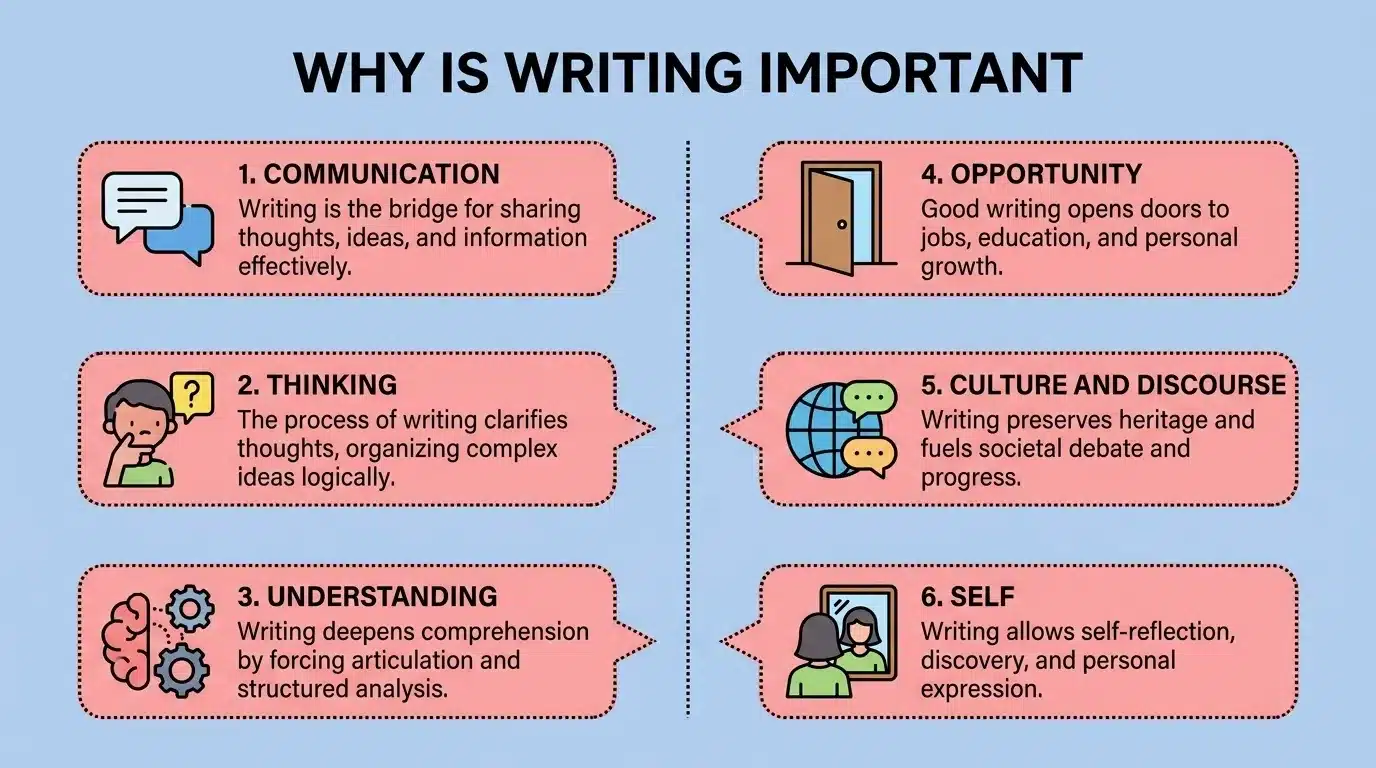
So what are the reasons why writing is important in 2026?
Let’s make it plain. Here are the reasons why writing is important, without pretending it’s only for creatives.
- Communication: Writing helps communication skills and makes it easier to communicate effectively across distance and time.
- Thinking: Writing helps you think, sharpen logic, and think critically. It supports problem-solving.
- Understanding: Writing creates deeper understanding by forcing structure, recall, and explanation.
- Opportunity: Strong writing skills create better first impressions and open the door to jobs, clients, and leadership.
- Culture and discourse: Writing keeps ideas alive, searchable, debatable, and transferable across generations.
- Self: Writing supports personal development, reflection, and lasting impact.
That’s the core. That’s the importance of writing. As we move further into 2026, it’s essential to recognize that improving our writing skills is not just beneficial but necessary. There are various strategies one can adopt to enhance their writing skills in English, which will ultimately serve as a key driver for both personal and professional growth.
Accelerate Your Writing Reps
Ready to master the art of written persuasion and leave a lasting academic impression? Our PhD-level editors provide direct feedback and coaching to help you find your unique voice and sharpen your logical flow. Start your journey toward writing mastery by securing professional support for your next assignment right now.
Get Help NowWays to improve without making it a whole personality
You don’t need to become a “writer” to benefit from writing skills. You just need reps and a little intention. Here are a few ways to improve that actually work:
- Write one clear email a day. Seriously. Slow down, read it twice, tighten the sentences.
- Do tiny essays. Pick a thought, write 300 to 500 words. One idea. One point.
- Summarize what you learned. After a podcast or article, write a short paragraph explaining it.
- Practice feedback. Giving feedback is an underrated writing instruction for adults. It teaches clarity and tact.
- Read your writing out loud. You’ll hear the awkward grammar and punctuation issues fast.
- Use AI as a helper, not a driver. Let it draft, then you rewrite. Keep ownership of thought.
If you want something more structured, writing English courses or advanced writing courses can help, but only if you actually write. Skill comes from doing. Writing requires writing. Which is annoying. But also kind of empowering. It’s in your control.
The real ending, I guess
Writing is so important because it’s still the cleanest interface between your brain and the world. It turns thought into something shareable. It turns knowledge into something useful. It turns vague feelings into language. It turns confusion into a plan. It turns research into a document people can challenge. It turns ideas into culture.
And in 2026, when a lot of communication is fast, noisy, and outsourced to tools, writing becomes the signal. The part that proves you can think, that you can write clearly, that you can understand and be understood. That’s why writing important reasons keeps stacking up, even now. Maybe especially now.
Why Is Writing Important FAQs
Does writing still matter in the age of AI tools like ChatGPT?
Absolutely. Writing remains a crucial skill because it is the primary way modern life coordinates itself, across work, education, relationships, and more. AI tools can assist by drafting or formatting content, but they don’t replace the need for clear, thoughtful written communication that builds trust and leaves a lasting impact.
Why is writing considered a form of thinking in public?
Writing forces you to shape your thoughts clearly by choosing words, building sentences, and committing to logic. This process reveals contradictions or gaps in understanding, helping you slow down and improve your ideas. Essentially, writing acts as a mirror for your thinking, making it visible and open to refinement.
In 2026, are first impressions still made through writing?
Yes. Most initial interactions happen via written text, emails, DMs, resumes, cover letters, comments, proposals, and more. Well-crafted writing signals clarity, care, and thoughtfulness, which builds trust and opens doors to opportunities. Strong writing skills remain essential for making positive first impressions.
How does writing impact organizational effectiveness?
Organizations rely heavily on written communication to operate smoothly, from meeting summaries to plans, budgets, decisions, and processes. Good writing reduces misunderstandings, saves time clarifying details, prevents costly mistakes, fosters alignment across teams, and supports better decision-making and culture building.
Has AI like ChatGPT replaced the need for skilled writers?
No. While AI can produce clean drafts quickly and assist with tasks such as summarizing or outlining essays, skilled writers bring essential abilities like understanding audience intent, context, tone, and deciding what to say or omit. These nuanced skills ensure communication is effective and meaningful beyond what AI alone can achieve.
How can one maximize the benefits of AI tools without losing essential writing skills?
Use AI as an enhancement rather than a replacement, leverage it for research assistance or formatting help while maintaining active engagement in crafting your own ideas clearly. Combining human critical thinking with AI-generated support ensures stronger writing outcomes that reflect your understanding and voice.

With a passion for helping students navigate their educational journey, I strive to create informative and relatable blog content. Whether it’s tackling exam stress, offering career guidance, or sharing effective study techniques