

Key Takeaways
- English is full of phrases and idioms that don’t mean what they literally say, making them a significant challenge for new learners and even native speakers.
- Many expressions are confusing because of homophones, similar spellings, or subtle differences in meaning that require careful attention to context.
- Idioms, proverbs, and slang terms often have historical origins or cultural references that are not immediately obvious, contributing to their enigmatic nature.
- Active engagement with the language through reading, listening, and consistent practice is essential for internalizing the correct usage of tricky words and phrases.
- Developing a habit of researching unfamiliar expressions and understanding their contextual application will significantly improve your fluency and reduce common communication mistakes.
The thing is, many of these “walls” are actually just unique ways English speakers have developed to communicate; they’re called Confusing Expressions for a reason. They don’t follow the straightforward rules you might expect. But here’s the thing: once you crack the code, once you understand the origin or the common usage, they stop being barriers and start becoming tools for richer, more authentic communication.
In this guide, we break down the most commonly confusing expressions, explain what they actually mean, and show you exactly how to use them correctly in a sentence.
Why English Expressions Are So Tricky
English is a linguistic melting pot, constantly absorbing words and phrases from other languages, evolving its own rules, and then cheerfully breaking them. This rich history is a primary reason why so many English words and phrases can confuse even the most diligent learner. Think about it: you’re trying to navigate a language where “set” has over 400 definitions in the Oxford English Dictionary. It’s no wonder many non-native English speakers feel overwhelmed.
The sheer volume of its vocabulary and the influence of various cultures, from England to America and beyond, have given rise to countless expressions that often defy literal interpretation. For someone learning English as a second or foreign language, this can be incredibly frustrating. It’s like trying to understand a complex insurance policy without reading the fine print; every word seems clear, but the overall meaning is lost.
One of the biggest reasons for this difficulty lies in the fact that much of everyday English isn’t just about individual words; it’s about how those words combine into phrases, idioms, and even slang that carries a meaning far beyond its components. A native speaker might pick up on the nuance instantly, but for someone whose first language has a different structure, it’s a huge hurdle. This particular difference between these similar words or phrases is often what trips people up.
Commonly Confused Words and Phrases
Let’s start with some of the most basic offenders: words that sound alike or look similar but have distinct meanings. These commonly confused word pairs are a perennial source of accidental misuse. You’ve probably stumbled over some of these yourself, accidentally using the wrong word in a sentence because you thought they were interchangeable. It’s a common mistake, and even native speakers make them.
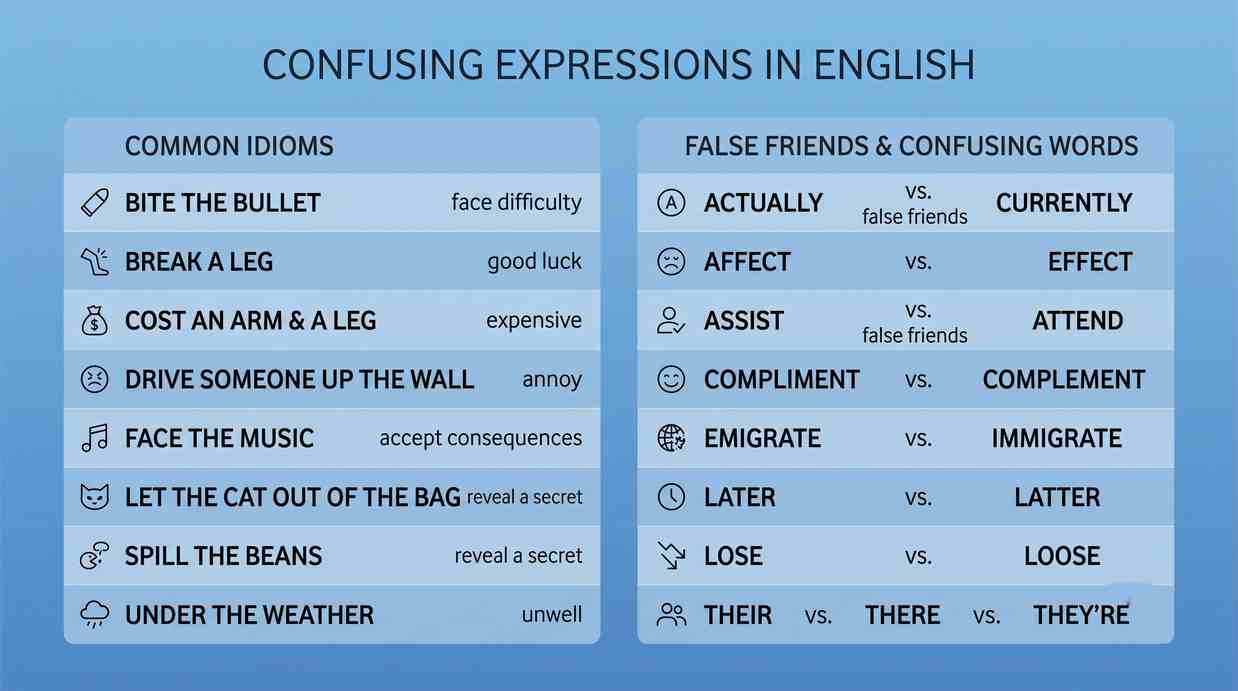
Here are some classic examples of commonly confused words in English:
- Affect vs. Effect: “Affect” is usually a verb (to influence), while “effect” is usually a noun (the result). Example: The rain will affect the game. The effect of the rain was a delay.
- Lie vs. Lay: “Lie” means to recline (you lie down), and it doesn’t take a direct object. “Lay” means to put something down (you lay the book down).
- Compliment vs. Complement: A “compliment” is an expression of praise. A “complement” is something that completes or enhances something else.
- Than vs. Then: “Than” is used for comparison. “Then” refers to time or sequence.
- Less vs. Fewer: “Less” is for uncountable nouns (less water). “Fewer” is for countable nouns (fewer students).
- Principle vs. Principal: A “principle” is a fundamental truth or belief. A “principal” is the head of a school or a main sum of money.
- Stationary vs. Stationery: “Stationary” means not moving. “Stationery” refers to writing materials.
- Their, There, They’re: “Their” is possessive. “There” refers to a place. “They’re” is a contraction of “they are.”
- Regardless vs. Irregardless: “Regardless” is the correct word. “Irregardless” is nonstandard and often considered a double negative, though it’s unfortunately used in everyday speech.
- A lot vs. Alot: “A lot” is two words, meaning many. “Alot” is not a word. It’s a common mistake in written English.
Need Help with Academic Writing?
Our expert writers can help you craft clear, concise, and impactful essays and papers, free from confusing expressions. Get the professional assistance you need to achieve academic excellence and communicate your ideas effectively.
Knowing the difference between these similar words is half the battle. Often, the reason people confuse them is simply a lack of exposure to their distinct usage in context. A good dictionary and careful reading can help you determine the right word for the situation. It’s a habit worth cultivating.
The World of Idioms and Figurative Language
Beyond simply confusing words, we plunge into the deeper, often nonsensical, territory of idioms. An idiom is a phrase or expression whose meaning cannot be deduced from the literal meaning of its individual words. For example, “kick the bucket” means to die, not to literally apply your foot to a pail. For non-native English speakers, these can be especially frustrating, almost like a secret code that native speakers inherently understand.
The origin of many idioms can be historical, cultural, or even observational, often relating to past professions, historical events, or even farming. Take “raining cats and dogs”; it’s not about actual animals falling from the sky (thank goodness!), but likely refers to ancient beliefs or the sound of heavy rain on thatched roofs. These linguistic quirks are often used in everyday conversation, making it crucial to learn when to use them.
Understanding these confusing phrases requires more than just looking up individual words in a dictionary; it demands an appreciation for the cultural context. What might be straightforward in one language becomes incredibly tricky in another. We even have regional variations, like British vs American English, which can further complicate things, with different idioms for similar situations.
Here’s a taste of common idioms that often confuse:
- Break a leg: Good luck.
- Bite the bullet: To endure a difficult situation.
- Cost an arm and a leg: Very expensive.
- Spill the beans: To reveal a secret.
- Hit the road: To leave.
- Piece of cake: Very easy.
- Get cold feet: To become nervous and hesitant.
- Pull someone’s leg: To playfully tease someone.
- The ball is in your court: It’s your turn to act.
- Under the weather: Feeling ill.
Learning these isn’t about memorization in alphabetical order, but about exposure and contextual understanding. You won’t learn them all at once, but rather by observing how native speakers use them in real life. It’s part of building a deeper vocabulary and truly immersing yourself in the English language.
When Slang and Mondegreens Confuse
Slang is another huge category of confusing expressions. It’s informal language, often specific to a particular group, region, or time period. It changes rapidly, which means what was cool last year might be totally uncool in 2026. Slang is usually used in spoken language and less in written English, though it’s creeping into texts and social media more and more. It can refer to anything from common emotions to specific objects, making conversation feel like a guessing game if you’re not in the know.
Then there are mondegreens, oh, mondegreens. These are mishearings of a phrase or song lyric, leading to a new, often nonsensical, meaning. The word itself comes from a mishearing of “Lady Mondegreen” from a Scottish ballad. Think of a child singing “Gladly, the cross-eyed bear” instead of “Gladly, the cross I’d bear.” These accidental variations are quite common and can lead to some truly hilarious mix-ups in everyday conversation. It highlights how sound can sometimes betray meaning, especially for those who are still tuning their ears to a new language.
Take the phrase “for all intents and purposes.” Many people accidentally say or write “for all intensive purposes.” The latter is a mondegreen, a complete misuse that sounds somewhat similar but carries no actual meaning. It’s an unnecessary alteration of a perfectly good phrase, but because people confuse it so often, it’s unfortunately used instead in some circles. If you hear someone say it, you now know it’s a variation of the correct phrase.
Another example is “could care less” vs. “couldn’t care less.” The actual idiom is “couldn’t care less,” meaning you don’t care at all. If you “could care less,” it implies you do care to some degree. This subtle but critical difference is often lost, leading to unintended meanings. These commonly confused phrases stem from a literal interpretation that clashes with the intended meaning. This is why paying attention to the exact wording, and not just the general sound, is crucial.
Avoid Common Writing Mistakes!
Ensure your essays are clear, compelling, and error-free with our professional proofreading and editing services. Get expert help to refine your work, eliminate ambiguities, and ensure your message is perfectly understood.
Navigating Grammatical Gremlins and Misuse
Sometimes the confusion isn’t about an idiom or slang, but rather a subtle grammatical point or the misuse of a word. English grammar, with its exceptions to every rule, can feel like a minefield. Consider those tricky irregular verbs; they don’t follow the regular past tense or participle patterns, and you simply have to learn their unique forms. This is a common phrase to describe verb forms that just don’t play by the rules.
Another area of confusion is the proper use of adverbs or adjectives, or even the correct plural forms. Take “data”, for instance. Technically, “data” is the plural of “datum,” but in everyday English, it’s often treated as a singular noun. This ongoing linguistic shift means what was once a grammatical mistake can become commonly used over time. It can be a very tricky area for students, especially in academic writing where precision matters. Learning when to use a word correctly is vital.
Then there’s the whole discussion around possessives and contractions. Is it “its” or “it’s”? “Its” shows possession (like “the dog wagged its tail”), while “it’s” is a contraction of “it is” or “it has” (“it’s raining”). Simple, right? But the number of times you see these mixed up, even in written English by native speakers, is astounding. These words that seem straightforward often hide particular differences.
Let’s not forget how context changes everything. A word like “run” can mean to move quickly, to operate a machine, to manage a business, or even to flow (as in water). The specific context surrounding the word is usually what makes the difference between clarity and confusion. Without understanding the broader sentence or situation, you can easily refer to the wrong meaning. This is where AI translation tools can sometimes struggle, too, because they lack the human intuition for contextual nuance.
Strategies for Mastering Confusing Expressions
So, how do you combat this linguistic labyrinth? It’s not about being a human dictionary; it’s about developing habits and strategies that empower you to understand and use these expressions correctly. Learning English effectively means embracing its quirks, not just its rules. You need to train your brain to recognize patterns and cues.
Here are some actionable steps you can take:
- Read Widely and Actively: Immerse yourself in English literature, news articles, and even casual online content. When you encounter a confusing phrase, stop. Don’t just skim past it. Look it up. Pay attention to how it’s used in context. This builds your vocabulary and your understanding of natural usage. It’s far more effective than rote memorization.
- Listen and Observe: Pay close attention to how native speakers use these expressions in conversation, movies, and podcasts. What situations trigger certain phrases? How do they affect the tone? This passive learning is incredibly powerful for internalizing common phrases. You’ll start to see patterns and determine their intended meanings more intuitively.
- Keep a “Confusion Journal”: When you come across a word or phrase that confuses you, write it down. Then, research its definition, origin (if interesting), and several example sentences. This active engagement helps solidify your learning. This is particularly useful for things like Common App essay mistakes – understanding why certain phrases are incorrect will prevent you from making them.
- Practice Speaking and Writing: Don’t be afraid to try using new expressions. You’ll make mistakes, and that’s okay! It’s part of the learning process. The more you use these words and phrases, the more natural they’ll become. Ask for feedback. This is how your usage becomes second nature.
- Utilize Online Resources: Websites like ours, grammar guides, and specialized dictionaries for idioms can be invaluable resources. There are countless comprehensive lists of commonly confused words and phrases available. Just be sure to cross-reference to ensure accuracy, as rumor and variation can sometimes lead to incorrect information spreading online.
- Seek Clarification: If you’re talking to a native speaker and they use a phrase you don’t understand, don’t hesitate to ask! Most people are happy to explain. A simple, “What does ‘jump on the bandwagon’ actually mean?” can lead to a quick lesson.
Remember, the goal isn’t perfection from day one. It’s about gradual improvement and developing a consistent habit of curiosity about the language. Every new expression you master adds another layer to your fluency. This isn’t just about academic writing; it’s about navigating the nuanced world of everyday communication. You’ll find yourself able to contribute more effectively to discussions and even understand jokes that once went over your head. When writing academic papers, like a thesis discussion, using precise language is paramount, and avoiding these pitfalls demonstrates a mastery of English. It’s about clarity and accuracy, which are crucial for incorporating evidence in an essay effectively.
So what now?
You’ve seen that tackling Confusing Expressions in English isn’t just about memorizing rules; it’s about becoming a linguistic detective, always curious and always digging a little deeper. It’s a journey, not a destination, and every single time you figure out a new idiom or correctly use a tricky word pair, you’re not just improving your English; you’re building confidence. Don’t let a single phrase derail your progress. Embrace the confusion as an opportunity to learn, to grow, and to truly master the rich, complex tapestry of the English language. Keep at it, and you’ll be navigating these linguistic waters like a pro in no time.
Confusing Expressions in English FAQs

I am dedicated to creating engaging blog posts that provide valuable insights and advice to help students excel in their studies. From study tips to time management strategies, my goal is to empower students to reach their full potential.