Have you ever been tasked with delivering a great persuasive speech on a social issue that truly matters? Presenting your viewpoint clearly and compellingly can be a real challenge, right?
Well, fear not! Writing a persuasive speech can be a good way to inform and persuade others about important social issues. I’ve observed firsthand situations where a well-crafted speech has the power to make a lasting impact and bring about positive change.
In this article, we can explore some amazing social issues persuasive speech topics that can help you impress your audience and make a difference.
Key Takeaways
Crafting a persuasive speech involves choosing an engaging topic that resonates with both the speaker's passion and the audience's interests.
Understanding the audience is crucial; tailoring the speech to their concerns and interests increases the persuasive power.
A well-structured speech should begin with a strong introduction, logically organized main points, and compelling language to emphasize arguments.
Addressing counterarguments thoughtfully shows that the speaker has considered multiple perspectives, enhancing their credibility.
Visual aids, storytelling, and a strong conclusion leave a lasting impression and motivate the audience to reflect on the message.
How to create and deliver a compelling, persuasive speech
Crafting and delivering a compelling, persuasive speech might seem daunting, but with the right approach, it’s much easier than you think. First things first, when you’re choosing a topic for your speech, pick something you’re passionate about. After all, if you’re not interested in the topic you’re talking about, how can you expect your audience to be engaged? Don’t worry if you need clarification on the topic you’ve chosen because I’ve got some informative tips for crafting your persuasive speech that will help you captivate your audience and leave a lasting impression.
Here’s how you can go about it:
Choose an Engaging Topic: Think about what matters to you and what issues you feel strongly about. Your passion for the subject will shine through your words and captivate your audience.
Understand Your Audience: Before diving into writing, consider who you’re talking to. What are their interests and concerns? Tailoring your speech to your audience’s perspective can enhance your persuasive power.
Structure Your Speech: Start with a strong introduction that grabs your audience’s attention. Then, organize your main points logically, providing evidence and examples to support each argument.
Use Compelling Language: How you express your ideas can make a huge difference. Use strong, clear, convincing language to emphasize your points and evoke emotions.
Address Counterarguments: Acknowledge the potential counterarguments to your viewpoint and effectively refute them. Showing you’ve considered different perspectives demonstrates your understanding of the issue’s complexity.
Employ Visual Aids and Stories: Visual aids and personal stories can add depth and credibility to your speech. They make your message more relatable and memorable for your audience.
Conclude with Impact: Your conclusion should summarize your main points and reiterate your stance. Leave your audience with a thought-provoking message that lingers in their minds even after the speech is over.
Pay Someone To Take My Online Exam
Struggling to keep up with your exams, quizzes and tests? Click here to discover how you can get someone else to take them for you!
When writing a persuasive speech, choosing the right topic can make all the difference in capturing your audience’s attention. A perfect persuasive speech topic is one that not only interests you but also sparks a discussion and ignites passion in your listeners. So, what makes a good persuasive speech topic? From my perspective, the key lies in selecting a subject that people have varying opinions about. Here are a few pointers to help you find that ideal topic:
Relevance and Timeliness: Look for issues that are currently making headlines or have a significant impact on your community. Topics that are timely and relevant often capture people’s attention more effectively.
Your Passion and Knowledge: Consider what you care about deeply and what you have a hunch that your audience might care about, too. When you’re passionate and knowledgeable about a topic, your enthusiasm will naturally shine through in your speech.
Controversial Yet Respectful: Seek topics that allow for healthy debate and discussion. Controversial topics can be engaging, but it’s essential to handle them with sensitivity and respect for differing viewpoints.
Audience’s Interests and Concerns: Keep in mind the interests and concerns of your audience. What issues do you think they would want to know more about or have strong opinions on? Choosing a topic that resonates with your audience will make your speech more engaging.
Personal Experience and Anecdotes: Reflect on your own experiences or stories you’ve come across that relate to the topic. Sharing personal anecdotes can add a human touch and make your speech more relatable.
Impact and Call for Action: Look for topics that have the potential to bring about positive change or inspire action. A persuasive speech that motivates people to take action on a pressing issue can be particularly powerful.
Top Persuasive Speech Topics for 2023 on Ethics
The Future of Genetic Engineering Ethics
Enhancing Transparency in Corporate Governance
Balancing Privacy and Security in the Digital Age
Ethical Implications of Artificial Intelligence Development
Ensuring Ethical Practices in Global Supply Chains
The Importance of Ethical Journalism in the Digital Era
Addressing Ethical Dilemmas in Healthcare Policy
Promoting Ethical Consumption and Sustainable Living
Ethical Considerations in Emerging Biomedical Technologies
Navigating the Ethics of Animal Testing in Research
The Ethics of Diversity and Inclusion in the Workplace
Ethical Implications of Climate Change Policies
Maintaining Ethical Standards in Political Campaigns
Exploring the Boundaries of Ethical Hacking and Cybersecurity
Ethical Challenges in the Development of Autonomous Vehicles
The Morality of Capital Punishment in Modern Society
Promoting Ethical Behavior in Social Media Platforms
Ensuring Ethical Conduct in Humanitarian Aid Programs
The Ethics of Data Collection and Privacy Protection
Resolving Ethical Issues in Access to Quality Education
The Importance of Audience Analysis in Speech Delivery
Crafting Compelling and Persuasive Speech Introductions
Mastering the Art of Engaging Storytelling in Speeches
Using Visual Aids to Enhance Speech Presentations
The Role of Rhetorical Devices in Captivating Audiences
Effective Techniques for Managing Speech Anxiety
The Impact of Voice Modulation and Tone in Public Speaking
Tailoring Speech Content for Different Audience Types
The Significance of Practice and Rehearsal in Speech Delivery
Addressing Difficult Questions and Challenges during Speeches
The Power of Authenticity and Sincerity in Speech Delivery
Overcoming Language Barriers in Multicultural Public Speaking
Promoting Inclusivity and Diversity in Speech Presentations
The Influence of Confidence and Poise in Public Speaking
Navigating Unexpected Situations and Mishaps during Speeches.
List of Social Issues Persuasive Speech Topics
Impact of Social Media on Mental Health
Ethics of Gene Editing and Manipulation
Benefits of Renewable Energy Adoption
Importance of Financial Literacy Education
Necessity of Mental Health Awareness Programs
Role of Technology in Modern Education
Importance of Cultural Diversity Appreciation
Impact of Climate Change on the Global Economy
Promotion of Sustainable Living Practices
Importance of Community Service Engagement
Role of Government in Promoting Healthcare
Significance of Arts Education in Schools
Ethics of Animal Testing in Scientific Research
Importance of Gender Equality in the Workplace
Necessity of Balanced Media Representation
Promotion of Healthy Lifestyle Choices
Impact of Fast Food Consumption on Health
Importance of Wildlife Conservation Efforts
Necessity of Addressing Homelessness Issues
Ethics of Artificial Intelligence Development.
School Application Essay Writing Help
Feeling overwhelmed by the task of writing a standout school application essay that highlights your leadership abilities? Our proven step-by-step guide and personalized essay writing assistance will help you craft a compelling narrative that leaves a lasting impression on admissions committees.
Exploring the Benefits of Volunteering in Community Service
Necessity of Implementing Stricter Gun Control Measures
Role of Education in Empowering Underprivileged Youth
Exploring the Impact of Social Media on Mental Well-being
Importance of Promoting Gender Equality in the Workplace
Necessity of Addressing Environmental Pollution and Conservation
Role of Technology in Enhancing Access to Healthcare
Exploring the Benefits of Adopting Sustainable Living Practices
Importance of Promoting Ethical Treatment of Animals
Necessity of Addressing Homelessness and Poverty in Society
Role of Education in Promoting Global Citizenship
Exploring the Impact of Climate Change on Future Generations
Importance of Promoting Inclusive Policies for Individuals with Disabilities
Necessity of Addressing the Stigma Surrounding Mental Health
Role of Arts Education in Fostering Creativity and Innovation
Exploring the Benefits of Implementing Mindfulness in Education
Importance of Addressing Racial Discrimination and Inequality
Necessity of Promoting Responsible Use of Technology
Role of Education in Promoting Critical Thinking Skills
Exploring the Benefits of Promoting Cultural Exchange Programs.
Get Help With Your Social Issues Persuasive Speech Paper
Need help with your social issues persuasive speech paper? Look no further! Essay Freelance Writers is the best in the industry, providing top-notch writing assistance tailored to your needs. Our expert writers are equipped to handle various topics, ensuring your speech paper is well-researched, compelling, and engaging. I’m really worried about meeting your deadline. Don’t fret! With our timely delivery and commitment to quality, you can be confident in receiving a speech paper that will impress your audience. You can place your order today by clicking the ORDER NOW button above to get the expert help you need for your persuasive speech paper on social issues.
FAQs
What are the social issue topics for a persuasive speech?
Some social issue topics for persuasive speeches include climate change, gender equality, mental health awareness, and animal rights, among others.
What would you say is a good persuasive topic to talk about?
A good persuasive topic to discuss can be one that you’re passionate about, sparking meaningful discussion, such as the importance of community service or the need for stricter gun control laws.
What are the controversial topics for persuasive speeches?
Controversial topics for persuasive speeches may include debates on abortion, capital punishment, gun control, and same-sex marriage, among others, which often elicit strong and opposing viewpoints.
What are the three persuasive issues questions?
Three persuasive issues questions might include inquiries such as “Why is climate change a pressing concern?”, “How can we promote inclusivity in our communities?” and “What are the ethical implications of genetic engineering?”
With a passion for helping students navigate their educational journey, I strive to create informative and relatable blog content. Whether it’s tackling exam stress, offering career guidance, or sharing effective study techniques
Freelance writing is detail-oriented work. You need to have a wide range of samples at your disposal—covering a diverse array of topics—just to optimize your freelance writing portfolio.
If you’re juggling multiple clients at once, you need to get your deliverables in before every deadline while simultaneously maintaining quality so you can maintain your professional reputation. All these tasks will see you working long hours just to get things done.
This kind of work—which is, more often than not, done remotely—can pose significant risks to your physical health. The main thing you’ll want to worry about is your eyes. Freelance writers, as well as other people who work outside offices, spend an average of 13 hours a day looking at screens. That includes not just your work devices, but other gadgets you use for leisure after you clock out (like smartphones and TVs). All that time spent looking at screens up close causes you to blink less and locks your eyes in one position for prolonged periods, straining them.
The result? Computer vision syndrome (CVS). This condition can cause pain and discomfort that can affect your productivity—and, ultimately, the quality of your writing. If you’re looking for ways to alleviate it, one common solution you may discover is the use of blue light glasses.
But what exactly are they? Here’s a quick guide to these specs for freelance writers:
Key Takeaways
Freelance writing requires diverse samples and the ability to deliver quality work under tight deadlines.
Excessive screen time, averaging 13 hours a day for freelance writers, can lead to computer vision syndrome (CVS), impacting productivity and eye health.
Blue light emitted from screens can disrupt sleep quality and may lead to permanent retinal damage.
Blue light glasses can effectively filter harmful wavelengths, reducing the risk of CVS while retaining productivity benefits.
To maximize the benefits of blue light glasses, maintain good lighting, hydrate eyes, and take regular breaks.
The dangers of blue light
Blue light is a group of light wavelengths primarily emitted by the sun—and artificially emitted by digital screens. That means you’re exposed to it both outdoors and indoors, including when you’re working on freelance writing projects.
As with most other things, blue light is beneficial in moderation. Because it mostly comes from the sun, it can help regulate your sleep cycles. That means blue light can make you more alert and focused, boost your mood, and even sharpen your memory and thinking skills. These are all pluses for productivity when you’re writing during the day.
However, considering how long you use devices when working for a client, you’re likely regularly overexposing yourself to blue light. At the most, that will disrupt your body’s circadian rhythm, worsen your sleep quality, and make it harder to keep regular working days. However, most of the risks that come with blue light affect your eyes.
One of the effects you may experience is CVS. However, reviews on artificial blue light add that the eye isn’t designed to naturally filter these wavelengths, so they can reach the retina—which helps your brain process what you see—all the way at the back of the eye. Given the vision-heavy tasks involved in freelance writing, you may thus permanently damage the retina due to blue light overexposure. That can impact your ability to continue this career in the long run. More importantly, it can lead to irreversible eyesight changes that negatively impact your quality of life.
Why blue light glasses can help
As their name suggests, these specs can block blue light. Backed by more than a decade of research, today’s blue light glasses now integrate special pigments into the lenses that allow them to block wavelengths ranging between 440 and 500 nanometers (nm) on the light spectrum. That effectively filters the majority of blue light, which is found between 400 and 500 nm.
Though you’re usually not exposed to much sun—and thus blue light—indoors, these glasses can be especially beneficial for the long work hours of the freelance writer, which are often spent looking at digital devices and can increase the risk of overexposure with every passing hour. If you’re a digital nomad, blue light glasses can help block the additional wavelengths emitted by the sun when you’re working outdoors. The best part is that, since these specs leave around 40 nm for blue light to come through, you can still reap its productivity-boosting benefits while avoiding adverse effects like CVS and retinal damage.
How to get blue light glasses
Blue light glasses can be bought in person or online, and the latter option may be more appealing because it can be more cost-effective and means you can get yourself a pair even while you’re working. If you’re shopping on the internet, make sure to check for product page listings that confirm a pair of glasses can block blue light within the aforementioned 440 to 450 nm. If you work outdoors often, opt for a pair with blue-violet light-blocking lenses that can additionally shield you from the sun’s UV rays. From here, make sure to carefully detail your measurements.
One thing you’ll want to get right is pupillary distance, which measures the distance between the centers of your pupils to anchor your lenses and provide greater visual comfort. The wrong measurement can cause eye strain and fatigue, which will negate the benefits of these glasses altogether. Opticians will take your pupillary distance and apply it to your lenses when you’re buying your glasses physically. If you’re wondering how to measure pupillary distance at home, try getting the Opthy app to do it for you with your smartphone camera, then use the results to purchase your pair of glasses.
You’ll also want to ensure your frames will uniquely and securely fit your face. That’s easily done via trial and error when shopping in-store, but how do you fit glasses remotely? Look to Ditto’s virtual try-on app. It’ll ask you to take a short video of you rotating your head in multiple directions, then draw on its library of 3D glasses models to help you find suitable frames based on the estimated size of your face. With it, you can ensure that the blue light glasses you buy can be worn comfortably, even during longer writing sessions.
Ways to boost the benefits of blue light glasses
Of course, blue light glasses work best when used as part of a holistic strategy to protect against CVS. To make the most out of wearing them while freelance writing, make sure you also do the following:
Work in a well-lit environment. If your screen is brighter or darker than your surroundings, your eyes will strain twice as hard just to see what you’re writing.
Keep your eyes hydrated. Try to be self-aware of the fact that you blink less when looking at screens. Rapidly blinking for 30 seconds every so often is considered a great eye exercise that helps your eyes naturally moisturize themselves with tears. If you still experience eye dryness, apply oil-based eye drops designed to supplement that moisture and lock it in for longer.
Take more breaks. Try standing up, stretching, or simply looking away from your screen at least every 20 minutes or between the pieces you’re writing. This will help give your eye muscles a break so they don’t get strained.
With a passion for helping students navigate their educational journey, I strive to create informative and relatable blog content. Whether it’s tackling exam stress, offering career guidance, or sharing effective study techniques
Today, it’s super important to have original work, whether you’re a student doing homework, a professional writing reports, or just creating something personal. But it can be tough to make sure your work is truly your own with so much information out there online.
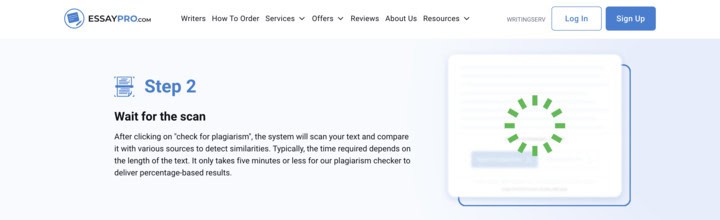
This is a common challenge across all types of writing—ensuring your content is unique in a world overflowing with information. That’s where EssayPro Plagiarism Checker comes in handy. This tool is easy to use and helps you check your work quickly. It scans your writing and identifies any parts that might be too similar to published content, helping you avoid unintentional plagiarism. For detailed guidance on maintaining academic integrity, read our in-depth article on how to avoid plagiarism in your academic writing.
By using EssayPro.com’s tool, you can maintain the integrity of your work, ensuring it’s always original. It provides peace of mind and supports you in upholding high standards in your writing projects – freeing you from the worry of copying errors and boosting your credibility!
If you’re looking for alternatives, check out our comprehensive guide to the top 10 free plagiarism checkers available online.
Key Takeaways
EssayPro's Plagiarism Checker helps ensure original work by scanning writing and identifying similarities to published content.
The tool is user-friendly, allowing quick checks by simply pasting text, and delivers detailed reports highlighting potential plagiarism.
Privacy is prioritized; EssayPro does not store or share user content, providing a secure experience.
Compatible across devices, it allows users to check work on-the-go, catering to various lifestyles and time constraints.
The tool enhances writing quality by supporting proper citation practices and reducing anxiety over plagiarism issues.
EssayPro: Fast and Dependable Plagiarism Scans
EssayPro’s Plagiarism Checker is fantastic for pinpointing exactly what parts of your writing are unique and which parts might be too similar to existing content out there. This feature is incredibly useful for both students and professionals who need to ensure their work is original, as schools and workplaces often have strict rules against copying.
Anyone creating content that needs to be original will find this tool essential. Whether you’re working on academic essays, research papers, or professional reports, EssayPro’s checker quickly identifies any sections of your text that might inadvertently mirror online material. This lets you make necessary changes before finalizing your work, helping you avoid potential issues with plagiarism.
Using the EssayPro plagiarism tool is a breeze. You simply paste your text into the system, and within minutes, it analyzes your work and provides a detailed report. This report highlights any text that matches with content on the web, allowing you to revise those parts as needed. The tool’s design is intuitive, which makes it accessible for users who are not tech-savvy, saving time and enhancing productivity. For a complete overview of all services and features, you might want to read our detailed EssayPro.com review.
Privacy is a paramount concern when using plagiarism detection software. EssayPro respects this by implementing strict measures to ensure that your content remains confidential. The system does not store or share your text with third parties, so you can use the tool with the confidence that your information is secure and private!
Overall, EssayPro’s Plagiarism Checker stands out as a top choice for verifying the originality of your work. Its fast, user-friendly, and reliable features make it an indispensable tool for students and professionals alike. Whether you’re polishing a critical assignment or ensuring that a business document is free of plagiarism, EssayPro reviews your work and confirms it’s authentically yours.
Streamlined Plagiarism Checking with EssayPro
EssayPro’s plagiarism detection tool stands out for its user-friendly design, making it incredibly accessible for users from all backgrounds. Whether you’re a seasoned academic or a professional embarking on a writing project, the intuitive layout of the website ensures that anyone can start using the tool without prior technical knowledge.
This ease of use is a core feature designed specifically to help users like you to check my paper for plagiarism free efficiently.
Navigating the EssayPro site is straightforward. From the moment you land on their page, it’s clear how to initiate a plagiarism check. The process is designed to be simple: just upload or paste your text, and with a few clicks, you’re set to go! This simplicity is vital, allowing users to focus more on the content of their reports rather than getting bogged down by a complex process.
The beauty of EssayPro’s Plagiarism Checker lies in its no-frills approach to delivering results. It avoids cluttering the user experience with unnecessary features, opting instead to provide clear, concise reports. Each section of the report highlights potential issues in an easy-to-understand manner, making it quick for you to identify and rectify sections of your text that may raise plagiarism concerns.
In sum, EssayPro’s Plagiarism Checker simplifies the plagiarism detection process, allowing you to check your paper quickly and effectively. With its user-friendly website and straightforward reporting, the tool ensures that verifying the originality of your work is hassle-free!
Streamlining Writing: Time-Saving and Accessible Tools for All
EssayPro’s Plagiarism Checker really saves your time, allowing you to focus more on enhancing your writing rather than getting bogged down by manual plagiarism checks. With a quick Essay Pro login, you can access this user-friendly tool promptly, ensuring your work is thoroughly original and adheres to academic integrity.
The standout feature of EssayPro’s Plagiarism Checker is its universal compatibility. Whether you are working on a laptop, tablet, or smartphone, this tool ensures a seamless operation across all devices.
This adaptability is crucial for today’s dynamic lifestyles, enabling you to conduct necessary checks on-the-go. Whether you’re transitioning between classes, finding a spot in a café to study, or managing assignments while traveling, this tool fits perfectly into your busy schedule. You can also access these features through the EssayPro mobile app for checking on the go.
The global accessibility of the EssayPro Plagiarism Checker is another significant advantage. It caters to users from various countries and academic systems, making it a versatile tool for students, professionals, and content creators around the world.
No matter your location, you can rely on this tool to maintain high standards of originality in your work. The time-saving nature of the tool is particularly valuable for those working under tight deadlines, as it delivers quick and accurate results that allow for swift corrections and enhancements without delays.
This not only helps in producing cleaner, more ethical work but also in fostering better writing habits overall. This tool isn’t just about maintaining the status quo – it’s about elevating your writing quality and integrity to new heights!
Discover the Advantages of Using EssayPro’s Plagiarism Checker
EssayPro’s Plagiarism Checker offers a host of benefits that make it an indispensable tool for anyone serious about producing original, high-quality content. It’s celebrated for its user-friendly interface, ensuring that anyone can navigate it with ease, and its precise analysis provides quick and accurate plagiarism detection. This tool shines in its ability to function seamlessly across various devices, making it accessible wherever you are, whenever you need it.
By using EssayPro Plagiarism Checker, you can save valuable time and eliminate the anxiety associated with manual plagiarism checks. The tool not only identifies areas that need revision but also reinforces proper citation practices, enhancing the integrity of your work.
Step into a stress-free writing experience that lets you focus on what truly matters—creating great content!
With a passion for helping students navigate their educational journey, I strive to create informative and relatable blog content. Whether it’s tackling exam stress, offering career guidance, or sharing effective study techniques
In today’s competitive job market, writing an internship cover letter is essential for securing an internship to launch your career. This article will guide you through how to write a cover letter for an internship that complements your résumé and highlights your unique skills and experiences relevant to the job description.
Many applicants overlook the importance of this crucial document. Still, a well-written internship cover letter can set you apart from the competition and grab the attention of hiring managers during the recruitment process.
Whether you’re seeking paid opportunities that offer valuable money or unpaid experiences for skill-building, knowing how to write a CV letter for an internship is a vital step.
By following the key points outlined in this article, you’ll be equipped to create a powerful cover letter that showcases your enthusiasm and qualifications, making a lasting impression on potential employers.
Before writing your internship cover letter, ensure you have a strong resume ready – learn how to craft the perfect internship resume in our detailed resume writing guide.
Key Takeaways
An internship cover letter is essential for launching a career and should complement your résumé by highlighting unique skills and experiences.
A strong internship cover letter contains five key components: a professional header, compelling opening, relevant experiences, specific company connections, and a strong call to action.
Research on the target company is crucial for writing a standout cover letter; it helps align personal values with company culture and demonstrates genuine interest.
Common pitfalls to avoid include using generic content, poor formatting, language issues, and submission mistakes that can weaken your application.
Tailor your cover letter for different industries by emphasizing skills and experiences that are most relevant to the specific internship role.
Looking for professional help with your internship application? Our expert writers specialize in crafting compelling cover letters that showcase your unique potential. Place your order today!
The Essential Elements of an Internship Cover Letter
Before diving into writing, it’s crucial to know that a strong internship cover letter contains five key components: a professional header, a compelling opening, relevant experiences, specific company connections, and a strong call to action. Let’s break down each element to understand how they work together to create a well-written cover letter that will capture the attention of hiring managers.
For more comprehensive guidance on cover letter writing beyond internships, check out our complete cover letter writing guide that covers all job application scenarios.
Professional Header and Formatting
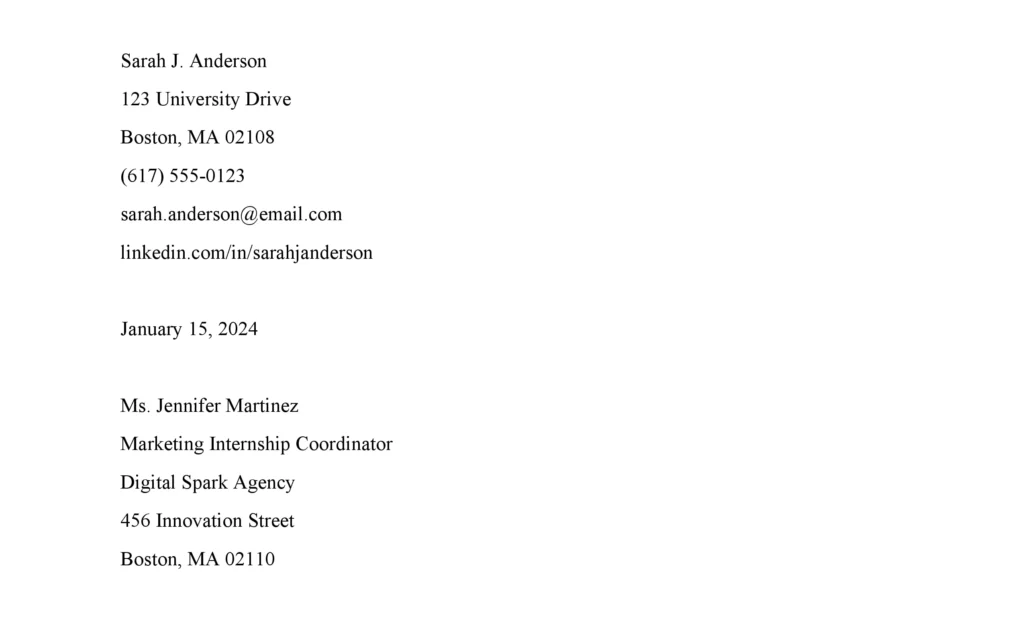
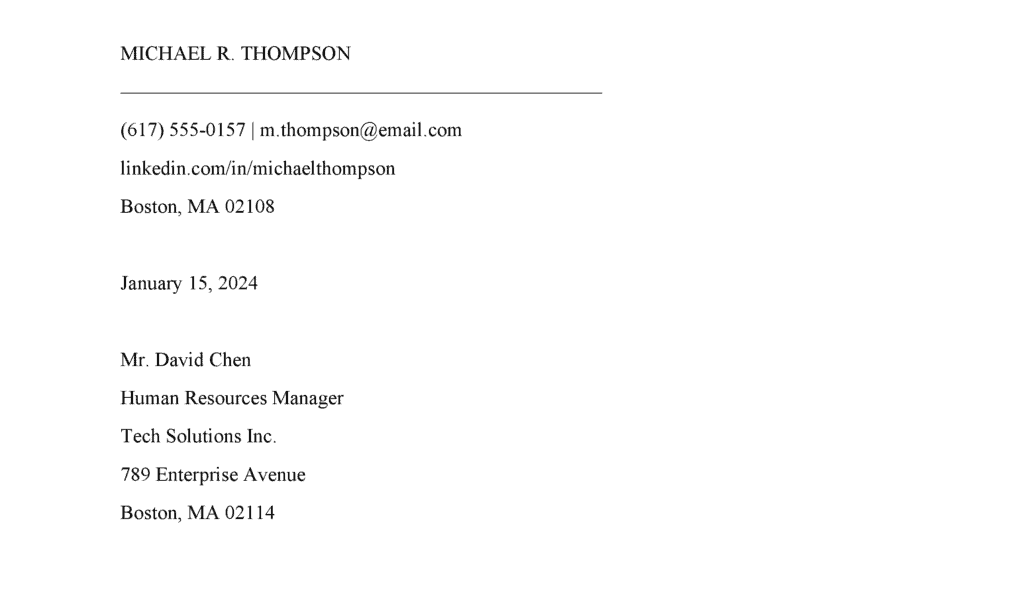
Your header should include your full name, email address, telephone number, and LinkedIn profile link. The proper business letter format requires the following:
Your complete contact information at the top
The date
The employer’s contact information
A professional salutation
Proper spacing between paragraphs
Consistent font and formatting throughout
Professional Header Example:
Professional Header Example
Alternative Format:
Alternative Format
The Perfect Opening
Regarding the opening paragraph, you need to hook your reader immediately. Here’s how:
Reference how you learned about the internship opportunity
Show genuine enthusiasm for the internship
Demonstrate your knowledge of the company
Briefly mention why you’re the best fit
Keep it concise but impactful
Compelling Opening Examples:
Example 1 (For Marketing Internship):
Dear Ms. Martinez,
When I saw Digital Spark Agency’s summer marketing internship posting on LinkedIn, I immediately knew it was my dream opportunity. As a junior marketing student at Boston University who has led three successful social media campaigns for student organizations, I am excited about the possibility of bringing my creative energy and analytical skills to your dynamic digital marketing team.
Example 2 (For Finance Internship):
Dear Mr. Roberts,
Through my conversation with Jane Smith at the Boston University Career Fair, I learned about Goldman Sachs’ Summer Analyst Program, and I am thrilled to submit my application. My strong academic background in finance, combined with my experience managing $50,000 in my university’s student investment fund, has prepared me to contribute effectively to your investment banking division.
Example 3 (For Tech Internship):
Dear Dr. Chen,
Your presentation at last month’s Tech Innovation Summit about Tech Solutions’ breakthrough in AI-driven healthcare solutions deeply resonated with my career aspirations. As a computer science junior who has developed two healthcare-focused mobile applications, I am excited to apply for your Summer Software Engineering internship position.
Transform your academic journey with our comprehensive writing services – from research papers to complex dissertations, we deliver excellence every time!
Researching Your Target Company: The Foundation of Success
The secret to writing a standout cover letter begins long before you type your first word – it starts with thorough research on the company you’re applying to. Let me show you how to conduct effective research that will inform your application for employment.
Company Research Strategies
Study the company website:
Mission and values
Recent news and achievements
Company culture
Key projects and initiatives
Management structure
Analyze social media presence:
Company updates
Employee testimonials
Corporate responsibility initiatives
Industry involvement
Review the internship description:
Required Qualifications
Key Responsibilities
Company expectations
Growth opportunities
Department structure
Using Research in Your Letter
Transform your research into compelling content by:
Aligning your values with company culture
Referencing specific company projects
Demonstrating industry knowledge
Showing long-term interest in the field
Making connections between your goals and company objectives
Structuring Your Letter for Maximum Impact
A well-organized cover letter follows a clear format that guides recruiters through your story while maintaining their interest. Let’s examine each component in detail.
Opening Paragraph (The Hook)
Your first paragraph should:
State the specific internship position
Reference how you learned about the opportunity
Express genuine enthusiasm for the internship
Include a brief preview of why you’re qualified
Show motivation for applying
Key Elements to Include in Your Hook:
Specific position name
How you learn about the opportunity
A relevant achievement or skill
Connection to the company
Genuine enthusiasm
Opening Paragraph (The Hook) Examples
Example 1 (Referral Hook):
Dear Ms. Williams,

Your colleague, Professor James Anderson, suggested I contact you regarding the Content Marketing internship at Digital First Media. As the editor-in-chief of my university's digital newspaper, which has seen a 200% increase in readership under my leadership, I am excited about the opportunity to bring my content strategy experience to your innovative team.
Example 2 (Research Hook):
Dear Mr. Johnson,

Your recent partnership with UNICEF to develop sustainable water solutions in developing countries caught my attention on Engineering Weekly. As an environmental engineering student who has completed three water purification projects, I am enthusiastic about contributing to Tesla's Summer Engineering internship program's focus on sustainable innovation.
Example 3 (Achievement Hook):
Dear Ms. Rodriguez,

After leading my university's marketing team to first place in the National Student Marketing Competition, I was thrilled to discover Procter & Gamble's Brand Management internship opportunity. My experience in developing award-winning marketing strategies, combined with my passion for consumer behavior, makes me particularly excited about contributing to P&G's innovative brand initiatives.
Example 4 (Company Connection Hook):
Dear Mr. Thompson,

As a long-time user and advocate of Spotify's platform who has built a machine learning algorithm to predict song popularity for my university's radio station, I was excited to find your Data Science internship position. My combination of technical skills and genuine passion for music analytics makes me particularly enthusiastic about contributing to your music recommendation system team.
Body Paragraphs (The Evidence)
In the body of your letter, focus on your relevant experience and skills. Even if you’re applying for an internship with no prior professional experience, you can highlight:
Relevant coursework
Extracurricular activity
Leadership roles
Soft skills
Communication abilities
Academic achievements
Key Elements for Body Paragraphs:
Start with the strongest relevant experience
Use specific examples and metrics
Connect experiences to job requirements
Demonstrate both technical and soft skills
Show progression and growth
Use active voice and strong verbs
Include relevant coursework and projects
Highlight leadership and initiative
First Body Paragraph:
Your most relevant experience and skills
Direct connections to job requirements
Specific achievements and metrics
Relevant coursework and projects
Leadership examples
Second Body Paragraph:
Soft skills demonstration
Communication abilities
Organization capabilities
Extracurricular activity relevance
Cultural fit evidence
Body Paragraphs Examples
Example 1 (Marketing Internship)
During my role as Marketing Director for the Business Student Association, I spearheaded three major digital marketing campaigns that directly align with Digital Spark's data-driven approach. Our most successful campaign increased event attendance by 150% through targeted social media strategies and email marketing. I analyzed engagement metrics across platforms, created A/B tested content, and managed a team of five content creators. This experience, combined with my advanced coursework in Digital Marketing Analytics and Consumer Behavior, has equipped me with the technical and analytical skills crucial for this internship.
My passion for innovative marketing extends beyond the classroom. As a social media volunteer for local non-profit Youth Forward, I developed and implemented a content calendar that grew their Instagram following from 500 to 3,000 in just four months. I also designed and analyzed surveys to better understand audience preferences, resulting in a 200% increase in post engagement. These experiences have honed my ability to create engaging content while measuring and optimizing performance – skills that would be valuable for Digital Spark's influencer marketing initiatives.
Example 2 (Software Engineering Internship)
Through my academic projects and personal initiatives, I've developed technical skills that align perfectly with Microsoft's internship requirements. In my Advanced Software Development course, I led a team of four to create a full-stack web application using React and Node.js, which is now used by our university's student organizations to manage events. This project required me to implement agile methodologies, write clean, documented code, and collaborate using Git – all skills mentioned in your internship description.
My technical foundation is further strengthened by my work as a Teaching Assistant for Introduction to Python Programming, where I help 50+ students debug their code and understand complex programming concepts. Additionally, I've contributed to three open-source projects on GitHub, focusing on accessibility features that have been merged into production. These experiences demonstrate not only my coding abilities but also my commitment to writing maintainable, user-focused code – a priority I know Microsoft values.
Example 3 (Financial Analysis Internship)
My academic excellence in finance-related coursework has provided me with a strong foundation in financial modeling and analysis. Maintaining a 3.9 GPA in advanced courses such as Financial Derivatives and Investment Analysis, I've completed complex projects including a comprehensive valuation of Tesla using DCF analysis and comparable company analysis. For this project, I built detailed financial models in Excel and presented investment recommendations to a panel of industry professionals, receiving the highest grade in my class.
As the Portfolio Manager of our university's Student Investment Fund, I manage $100,000 in assets and lead a team of ten analysts. Using Bloomberg Terminal and financial modeling tools, I've conducted thorough market research and generated investment ideas that resulted in a 12% return over the past year, outperforming our benchmark by 3%. This hands-on experience with real-world financial analysis and decision-making has prepared me well for the challenges of an internship at Goldman Sachs.
Closing Paragraph (The Call to Action)
End strongly with:
Restated interest in the position
Thank you for your consideration
Clear next steps
Interview availability
Professional sign-off
Key Elements for Closing Paragraph:
Restate interest in the position
Reference any attachments
Provide contact information
Express gratitude
Include a clear call to action
Maintain professional tone
Keep it concise
End with a forward-looking statement
Closing Paragraph (The Call to Action) Examples
Example 1 (Professional Services)
I am excited about the possibility of joining Deloitte's summer internship program and contributing to your consulting team. My analytical skills, leadership experience, and passion for problem-solving make me a strong candidate for this role. I would welcome the opportunity to discuss how my capabilities align with your needs in an interview. Thank you for considering my application. I look forward to speaking with you soon.
Example 2 (Creative Industry)
I would be thrilled to bring my creative energy and technical skills to Adobe's design team this summer. My portfolio (www.myportfolio.com) showcases additional examples of my work, and I would welcome the opportunity to discuss how my innovative approach to design could contribute to Adobe's cutting-edge projects. Thank you for your time and consideration. I look forward to the possibility of joining your team.
Example 3 (Technology)
The opportunity to contribute to Google's innovative projects while learning from industry leaders would be invaluable to my professional development. I am available for an interview at your convenience and can be reached at (555) 123-4567 or [email protected]. Thank you for considering my application. I look forward to discussing how I can contribute to Google's mission of organizing the world's information.
Example 4 (Research/Academic)
I am particularly drawn to the NIH's commitment to groundbreaking research and would be honored to contribute to your team's important work. I have attached my resume and research abstract as requested. I am available for an interview at your convenience and can provide additional references or materials if needed. Thank you for considering my application for this research internship opportunity.
Do you need help perfecting your academic assignments? Our expert team comprehensively supports essays, term papers, and research projects!
Showcasing Relevant Skills and Experiences
Even without extensive work experience, you likely possess valuable skills and achievements that make you an ideal candidate. Here’s how to present them effectively.
Business Analytics (Mastered Python, SQL, and Tableau)
Led team of 4 in semester-long equity research project:
Conducted industry analysis of renewable energy sector
Built complex financial models using Bloomberg Terminal
Presented findings to panel of investment professionals
Received Excellence in Financial Analysis award
Example 2 (Technology/Computer Science Focus)
Relevant coursework and projects demonstrate my technical capabilities:
– Advanced Programming Projects: – Developed full-stack web application using MERN stack – Created machine learning algorithm for predictive analytics – Built mobile app with 1000+ downloads on Google Play – Implemented secure payment gateway system
– Technical Certifications & Achievements: – AWS Certified Cloud Practitioner – Google Analytics Certification – 1st Place, University Hackathon 2023 – Perfect score in Data Structures course
Example 3 (Marketing/Communications Focus)
Academic projects showcasing marketing expertise:
– Digital Marketing Campaign Development: – Created comprehensive social media strategy for local business – Increased online engagement by 200% through targeted content – Managed $500 Google Ads budget achieving 3.5% CTR – Conducted market research with 500+ respondents
– Leadership & Management: – Led team of 10 executive board members – Increased membership by 75% in one semester – Managed annual budget of $15,000 – Organized 15+ professional development events
– Project Management: – Coordinated annual career fair with 50+ companies – Launched mentorship program matching 100+ pairs – Created new member onboarding system – Developed partnership with 5 Fortune 500 companies
Skills Translation
Transform everyday experiences into professional assets:
Part-time job responsibilities
Club membership duties
Sports team participation
Creative projects
Personal initiatives
Avoiding Common Pitfalls and Mistakes
While crafting your cover letter, consider several red flags that could weaken your application. Let me guide you through the most common mistakes and how to avoid them.
Format and Structure Mistakes
Length issues:
Too long (over one page)
Too short (under half a page)
Inconsistent paragraphs
Poor spacing
Irregular margins
Formatting inconsistencies:
Multiple fonts
Varying text sizes
Inconsistent alignment
Improper line spacing
Header misalignment
Content Pitfalls
Generic content:
Using a general cover letter
Failing to address specific requirements
Copying online templates
Lacking personal touch
Missing company research
Language issues:
Excessive jargon
Informal tone
Grammatical errors
Spelling mistakes
Poor proofreading
Professional Presentation
Contact information errors:
Outdated email address
Wrong telephone number
Missing LinkedIn profile
Incorrect company details
Wrong hiring manager’s name
Submission mistakes:
Wrong file format
Poor file naming
Missing attachments
Incorrect email subject
Late submission
From research papers to comprehensive thesis projects, our academic writing services ensure your success – order now!
Customizing Your Letter for Different Industries
Different industries require different approaches. Let me show you how to tailor your letter for various fields.
Technology Industry
Technical internships:
Programming skills
Project examples
Technical coursework
GitHub portfolio
Coding competitions
IT support roles:
Troubleshooting experience
Customer service skills
Technical certifications
System knowledge
Problem-solving examples
Marketing and Communications
Marketing internships:
Creative projects
Social media experience
Content creation
Analytics knowledge
Campaign examples
PR positions:
Writing samples
Media Relations
Event planning
Crisis management
Social media management
Finance and Banking
Financial roles:
Analytical skills
Mathematical ability
Risk assessment
Market knowledge
Excel proficiency
Banking positions:
Customer service
Attention to detail
Regulatory awareness
Financial software experience
Professional demeanor
Polishing Your Final Draft
Before submission, your letter needs thorough review and refinement. Let’s look at the complete polishing process.
Review Process
Content check:
Relevance to position
Skills Alignment
Achievement highlight
Company connection
Value proposition
Technical review:
Grammar check
Spell check
Formatting consistency
Link verification
Contact info accuracy
Feedback and Revision
Peer review:
Professional mentor input
Career center feedback
Industry expert review
Alumni network advice
Professor recommendations
Final touches:
File naming convention
PDF Conversion
Email formatting
Attachment check
Follow-up plan
Industry-Specific Internship Cover Letter Examples and Internship Cover Letter Templates
Technology Industry Example
Software Engineering Internship at Google
Jane Chen 123 Tech Avenue San Francisco, CA 94105 [email protected] linkedin.com/in/janechen github.com/janechen
January 15, 2024
Mr. David Kumar Technical Recruiting Manager Google 1600 Amphitheatre Parkway Mountain View, CA 94043
Dear Mr. Kumar,
As a computer science junior at Stanford University who recently built a machine learning model that won first place at our university’s AI competition, I am excited to apply for Google’s Summer Software Engineering internship. Your recent announcement about Google’s advancement in quantum computing aligns perfectly with my research interests and technical expertise.
My technical background directly matches your internship requirements:
– Languages & Frameworks: – Proficient in Python, Java, and C++ with 3+ years of experience – Created full-stack applications using React, Node.js, and MongoDB – Developed Android apps with 10,000+ combined downloads – Implemented machine learning models using TensorFlow and PyTorch
During my role as Technical Lead for Stanford’s Developer Student Club, I managed a team of five developers to create an AI-powered campus navigation app. We used Google Cloud Platform’s Vision API and Maps SDK, achieving 95% accuracy in destination recognition. The app now serves 5,000+ monthly active users and was featured in Stanford’s Technology Review.
I’m particularly drawn to Google’s commitment to solving complex problems at scale. My recent project involving natural language processing demonstrates my ability to tackle challenging technical problems: – Developed sentiment analysis algorithm with 92% accuracy – Processed 1M+ social media posts using distributed computing – Optimized performance resulting in 40% faster processing time – Published findings at university’s research symposium
I would welcome the opportunity to discuss how my technical skills and passion for innovation could contribute to Google’s mission. Thank you for considering my application.
Best regards, Jane Chen
Marketing and Communications Example
Digital Marketing Internship at Nike
Michael Rodriguez 456 Creative Drive New York, NY 10013 [email protected] linkedin.com/in/michaelrodriguez portfolio: michaelrodriguez.com
January 15, 2024
Ms. Sarah Thompson Marketing Internship Coordinator Nike, Inc. 1 Bowerman Drive Beaverton, OR 97005
Dear Ms. Thompson,
When I saw Nike’s sneaker launch campaign featuring urban artists last month, I knew I had to apply for your Digital Marketing internship. As a marketing major at NYU who increased my university’s athletics Instagram engagement by 300% through creative storytelling, I am excited about the possibility of bringing my innovative marketing approach to Nike’s dynamic team.
My relevant marketing experience includes:
– Social Media Management: – Managed social media for NYU Athletics reaching 50,000+ followers – Created viral TikTok campaign achieving 2M+ views – Developed content strategy increasing engagement by 300% – Collaborated with student athletes to create authentic content
During my current role as Marketing Director for the NYU Fashion Society, I’ve demonstrated skills directly relevant to Nike’s marketing initiatives: – Led rebranding campaign resulting in 150% membership increase – Organized influencer collaboration program with 20+ campus leaders – Implemented data-driven content strategy using Google Analytics – Created engaging video content with 500K+ total views
My passion for sports marketing extends beyond academics. As a freelance content creator, I’ve worked with local athletic brands to: – Design and execute social media campaigns – Create engaging photo and video content – Analyze metrics and optimize performance – Build brand awareness among Gen-Z audience
I would be thrilled to bring my creative energy and analytical skills to Nike’s marketing team. Thank you for considering my application.
Best regards, Michael Rodriguez
Finance and Banking Example
Investment Banking Summer Analyst at Morgan Stanley
Alexander Patel 789 Finance Street Boston, MA 02110 [email protected] linkedin.com/in/alexanderpatel
January 15, 2024
Ms. Jennifer Williams Campus Recruiting Director Morgan Stanley 1585 Broadway New York, NY 10036
Dear Ms. Williams,
Through my conversation with Morgan Stanley analysts at the Harvard Investment Conference, I learned about your Summer Analyst Program, and I am eager to apply. As the Portfolio Manager of Harvard’s Student Investment Fund managing $2M in assets and maintaining a 3.95 GPA in Finance, I am well-prepared to contribute to Morgan Stanley’s legacy of excellence.
My relevant financial experience includes:
– Investment Analysis: – Managed $2M student-run investment fund – Generated 15% returns, outperforming S&P 500 by 3% – Conducted 20+ equity research reports – Built complex financial models using Bloomberg Terminal
My internship at a boutique investment firm last summer enhanced my technical skills: – Assisted in $50M merger & acquisition transaction – Created detailed DCF models and comparable analyses – Prepared client presentations and pitch books – Conducted industry research across various sectors
I am particularly drawn to Morgan Stanley’s leadership in technology sector deals and would welcome the opportunity to discuss how my analytical skills and passion for finance could contribute to your team.
Thank you for your consideration.
Sincerely, Alexander Patel
Conclusion
Creating a winning internship cover letter is an art that combines proper formatting, compelling content, and attention to detail. By following this comprehensive guide, you’ll be well-equipped to craft a cover letter that meets professional standards and effectively showcases your unique value proposition to potential employers. Remember, your cover letter is often your first impression – make it count by putting in the time and effort to make it exceptional.
How to write a cover letter for an internship position FAQ
How do I write a simple CV for an internship?
✓
Start with a clear header containing your contact information. Focus on your education, relevant coursework, and skills. Include any work experience, leadership roles, and extracurricular activity. Keep it concise, professional, and tailored to your desired position.
How do I write a good internship application letter?
✓
Begin by properly researching the company and position. Use the correct letter format and address it to the specific hiring manager. Highlight relevant skills and experience, demonstrate a genuine interest in the role, and maintain professional language throughout. End with a strong call to action.
How to write an internship letter with no experience?
✓
Focus on transferable skills from your education, volunteer work, and extracurricular activity. Highlight relevant coursework, academic projects, and leadership roles. Demonstrate your enthusiasm for the internship and willingness to learn. Use specific examples to show how your current skills match the position requirements.
How do you write an internship description on a CV?
✓
Include the company name, dates, and location. Use strong action verbs to describe your responsibilities and achievements. Quantify results when possible. Focus on skills and experiences relevant to the internship you’re applying for. Highlight specific projects and contributions that demonstrate your capabilities.
With a passion for helping students navigate their educational journey, I strive to create informative and relatable blog content. Whether it’s tackling exam stress, offering career guidance, or sharing effective study techniques
The abstract is one of the most crucial elements when writing a dissertation or thesis. As someone who’s guided countless students through this process, I can’t stress enough how important it is to craft a compelling abstract for your dissertation. Think of it as your research’s first impression of the academic world. A well-written abstract can distinguish between capturing your reader’s interest and losing them before they even begin exploring your work.
In this guide, I’ll walk you through how to write an abstract for a dissertation, step by step. We’ll cover everything from understanding an abstract to polishing your final draft. By the end, you’ll have a clear roadmap for creating an abstract that summarizes your research effectively and entices readers to dive deeper into your dissertation or thesis.
Before diving into the specifics of abstract writing, it’s important to understand the broader context of your dissertation. If you’re still in the planning stages, you might find our step-by-step guide to writing a dissertation proposal helpful in laying the groundwork for your research.
Key Takeaways
The abstract is a crucial element of a dissertation or thesis, serving as the first impression of your research.
Key components of an effective abstract include a clear problem statement, methodology, results, implications, and conclusions.
The appropriate length for an abstract typically ranges between 150 and 300 words, depending on institutional guidelines.
Common pitfalls in abstract writing include including too much background information, being too vague, and exceeding word limits.
A well-crafted abstract is a powerful tool that can attract readers, including researchers, journal editors, and employers.
Looking for expert help with your dissertation abstract? Our academic writing services can provide the guidance you need. Place your order today by clicking the ORDER NOW button above to get our expert writing help.
Key Components of an Effective Abstract
To create a powerful abstract, you must include several essential elements that concisely overview your research. Let’s break down these components:
Problem statement: This is where you clearly articulate the research question or problem your dissertation addresses. It’s crucial to convey the significance of your study right from the start.
Methodology: Briefly outline the methods you used to conduct your research. This gives readers a snapshot of your approach without delving into too much detail.
Results: Present the most significant findings of your research, focusing on those that directly answer your research question.
Implications: Explain how your findings contribute to your field’s knowledge and potential impact.
Conclusions: Summarize the main takeaways from your research and any recommendations for future studies.
Remember, each of these components should be presented clearly and concisely. Your goal is to give readers a comprehensive overview of your research without overwhelming them with unnecessary details.
Determining the Appropriate Length
Finding the right balance is key regarding the length of your abstract. While abstract length can vary by discipline, most fall between 150 and 300 words, balancing brevity and comprehensiveness. However, some institutions or academic journals may have specific word count requirements, so it’s always a good idea to check the guidelines provided by your university or target publication.
Generally, aim for about one double-spaced page or roughly 250 words. This length typically allows you to include all the necessary components without getting too wordy. Remember, the goal is to concisely summarize your dissertation, not rewrite it in miniature.
If you struggle to fit everything into the word count, don’t worry – it’s a common challenge. I always tell my students that writing a good abstract is as much about what you leave out as what you include. Focus on the most critical aspects of your research and resist the urge to include every detail.
While we’re focusing on the abstract here, it’s worth noting that understanding the overall structure and length of your dissertation is crucial. For more information on this topic, check out our guide on understanding dissertation length: factors and guidelines.
Crafting a Clear Problem Statement
Your abstract should begin by clearly articulating the research problem or question your dissertation addresses. This is your chance to hook the reader and demonstrate why your research matters.
Start by providing a brief context for your study. What’s the bigger picture? What gap in knowledge are you addressing? Then, clearly state your main research question or hypothesis. For example:
“In recent years, immigration policies in the United States have undergone significant changes. This study examines the impact of these policy shifts on second-generation immigrant students in higher education, addressing the question: How do recent immigration policy changes affect the academic performance and career aspirations of second-generation immigrant college students?”
Notice how this problem statement provides context, identifies a specific issue, and clearly states the research question. It gives the reader a clear idea of what to expect from the rest of the abstract and the dissertation.
Your problem statement in the abstract should align with the overall structure of your dissertation. If you’re unsure about how to organize your full dissertation, our article on how to structure a dissertation provides valuable insights.
Summarizing Your Research Methodology
After stating your research question, it’s time to briefly outline the methods you used to conduct your research. This gives readers a snapshot of your approach without getting bogged down in details.
When describing your methodology, focus on the key aspects:
What type of study did you conduct? (e.g., qualitative, quantitative, mixed-methods)
What was your sampling strategy?
What data collection methods did you use? (e.g., surveys, interviews, experiments)
How did you analyze your data?
Here’s an example:
“This study employed a mixed-methods approach, combining quantitative data from surveys of 500 second-generation immigrant students across ten universities with qualitative insights from in-depth interviews with 30 participants. Data analysis involved statistical analysis of survey responses and thematic coding of interview transcripts.”
Remember, you don’t need to include every detail of your methodology in the abstract. The goal is to give readers a general idea of how you approached your research.
Remember, the methodology section in your abstract is just a snapshot. For a more detailed look at how to present your research approach, consider reading our tips for writing an excellent dissertation structure.
Highlighting Key Findings and Results
Now comes the exciting part – presenting the most significant findings of your research. This is where you show the fruits of your labor and demonstrate how your study contributes to the field.
When presenting your results, focus on those directly answering your research question. Be specific and use concrete data where possible. For instance:
“The study revealed that 78% of participants reported increased anxiety about their academic future following recent immigration policy changes. Qualitative data indicated that this anxiety stemmed primarily from uncertainties about post-graduation work opportunities and family reunification policies.”
Avoid the temptation to include every single finding from your research. Instead, highlight the most important and impactful results. If you’re unsure which findings to include, consider which ones surprised you the most or which have the most significant implications for your field of study.
Need help distilling your research findings into a concise abstract? Our expert writers can assist you in crafting a powerful summary of your work. Place your order today by clicking the ORDER NOW button above to get our expert writing help.
Emphasizing the Implications of Your Research
After presenting your findings, it is crucial to explain how your research contributes to your field’s existing body of knowledge and its potential impact. This is where you make the case for why your research matters.
Consider both theoretical and practical implications:
How does your study advance theory in your field?
What practical applications might your findings have?
How might your results influence policy or practice?
For example:
“These findings suggest a need for universities to develop targeted support programs for second-generation immigrant students to address immigration-related anxieties. Furthermore, the study highlights the interconnectedness of immigration policy and higher education outcomes, calling for greater collaboration between policymakers in these areas.”
By clearly articulating the implications of your research, you’re helping readers understand the value and relevance of your work. This can be particularly important for academic publishing or when applying for research funding.
Polishing Your Abstract: Editing and Refining
Once you’ve drafted your abstract, revising and refining it is crucial to ensure clarity, concision, and impact. This is where the real work of writing begins. Here are some tips to help you polish your abstract:
Read it aloud: This can help you identify awkward phrasing or overly complex sentences.
Check for clarity: Every sentence should be clear and easy to understand. Avoid jargon or overly technical language unless necessary.
Ensure coherence: Ensure each sentence flows logically from the one before it.
Eliminate redundancy: Look for places where you’re repeating information unnecessarily.
Use strong, active verbs: Replace passive constructions with active ones to make your writing more dynamic.
Proofread carefully: Check for any spelling, grammar, or punctuation errors.
Remember, writing an effective abstract is an iterative process. Don’t be afraid to go through several drafts. Each revision will bring you closer to a polished, professional abstract that effectively represents your research.
The process of refining your abstract is similar to writing a thesis summary. For more guidance on this skill, which can be applied to your abstract, check out our article on writing a thesis summary
Common Pitfalls to Avoid
As someone who’s reviewed countless dissertation abstracts, I’ve seen some common mistakes that can weaken an otherwise strong abstract. Here are some pitfalls to watch out for:
Including too much background information: While some context is necessary, your abstract should focus primarily on your research and findings.
Being too vague: Use specific data and concrete examples where possible.
Using too much jargon: Remember, people outside your expertise may read your abstract. Aim for clarity and accessibility.
Forgetting the implications: Don’t just present your findings – explain why they matter.
Exceeding the word limit: Respect word count guidelines. Focusing on the most crucial elements is better than squeezing in every detail if you’re struggling to fit everything in.
Not following the required format: Pay attention to specific formatting requirements, such as those outlined in APA style.
By avoiding these common mistakes, you’ll be well on your way to crafting a strong, effective abstract for your dissertation.
While we’ve covered the major points about writing an abstract, it’s important to remember that this is just one part of your larger dissertation. For more comprehensive guidance, you might find our tips on designing a perfect thesis structure helpful.
Well-Written Abstract Examples
Example from the field of Psychology
Title: The Impact of Mindfulness-Based Interventions on Stress Reduction in College Students
This study explores the effectiveness of mindfulness-based interventions (MBIs) in reducing stress levels among college students. Through a randomized controlled trial, participants engaged in an 8-week mindfulness program. Results indicate a significant decrease in self-reported stress levels and improved emotional well-being. This research contributes to the growing body of literature supporting the integration of MBIs in educational settings for stress management.
Example from the field of Computer Science
Title: Enhancing Data Security in Cloud Computing through Homomorphic Encryption
This research focuses on enhancing data security in cloud computing environments through homomorphic encryption techniques. Enabling computations on encrypted data allows confidential information to be processed in the cloud without compromising privacy. A novel hybrid approach is proposed combining partially and fully homomorphic encryption, demonstrating significant improvements in security and computational efficiency. The findings of this study provide valuable insights for cloud service providers and organizations seeking to protect sensitive data in the cloud.
Example from the field of Environmental Science
Title: Assessing the Impact of Land-Use Changes on Biodiversity in Urban Areas
This study investigates the relationship between land-use changes and biodiversity patterns in urban areas. Using a combination of remote sensing data, species inventories, and statistical analysis, we analyzed the effects of urbanization on species richness and composition. The results reveal a significant decline in biodiversity associated with increased urbanization and conversion of natural habitats. Our findings underscore the urgent need for proactive conservation strategies and urban planning initiatives to mitigate the negative impacts of urban development on biodiversity.
Conclusion: Your Abstract as a Powerful Tool
As we wrap up this guide, I want to emphasize that your abstract is more than just a summary – it’s a powerful tool that can open doors for your research. A well-crafted abstract can pique the interest of potential readers, including fellow researchers, journal editors, and even potential employers. It’s often the first (and sometimes only) part of your dissertation that people will read, so it’s worth investing time and effort to get it right.
Remember, writing an abstract is a skill that improves with practice. Don’t be discouraged if your first draft isn’t perfect. Keep refining and polishing until you have a clear, concise, and compelling research summary. Your future readers – and your future self – will thank you for it.
As you progress with your dissertation, remember that different types of dissertations may require slightly different approaches. For instance, if you’re working on a longer piece, you might want to review our guide on 6000 word dissertation structure for additional insights.
Ready to take your dissertation abstract to the next level? Our team of experienced academic writers is here to help. Place your order today by clicking the ORDER NOW button above to get our expert writing help.
How to Write an Abstract for a Dissertation FAQ:
How do you start an abstract for a dissertation?
✓
To start an abstract for your dissertation, begin with a clear statement of your research question or problem. This should be followed by briefly explaining why this research is important or relevant. For example: “This study investigates the impact of social media use on adolescent mental health, addressing the growing concern over increased rates of depression and anxiety among teenagers in the digital age.”
What are the 5 basic contents of your abstract?
✓
The five basic contents of your abstract typically include:
Problem statement or research question
Methodology or approach
Key findings or results
Main implications or conclusions
Significance or contribution to the field
How long should a dissertation abstract be?
✓
A dissertation abstract is typically between 150 and 300 words, varying depending on your institution’s guidelines. Some universities may allow longer abstracts, up to 350 or even 500 words. Always check your specific requirements.
How do you start writing an abstract?
✓
To start writing an abstract, clearly state your research question or problem. Then, briefly outline your methodology, summarize your key findings, and conclude with the main implications of your research. It’s often helpful to draft your abstract after you’ve completed your dissertation, as this allows you to more easily identify and summarize the key points.
How do you structure your dissertation or thesis abstract?
✓
When structuring your thesis or dissertation abstract, it’s essential to organize it logically and coherently. Typically, you’ll want to follow this structure:
Opening paragraph: Begin with a concise statement of your research problem or question.
Methodology paragraph: Briefly describe your research methods and approach.
Results paragraph: Summarize your key findings.
Conclusion paragraph: Highlight the main implications and significance of your research.
Remember, each paragraph should flow smoothly into the next, creating a cohesive document. As you write the abstract, consider it a miniature version of your thesis or dissertation. Use clear, concise language and avoid unnecessary jargon. From 2024, many institutions and databases have used keywords to index research, so consider including relevant index terms to improve the discoverability of your work when you submit it.
What does a Dissertation or Thesis Abstract Include?
✓
A comprehensive thesis abstract or dissertation abstract typically includes the following elements:
Keywords: Include relevant keywords that accurately represent the content of your work. These are crucial for indexing in academic databases.
Research question or problem: Clearly state your research paper’s aims.
Context: Provide a brief background or context for your study, which might include a brief mention of relevant literature review findings.
Methodology: Describe your research approach and methods used.
Results: Summarize your main findings and data.
Conclusions: Highlight the key takeaways and implications of your research.
Contribution: Briefly explain how your work contributes to the existing literature in your field.
With a passion for helping students navigate their educational journey, I strive to create informative and relatable blog content. Whether it’s tackling exam stress, offering career guidance, or sharing effective study techniques
This website uses cookies to improve your experience. We'll assume you're ok with this, but you can opt-out if you wish. ACCEPTPrivacy Policy
Privacy & Cookies Policy
Privacy Overview
This website uses cookies to improve your experience while you navigate through the website. Out of these cookies, the cookies that are categorized as necessary are stored on your browser as they are essential for the working of basic functionalities of the website. We also use third-party cookies that help us analyze and understand how you use this website. These cookies will be stored in your browser only with your consent. You also have the option to opt-out of these cookies. But opting out of some of these cookies may have an effect on your browsing experience.
Necessary cookies are absolutely essential for the website to function properly. This category only includes cookies that ensures basic functionalities and security features of the website. These cookies do not store any personal information.
Any cookies that may not be particularly necessary for the website to function and is used specifically to collect user personal data via analytics, ads, other embedded contents are termed as non-necessary cookies. It is mandatory to procure user consent prior to running these cookies on your website.






![How to Write a Winning Cover Letter for Your Dream Internship| [2025 Guide]](https://essayfreelancewriters.com/wp-content/uploads/How-to-Write-a-Cover-Letter-for-an-Internship-1080x675.webp)
![How to Write an Abstract for a Dissertation or Thesis: A Comprehensive Guide [2026]](https://essayfreelancewriters.com/wp-content/uploads/how-to-write-an-abstract-for-a-dissertation-1080x675.webp)