A SWOT analysis is a simple but powerful tool that gives you a good business overview. It helps you see strengths and weaknesses and opportunities and threats that may affect your business. This blog will provide insights on how to write a SWOT analysis for a business or a new product, examples of SWOT analysis, and free templates you can use.
What is SWOT analysis?
SWOT analysis is an acronym for Strengths, Weaknesses, Opportunities, and Threats. Businesses can use a SWOT analysis tool to evaluate the strengths and weaknesses of a company or business.
SWOT analysis is a tool often used as an effective way to identify opportunities and threats in the environment. This type of process aims to generate new ideas for marketing campaigns or business strategies that will help you achieve your goals.
The first step in conducting a SWOT analysis is identifying what makes your company strong or weak compared with competitors. You’ll also need to look at how external factors like market trends can influence how well your brand will perform against competitors in the future (and whether those trends will be positive or negative).
Breaking down the SWOT analysis definition
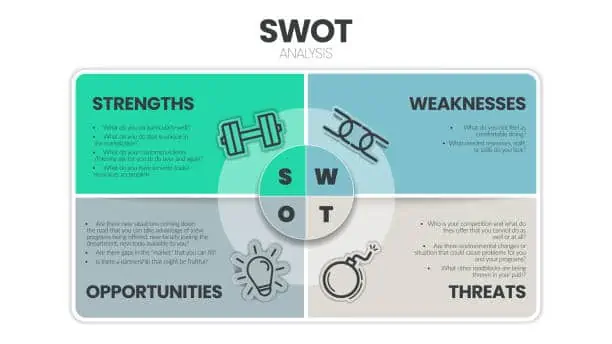
SWOT stands for Strengths, Weaknesses, Opportunities, and Threats, divided into four quadrants (SWOT Matrix). It is a strategic planning tool to analyze the internal and external factors that affect a business. It helps you determine your position about your competitors, customers, suppliers, and partners and identify opportunities to be exploited or threats that may impact your company.
For example, A company wants to find out whether their new product will succeed in the market before they start production. They can use their SWOT analysis template (see below) to consider various factors such as their strengths (what makes them unique), weaknesses (what they lack), opportunities (what markets they can target), and threats (potential obstacles).
1. Strengths
Strengths are the positive aspects of your business. These can be related to anything: your company’s mission statement, its products or services, it’s brand identity and reputation, or even things like location (if you’re a brick-and-mortar store).
Critically thinking about your strengths is a great way to improve them. Suppose any characteristics will help you grow as a company. In that case, whether they’re related to how you operate internally or what kinds of products/services you offer—they’re strengths worth highlighting in your SWOT analysis.
2. Weaknesses
The second section of your SWOT analysis is about weaknesses. Weaknesses are problems you have to solve to achieve your goals and objectives, but they can also be opportunities for your competitors. Weaknesses are usually internal or external factors that prevent you from achieving what you want.
They’re not always negative, though! If the weakness is something like “not enough money” or “lack of time,” then it’s probably a good thing because it means something is stopping you from doing something else instead!
3. Opportunities
The key to identifying opportunities is to think about how your business could grow. Opportunities are external factors that can help your business, such as:
Expanding into new markets or increasing sales in existing markets
Launching a new product or service
Acquiring another company, either through acquisition or mergers & acquisitions (M&A)
4. Threats
The threats section of your SWOT analysis is where you will detail any external factors that could negatively affect your business. This includes economic downturns, anti-competitive legislation, and disruptive new technologies.
As with the other sections, it’s important to carefully consider each threat before deciding how to address it.
For example, if a competitor has higher quality products at lower prices than you do, then there’s no point in addressing this issue unless it’s something that your company can change. Likewise, suppose state or federal laws are about to change in a way that makes running your business more difficult (such as stricter environmental regulations). In that case, these should be included in the threats section, along with suggestions for how they might be mitigated (like investing in pollution control equipment).
Need Help With Your SWOT Analysis Paper?
We are experts in writing SWOT analyses because understanding your business and its position in the industry helps you capitalize on your strengths and work on your weaknesses. Hire us to be inspired by our custom-written SWOT analysis of your business.
It’s an effective way to identify and address key issues in your company and determine how best to use your resources (money, time, talent) to improve them.
The SWOT analysis is a technique that is extremely helpful to a small business owner because it allows you to focus on your strengths while identifying areas where improvement is needed.
You can also use your SWOT analysis information to create an action plan to address any shortcomings identified in your analysis. This will help keep you from making costly mistakes later on down the road.
SWOT analysis may be used to brainstorm ideas and is an important tool for strategic business planning.
It helps you to identify your strengths, weaknesses, opportunities, and threats.
It also helps you to identify your competitors and define your business strategy.
SWOT analysis of internal and external factors
SWOT analysis also includes internal and external factors. Internal factors like structure, management, and employees are related to your business. External factors were identified as that outside of your control. These include the economy, legal environment, and technological developments.
1. Internal factors
Company’s culture: A company’s culture is the way people work together. It can be an important factor in whether or not your business is successful, as it affects how well employees work together and your ability to attract new talent.
Company’s management: Your management team sets the tone for everything that happens within your organization, so it’s essential to ensure they have a positive attitude about the company and its prospects.
Employees: A well-trained workforce will help you provide better customer service and build goodwill with existing clients, which can lead to increased sales.
Resources: The equipment and supplies necessary for running your business are called resources; if these aren’t available when people need them, production may halt until they show up again (or until someone goes out and buys more).
2. External factors
External factors are the environmental, economic, political, social, and technological forces that affect your business. These factors can be either positive or negative. If a business is affected by external factors positively, it’s known as an opportunity; if affected negatively, it’s known as a threat.
For example:
-The economy may be booming right now, but this doesn’t necessarily mean that all businesses will benefit from this boom because of other external factors, such as the availability of resources and competition from other companies in the market. -Congress has passed new laws that affect how employers should treat their employees regarding wages and benefits. This will affect every business operating within America today because everyone must comply with these new changes even though they might not seem fair or beneficial for some companies (or individuals).
Conducting a SWOT analysis/ How to Write a SWOT Analysis
Conducting a SWOT analysis is the first step in determining how to prepare your business for success in the new year. Follow these steps:
1. Decide on the objective of your SWOT analysis
Now that you know what a SWOT analysis is and how it works let’s focus on what it does. A SWOT analysis has one main objective: to help you make good decisions. This is done by helping you understand your current situation in light of opportunities and threats. Doing so will also help clarify where the strengths and weaknesses of your business lie so that you can take advantage of them while mitigating any future liabilities.
In addition to providing an overall view of your company’s position within the market, this type of analysis also provides valuable information about its strengths and weaknesses and its opportunities and threats.
2. Research your business, industry, and market
When writing a SWOT analysis, it’s important to do your research. It would be best if you looked at the strengths, weaknesses, opportunities, and threats related to your business.
To do this effectively, you should spend some time researching everything that could have an impact on your business:
Your business itself (strengths and weaknesses)
The industry in which it operates (strengths and weaknesses)
Your market (the competition) and how it’s changing over time
3. List your business’s strengths
Now, list your business’s strengths. What are your company’s greatest strengths? What makes your business unique? What are you good at? Remember that this is not an exhaustive list of everything your company does well; it’s just a summary of the most important qualities that make up its core competencies.
For example: “Our company is great at providing quality service and high-quality products.”
If you don’t have too many strengths to choose from, consider working on improving some of them over time so that they can become even more powerful in helping you achieve success.
For example: “Our marketing team has been working hard to improve our SEO ranking on Google.”
4. List your business’s weaknesses
The fourth step of the SWOT analysis is to list your business’s weaknesses. Weaknesses are things that you aren’t doing well or need to improve, such as
Internal factors include poor relationships with suppliers or an inability to listen to customers’ needs.
External factors include intense competition in your industry or a lack of funding for new projects.
Weaknesses can also be tangible (such as insufficient storage space) or intangible (such as not knowing how to use social media effectively). They can be current (for example, your website is down right now) or potential (you don’t have any employees yet). They can also be specific (you don’t know how many people visited the site yesterday) or general (“we need more money!”).
5. List potential opportunities for your business
You can also list opportunities for your business, industry, market, and country. These are the areas that you’ll want to explore in more depth. You may find that there are opportunities for your business within these areas. For example:
A new product or service
A new technology trending in the market
An increase in demand for product/service X
6. List potential threats to your business
Now, it’s time to identify the threats that could affect your business. These can include:
The threat of another company coming in and taking over the market
The threat of the economy collapsing and making it difficult for you to generate revenue
The threat of customers not being satisfied with your service or product quality, which would result in poor reviews on social media platforms and other review sites that may hurt your reputation
The threat of a competitor being able to create a similar product at a lower price point
7. Establish priorities from the SWOT
Now that you have a clear idea of your strengths, weaknesses, opportunities, and threats, it’s time to establish priorities. This is an important step in creating a good SWOT analysis.
Your priorities will vary depending on what type of business you want to start and the available resources.
For example, if your company has access to plenty of capital but doesn’t have much experience in marketing or customer service, then it would make sense for them to focus its efforts on building up those departments more than anything else. On the other hand, if they have limited funding but strong expertise in sales, then maybe they should focus more on expanding their sales team so they can grow faster while keeping costs low, at least until they’re making enough money from sales alone without having additional expenses due solely because one department isn’t as well staffed as another department needs them
8. Develop a strategy to address issues in the SWOT
You now have a very clear idea of where you’re standing and where you need to go. Developing a strategy to take you from point A to point B will help keep your goals achievable and measurable so that you can measure success along the way. Your strategy should be goal oriented: what exactly do you want your organization or business unit to accomplish? What resources do they need?
With this information in mind, it’s time to develop an action plan with specific milestones and timelines for each step. This is similar to how any company develops an annual plan; however, with SWOT analysis, there are also external factors affecting your organization that must be accounted for when developing this plan (e.g., competitors).
Do you need assistance with writing your SWOT Analysis paper?
Are you finding it tough to write your SWOT analysis paper? Would you like someone to help you get it done in 3 hours flat? Just click on the link below, enter your email address and watch us do the rest!
Strengths. What do you do well? What makes you better than the competition?
Weaknesses. What could hurt your business if it wasn’t fixed, improved, or addressed?
Opportunities. Where is this market headed, and what opportunities does that present to you? Consider trends, new technologies, and changes in legislation, for example.
Threats. Who or what poses a threat to the success of your business now or in the future?
1. Strengths questions
What are our strengths?
What do we have going for us?
What are some of the things we’re good at?
How can we leverage these strengths to achieve our objectives and make better decisions in the future?
2. Weakness questions
What are your weaknesses?
What are the weaknesses of your competitors?
What are the weaknesses of your industry?
What are the weaknesses of your company? (For example, does it have a high debt load or low cash reserves?)
What are the weaknesses of your product or service (e.g., is it too expensive)?
3. Opportunities questions
What opportunities are there in the market?
What opportunities can you create for your business?
What opportunities are there for your products or services? (For example, this could be a new product line.)
What opportunities are there for new markets? (This could be an expansion into other countries.)
What opportunities are there for new products or services? And so on…
4. Threat questions
What are the biggest threats to our business?
What are competitors trying to do damage to us?
How could the industry change that would negatively impact us?
How can we protect ourselves against these threats?
What could happen if we don’t take action right now?
PEST analysis
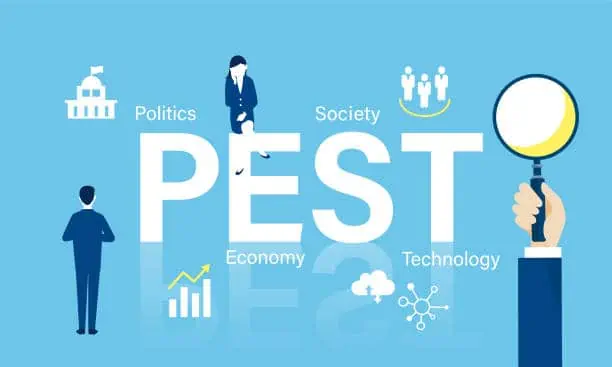
PEST stands for Political, Economic, Social, and Technological factors. PEST analysis is one of the most popular techniques used to analyze an industry. It helps you understand the external factors that may affect your business.
You can use a PEST analysis template or create your own to ensure you consider all aspects of your business when making strategic decisions.
1. List of Pros of PEST analysis
PEST analysis is a great way to understand the external factors that may affect your business.
It allows you to see how the factors are related and how they can impact your business. You can use this information to make strategic decisions about your company.
Provides a snapshot of the industry and its current trends
It allows you to see what competitors are doing
It can be used as a diagnostic tool to determine whether your business is performing well or not
Identifies opportunities and threats that may not have been obvious before
It helps you to predict what will happen in the future
It allows you to make informed decisions about where your business is heading
2. Cons of PEST analysis
The biggest problem with PEST analysis is that it can be very difficult to do correctly. It’s easy for a company to make mistakes, especially if they don’t have enough information about its industry or market.
It isn’t easy to assess the impact of external factors on your business because it does not consider how much control you have over them. For example, if there is a war in a country where you do business, it will affect your company’s profitability. However, if you cannot predict the war and get out of the market before it starts, PEST analysis will not help you much.
PEST analysis is less useful for evaluating small businesses because they often have no competition and, thus, no need to consider what competitors are doing.
It is a popular method, but its simplicity also limits it. For example, PEST analysis will not help you identify new market opportunities or threats unrelated to economic forces (such as government regulations).
It also does not provide insight into why certain developments happen or how they might affect your business.
It’s not foolproof. It doesn’t include everything you need to know about your industry and market, which can lead to gaps in your knowledge. These gaps may leave you unprepared for changes in your environment or unable to capitalize on opportunities when they arise.
It isn’t easy to quantify external factors’ effects, which are usually very broad. For example, it might be hard to determine how much of your success is due to favorable economic conditions versus how much is due to good management decisions.
Another major problem with using PEST as a standalone tool is that it doesn’t give much insight into how competitors compete within those environments.
Are you stuck writing a PEST analysis paper?
I can help you with your PEST analysis and other strategic paper writing assignments. All of my papers are written strictly per your requirements. I guarantee high quality. My rates are reasonable and negotiable. Just click the button below, signup, place your order and get your paper done in next to no time!
SWOT analysis helps you identify your strengths and weaknesses. When you know what your business is doing well, you can use SWOT information to develop an effective marketing plan and improve your products or services positively.
SWOT analysis helps you identify your opportunities and threats. This can help small businesses avoid surprises by warning them of any market changes that could affect their bottom line, as well as alerting them to upcoming innovations they may want to take advantage of before their competitors do so themselves!
SWOT analysis helps create a strategy for addressing issues. Once again, since it’s based on objective facts rather than guesswork or assumptions, SWOT analysis gives businesses concrete strategies for dealing with any problems they encounter along the way – without wasting time trying out ideas that won’t work anyway (or worse yet, trying something new only because someone said so).
Improve specific campaigns and projects. SWOT analysis can help you identify the strengths and weaknesses of your current marketing efforts, including how they’re being implemented. This can help you improve those campaigns that are not currently working and determine how to improve those that are working.
The following free SWOT analysis template contains all of the basic elements that you need to develop an effective strategy:
Need Our Writing Help With Your Swot Analysis Paper?
Need our writing help with your SWOT analysis paper? Place your order today by clicking the ORDER NOW button above. Our writers are experienced and qualified to help you with your assignment. They’re native speakers of English, too! We have a 100% money-back guarantee if you’re not satisfied with the quality of our work.
Conclusion
We hope this guide has given you a better understanding of conducting and writing a SWOT analysis. If you need help with your paper or want us to write it for you, we’re here to help! Just reach out and tell us what you need. We’ll get back to you ASAP.
Through my engaging and informative blog posts, I aim to provide helpful tips on topics such as essay writing, research skills, and academic planning, empowering students to thrive in their academic pursuits.
A tragic hero is a literary term used in drama, film and theatre to refer to the protagonist of an otherwise tragic play or story. The tragedy stems from the fact that he has been brought down by his hubris, overreaching ambition or another form of folly. He often dies at their hands as a result.
Tragic heroes are literary characters who conflict with society and its expectations. They often have tragic flaws that make them unfit for society, but they also have heroic qualities that allow them to do great things.
Some may argue that it is simpler to make someone weep than to make them laugh. In some ways, they are correct. However, building a sad and humorous persona is a difficult challenge.
Our writers have compiled some of the most intriguing advice and information about the tragic hero character in this post—the most comprehensive approach to understanding what you should do and how your character should act. If producing a custom thesis sounds daunting, reach out to one of our expert writers for assistance.
Definition of a Tragic Hero
So, what is the definition of a tragic hero? We’ve come up with a simple and logical definition for you:
Tragic heroes are often characters who appear in tragedies. Those characters often face adversity and make blunders during the tale. They go through ups and downs in their lives and are frequently sympathized with by the audience.
From Shakespeare’s famed and classic Romeo and Juliet with a brilliant thesis, Rome is one of the most famous tragic protagonists. His love is a huge passion that takes him to the grave. It’s the most terrible conclusion a character could have.
Here are some fascinating facts about the classical tragic hero:
An ancient Greek mythology philosopher, Aristotle was the first to identify and characterize such a personality.
The term “hero” may not necessarily imply a hero in the traditional sense. Usually, they aren’t even heroes. Instead of a typical protagonist, they are characters and occasionally villains.
A Little Background Information
The fundamental characteristic that distinguishes this sort of character is a tragedy. Here’s where you can perform some basic research. But, like every other genre or character, the tragic hero evolved with time.
Tragic Hero of Antiquity
As previously stated, Aristotle was the first to coin the phrase “tragic hero.” He thought that a good tragedy should elicit a few primary sorts of emotions from the audience:
Fear
Pity
Sympathy
According to Aristotle, these are the basic sentiments for a genuine catharsis experience. Aristotle offers another sad list:
In ancient art, the tragic figure was expected to be noble. At the same time, a heroic element must be present. As a result, we may expect the figure to function as a role model and provide a compelling message. However, the spectator should still feel pity and fear.
This sort of person’s life and flow should have a sad sense. Hamartia is another name for this condition. A specific life event should cause a character’s decline.
All these life challenges should make you feel like you know the tragic hero. You’re aware of some of their problems and defects.
When we speak about a tragic hero, as the ancients understood it, one of the primary factors that impact all of the characters is a fortune.
Tragic Hero of the Modern Era
The overall look of the modern tragic hero has been streamlined in modern times.
It no longer matters if the character comes from a noble family. It makes no difference what gender or class you belong to. Tragic heroes may be men or women from various social backgrounds.
You don’t have to make a true hero these days. It might be anybody with a compelling tale to tell. Those individuals could not be classified as heroes. However, it just signifies that such a good person lacks heroic characteristics. They may even have the potential to be a villain. You may use some of their words as citations.
At the same time, just a handful of Aristotle’s main characteristics are still relevant in current art. The audience should constantly sympathize with your sad hero. Sad occurrences, blunders, and good fortune are crucial in developing the character and giving it a tragic name.
Examples of Tragic Heroes
There are many outstanding instances of tragic heroes who are both traditional and classical. Here are a few of them for your consideration.
William Shakespeare’s Macbeth is a well-known dramatic play. It relates to the narrative of a man who, with the help of his wife, murders his king because of a prophecy. Then, as the narrative progresses, his murders get more bloody, and Macbeth becomes a true villain. He discovers that all his close friends, including his wife, have passed away and that his life has been spent.
Michael Corleone is a fascinating character from the famous Godfather trilogy. In all three episodes, Michael tries to escape his destiny as a mobster until his daughter is slain by his enemies in the finale. And this catastrophe occurred after Corleone completed the last step toward legal life. Even though he is a true antihero, the viewer sympathizes with him since it is evident that becoming a mafioso was not his decision and that he was attempting to rescue his family.
Anakin Skywalker: We can observe Anakin Skywalker developing into a tragic hero throughout all three iconic sections of Star Wars. A misunderstood and lost individual who eventually becomes the series’ major antagonist. He begins as one of the world’s purest and most positive heroes, wielding enormous power. However, to have greater control over the situation, he falls into the Dark Side’s trap, becoming the only Darth Vader. In some ways, he’s just a victim of unfortunate circumstances.
The Tragic Hero’s Role
One thing is certain: there can be no tragedy without tragic heroes. In the first place, such tragic personalities provide the point of tragedy.
Our pity and other key sentiments are triggered by their demise and life struggles. They sometimes teach us a lesson by instilling dread in us. Tragic heroes are often richer and more nuanced than other characters in a story or film.
Our writing gurus are true pros that can assist you with any form of essay or even a thesis abstract. These are the individuals you need. You may be certain that the outcome of your purchase will meet your expectations, so please do not hesitate to contact us at any moment.
Frequently Asked Questions
What is a tragic hero’s simple definition?
A: A tragic hero is a protagonist in a work of literature that has an inflated sense of self-importance and believes the ends justify the means. Some examples are Oedipus, Macbeth and King Lear.
What are the 4 characteristics of a tragic hero?
A: The 4 characteristics of a tragic hero are that he is the protagonist, has an inner conflict, suffers from hubris with great consequences, and eventually dies.
What are the 5 characteristics of a tragic hero?
A: A tragic hero is someone who does not realize their power and leads a miserable life because of it. They are often portrayed as an underdog, but one that has exceptional powers or skills. This type of character typically experiences some downfall due to this lack of self-awareness, and the audience feels sympathy for them while they watch their tragedy unfold on screen.
Through my engaging and informative blog posts, I aim to provide helpful tips on topics such as essay writing, research skills, and academic planning, empowering students to thrive in their academic pursuits.
2 Autobiography Examples and Autobiography Samples
On Autobiography Examples, I often get asked the difference between an autobiography, a biography, and a memoir. The truth is that there isn’t a hard and fast distinction between these terms. So while there are some differences between these three types of stories, they are very closely related and often lumped together as “biographies.”
Sometimes people use the word “memoir” to refer to the personal life stories people write about themselves or their lives.
What is an autobiography?
Typically, an autobiography is personal narrative nonfiction told from the author’s point of view. A great autobiography is a story that can chronicle an entire author’s life or only a portion of it. It’s typically a life story of its author.
It is a personal history of an individual’s life written by themselves.
Spiritual autobiography is a type of autobiography about the author’s life, but it is also a story of the author’s relationship with God. The spiritual autobiography is a recounting of events and a story of the author’s spiritual journey.
Famous examples of autobiographical works are “The Diary” by Anne Frank and ‘Frost” by Thomas Bernhard.
What is a Biography?
Also, narrative nonfiction, a biography, tell a person’s life story. You may tell it from the point of view of the biographer or by using a third-person point of view. Biographies typically focus on prominent individuals, but they may also concentrate on the lives of less well-known people, as in Alex Haley’s Roots (the story of Haley’s family) and Helen Keller.
What is a Memoir?
Memoirs also tell the interesting story of someone’s life, but they usually focus on one event, relationship, or period in that person’s life.
You can also write a memoir about someone else by someone else. So you could write a memoir about your mother or father, for instance, even if you are not them. Exploring their life experiences and sharing personal anecdotes can provide a unique perspective that honors their journey. When considering how to write a memoir essay focused on another person, it’s essential to gather stories, impressions, and even insights from others who knew them well. This collaborative effort not only enriches the narrative but also offers readers a multifaceted view of the subject’s life.
Like biographies and autobiographies, memoirs are told from the first-person point of view (using “I” statements).
Still, memoirs are typically written after the events have taken place as a written record of the author. For instance, The Glass Castle by Jeannette Walls is a memoir about her unusual
How to start an autobiography
When you start an autobiography, think about what part of your life you want to write about. Then, write a thesis for your autobiography that acts as a timeline for the events you will include. When writing an autobiography, focus on including details and specific examples from your life.
Additionally, you can use the third-person point of view to make it sound more objective and professional. If you need to revise your autobiography, read through it and make sure everything sounds true to your life story.
Map out your whole life
If you decide to write a formal book-length autobiography, it can be useful to plan it like a novel. Look at your life as if it were a book with four or five acts containing several chapters. For example, you might have chapters on your childhood, teenage years, young adulthood, midlife, and old age. Alternatively, your chapters could be based on themes such as the suffering you endured during World War II or the challenges you faced as a new parent in the 1970s.
1. Autobiographies needn’t always start with your birth
Most people who write an autobiography start at the beginning, with their birth. This is fine if you only aim to write a short memoir of a few thousand words about a specific incident in your life, but if you are aiming for something more substantial, the beginning of your life is probably not the best place to start.
Instead, pick a theme that captures the main idea of your life up to this moment and start there.
For example, if you are assigned to write about your experiences growing up on a farm, you might start writing your story of your first day tending sheep alone in the field as a teenager.
The life story can be a short autobiography as a paragraph or two or longer than that. It sets the tone for what is to come and gives the reader some idea of where the narrative is heading.
2. Identify your main characters
List key people who have influenced and helped shape who you are today. The autobiography includes family, friends, and mentors.
3. Include the best stories
You can write about everything that has happened in your life – from what you ate for breakfast as a child to when you spent a summer in Europe or Asia. However, try to focus on one story at a time, as it can be difficult for readers to follow several stories at once if they don’t know the characters involved.
4. Write using your voice
Don’t try to sound like a famous writer or thinker; it will make you sound silly and self-conscious.
Don’t worry too much about sounding artificial or overly formal. Even if you are writing in the first person, your autobiography should still sound like you.
5. Reveal things about your life
Autobiographies are supposed to be honest accounts of someone’s life so far; this means revealing things that might not necessarily be obvious to everyone else (e.g., your hobbies).
6. Show your weaknesses too
Show the good and bad parts of yourself.
Nobody is perfect, so don’t try to make yourself look perfect in your autobiographies.
Creating your narrative
1. Build the suspense and tension to make it interesting
Create suspense and tension for a more interesting reading experience and keep them hooked to read further until they reach the climax or resolution of the story and then end it with an unexpected twist if possible related
2. Think about your climax
The climax of an autobiography is the moment of greatest tension-not necessarily a crisis in the plot. Still, something where the action stops for a minute, and the reader feel or wonders how things will turn out. Not every autobiographical book has a climax, but biographies usually do.
So choose what you want your climax to be then work backward.
What will have happened just before your climax? What was going on at that point? What preceded that?
3. Also, think about the resolution
When you write a biographical account of yourself, it should be clear what the resolution is.
What were the people’s problems? How did you solve it? Then why are you writing this account?
4. Determine where to start your story
Before your story begins, take a few moments to think about the most important events in your life. What things have shaped you and made you who you are? How can you best use these experiences to share valuable life lessons?
5. Weave in your themes
The themes and lessons learned from your life experiences will be what people come away with after reading your book. You can incorporate these themes by weaving them into every aspect of your book: from the stories you tell to how you structure your book.
6. Reflect on the content of your autobiography template
As you write about each event or experience, ask yourself which emotions are associated with that particular memory and how they have made you who you are today.
7. Add structure to your book by using chapters
Books usually contain a series of chapters so readers can easily navigate between different book sections. When creating chapter headings for an autobiography, try thinking about the main ideas or events that define each period of your life.
Sample Autobiographies and Amazing Examples
Check the following autobiography examples for students as an inspiration
Through my engaging and informative blog posts, I aim to provide helpful tips on topics such as essay writing, research skills, and academic planning, empowering students to thrive in their academic pursuits.
As of 2022, the average time to complete a PhD degree is nearly seven years. Despite this lengthy process, only 42% of students will earn their doctorate by age 30. What are some reasons for these PhD failure rates?
The incidence of PhD failure among students has been a source of work for a long timery. The emergence of the internet, which has spawned a plethora of PhD writing services, has exacerbated the situation. Few students are enrolling in PhD programs at universities, and the completion rate is also concerning.
How frequently do you see PhDs mentioned in local newspapers or news bulletins? Except for the two or three specialists invited for a TV interview, the remainder of the room will be filled with Mrs. and Mrs. That telling you about the number of PhD holders in the nation and the globe. According to research, most college students only get to the degree level and then drop out.
Why is this the case, though? Why is there such a low percentage of PhD completion in our society? This article aims to go into the topic in depth. So, my buddy, let’s go on an adventure together.
What Exactly Is A PhD?
“Doctor of Philosophy” is an abbreviation for “Doctor of Philosophy.” It refers to the greatest academic qualification one may earn in terms of a professional or academic degree. A PhD is conferred at the university level after completing advanced research that may considerably enhance knowledge in a particular topic.
The doctor is the title given to PhD holders. Getting the requisite research experience and methodologies for a P takes years. Most students who seek such a degree get disheartened along the road. As a result, such titles are held by a small number of people in today’s society.
Furthermore, in recent years, the failure rate for PhD candidates has been substantial. The number of postgraduate students enrolled in PhD programs has decreased at most institutions. Many nations are concerned about the future due to this alarming trend. Imagine a country where no professors or senior lecturers teach at universities!
What Percentage Of PhD Students Complete Their Education?
According to the American Psychological Association (APA), 33 percent of students earn doctoral degrees in several disciplines. In comparison to the sciences, the humanities have continued to produce a large number of graduates.
According to statisticssolutions.com, about half of doctoral candidates do not finish their studies. The site discovered that the PhD dropout rate rises to 56.6 percent after surveying 30 universities, 54 fields, 330 programs, and 49,000 students.
That should give you an idea of how bad things are with dissertation defenses. Some students get off to a good start only to give up along the road. Others finish their dissertations but cannot defend them and so wind up on the failure list. It’s important to note that not all failed PhD instances are due to inactivity. In the next parts, we’ll discuss this topic in great depth.
Why Does It Take So Long To Get A PhD?
We’ll look at the structure of a PhD thesis and what it takes to prepare the final paper for presentation to comprehend this better. While various universities may have different forms for PhD papers, the following is a basic rule of thumb that applies to all of them:
Page 1 of 2
Abstract
Introduction
Review of the literature
Methodology of investigation
Results
Discussion
Conclusion
Reference
The preceding description should be enough to demonstrate that a PhD paper does not take 30 minutes to produce. It’s one of the main reasons most students don’t make it through their PhD papers. Each of the parts above is the product of a considerable study that lasted between 13 and 20 months.
Students must go through the following phases while preparing a PhD paper:
The prospectus section is where the foundation for the whole paper is laid. It will take around 3-6 months to complete. Most of this stage is dedicated to fine-tuning the subject and the researcher’s approach to the challenge.
The proposal is made up of the first three chapters of the paper. Students must elaborate on their prospectus, research extensively, and explain the technique in depth. This phase takes around four months to finish as well.
Approval of the plan: At this point, the committee evaluates your proposal before giving you the green light to go forward. Your idea might take up to two months to be accepted.
Data gathering is critical in producing a PhD thesis since it serves as the foundation for your findings and debate. Though it varies greatly based on various circumstances, it might take up to two months.
Make a summary of your findings and a discussion: The students will now present the outcomes of the data collecting and explain what they signify. Even though it is one of the easiest portions of a thesis paper to write, it might take up to a month.
Defense and completion: Before being placed on the graduation list, students must defend their papers and meet certain university criteria. This procedure might take up to two months to complete.
As you can see from the phases above, a PhD paper takes around a year to finish. Other elements that make obtaining a PhD a lengthy procedure include:
During the study phase, there were insufficient resources.
Pandemics occur naturally, such as the COVID-19 virus.
Sluggishness on the supervisor’s side
Obtaining permissions and approvals may take some time as well.
A PhD might take up to two years for certain students. This contains additional frequent PhD issues that are out of reach for students.
What Exactly Is A Thesis Defense?
One of the most common causes of Master’s thesis failure is how students portray themselves in the defense. It’s an important aspect of getting a PhD, and many people have been shut out. But how does it appear?
A defense now presents evidence in support of a certain proposition. The type of proof required will determine the type of thesis at issue. At this point, you must convince the committee that you are knowledgeable about your subject and concentration area. It consists of the following:
The student gives a presentation of their thesis.
Open-ended inquiries that force you to consider your work critically
Creating an overview of the thesis’s particular findings
Is earning a PhD difficult, you may wonder? Without a doubt! As easy as they seem, these three things may cost you a year of hard effort and restless nights. The above elements must be emphasized to achieve a good thesis defense. According to studies, most students who distribute their papers are detected at this point. As a result, you must complete your task and produce something you can easily defend.
Factors That Cause PhD Defense Failure
We’ve seen how defending a thesis requires students to put their best foot forward. Everything that happens throughout the process has an impact on the end product. Some of the reasons why students fail to defend their PhD thesis are as follows:
Inadequate supervision from the supervisor: A supervisor not participating in the research process may have a major role in the student’s failure. They are responsible for providing guidance and assistance to the student throughout the PhD writing process.
Students’ laziness: Some students are naturally lazy and do not want to put any more effort into their work. Others would even submit PhD papers that have been copied and pasted from the internet. The committee may point out all of these blunders, and the student might be penalized.
Improper attire: Most students ignore this, yet it makes a big difference when defending a PhD work. Your dress says a lot about how serious you are about the endeavor.
During the presentation, some students fail to pay attention to customary standards such as etiquette, graphics, structure, and style. Consequently, marks are deducted, leading to the student’s overall failure.
Insufficient presentation time: During the defense, some people fail to use the time allotted to persuade the committee. They end up wasting their time without being able to persuade the panel.
The failure rate among students has been largely attributed to the PhD defense. The five factors mentioned above are just a small part of the bigger picture.
PhD Supervisory Issues
A PhD supervisor’s job is to mentor a student through the PhD writing process. A supervisor is essential in assisting the student in making educated judgments about the project’s many parts. Nonetheless, some PhD supervisors cause a slew of issues:
Some supervisors may be abusive: they may reply brutally to students’ concerns, humiliate them, or blame them for their faults. Such supervisors may result in the student’s dismissal from the PhD program.
Others are overbearing: they don’t let kids make their own choices. In other words, they are the dictatorial types who will prescribe the thesis paper’s subject, methodology, and theoretical approach. You may not have a say in your paper if you have such a supervisor and lack the incentive to proceed.
Passive supervisors have no leadership qualities and do not interfere with the student’s work. They are only allowed to enter if the pupil has a serious issue. A situation like this is a slacker graduate student who submits a bad paper at the end of the semester.
Supervisors that are uninterested in the supervisory process are known as indifferent supervisors. They may fail to follow up on recent developments or demonstrate commitment. Students with such supervisors are more likely to become indifferent and produce low-quality PhD work when it comes time to submit.
One can note from the above PhD Supervisory Issues that failure is inevitable. If the supervisors neglect their advising and guiding the students, the failure rate will continue to soar. Therefore, the student and supervisor need to have a one-on-one relationship that will foster good relationships throughout the process.
If the PhD student-supervisor relationship’s expectations are incorrect, the ultimate result will be a shambolic effort that will never see the light of day. PhD supervisors should assist students in improving their papers by offering ongoing constructive criticism.
Low marks will also result from an imbalance between the two (student and supervisor). Problems may occur if the supervisor is engaged in the PhD project too much or too little. It will impact the ability to write a well-written PhD thesis that offers new results to a certain topic area.
Should I Be Concerned If My PhD Advisor Ignores Me?
Yes! Remember, this is the individual who will lead you through the process – in other words, the PhD paper’s anchor. If they are ignoring you, you should be concerned right now! The following are some of the possible outcomes of such an action:
It’s possible that you won’t be able to stick to your timetable.
It’s possible that you won’t be able to get the necessary competence in your field.
Some of the choices you make may not be the best.
You may risk making mistakes and overlooking important aspects of thesis writing.
You can be discouraged since you don’t have a mentor.
What proportion of PhD candidates fail to complete their studies? We estimated that over half of them would join. When considering the crucial function of a supervisor, it is apparent that they play a part in PhD student dropout. Without the help of a supervisor, it is difficult for a student to write a high-quality thesis paper.
I Need Thesis Help Because My Dissertation Is Bad
To prevent failing or being part f the statistics on the PhD failure rate, you may seek low-cost research paper assistance. We have the highest-rated PhD writers who have recently published award-winning articles. Try our expert help now and realize how fun writing a PhD dissertation can be. You will not be disappointed with this deal.
Through my engaging and informative blog posts, I aim to provide helpful tips on topics such as essay writing, research skills, and academic planning, empowering students to thrive in their academic pursuits.
Scholars use tertiary sources to collect information that is not primary or secondary but reliable. Examples include books, journal articles, and files from archives.
If you’re writing a long essay, term paper, or thesis, you’ll undoubtedly want to know all there is to know about different sorts of sources. There is a tertiary source in addition to the main and secondary sources (which you may already be aware of). What is a tertiary source, though? How can you know which one is which, and why is it crucial to distinguish between the three sorts of sources?
We will cover all you need about the tertiary source in this blog article. You’ll find examples and even a fantastic proposal for academic writing help. Continue reading!
What Is a Tertiary Source of Information?
Because this blog will mostly concentrate on tertiary sources, we’ll begin with a definition of tertiary sources.
This source organizes, indexes, compiles, or digests primary and secondary materials. It’s important to remember that tertiary sources seldom offer author credit.
On the other hand, a main secondary, tertiary source provides a firsthand account (primary) or an analysis/explanation of the event recorded in a primary source (secondary).
The distinction between Primary, secondary, and tertiary sources.
It is critical to distinguish between primary, secondary, and tertiary sources. Why? Because your papers should mostly consist of primary and secondary sources. You may mistakenly utilize too many tertiary sources if you cannot distinguish between different academic sources. Unfortunately, this may result in your paper being penalized. Here’s what you need to know about primary, secondary, and tertiary sources so you can choose the best ones:
A primary source is generally produced when the events took place. It is a personal description of what transpired, on the other hand. A main source of knowledge might be a journal, an interview, a poem, a relic, or an item.
A secondary source is often written after the events have occurred. They are studying or interpreting the main source or sources in most situations. For example, a magazine or a biography are examples of secondary sources.
A summary of primary and secondary sources is referred to as tertiary sources. It’s also possible that it’s an abstract. A dictionary, for example, is an excellent tertiary source.
A Few Examples of Tertiary Sources
Now that you’ve learned more about primary, secondary, and tertiary sources of information, it’s time to concentrate completely on tertiary sources of information. Here are some of the greatest examples of tertiary sources:
An encyclopedia
An online encyclopedia (including online encyclopedias)
A handbook
A collection of facts
A handbook (if it is not a secondary source)
A handbook
Any kind of indexing source is acceptable.
Any kind of abstracting source is acceptable.
Where Can I Find Tertiary Sources?
Do you know what a tertiary source is in terms of research? Based on our examples, you should be able to tell the difference between primary, secondary, and tertiary sources. Even though we defined tertiary sources, we did not tell you where to acquire them. Of course, there are a plethora of them available on the internet. Many, such as dictionaries and textbooks, are also available offline. Your local library should be a great place to go for tertiary information.
The following are some examples of reputable tertiary sources that you may find online:
California’s Statistical Abstract
The New Dictionary of Intellectual History
The ABI/Inform database is searchable.
Atlas of the World
Online database of Columbia International Affairs
The National Biography of the United States of America
The Oxford Islamic Studies Center is a research institute dedicated to Islamic studies.
The Oxford Encyclopedia of Military and Diplomatic History in the United States of America
The Directory of Correctional Institutions
Even if tertiary sources are many, it is critical to ensure that you are utilizing trustworthy ones. Some Wikipedia entries (which might be considered a tertiary source) are inaccurate, for example. After all, anybody with access to the internet can edit a Wikipedia entry and add inaccurate or misleading material.
Final thoughts
Working with an academic writer is the greatest way to obtain good tertiary sources. You may seek assistance from your lecturer, but don’t hold your breath. Another option is to use a writing service such as ours. We can connect you with a specialist in your subject. They can aid you in locating the tertiary sources you want with citations and references. Remember that our professionals have premium online databases of primary, secondary, and tertiary sources at their fingertips. Why pay for a membership when our expert can help you choose the finest sources for your academic paper?
Get professional writing help from Pro-Thesis Writers.
Now that you know what constitutes a tertiary source, it’s time to discuss your academic work. We know that most students are having difficulty with their academic writing tasks. Our firm, on the other hand, is here to assist. Our ENL writers (all native English speakers) have years of expertise producing academic papers in whatever style. Furthermore, since we have degree-holding professional writers on board, we can create an essay on any subject or topic.
We can assist you with custom thesis writing if you don’t need us to prepare a sample paper. We can also proofread and polish your work for you. Professional editing services are also available from us. Our professionals can even assist you in coming up with the ideal essay themes and designing an outline for you. Please do not hesitate to contact our staff if you need any academic writing or editing assistance. We are available seven days a week, 24 hours a day.
FAQ
We’re pretty confident you have some inquiries concerning tertiary academic sources. We’ll address the most frequent questions we get from students in this area of Frequently Asked Questions:
Q: Is it possible to include tertiary sources in a research paper?
Yes, you may utilize tertiary sources in your research writings. After all, they are trustworthy sources of information. It is, nevertheless, considered best practice to back up crucial concepts with more than a tertiary source.
Q: How can I do academic research using a tertiary source?
A: You’ll utilize them in the same way that you’d use a main or secondary source. You incorporate the knowledge into your work, credit the source, and include it in your References section.
Q. Is Wikipedia considered a tertiary source?
A: Wikipedia is classified as a tertiary resource. Fun fact: Wikipedia has a page stating that it is a tertiary source and demonstrating how to reference it in all academic writing styles.
Q: Can I solely utilize secondary sources?
A: No, you should now strictly rely on tertiary sources for your study. Your work will lack credibility if it is not based on peer-reviewed sources.
Q: In legal papers, may I utilize tertiary sources?
A: In most cases, law students are not permitted to utilize tertiary sources in their papers. The majority of institutions only accept primary and secondary materials. This is because tertiary legal sources are not reliable enough to use as a foundation for your essay.
Through my engaging and informative blog posts, I aim to provide helpful tips on topics such as essay writing, research skills, and academic planning, empowering students to thrive in their academic pursuits.
This website uses cookies to improve your experience. We'll assume you're ok with this, but you can opt-out if you wish. ACCEPTPrivacy Policy
Privacy & Cookies Policy
Privacy Overview
This website uses cookies to improve your experience while you navigate through the website. Out of these cookies, the cookies that are categorized as necessary are stored on your browser as they are essential for the working of basic functionalities of the website. We also use third-party cookies that help us analyze and understand how you use this website. These cookies will be stored in your browser only with your consent. You also have the option to opt-out of these cookies. But opting out of some of these cookies may have an effect on your browsing experience.
Necessary cookies are absolutely essential for the website to function properly. This category only includes cookies that ensures basic functionalities and security features of the website. These cookies do not store any personal information.
Any cookies that may not be particularly necessary for the website to function and is used specifically to collect user personal data via analytics, ads, other embedded contents are termed as non-necessary cookies. It is mandatory to procure user consent prior to running these cookies on your website.