by Herman Bailey | Mar 14, 2026 | Essays |
Introduction
The main objective of this research was t study cases of sexting among the teens. Due to the nature of behavior and the privacy concerned with the same, the study focused on teens who had been arrested by the police for engaging in such behavior. The focus was on understanding the prevalence of sexting, the risks involved and how teens responded tot any clinical measures that wren applied. Chalfen (258) begin by shoeing recent trends in sexting. The study may seem benign but the authors through the first paragraph quickly show the distress and the severance of the problem of texting. With the introduction of various technological aspects such as the freedom to use the internet, the fact that each teenager and in fact child owns a phone the prevalence of sexting has moved from adult circles to teens and children. The authors highlight that averagely every child by the age of 10 owns a cell phone which has unlimited access to the intent. Further, majority of the adults do not monitor what the child does with the phone. They give an example of a study conducted by Ringrose et al.(210) which found that more than 96% of teens have been exposed to sexting, and of this population more than 84% have continued to engage in sexting so that it has led to more and more graphic messages over time. With more social media sites dedicated to sexting, sexual exposure and pornography it is therefore likely that every teenager is exposed to the same behavior which to many seems harmless even though it can lead to severe consequences such as is addressed in this study that is, arrest by the police and engagement with the justice system.
Methodology
Two matters were considered in the selection of the methodology: on the one hand, there are the limits that come with studying teens who are considered children. There are several ethical issues which include consent by parents and limits to what the researcher can ask the children and how they can engage with the children. Although the primary data would be more useful and in fact more insightful, it is clear that such limitation would not only lengthen the study, they would also limit the number of respondents. Secondly, the data being sought by the study seems to been centered more on privacy. Sexting and engagement in any sexual behaviorism considered a highly private matter. Few if any of the teens that have been sampled for the study would be willing to engage with the researcher on the same. It is n this basis that the researchers approached the study from the police and investigator’s view. The researchers sampled the investigators who have handled sexting as cases and mailed questionnaires with the required responses to them (260). Mailed questionnaires have several advantages that in themselves could have been attractive to this study. First, investigators rarely have time to sit through an interview, therefore the questionnaire allows them to structure and fit in the study into their own schedule. Secondly, some of the questions would require a look into case files which are not only confidential but also need time to recall. The mailed questionnaire allows the investigator to maintain confidentiality and not divulge unnecessary information thereby ensuring protection of the subjects being studied and maintaining ethical principles of research.
Results of the study
Definition of sexting: according to Chalfen (262) sexting in this study was not limited to the sending of explicit messages whether coded or otherwise, but also the sending of sexually provocative images and production of the same. Before an image is sent, there must be a process of production that is the posing and taking of the picture to be sent. This entire process as highlighted through the study culminates in setxing. Teens not only send explicit message, they are also involved in production of the same messages. From the data gathered from the police officers, it is the images which often draw attention of investigators because majority of the images may not be taken through consent and where teens are involved are considered distribution of child pornography which in itself is illegal whether consent was involved or not.
Prevalence of sexting: more than 3,477 cases were reported to the police and investigated for producing and disseminating sexually explicit images. This is in comparison to data collected by the police departments involved in the previous year showing the cases to stand at slightly below 2000,Chalfen (262). The increase in sexting could be attributed to early exposure to sexuality among the teens and access to private mobile phones as well as free internet for purposes of sexting. With the resources being available, it is difficult to control the menace. Further, there has been an increase in investment by police and justice departments in resources and technology that are directed at curbing the behavior which in turn means that culprits are easier to find and records are easier to maintain on the same issue.
Aggravating circumstances: the authors are quick to differentiate between normal sexting and sexting that is directed to aggravated behavior such as forcefully obtaining images and distribution of images without consent. The study found that two thirds of the cases reported involved aggravated behavior where the victims are more than likely to have reported such behavior. The reports came therefore not form constant monitoring but rather from the reports of victims who were caught in the sexting scandals and processes. Of these as shown in . Chalfen. (265) 36% involved an adult as the initiator of the behavior. Therefore, the teen either was coerced or forced to produce, send and disseminate sexually exploitative images of themselves or others by an adult. And 31% involved a minor as both the producer and victim of the sexting. From the study, it is clear to see that more and more teens are becoming producers often sending the same images as either acts of maliciousness or simple misdirection. This concurs with data gathered by Dake et al. (3) who also showed that more teens are engaged in sexting, a behavior that has led to many arrests and other risky behavior. In fact, in their study they found that few if any teens understood the risks of engaging in sexting. Majority were not even aware that they could be arrested or that there exists a law that prohibits distribution of sexually exploitative images until they were arrested. In 62% of the cases where an adult was involved arrest was made. However, the study also found that in 18% of the cases arrested, the youths were simply experimenting new ways to engage their own partners in sexuality.
Mode of distribution: there are various ways of distributing sexting images, including the use of computer through emailing and social media and the use of the mobile phone through sending messages and social media. With this in mind, the study found that from the data gathered 63% of the images were distributed by phone only. With more and more teens owning phones and technology having advanced so much that the phone can send and receive documents of all nature, it is not surprising that majority of the images were sent via phone. Henderson (9) concurs in his study indicating that, majority of the teens often feel that the use of the cell phone guarantees a form of privacy for both the receiver and the sender. In addition, the mobile phone is much easier to access and make use of at any time with much convenience thus making it an ideal tool for sexting. This, in addition to the fact that it is quite difficult to monitor the activity of a cell device without violating the rights of the individual involved.
Dissemination: the study further found that majority of the images (70%) that were sent did not reach the internet. This limited the distribution and viewing of such images. The senders seem to be aware of monitoring of internet images but lack the same for withal when it comes to the use of their own mobile phones. Police have applied resources in ensuring that sexually explicit images do not reach the internet. This also means that the individuals involved made use of private accounts rather than public social media sites to produce, manufacture and distribute the images involved.
Conclusions
The study was to just direct at gathering data but also highlighting the risks that are involved in sexting and one such risk that was the focus of this study was arrest. By making use of arrest records, the study allowed the readers to get an idea of the prevalence of sexting as a behavior and some of the ways in which the images are produced and disseminated. As seen in this study majority of the cases that come to the attention of the police pose a form of risk healthiest and emotionally to those involved. This could include exposure to abuse and psychological manipulation. Majority of these cases involve an adult and a minor who is unaware of the risk that they are exposing themselves to.
However, there are some cases where the behavior involved was quite being. Where such cases were reported, scare tactics were used to discourage the building up of such behavior including, arrest, slight interrogation and lockup for a few hours. It is important to note that few offenders of the being nature were arrested again; most were reformed by the simple scare they got from the brush with the law.
Overall, the study found that arrest is not typical where adults are not involved. This supported the conclusions found by Wolak et al. (5) who indicated that cases where adults are not involved are often considered benign and built on youthful negligence, experimentation and poor judgment. They are therefore not taken as seriously, and as such rarely investigated deeply or with the aim of ensuring an arrest and conviction for malicious intent or breaking of the law.
References
Chalfen, R. (2009). ‘It’s only a picture’: Sexting,‘smutty’snapshots and felony charges. Visual Studies, 24(3), 258-268.
Dake, Joseph A., et al. “Prevalence and correlates of sexting behavior in adolescents.” American Journal of Sexuality Education 7.1 (2012): 1-15.
Henderson, L. (2011). Sexting and sexual relationships among teens and young adults. McNair Scholars Research Journal, 7(1), 9.
Ringrose, Jessica, and Laura Harvey. “Boobs, back-off, six packs and bits: Mediated body parts, gendered reward, and sexual shame in teens’ sexting images.” Continuum 29.2 (2015): 205-217.
Wolak, Janis, David Finkelhor, and Kimberly J. Mitchell. “How often are teens arrested for sexting? Data from a national sample of police cases.” Pediatrics (2011): peds-2011.
With a student-centered approach, I create engaging and informative blog posts that tackle relevant topics for students. My content aims to equip students with the knowledge and tools they need to succeed academically and beyond.
by Herman Bailey | Feb 25, 2026 | Essays |
The essay argues that text messaging has many advantages compared to phone calls and will argue in support of text messaging with relevant examples. It is common to observe many young people especially the teenagers and the young adults prefer texting messages using their phones instead of making phone calls. This is because of relative advantages text messaging has over phone calls.
The first advantage of text messaging is that it is more discrete compared t phone conversation. Hence more ideal for a person who wants to communicate when they need not be heard. For example, in a group of people or in an office or in the house, person will prefer to send a text message so as to pass message when the people around are not aware of the content and to whom you have communicated with.
Another advantage t text messaging over phone calls is that it is a convenient way of communication to the hearing impaired people and the deaf. A deaf person can easily communicate with another person if he or she can read and text a message since they are unable to communicate verbally and listen. This makes text messaging advantageous compared to phone calls.
Text messaging is a store- and –forward service which means that when a person send a text message to another person be it a friend or a family member, the message does not go to the receiver’s phone directly. The advantage of this service is that the receiver’s phone does not need to be in range or active for an individual to send a message. The message will be stored for some few days in SMSC until the receiver will turn on his or her mobile phone at which the message will be delivered at that point. His is unlike phone calls where a person needs to be active to receive the call, or be in range to receive it when they are offline, the receiver will not receive the phone call or when he or she I not near the ringing phone, they will not answer it. Similarly, the text message will remain in the receiver’s Sim card or in the phone until the time he or she will delete it. This is unlike phone calls where you could not trace a conversation after the end of the phone call if it was not recorded.
Another advantage of text messaging compared to phone calls is that text messaging can be used in sending similar messages to a large group of people at a time especially from users of a particular area or from a contact list, and this process is referred to as broadcasting. For example, may companies especially the mobile phone companies and use text messaging service to send similar text messages over a large number of people at the same time from their contact lists. Similarly, many companies use text messaging in distributing news from the company and other relevant information to their subscribers. This is unlike phone calls where you anno call a large group of people with similar messages and is also cumbersome.
Text messaging does not overload networks compared to phone calls. For examples, many companies especially the TV shows and radio programs frequently use text messaging to engage their listeners and also let their viewers and listeners to make a contribution on a topic or even vote in a poll topic.
Lastly, a person can subscribe to get a test messaging on services such as weather alerts, medication reminders, news headlines, movie showtimes, driving directions, traffic updates, and local business listings. These services are not offered by phone calls hence texting is advantageous.
In conclusion, from the example essay text messaging has many advantages compared to phone calls since it is more discrete, it is convenient for the deaf,, it stores information, can be used for large number of people, does not overload network and offer subscription services.
With a student-centered approach, I create engaging and informative blog posts that tackle relevant topics for students. My content aims to equip students with the knowledge and tools they need to succeed academically and beyond.
by Herman Bailey | Jan 26, 2026 | Essays |
BACKGROUND OF THE PROBLEM
Project plans are used to guide the project from initiation all the way to closure. In the past, more focus was given to the actual implementation of the project. There was little attention is any directed at planning before takeoff. The result is that majority of the projects by organizations were established haphazardly and lacked the proper sustainability. In the end, failure was imminent. Through research and various studies, the importance of project planning was understood.
Today, many NGOs seek professionals to plan their projects. In essence the organizations themselves posses the dream that is what they would like to accomplish through their projects but lack the way to make such dreams a reality. The planners offer a bridge from the dream into reality. They establish the project goals and objectives and translate the same into workable tasks with responsibilities. Though some of the responsibilities of the planner fall into the category of a project manager during the planning stage, they are completely dedicated to planning and reviewing.
It has been noted that despite the importance of the planner, few have the necessary skills to organization, trouble shoot and manage the challenges associated with planning. This can be attributed to the lack of information with regard to proper and quality planning. Most of the information focuses on management of the project and completely neglects planning. Planning information is often in the footnote or hidden among the massive information on management. It is therefore not surprising that planners are unable to produce quality, workable and achievable plans which meet the expectations of the organizations.
STATEMENT OF THE PROBLEM
Project planning is the backbone of the entire project. Success and failure of the project rely heavily on the plan which must some together properly to deliver quality. Planners are tasked with the responsibility of taking the dream and turning it is not a reality. The process of planning includes the use of various methods and even strategies. However, planners often encounter various challenges that threaten the entire plan. Without addressing these challenges properly and exhaustively, the plan put forward for the project often lacks quality and integrity. Whereas some of the challenges may seem like large obstacles, resolving them is also quite easy and may require only a little more effort.
EVIDENCE OF THE PROBLEM
Recently focus has been drawn to various stagnated projects by NGOs. Though the initial expected outcomes of the project was one that could have led to increased development, more and more projects are failing to meet this objective. After much research, organizations have to the conclusion that majority of the projects fail due to lack of proper planning. Planners are unable to produce quality plans to guide the projects from initiation to closure.
THE CHALLENGE OF PLANNING FOR PROJECTS
ALLOCATING AND SCHEDULING
The most difficult step in planning is the allocation of time and estimation of budgets. Often planners find that time allocated to the project is not sufficient and the budgets are not factual. There are more proposals and activities than there are resources and time in every project. The ideal situation is one in which a proper balance is achieved between the activities and resources. Planners require a priority system through which they can determine activities with the biggest pay off and therefore focus available resources on the same. Planners are often dealing with little information on the type and general challenges that the project maybe facing. The tools employed in the early stages of allocation and estimation may therefore fail when tested in the field.
Up to now in the project planning phase, the sequence of activities is based solely on the technical or logical considerations. This means that the sequential activity cannot be completed up to and until the previous activity is completed. The plans at this stage assess that resources such as people and materials are available for the completion of the activities. In many cases however, upon implementation of the plan this is found not to be true, (Lewis 1995). A project planner may assume that adequate resources are available or will be available for the activities and therefore schedule parallel activities. However these activities hold the possibility of resource conflicts arising. The interrelationships and interactions among the time and resource conflicts are too complex in nature and solution. Often project mangers learn of this difficulty when it is too late and solutions are unavailable. A deficit of resources alters the goals and even the quality of the project. Planners need to be careful to allocate the resources properly to ensure availability in the right quantities and din the right time.
The resource constraints often facing a project planner and for which he must find solutions include:
People: often called human resources and classified as per the skills and experience that they will bring into the project. The skills need to be exploited and properly utilized to ensure that the project moves on smoothly. Where human resources are not properly utilized losses and stagnation can easily besiege the project.
Materials: cover a very large spectrum dependent on the nature of the project. A majority of the delays in the project and stagnation of the same have been blamed on the scheduling of material delivery is now becoming a must in the plan.
Equipment: is usually presented in terms of type, size and quantity. Often planners overlook the availability of equipment as a constraint. The most common mistake is to assume that the available resource pool will be adequate for the project. However at the time of the project such resource pools maybe occupied.
The Scheduling Problem
Where scheduling is a problem planners are expected to classify the problem into either: time constrained problem and resource constrained problem. Haugan (2002) states that a time constrained project needs to be completed within a specific time and date. Time for this project is critical, failure is deemed as delay and wastage of exact resources. That being said, projects with resource constraints need to ensure that resource usage should be no more than is necessary and sufficient. A resource constrained project is one that assumes the resources available are completely sufficient for the completion and success of the project. Once the resources are deemed inadequate it becomes necessary to delay the project until when resources shall again be deemed sufficient. To resolve this problem, planners take into considerations a few basic rules in the planning stage:
Keep allocation and estimation separate: allocate resources based on the amount of time and money the NGO can reasonably spend to get project results. Estimates however need to come from the project plan. After both the allocations and estimates are prepared, ensure that the project can be affordable. Otherwise return to change the plan.
In estimating, avoid bias: bias means focusing attention in either one way or another. This means that it is easy for the planner to biased in terms of quality and cost of the services required to make the project a success. Instead, it is better to make an honest estimate based on the maret prices without exaggeration, than deal with gaps that arise from biasness.
In estimating, be as accurate as possible: in the planning stage, often the project planner lacks the information required to make a precise estimate. Instead of making an actual, factual singular amount; it is better to use range where time and costs are concerned. Ranges allow for delays in time and increase in cost.
Details: planners often fail to put as much information as possible in the schedule and budget. According to Melton (2008), it is wise to ensure that the schedule and budget are more than detailed. Each minute and dollar needs to be accounted for so that it is easy to follow through with the plan. Further, a detailed budget and schedule plays a major role in the monitoring of the project progress.
ENSURING QUALITY IN THE PLAN
Many planners focus more on ensuring that the job gets done whichever way it is to be done. Often the quality of the project takes back burner. However, when the job is not done right it is just not done. This leads to the organization losing in terms of money, resources, time and even money. Organizations end up having to re-work the plan or lose to competitor projects that planned right with quality in mind, (Klein 2008). Errors in a project plan are expensive in terms of resources and even the success of the project itself. If a plan includes quality right from the beginning the expected costs are much lower. During planning, it is important to note that a good blue print of the project costs much less than a bad blueprint. However, the price of a bad design and plan will definitely be felt in the future.
Many planners ignore the importance of accounting for errors in that plan. Even when considering quality it is important to note that quality does not mean perfect. A quality plan acknowledges the mistakes, makes correction and manages them properly. When managed properly, the errors do not compound and therefore affect the entire plan. The focus is on preventing or removing the mistakes completely.
Quality planning puts the focus on the process that is, improving how the project itself works. When the planner improves the processes it follows therefore that the project will function smarter. In such a plan, the project is completed in less time and money.
Defining Quality
The biggest challenge in defining quality is that majority of the people will tell you that not much time should be spend on planning but rather you should just take off and begin working. Many planners imagine that quality is expensive; however, this is not exactly true. In a project, errors and mistakes cost much more and may weigh heavily on the success of the project. Quality is defined by the value. The planner needs to understand why the project is being undertaken by the organization. Further, quality also goes ahead to define exactly which value is added to the organization by the project. Quality can be defined in one singular statement. Therefore, the project should indeed begin working from the beginning with the quality being the driving concept. According to Raz and Shenhar (2003), to ensure quality, project planners must:
- Collaborate not just with the organization for which the plan is being made but also the community who are recipients of the project. The plan needs to take the recipient’s view into consideration so that it remains relevant during the duration of the project.
- Continually remind the different stakeholders to keep focused on quality. There are times when teams are more focused on just completing a particular activity and less focused on how quality is measured for the same. Motivation for quality should be carried on through the different activities included at different stages of the project plan implementation.
- Plan for ideal communication channels. Most errors and delays in the project implementation can be attributed to poor understanding of the project plan itself. Stage after stage should include proper channels of communication to ensure that the message is well put and received by the recipients.
For some planners quality is an option. Sometimes they are more focused on making their project ideas and proposals the least expensive or doing the fastest jobs within the shortest schedules rather than delivering than actually delivering the best. The key to ensuring quality in a project is connecting the user benefits, that is, the benefits to the recipients to the technical functions that make the project work. Organizations are most likely to gain value and experience high quality when the tools being used are right for the job and every stage runs smoothly from the beginning to the end. Therefore planners design quality in from the top down, ensuring that they consider what adds value to the project recipients and then making sure that the project runs exactly as it is supposed to.
As each component is being structured and included in the planning of the project, test its features and functionality. As the entire project is coming together in the plan, it is also important to continually test the relationship of the various features, (Platje et al 1994). This ensures that each of the features continues to be reliable as well as valid in the project plan. The testing is done before the plan is implemented so that minor errors can be caught and dealt with before they become major errors. Without testing, planners increase the chances of letting errors slip through.
RIGHT PLANNING FOR THE RIGHT TEAM
A successful project is often defined as the rightly skilled people doing the right job. From this perspective the job of a project planner is to define the right job clearly, which ensures that organization can therefore reciprocate by finding the right people for the job. Once again the planner has the responsibility of keeping them focused on the job and removing any obstacles from their way. If all aspects of the project plan are under excellent control, people are facilitated to ensure team success which in turn translates to project success. The key for the right team is to combine an excellent team with a focus on proper goals for the project. Burke (1999) stipulates that Good teamwork reduces hassles, errors and keeps the human resource efficient. However, without the proper goals as set on the project plan teamwork is just fun that does not help to progress the project. The project plan provides the ideal focus so that the team proceeds with excellent work that has excellent results.
Getting The Right Team
In project planning, there are situations where the planner has no ability to select the team. In this case, the best that they can do is define the skills required for the completion of the task with as much detail as possible. This ensures that the implementers can therefore select the right people for the job. However, as is the custom today many organizations are opting to have the planners as part of the selection team. Project planners often play a key role in ensuring and making it possible to develop high performance project teams. They establish a team identity, create a common sense of purpose or shared vision and orchestrate decision making.
The process of selecting and recruiting project members will vary across organizations. The most important factors to consider for the planner are the importance of the project and the management structure of the project itself or the organization running the project. Lester (2003) insists that for high priority projects which critically determine the direction of the organization in the future, the project manager has the final say on whom they would like to be part of the team. For less significant projects, the planner and manager may require to convince the other branches of the organization on the importance of each individual to the success of the project.
In many project matrix structures, functional mangers control who is allowed into the project team. In such a case, it is ideal for the planner to work together with the functional manager in the selection of proper personnel. Experienced project planners often stress in their plans the importance of requesting and making use of volunteers, (Potts 2002). This means that the organizations give a chance to the employees to volunteer for the project. In this way a crucial balance between interest and skills can be reached, employees can be merited and an ideal team created for the project. When organization employees volunteer for the project, they complete the first step towards personal commitment in ensuring the success of the project. Such commitment as planners point out is essential in maintaining motivation when the project hits some hard times and extra effort from employees is required to pull out of the lag. For the planner there are less than obvious skills which are required in each step of the project and these include:
- Problem solving ability: If the project plan is complex and fuzzy, then it requires people who are excellent with creativity and posses the ability to work under uncertainty. This means that they can easily identify problems within the plan and find solutions for the same. They do not require a step by step guide in the plan but rather a general outline which guides the project.
- Availability: as any project planner indicates, sometime some of the most difficult things to predict in the plan is the availability of the ideal project team. Organizations may choose an ideal team which is overly committed and therefore bring little towards the success of the project. Planners require not just to state the ideal skills for the project but also the amount of time that such individuals require to ensure success of the project.
- Technological expertise: sometimes planners forget the importance of technological experts. This includes experts who can deal for example particular designs, machineries and other forms of technology. Unfortunately, these individuals may not be as available as imagined. This means that the plan should clearly state the skills required, for what importance and how such expertise will be applied.
In the corporate and NGO environment, the planner can seek audience with the HR managers who in turn fine tune the skills listed in the plan. This also gives the managers an opportunity to review the required skills and identify talent who can fill these positions.
Creating A Shared Vision
Project scope statements include specific costs, completion dates and performance requirements making them easy to define for the planners. On the other hand, the vision involves less tangible aspects of the same project and is much more difficult to draw. The vision provides a common image for the team on how the project will look upon completion. A poor vision has no clear definition of what the project is planning to create. The team therefore lacks a singular structure that brings them together, motivates them to work towards success of the project and highlight aspects of their success.
Majority of the planners often fail when they focus more on what the vision is rather than what it can accomplish. The vision can be captured in a slogan or even an image. Whatever it is does not really matter as much as what it seeks to bring together. A good vision gives members inspiration to give their best towards the project. The team includes various professionals, with different skills and backgrounds brought together by the vision which unites them, (Devaux 1999). Through the vision, project members are able to put down their individual agendas and come together to do what is best for the project. Visions also provide proper focus for the team members, giving them the opportunity to build upon the foundation in the decision making and selection process.
A good vision as generated in the planning of a project must include the following characteristics. First, the essential qualities of the vision should be able to be communicated. This means that the vision in itself should be clear and concise so that communicating to the team and other stake holders is an easy process which does not require any special skills. A vision is completely worthless, if the only person who understands it is the person who created it. Secondly, visions need to be challenging but in the banner of realism. A vision that lacks challenge often kills the motivation of the team at the early stages of implementation. On the other hand, if it is not realistic, it is not achievable and therefore also kills the morale of the team. Finally, a vision should be interesting enough to draw the right skills and talent to the project. People are not willing to put time and resources towards a vision that is boring and lacks interest.
Project planners often act as catalysts for the formation of the shared vision of a project team. The vision is designed to be inherent in the scope and objectives of the project. Even for the most mundane projects, planners face an array of opportunities through which they can create a compelling vision. Many visions evolve reactively in response to the situations on the ground. In some cases visions can arise informally. The planners take the time to collect the information on what the various stakeholders are interested in with regard to the project. They test bits of their working vision to gauge the level of excitement the early ideas elicit in others. Much has been written with regard to the role played by vision in the success of plans and projects as a whole. Some critics argue that the vision is just a glorified substitute for shared objectives. Others however, argue that it is one of the things that separates a successful project from the others. The key in a vision is to discover what excites the various stakeholders in a project, articulating the same source of excitement in the planning of the project and finally ensuring that this source is protected and nurtured throughout the plan of the project.
Defining Jobs Clearly Within The Plan
If an organization has team members who are willing to do the work, then the bulk of responsibility lies on the planner to ensure that they provide the right information that is the workers know exactly what they are supposed to do. At a minimum each singular worker required in the project should have clearly defined goals for each day they are linked to the project. In some cases, the planner may need to go beyond the goals and define the specific tasks that each worker will be undertaking. The key to making this work is being specific in the definition of tasks and the basic unit of work in the project. As planners, the task is to set up the job for someone else to complete. Rad and Anantatmula (2005), state that the task of the planner to ensure that all seven components of a task are put in place that is:
- Input: which are the terms and resources that go into the process and often end up as an output.
- Process: the actual steps and activities that the worker will do within the project.
- Output: this defines the product of the process, and includes the deadline and location of delivery.
- Tools: the planner defines everything that the worker will need to do the job properly.
- Techniques: here the planner sets forth the practical instructions for the sue process in addition to the skills required by the worker to complete the task successfully.
- Resources: the time spent and all other requirements which will be used up by the process and will therefore not be recycled.
- Work environment: this is the place where the project will take place. Dependent on the nature of the project, planners may provide insight into the physical terrain and even cultural dynamics of the setting of the project.
MAKING SURE THE JOB GETS DONE: PLANNING FOR RISKS TO THE PROJECT
Every planner understands that part of the process of planning is understanding the importance on anticipating and therefore planning for risks. Risk is defined as the inability to deal with, organize for and therefore manage chance events. The planner often has the difficult task of identifying and planning for various chance events that may affect the project. Vargas (2008) has been noted in majority of the cases planners are not equipped r skilled to plan for the unexpected. The process of planning for risks attempts to recognize and manage the potential and unforeseen troubles that may occur when the plan is put into action. The planner needs to identify as many trouble spots as possible (what could possibly go wrong), minimize the impact of the same (what can be done about the event in the plan), provide responses to those events in case they do occur (contingency plans) and provide for contingency funds to cover the risk events should they materialize.
The chances of a risk event occurring are greatest especially where it concerns an error in timing and cost estimates are greatest in the concept of planning. Conversely, the impact of the risk event can be minimized greatly through proper structuring and planning for the same. Planning for risks is a proactive approach rather than reactive. It is a preventive system that is designed to ensure that risks are reduced and negative effects associated with chance events are minimized. It gives the project better control over the future and can significantly improve the chances of reaching the project objectives and goals on time and within the budget.
The sources of project risks are many and mostly dependent on the nature of project that is being planned for. There are some sources which are from without the organizations such as the national political climate, the inflation rates and new laws set forth by the government. Such external events are vital to be considered in the planning stage before any organization can consider going ahead with the project.
Planning for risks begins by trying to generate a list of all the possible events that could jeopardize the project. Typically, the planner pulls together a risk assurance ad management team consisting of the relevant take holders. The team can help the planner through brainstorming and other problem identification methods to find and identify chance events within the project plan. One common mistake that planners often make is to focus more on the goals and objectives of the project rather than giving time to events that could in turn produce consequences whether positive or negative. Focusing on actual events ensures that it is possible to identify solutions for the same.
Risk Assessment
The first step in planning for the risk produces a list of potential events. However, not all the events require to be given attention at the planning stage. Providing attention to all the risks given could make the plan bulky, complex and confusing. Planners require to employ various methods to analyze the potential risks, eliminating those that seen inconsequential and organizing the worthy ones in terms of importance. Planners often asses the risks in terms of: probability and impact of the event. A main problem that faces the planners in this stage is biasness. Often planners are tempted to prioritize the scenarios for which they already have a solution to avoid work or even the probability of failure. The quality and credibility of the risk analysis requires that the planner defines each of the levels of risk and the probabilities of encountering the same, (Carmichael 2006). The likelihood of an event is completely different from the consequence of the same. Consequence needs to be the focus of risk assessment. Consequence in terms of the effect that may befall the project whether positive or negative from the risk.
Risk Response Planning
Once the risk is on the list, the next step is to determine what can be done to mitigate the risk. The planner commits to keeping the risk on track, and consequently doing something about the risk. The following are some the things that often provide a challenge in planning for a response to the risk:
- Mitigating the risk the information available to the planner may not be sufficient enough to plan for a proper and substantial response. There are two probable responses that is preventing the event altogether and reducing the impact of the event. In many cases, the planner often opts to reduce the impact of the same. However, even with strategies in place for mitigation it is likely that the risk will still pose a major problem to the project.
- In most cases in order to completely avoid the risk, the planner needs to alter the plans that have already been set. This means extra work, research, time and resources for the planner. In addition completely avoiding one event often translates to another risk taking its place.
- There are organizations that insist on avoiding risk through risk transference such as insurance. Unfortunately for the planner this may not be the most ideal of choices. Further, risk transference only covers very specific risks leaving the project open to others.
Planners often engage in planning for risks to compensate for the uncertainty inherent in project planning. Planning for risks reduces the number and impact of surprises and leads to a better understanding of the negative effects of some of the events. Contingency plans developed from risk analysis and planning often increase the chance that the projects will be completed in good time and within the stipulated budget of the organization, (Tomczyk 2005). Experience in project planning clearly indicates and shows that a formal, structured process to handle possible foreseen and unforeseen risk events will eventually minimize surprises, costs, delays, stress and even conflict. Planning for risk plays a major role in establishing and maintaining proper risk management throughout the project. Ultimately a successful risk identification and analysis in planning requires a culture where planners embrace threats rather than deny their existence; and also identify problems rather than hide them in the plan.
CONTINGENCY PLANNING
Because foreseen risks could easily become realities, planners need to come up with contingency plans. The contingency plan is drawn by the planner to mitigate the impact from the risk. The contingency plan is not part of the implementation plan. The contingency plan only comes to play when the project encounters the risk. When planners ignore the importance of a contingency plan, the project encounters a lot of delay and even risks of early closure before the outputs and products materialize. A contingency plan makes it easy to work around or with the problem so that delays and costs are managed properly.
One of the challenges encountered by planners when addressing contingency plans is the inability to decide the alternative path to be taken. When a risk is recognized as potential, planners come up with various solutions which can be used to address the same. Each of the solutions has its own advantages and disadvantages. The planners need to select the best alternative plan rather than prepare contingency plans for all the possible solutions. They make the decisions even though they may not be on the ground at the time when the project encounters the issue. They are however expected to find a solution that completely addresses the problem, maintains the budget and minimizes any delays.
The contingency plan often lacks the details that the implementation plan possesses. For this reason, there are organizations that do not see the importance of a contingency plan. Planners are therefore faced with the tough and difficult task of educating such organizations about the contingency plans and ensuring that they accept the contingency plan that they have drawn. According to Burton and Michael (1994), sometimes even when planners have taken the time to educate on the contingency plan, organizations still fail to implement the plan when the risk is encountered. Instead, they opt for trial and error methods of finding solutions. The result is an increase in cost and even time on the project. Where a proper solution is not found continued exposure to unnecessary risks often translates to complete failure of the project. For this reason, contingency plans should be addressed with the same seriousness and professionalism of the implementation plans. The plans should also address the what, why, who and how as in the implementation plans. As much detail should be given in the contingency plan to avoid miscommunication and half
PREVENTING SCOPE CREEP
Scope creep is defined as the addition of new pieces, goals and activities to the project after the plan has been completed. This is a major cause of delays, budget increments and ultimately failure of projects. When a project undergoes many changes, they compound and accumulate and in the end translate to scope creep. If a planner does not have a clearly written plan for the organization, it opens doors for anyone and anything to bring about major changes. A weak plan allows anyone who experiences challenges in implementing the plan to make their own changes. Majority of the reasons for scope creep are as a result of poor planning and communication of the plan to the team and stakeholders of the project.
Reason For Scope Creep
When stakeholders are not included in the planning stage of the project, they are often tempted to make their own additions to the plan and necessitate changes. Planners are often tempted to sit in their office and hammer out what they imagine to be the best plan without seeking the input of other stakeholders. When the plan is presented, however, everyone wants to make their own input which could in turn distort the plan completely.
The input from majority of the stakeholders should be sort not at the late stages or as a by the way, a practice that is common with planners but rather at the beginning of the planning. This ensures that their input is reflected in the plan from an early stage and avoids last minute changes which could translate into a bulk of work.
Sometimes, even with the best effort of the planners there often arises a misunderstanding on exactly what the organization is looking for or is seeking. This means that when such organizations see the plan, the end product of their project could differ greatly with what they wanted. The result is that major changes are required on the plan to meet the organization goals and demands, (Gaynor and Evanson 1992).
Finally, planners often ignore the importance of evaluating the situation on the ground before starting to plan. This ensures that the plan reflects current conditions and events surrounding the project. For example, the culture of the people may necessitate major changes in a project plan is the same is in conflict to ensure success. However, if the planner was aware of the situation and updated with the right information; the plan will reflect such culture and will not require a major overhaul. Regular evaluations and open communication channels are necessary to bring forth the right and best results in the project plan.
The project scope is the keystone that ensures all elements of the project plan come together in the most ideal way.
Defining The Project Scope
- Project objectives: the first step in defining the scope of the project is for the planner to come up with a general guiding objective. It is from this general objective that more specific objectives which guide the activities and the plan will be drawn. The project objectives help the planner to define the what, when and how of the project. Without a clear general objective, it is possible to lose focus and be steered in any direction.
- Deliverables: many times the planners ignore the outcomes or expected outcomes of the project until when the plan is completed. However, the outcomes should be defined at the beginning because they make it possible to make the plan as specific and the activities as directed as possible.
- Milestones: when planning, it is important to highlight events that are significant and that mark progress in a project. The deliverables often act as the right foundation from which the milestone schedule can be established and drawn. They occur naturally even during the planning stage and are easy for planners to recognize. Milestones often motivate those working on the plan and project because they establish growth and progress.
- Limitations: few planners understand the importance of limitations in defining the scope of the project. Limitations define the exclusions that the project will not be addressing. It may seem like an obvious aspect; however, without limitations stakeholders may not understand the boundaries of the project. When planners fail to define limitations, they open up the plan to false expectations and the [probability of expending resources on the wrong issues, (Bond 1996).
It is clear that scope creep can be reduced through a carefully structured scope statement. Although in a few cases, scope creep can have positive results; in majority of the situations scope creep results in added costs and possible delays in completion of the project. While planners are preparing to begin addressing the plan per se, it is important to be open about it so that stakeholders can bring in their contributions. Further, planners are tasked with the responsibility of investigating the situation that the project will be addressing thoroughly. From this investigation, they should draw a list of assumptions and address them in the plan. The result is that there will be very few surprises and/or reasons for change and demand for change.
MANAGING EXPECTATIONS
Planers often face the challenge that they may actually define the project correctly, prepare an exemplary plan with all the right information, and provide factual estimates and still end up with a plan which is a disaster. This is because the plan itself may not meet the expectations of the stakeholders and even the organization running the project. Organizations my not communicate their expectations openly or even in some cases communicate poorly. The result is that the planner may lack an understanding of the exact expectations of the organization. Though they labor continuously to work on a diligent project plan, the same is probably going to fail because it is not in line with the expectations of the organization.
Some of the problems in addressing expectations arise from simple miscommunications and misunderstanding. Still some from because planners do not take the time to understand and discuss expectations with the organization. It is important to discuss with the organizations, defining terms carefully and precisely to avoid simple misunderstandings. The communication channels with the planner remain open so that expectations can continuously be defined and specifications made clear.
A common error among planners is the simple lack of documentation. Sometimes, the planner has not misunderstood the expectations but because they did not document the same, they maybe unsure of what is expected. When people agree to sit down, agree and document what they have discussed, they give authority to the written documents. In any business and project, written documents should automatically be used in place of memory, (Dawson and Dawson 1998). Even those who claim to have the best memories can often forget small details at the most inopportune moments.
When planners fail to carefully manage the expectations of the organization, there is likely to arise major conflicts in the implementation of the plan. The organization could demand changes to a tirelessly and diligently prepared plan. On the other hand the planner may feel that the demands of the organization and changes requested are not realistic. All in all, there is a general dissatisfaction because the plan did not address the expectations of the organization. Zwikael and Globerson (2004), state that in other cases, the planner may focus s o much on addressing the expectations of the organization which may be unrealistic. Because they are striving to make unrealistic goals realistic, chances are that they will be frustrated and in the end develop a plan that has less about quality and integrity. Where the organization goals are deemed to be unrealistic, it is much wiser for the planner to politely and with the use of facts highlight how such expectations cannot be met. In the end, the expectations agreed upon should be not just realistic but also achievable through the plan to be set forth.
It is important for the planner to note that the expectations he addresses in the plan will be the responsibility of the project team and manager. If such expectations were below par, the project team may become frustrated, expecting larger results but only being able to make small milestones. On the other hand if they were unrealistic and not achievable, the team is likely to lose motivation as the purse goals that are unrealistic, (Richman 2002). In the end the frustration and exhaustion of the project managers and teams will translate to complete failure of the project. It is not surprising to find stalled projects and unsuccessful ventures which stand out to organizations and communities as sore thumbs and which began with the simple poor addressing of expectations by the planner. Most in fact become stalled at the first stages when the stakeholders realize that expectations are far from achievable.
PREPARING THE BUDGET AND WORK PLAN
Often planners work under tight schedules, with managers and their teams determined to begin working almost immediately. With this in mind, it is common for planners to avoid the hustle of estimating costs and time. This is the most costly mistake for planners as it reflects on the process of project control. Stakeholders expect accurate costs and time estimations. Poor cost and time estimations are likely to lead t false expectations and uncertainty. In order to provide enlightened estimates, planners can be guided by the following aspects:
Responsibility: when planning for costs and time, it is best for planners to work with people who understand the specific tasks. These individuals are enlightened on the situation at the ground in addition to possessing internal knowledge on how such things work. Of course such individuals should be independent of the organization and the project to avoid biasness in the cost tracking. Once the planner has arrived on particular costs they can liaise with the stakeholders to ensure that they agree and accept responsibility for the budget and work plan, (Leus and Herroelen 2004).
Use several different sources of information: a common error with planners is to collect information such as the costs from one source rather than several sources which could be more beneficial. Several sources provide varying ranges of time and costs, the average of which reflects best the situation on the ground. One source of information may prove to be less than reliable.
Use independent tasks: when preparing the work plan and budget, planners are often tempted to inter-relate all the activities. This leads to unrealistic plans and estimates. Each task should be treated independently to ensure that it receives the right attention in terms of resources, cost and time to ensure success. Only when each individual task has been tackled independently should the planner combine and rationalize what is now the cost and time for the tasks.
Add risk assessment to the plan: planners need to understand that some tasks carry a much greater risk in terms of cost, resources and even time. Such risk assessment should be included in the budget and contingencies made for the same. Adding the risk assessment allows the stakeholders to be aware of and plan for the contingencies. Without this, there is risk of going beyond the budget or even experiencing delays as solutions are sought when the risk comes into play.
REFERENCES
Bond, W. T. F. (1996). Design project planning: A practical guide for beginners. London: Prentice Hall.
Burke, R. (1999). Project management: Planning and control techniques. Chichester, England: J. Wiley.
Burton, C., & Michael, N. (1994). A practical guide to project planning. London: Kogan Page.
Carmichael, D. G. (2006). Project planning, and control. London: Taylor & Francis
Devaux, S. A. (1999). Total project control: A manager’s guide to integrated project planning, measuring, and tracking. New York: Wiley.
Dawson, R. J., & Dawson, C. W. (1998). Practical proposals for managing uncertainty and risk in project planning. International Journal of Project Management, 16(5), 299-310.
Gaynor, A. K., & Evanson, J. L. (1992). Project planning: A guide for practitioners. Boston: Allyn and Bacon.
Haugan, G. T. (2002). Project planning and scheduling. Vienna, Va: Management Concepts.
Klein, H. (2008). Basics project planning. Basel: Birkhäuser
Lester, A. (2003). Project planning and control. Oxford: Elsevier Butterworth-Heinemann.
Leus, R., & Herroelen, W. (2004). Stability and resource allocation in project planning. IIE transactions, 36(7), 667-682
Lewis, J. P. (1995). Project planning, scheduling & control: A hands-on guide to bringing projects in on time and on budget. Chicago, Ill: Irwin.
Melton, T. (2008). Real project planning: Developing a project delivery strategy. Amsterdam: Butterworth-Heinemann
Platje, A., Seidel, H., and Wadman, S. (1994). Project and portfolio planning cycle: project- based management for the multi-project challenge. International Journal of Project Management, 12(2), 100-106.
Potts, D. (2002). Project planning and analysis for development. Boulder, CO: Lynne Rienner Pub.
Rad, P. F., & Anantatmula, V. S. (2005). Project planning techniques. Vienna, Va: Management Concepts.
Raz, T., and Shenhar, A. J. (2003). An empirical analysis of the relationship between project planning and project success. International Journal of Project Management, 21(2), 89- 95.
Richman, L. L. (2002). Project management step-by-step. New York: Amacom
Tomczyk, C. A. (2005). Project manager’s spotlight on planning. San Francisco, Calif: Harbour Light.
Vargas, R. V. (2008). Practical guide to project planning. Boca Raton: Auerbach Publications.
Zwikael, O., & Globerson, S. (2004). Evaluating the quality of project planning: a model and field results. International Journal of Production Research, 42(8), 1545-1556.
With a student-centered approach, I create engaging and informative blog posts that tackle relevant topics for students. My content aims to equip students with the knowledge and tools they need to succeed academically and beyond.
by Herman Bailey | Jan 24, 2026 | Essays |
Introduction
This paper discuses ten individual case studies of different anatomical regions of the human body. Each individual case study has been briefly justified by providing the reasons why the case were chosen for the study and also provide a clinical context for the case. In addition, each case study has provided an overview and review of the imaging protocol that were performed in each image to demonstrate why the imaging protocol was performed and also to answer some of the relevant clinical questions poised for each case study. This included elaboration on the anatomical planes, structure and whether contrast media has been used or is needed to clearly show anatomical structures of each anatomical image. All the images used in this paper are anonymised to avoid breaching patient confidentiality. Finally, each case study has been provided with detailed annotation for each images. The case studies used included three for skeletal parts, four for human body organs, and three for muscular skeletal muscles anatomical regions
1.0 Case study 1: Skull
1.1 A brief justification
The bones found on the head play a critical role protecting the brain, nerves, sensory organs and the blood vessels of the head from mechanical damage. These bone’s movements by the muscles attached to the head provide for speech, eating, facial expressions and movement of the head (Larsen, 1997). According to Mays (1999), the skull is made up of 22 facial and cranial bones tightly fused together except the mandibles. The case was chosen because the skull is very vital to humans since it encases and protects the human brain and other special sensory organs of hearing, vision, taste, balance and smell
The skull also has muscle attachment points of the neck and the head located on the skull’s exterior surfaces and allow for movements such as facial expression, speech and chewing. Teeth are also deeply rooted in the sockets of the maxillary and mandible bones. Moreover, the upper sections of the respiratory and digestive tracts are also housed within the hollow nasal and oral skull cavities.
1.2 Overview & review of the imaging protocol performed
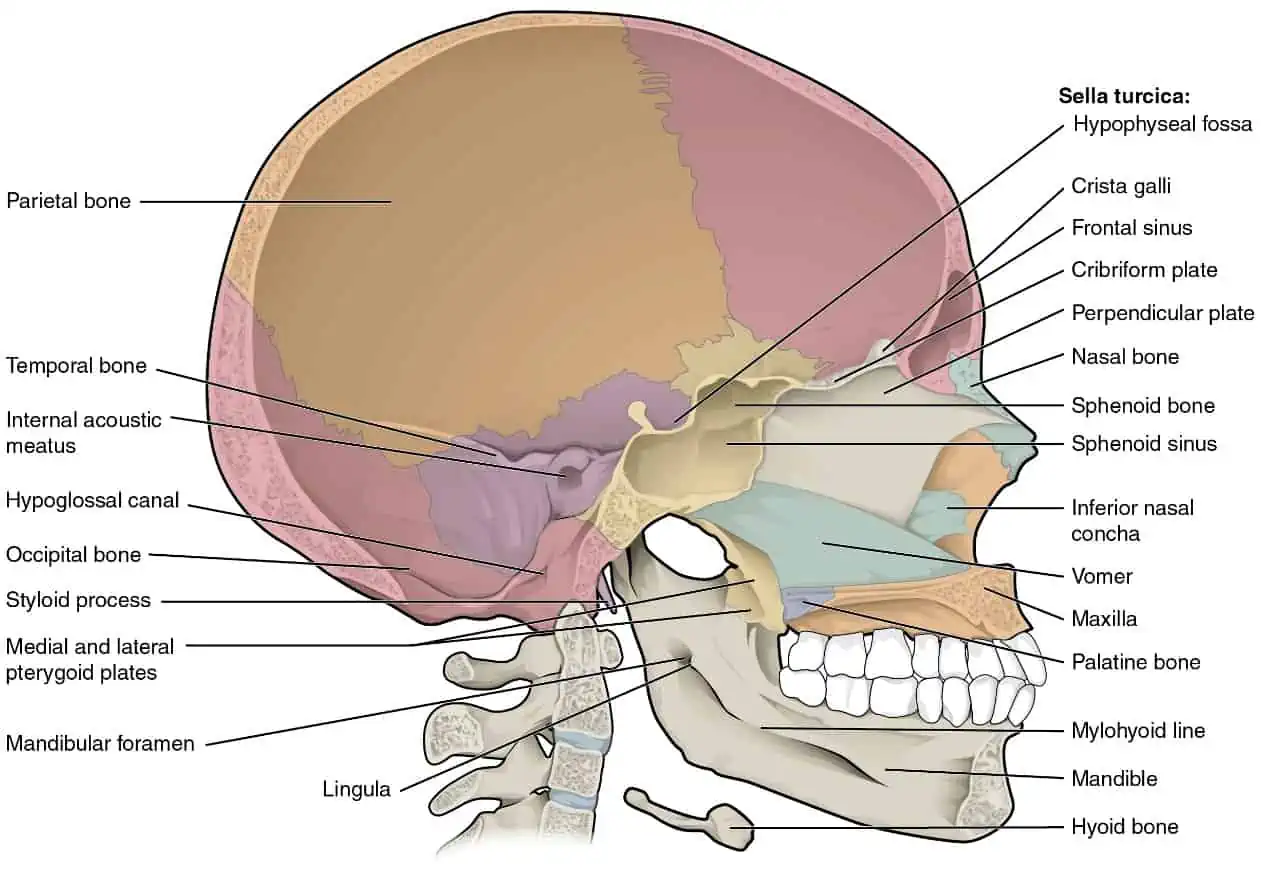
The skull images of this case studies has been presented in different anatomical planes, that is transverse, sagittal and frontal planes. Moreover, different anatomical directions has been applied in the imaging of the case study skull such as the frontal, lateral, posterior and superior anatomical directions. The anatomical structures of the skull has been labelled in the diagram for easier comprehension. A contrast media particularly a colored imaging is also helpful especially in the superior view of the cranium to differentiate the lobes, fissures, canals, openings and the sutures
1.3 Detailed annotation of all normal anatomy demonstrated on each image
1.3.1 Anterior view of the skull
The skull’s anterior view consisted of the facial bones in addition to supporting the structures and eyes of the face. The anterior view of the skull is majorly dominated by the orbits openings and nasal cavity. Also present are the lower and upper jaws and their respective teeth as shown in Figure 1. The orbit in the anterior part of the skull is the socket housing the eyeball and the neighbouring muscles that assist in the movement of the eyeball or opening the upper eyelid. Supraorbital margin is the anterior orbit’s upper margin. Supraorbital foramen is a small opening located near the supraorbital margin mid-point. Supraorbital foramen provides a passage for the skulls sensory nerve to the forehead skin. Infraorbital foramen is located below the orbit and is the emergence point for the sensory nerve supplying the anterior face just below the orbit (OpenStax, n.d).
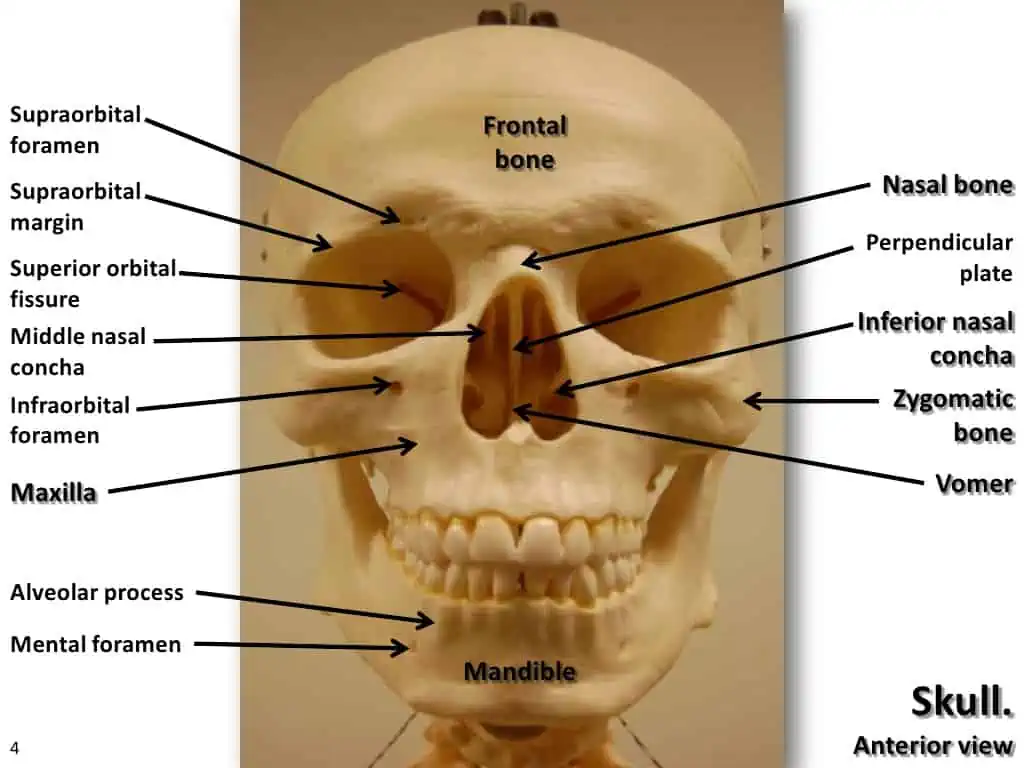
Figure 1: Frontal view of the skull
Inside the skull’s nasal area, the nasal septum divides the nasal cavity into halves. The perpendicular plate of the ethmoid bone forms the nasal septum’s upper portion and Vomer bone forms the lower portion. Every side of the nasal cavity has shape of a triangle, with a broad inferior space narrowing superiorly. Closely looking into the nasal cavity from the skull’s front, there are two projecting bones from each lateral wall. Inferior nasal concha is the larger among these projecting bones and it is an independent skull bone (Roberts & Manchester, 2010). Middle nasal concha is located above the inferior nasal concha, and it forms part of the ethmoid bone. Lastly, superior nasal concha which is the third bony plate and also part of the ethmoid bone is out of sight and smaller and is located above the middle concha. The location of the superior nasal concha is in the upper nasal cavity and lateral to the perpendicular plate as shown in Figure 1 (OpenStax, n.d).
1.3.2 Lateral view of the skull
The lateral view of the skull is dominated by the rounded, large brain case above and the lower and upper jaws with their teeth as shown in Figure 2 and 3. Zygomatic arch is a bridge of bone that separates these areas. OpenStax (n.d) defined zygomatic arch as the bony arch located on the side of the skull spanning from the areas just above the cheek to the area above the ear canal. Zygomatic arch is formed by two bony processes junction: zygomatic bone temporal processes (cheek bone) which is a short anterior component and the zygomatic process of the temporal bone which is longer posterior portion that extends from the temporal bone forward (OpenStax, n.d). Therefore, the zygomatic process (posteriorly) and the temporal process (anteriorly) join together to form the zygomatic arch. OpenStax (n.d) pointed out that one of the major muscles pulling the mandible during chewing and biting upwards originates from the zygomatic arch.

Figure 2: Lateral view of the skull.
According to White & Folkens (2005), on the brain case ‘lateral side, there is a shallow space above the zygomatic arch level called the temporal fossa. Additionally, deep to the mandibles deep portion and belwo the zygomatic arch level is another space referred to as the infratemporal fossa. Larsen (1997) stated that both infratemporal fossa and temporal fossa contain muscles acting on the mandible during the process of chewing.
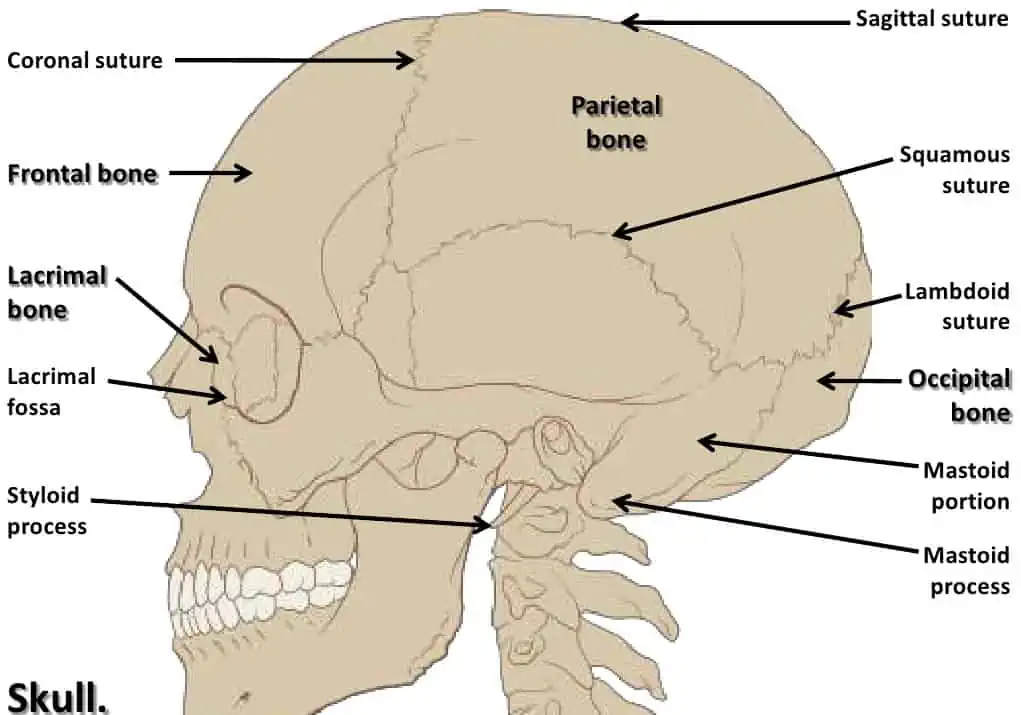
Figure 3
1.3.3 Internal and external views of the skull base
Part (a) of Figure 4 shows the hard plate that is anteriorly formed by the maxilla bones ‘palatine processes and posteriorly by the palatine bones ‘horizontal plate. Part (b) of Figure 4 shows the complex cranial cavity floor that is formed by ethmoid, frontal, temporal, sphenoid and occipital bones. The sphenoid bones’ lesser wings separates the middle and anterior cranial fossae. In addition, the petrous ridge (temporal bones petrous portion) separates the posterior n and middle cranial fossae.
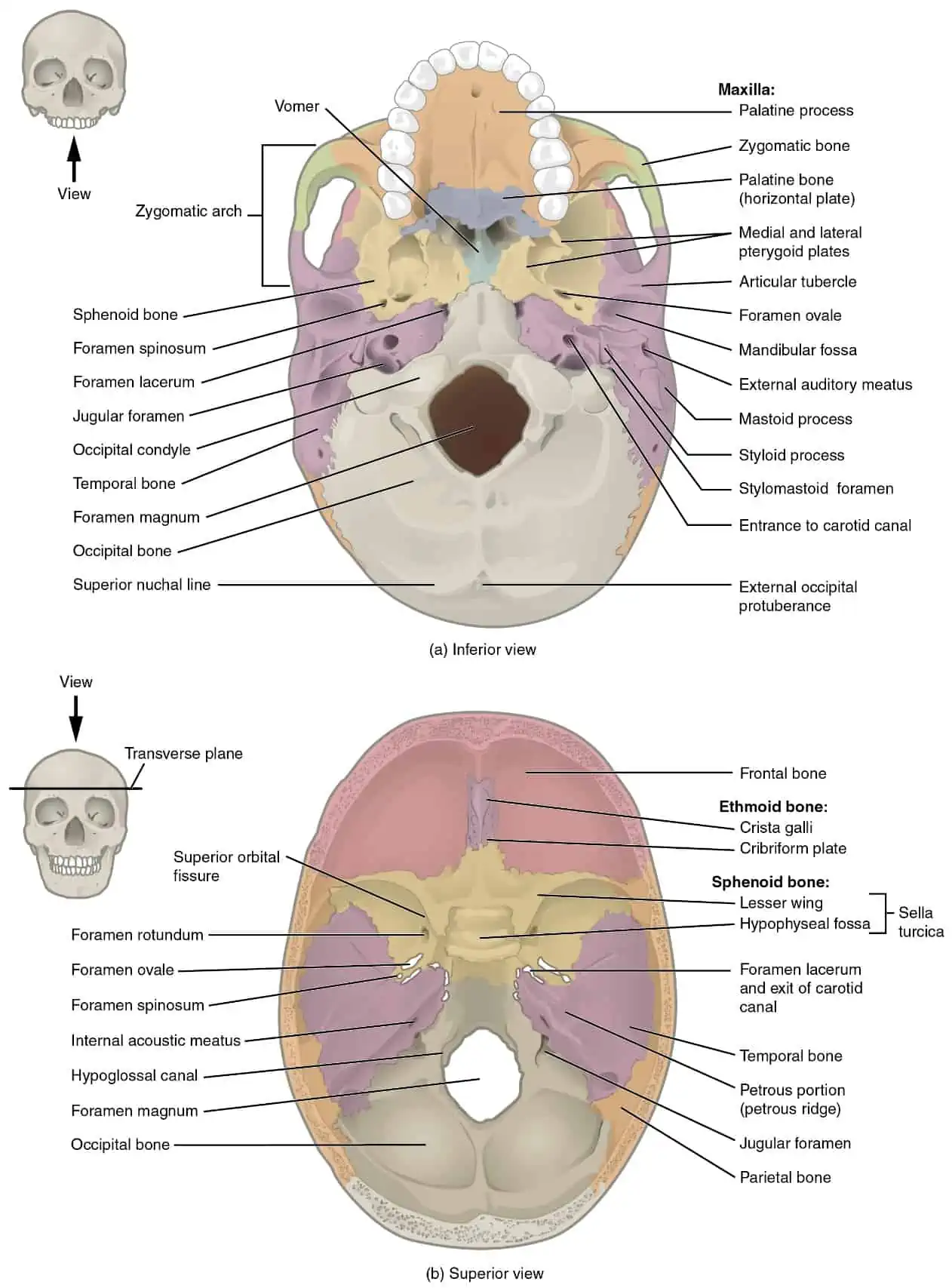
Figure 4: Internal and external parts of the skull
1.3.4 Sutures of the skull
According to Mays (1999), suture is a joint between skull adjacent bones that are immobile. The narrow gap that exists between the bones is filled with fibrous connective dense tissue that unites the bones. Roberts & Manchester (2010) pointed out that the long sutures found on the brain case bones are not straight rather follow tightly twisting irregular paths. The twisting lines serve the purpose of tightly interlocking the adjacent bones hence providing additional strength to the skull for protection of the brain
Sagittal and coronal sutures are found on top of the skull. The coronal suture runs across the skull side to side, within the coronal plane as shown in Figure 3. Moreover, it joins the left and right parental bones to the frontal ones. The sagittal suture, on the other hand, posteriorly extends from the coronal suture and runs along the midline at the skull’s top in the sagittal plane as shown in Figure 3, 6 and 7. Sagittal sutures unites the lefts and the right parietal bones (White & Folkens, 2005).

Figure 5
Figure 6
On the skull’s, the sagittal suture ends by joining the lambdoid suture which extends laterally and downwards to either sideway from where it meets with the sagittal suture. The lambdoid suture runs and joins the occipital bone to the left and right and temporal bones as shown in Figure 3 and 5.
The squamous suture is found on the lateral skull and it unites the parietal bone with the temporal bone’s squamous portion as shown in Figure 3.pterion is located at the four bones intersection and is a small suture line region that is capital H shaped uniting the parietal, frontal, temporal bone’s squamous portion, and sphenoid bone’s greater wing. Pterion is the skull’s weakest part (Larsen, 1997).
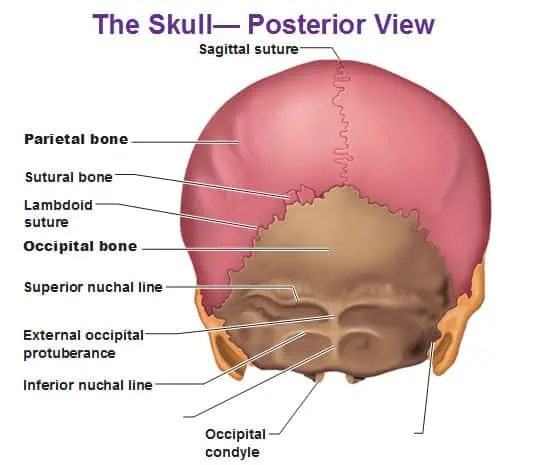
Figure 7
Sagittal section of the skull
2.0 Case study 2: Thoracic cage
2.1 A brief justification
The thoracic cage consist of ribs paired in 12 sets or curved bones surrounding the chest region. The thoracic cage helps in protecting the blood vessels and the vital organs in addition to expanding and contracting alongside the lungs for efficient breathing. Thoracic cage was chosen as case study in this paper because of its significant role in protecting the vital body organs such as the heart and lungs. The rib cage also helps assists during breathing using the intercostal muscles which lifts and lower the rib cage. The first seven ribs in the thoracic cage are referred to as the true ribs (Flynn, 1996).the ribs are directly connected to the sternum via costal cartilage which adds elasticity to the whole thoracic cage allows the ribs to move. The other five remaining ribs are referred to as the false ribs (Hale et al, 1983). Three ribs out of the false ribs are connected to the sternum via cartilage while the remaining two are not connected to the sternum but only the vertebrae hence referred to as the floating ribs as shown in Figure 8 (Kenyon, 1989).

Figure 8
Generally, ribs of the human being beings increase in length from rib one to rib seven and start decreasing n length again up to rib 12. Because of the change in size, the human ribs progressively become slanted (oblique) from rib one to rib nine, then again less slanted to rib 12.
2.2 Overview & review of the imaging protocol performed
The imaging protocol used in this study varied to give a clear view of different anatomical labels and directions of the thoracic cage. First, some x-ray was used as an imaging protocol to show the rib cage bones and the upper part of the spinal cord. Additionally, the images has been taken from different views which included rib projection on expiration, on inspiration and during fast and slow breathing. The views of the images in this case study were also taken at 300 and 450 angles sequentially in anterior oblique positions. The images of this case study also indicate that the subjects were standing in erect positions. Other imaging techniques used include line sketch images, CT scan, Ultra sound and bone scan.
The images are presented in different anatomical planes such as sagittal, frontal and transverse planes. The anatomical regions of the images are labelled clearly in each image for distinction. Contrast media were also used in some images to help in distinguishing key anatomical structures pertinent to each individual anatomical region of the thoracic age
2.3 Detailed annotation of all normal anatomy demonstrated on each image
2.3.1 Anterior view of the thoracic cage
On the anterior view of the thoracic cage is the sternum which is made up of the Xiphoid process, corpus Sterni and the Manubrium and the ribs forming the thoracic cage. From rib one to rib seven, the ribs normally increase in size and then decreases from rib seven to rib twelve (White & Folkens, 2005). The upper seven ribs on each side of the thoracic cage distally directly connect to the sternum. Additionally, the last two ribs referred to as the floating ribs have short cartilage at their ends freely lying on the body wall sides. According to White & Folkens (2005), the basic anatomy landmark of the rib include the long shaft, neck, head and the tubercle articulating with the thoracic vertebrae as shown in Figure 9. In Figure 9 below, the ribs head are medial while the sternal ends of the ribs are lateral. The cranial edge is the side that is superior while the caudal edge is the inferior part. Each pair of the ribs in the thoracic cage posteriorly articulates with the thoracic vertebrae. Costovertebral joints are the joints where the ribs articulates with the vertebrae. Flynn (1996) pointed out that on the anterior side of the thoracic cage, only the first seven ribs directly articulates with the sternum at the costosternal joints and they are referred to as the true ribs, while the rest are referred to as the floating ribs

Figure 9
Some of the distinctive elements of the thoracic cage include the following
- The first rib is the most unusual and can be easily be identified. Is normally thick, broad and blunt and that ribs has no caudal groove as observed by Roberts & Manchester (2010).
- The second rib serves as an intermediary to the first and the third rib up to the ninth ribs that are more regular. This rib also has a tuberosity that is large for the anterior serrator muscles half way long its length
- The eleventh rib has a sternal end that is often pointed and lacks the tubercle
- The twelfth rib is shorter compared to the eleventh rib and sometimes can be even be shorter that the first rib. Moreover, it lacks the costal and the angle groove and is identifiable easily (Mary, 1999).
Sternum
The sternum is made up of the three bones; the Xiphoid process, corpus Sterni and the Manubrium. As shown in Figure 10 and 11, there are seven facets laterally locates for the anterior of thoracic cage’s true ribs alongside manubrium and sterni. The manubrium is the squarest and thickest section of the sternum bones and is easily identifiable. At the superior corners of the manubrium are the clavicular notches which articulates with the lefst and right clavicles. The scapula and the clavicles helps in forming the shoulder girdle (Hale et al, 1983).

Figure 10
Compared to the manubrium. Corpus sterni is thin and is bladelike. Moreover, there is presence of costal notches and they cover for the second to seventh rib as shown in Figure 11. Lastly, the xiphoid process is inferiorly located to the corpus sterni. Xiphoid process in the sternum shares the seventh costal north and highly variable in shape (Kenyon, 1989).
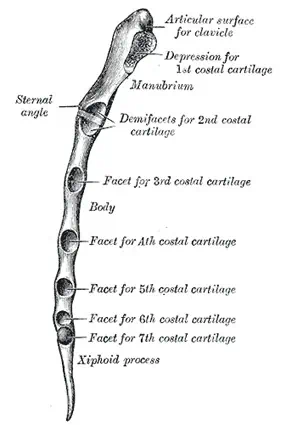
Figure 11
Costal cartilage
They make up the ribs medial portion on the anterior side to be more flexible as shown in Figure 12. The thoracic arch, which is a landmark on the surface is entirely made up of the costal cartilage.

Figure 12
Thoracic vertebrae
It runs down the posterior thoracic cage midline. Flynn (1996) indicated that the twelve thoracic vertebrae found on the posterior of the thoracic cage are regarded as part of the thoracic cage and the spinal column. Additionally, thoracic vertebrae are the only vertebrae in the spinal column with costal facets which makes sense because there is no any other kind of vertebrae which articulate with the ribs as shown in Figure 12 (Hale et al, 1983).
Case study 3: Arm skeleton
A brief justification
The bones of the hand and the arm have the critical job of providing the muscles attachment points moving the upper limb and also supporting the upper limbs. The arm skeleton was selected for this case study because these bones of the arms form joints which offer flexibility and wide range of motion that is needed to manipulate objects with the hand and arm deftly. The bones of the arms also provide strength to resist stresses and forces that are extreme and at upon the hands and arms during exercises, sports and heavy labour (Parker & Dowell, 1988).
Overview & review of the imaging protocol performed
The imaging protocol performed on the arm skeleton anatomy to best demonstrate the relevant anatomy to enable answering of the clinical question poised for the case study three. The images included different anatomical regions of the arm skeleton such as the clavicle, scapula, humerus, ulna, radius, phalanges, carpals, metacarpals and the joints. The images presented in the case study has been presented in different anatomical planes and direction. First, coronal and transverse planes are evident in the images in this case study three. Contrast media has not be used in these case study images like the way earlier case studies used the contrast media. However, some of the images in this case study used colored background to bring out the aesthetic beauty of the images. Moreover, the images has also used the line drawings to best illustrate the anatomical regions and easier understanding of the labels of the images.
Detailed annotation of all normal anatomy demonstrated on each image
The pectoral girdle which consist of the clavicles and the scapula forms the point of attachment between the arm and the chest. The clavicle is a long bone connecting the scapula to the sternum if the thoracic cage. According to Green (2006), clavicle forms two joints, that is the sternoclavicle joint formed with the sternum and the joint formed with the scapula’s acromion called acromioclavicular. The clavicle bone allows the shoulder joint to remain attached to the chest bones while moving in circles as shown in Figure 13
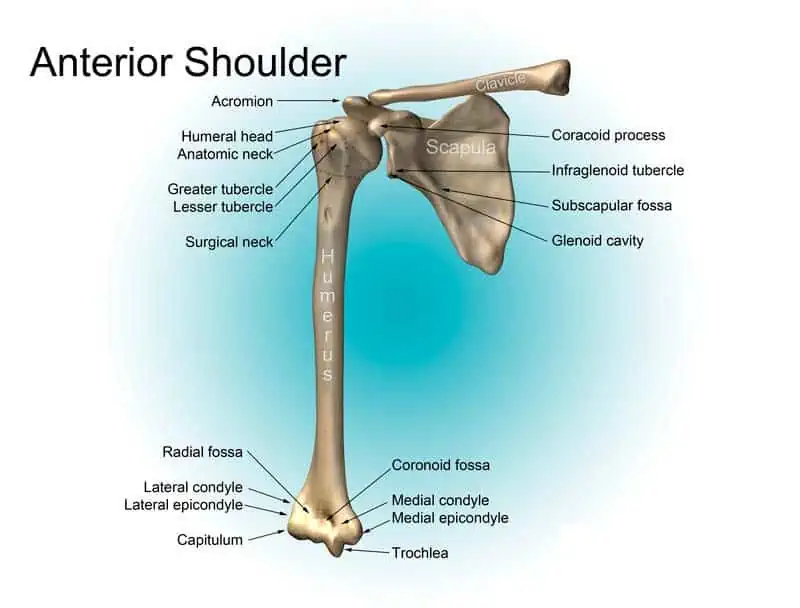
Figure 13
Scapula lies posteriorly to the clavicle and is a triangular flat bone that is located laterally to the thoracic spine in the body’s dorsal region. Parker (1989) indicated that the scapula forms two joints, that is the humeroscapular or shoulder joint with the humerus and the acromioclavicular joint with the clavicle. The glenoid cavity is situated on scapula’s lateral end and forms the socket for the shoulder joint that is ball and socket. Several muscles attach the scapula and assist in moving the shoulder as shown in Figure 13 and 14
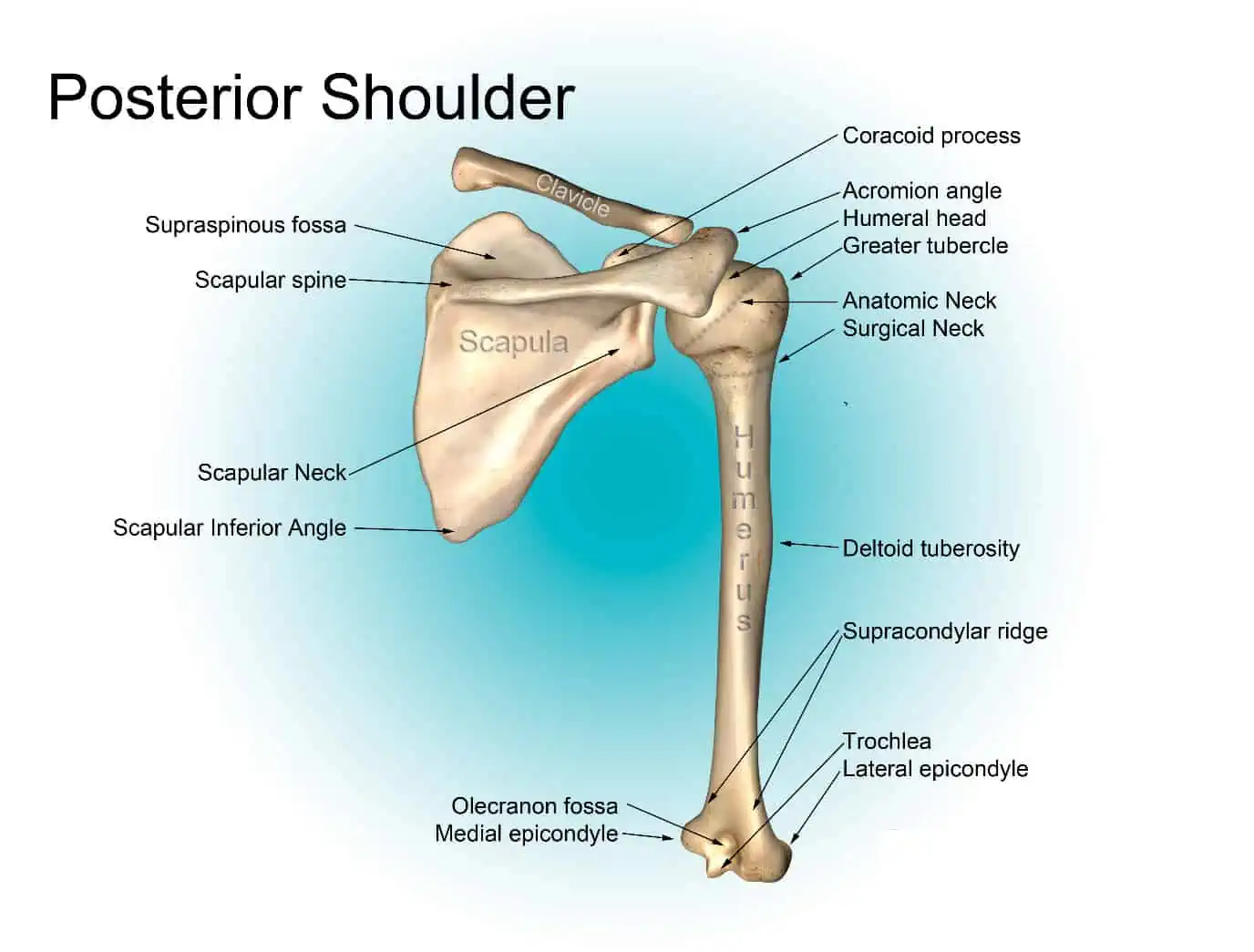
Figure 14
Parker & Dowell (1988) stated that the humerus is the only bone found in the upper arm. It is a large long bone extending from the scapula of the shoulder to the radius and ulna of the lower arm. The humerus proximal end also referred to as the head is a round structure forming the shoulder joint’s ball and socket. On the distal end of the humerus, it forms a cylindrical wide process that meets the radius and ulna to form the elbow joint’s inner hinge as shown in Figure 13, 14 and 15. The deltoid, pectoral, rotator cuff and latissimus dorsi attach to the humerus to raise, rotate and lower the shoulder joint’s lower arm.
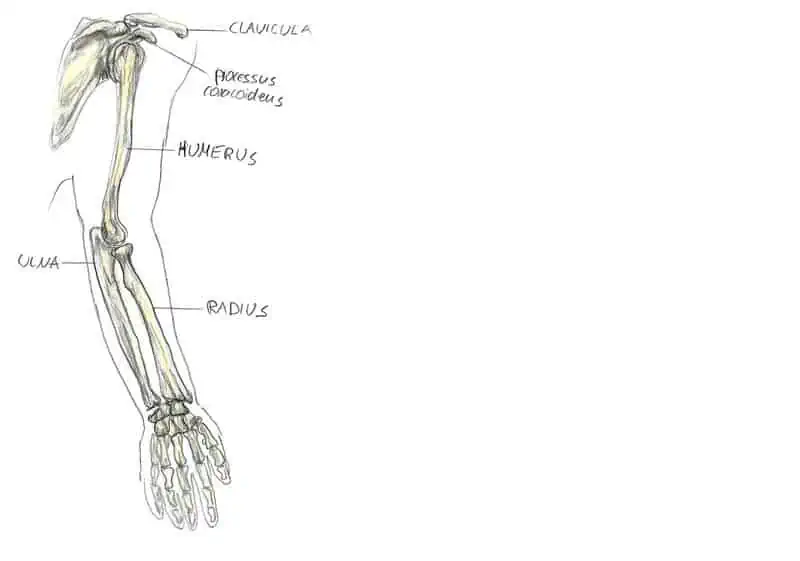
Figure 15
The forearm contains two parallel, long bones: the radius and the ulna. Between the two bones, ulna is the larger and longer residing in the medial side of the forearm. Green (2006) asserted that at the proximal of the ulna, it is widest and considerably narrows to the distal end. Furthermore, at the proximal end of ulna, it forms the elbow joint hinge with the humerus. Olecranon is the ulna’s end and it extends past the humerus forming the elbow’s bony tip. Ulna bone also forms a wrist joint at its distal end with the carpals and the radius as shown in Figure 15 and 16

Figure 16
When comparison is made to the ulna, the radius is slightly thinner, shorter and located at the forearms medial side. The radius bone at the elbow is narrowest and widens as it is extending towards the wrist. The radius rounded head at its proximal end forms the pivoting pint at the joint of the elbow that allows lower arm and hand rotation. Additionally, the radius at its distal end is much wider compared to the ulna and forms the wrist joint bulk with the carpals and the ulna (Parker, 1989). The radius distal end also rates around the ulna wen the forearm and hand rotate as shown in Figure 17

Figure 17
Parker & Dowell (1988) pointed out that despite the hand being such a small body region, it contains 27 tiny bones and many joints that are flexible.
- The carpals are collection of eight bones that are cube shaped roughly in the hand’s proximal end. Together with radius and ulna, they form the wrist joint and also forms joints with the palms metacarpals. Green (2006) asserted that carpals forms many small joints that are gliding with each other to provide extra flexibility to the hand and wrist as shown in Figure 17 and 18
- The five cylindrical, long metacarpals forms the palms supporting bones of the hand. Every metacarpal forms a joint with proximal phalanx of a finger and another joint with the carpals. Parker (1989) indicated that metacarpals have the ability of abducting to spread the palm and fingers apart and can also adduct to bring the palm and the fingers together. Additionally, metacarpals provide flexibility to the hand when touching the thumb, gripping an object and when pinkly fingers together as shown in Figure 16 and 18.
- The phalanges according to Parker & Dowell (1988), are a collection of 14 bones that move and supports the digits. Every digit has three phalanges that is the distal, middle and the proximal, except the thumb which only has the distal phalanx and the proximal phalanx. Green (2006) defined phalanges as long bones forming hinge joints between themselves and also the oval (condyloid) joints with the metacarpals. These joints allows the extension, flexion, abduction and adduction of the digits as shown in Figure 16, 17 and 18

Figure 18
Case study 4: The human Heart anatomy
A brief justification
The heart is a muscular body organ that operates as the circulatory pump of the body. The heart is located posterior to the sternum and medial to the lungs in the thoracic cavity (Boyd, 2003). The heart was chosen for this case study for its significance to the human body’s circulatory system. According to Lapatza et al (1994), the heart takes the deoxygenated blood in through the veins and then deliver it to the lungs where it is oxygenated before pumping it back into different arteries. These arteries provide nutrients and oxygen to the tissues of the body by transporting the oxygenated blood throughout the body.
Perin (1983) indicated that at the superior end of the heart is attached to the pulmonary vein, aorta and vena cava. On the other hand, the apex or the heart’s inferior tip just rests to the superior of the diaphragm. The heart’s base is situated along the midline of the body with its apex pointing to the left side. Therefore, given that the heart points towards the left side, about two-thirds of the mass of the heart is found on the body’s left side and the other one-third is found to the right.
Overview & review of the imaging protocol performed
The heart organ discussed in this case is entirely made of cardiac muscles. Therefore, to different anatomical parts, the images presented in this case study used contrast media where the images were presented in different colours. In all the images of the heart in this case study, the part of the heart that transports the deoxygenated blood are painted in blue colour whereas the sections of the heart that transports the oxygenated blood has been indicated by the red colour. These contrasting colours used in the imaging protocol has been performed to best demonstrate the relevant anatomy to enable answering of the clinical question poised for the case. The images have been presented in coronal plane where anterior and posterior view of the heart has been presented. The major anatomical regions covered on the coronal plane include the major blood vessels of the heart, the chambers and surface features. On the images that shows the internal parts of the heart, anatomical structures include the internal muscles, valves and the vessels
Detailed annotation of all normal anatomy demonstrated on each image
Anterior and posterior view
The anterior and posterior view of the heart shows the organ lying in the coronal plane. The anatomical structures found on the anterior side of the heart are many. This section will annotate some of these anatomical structures of the heart (Boyd, 2003).
The pericardium which is a double walled sac encases the heart and it functions to protect the heart in addition to anchoring it within the chest region. The outer wall of the heart comprises of three layers: pericardium or the outermost wall layer, myocardium or the middle layer which contains the contracting muscles, and the endocardium or the inner layer which is the lining in contact with the blood (Boyd, 2003).
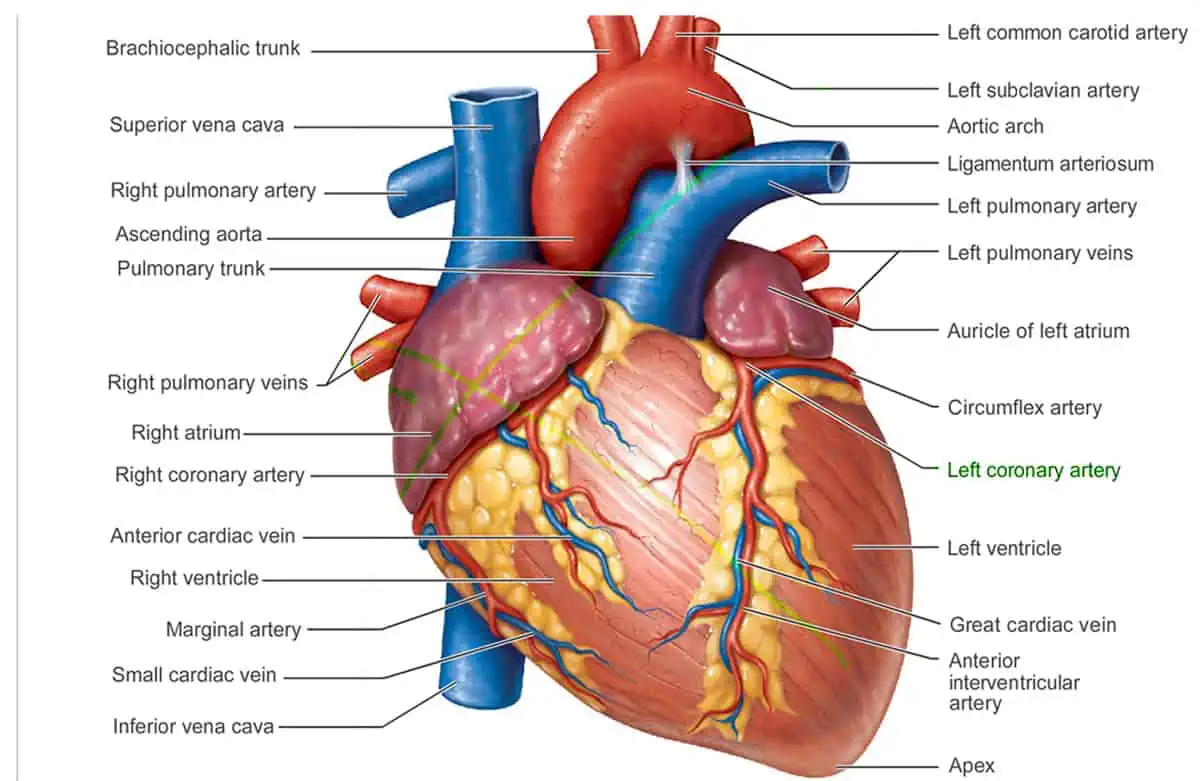
Figure 19
Coronary arteries- These are network of blood vessels that carry nutrient and oxygen rich blood to the cardiac muscle tissue. The heart muscles according to Lapatza et al (1994) is primarily composed of cardiac muscle tissue that contract and relax continuously and therefore must have supply of nutrients and oxygen constantly. The blood that leaves the left ventricle of the heart exits through the aorta, the main artery of the body. The two major coronary arteries known as the right and left coronary arteries emerge near the top of the heart from the beginning of the aorta the left main coronary which is the initial left coronary artery segment branches into two smaller arteries: the left circumflex coronary artery and the left anterior descending coronary artery which is embedded on the hearts front side on the surface. On the other hand, the left circumflex coronary artery is embedded on the hearts surface at the posterior side of the heart and circulates on the hearts left side
Perin (1983) pointed out that the coronary arteries progressively branch into smaller vessels which penetrate the heart muscles. The capillaries, which are the smallest branches are so narrow that only allows the red blood cells to travel only in single file
Superior vena cava- Is one of the major veins that brings de-oxygenated blood to the heart from the body. The veins from the upper body parts and the head feeds into the superior vena cava and then are emptied into the hearts right atrium.
Inferior vena cava- It is one of the major veins that brings de-oxygenated blood to the heart from the body. The veins from the lower torso and the legs feed into the inferior vena cava and then are emptied into the hearts right atrium.
Coronary sinuses– they collect the draining blood from the myocardium.
Aorta- It is the single largest blood vessel in the human body. The vessel carries blood that is rich in oxygen from the left ventricle to different body parts (Boyd, 2003).
Pulmonary artery-It is the vessel that transports de-oxygenated blood to the lungs from the right ventricle
Pulmonary vein– it is the vessel that transport blood that is rich in oxygen from the lungs to the left atrium
Right Atrium– it receives blood that is de-oxygenated from the body from both superior and inferior vena cava. It also allows the collected deoxygenated blood to flow into the right ventricle
Right Ventricle– it receives blood that is deoxygenated from the right atrium as it contracts. Moreover, it pumps the blood towards the lungs through the pulmonary vein
Left atrium– it receives blood that is oxygenated from the lungs through the pulmonary vein. It also passes the oxygenated blood to the left ventricle (Lapatza et al, 1994).
Left ventricle- it receives blood that is oxygenated as the left atrium contracts. The left ventricles contract when it is full with blood allowing the blood to flow throughout the body through aorta. The ventricles (right and left) of the heart are the discharging chambers or the hearts actual pumps. Compare to the atria, the ventricles’ walls are larger and upon contraction, they propel blood into circulation out of the heart. The right ventricle of the heart pumps blood into the pulmonary human trunk, which directs the blood to the lungs for gaseous exchange (Lapatza et al, 1994).

Figure 20
The human heart has four cambers, which is the two inferior ventricles and the two superior atria. The inter-atrial septum is an internal partition dividing the heart longitudinally and the inter-ventricular septum separates the ventricles. Perin (1983) stated that the right ventricle of the heart forms the most of hearts anterior surface whereas the heart apex is formed by the left ventricle.
On the surfaces of the heart, two grooves indicates the heart’s four chambers. The atrioventricular groove also referred to as the coronary sulcus encircles the atria and ventricles junction like the crown. Similarly, the anterior interventriculae sulcus marks the septum anterior position and cradles the anterior interventriculae artery where the left and right ventricles separate. This continues as the posterior interventriculae sulcus, that marks a similar position on the surface of the poseroinferior. Auricles are the only surface feature found on every atrium and it is wrinkled, small appendage (Boyd, 2003).
Internal view of the heart
Internally in the heart, the right atrium of the heart has two basic parts: that is a smooth anterior and posterior portion in which muscle tissue bundles form ridges on the wall. These bundles of muscles are referred to as the pectinate muscles. The anterior and posterior region of the right atrium are separated by crista terminalis, which is a C-shaped ridge. Contrastingly, the left atrium is almost wholly smooth and the auricle is the only region with pectinate muscles additionally, the interatrial septum has a shallow depression referred to as the fossa ovalis, which marks the spot where foramen ovale, an opening, existed in heart of a foetus. This opening closes after birth (Lapatza et al, 1994).
The irregular muscle ridges referred to as the trabeculae carneae mark the ventricular chambers inner walls. Moreover, the papillary muscles which is another bundles of muscles project into the cavity of the ventricles and play a role in function of the valve

Figure 21
Heart valves
The heart has four valves which enforce one way traffic of blood flow. The atrioventricular (AV) valves are two and prevent backflow of blood into the atria chamber when the ventricles pump or contracts. The tricuspid valve or the right AV valve has three cusps which are flexible whereas the mitral valve or the left AV valve or the bicuspid valve has two cusps. Chordae tedineae are collagen chords that are attached to each flap of AV valve, and they help in anchoring the cusps to the papillary muscles. Perin (1983) indicated that the papillary muscles and the chordae tendineae serve anchorage wires to the valve flaps during their closed positions as shown in Figure 22

Figure 22
Semilunar (SL) valves– the pulmonary and aortic semilunar valves guard largest arteries bases that stem from the ventricles and prevent backflow into the respective ventricles. Each valve has crescent moon shaped three cusps. The SL valves open and close due to pressure differences as shown in Figure 23


Figure 23
Case study 5: kidney anatomy
A brief justification
Kidneys are body organs that filters and dispose wastes from the body system. The kidney organ was selected for this case study because about a third of the blood that leaves the blood passes through it for filtration before flowing to the entire tissues of the body. Kidney organs are very vital to the human body to the point that any of them could result to rapid waste accumulation and even death. Kidney are found in pairs and located along the abdominal cavity’s posterior muscular wall. Brenner & Rector (1991) pointed out that the left kidney is slightly located superiorly than the right kidney because of the liver’s larger size on the right hand side of the body. Additionally, it lies behind the peritoneum lining the abdominal cavity. The perirenal fat, an adipose tissue surrounds the kidney organs and act as a padding for protection. Other reasons why kidney was chosen for the case study because of its further significant functions of electrolytes regulation, fluid regulation, acid-base balance and stimulation of production of the red blood cells. Moreover, kidneys serve in regulation of blood pressure through the renin-angiotensin-aldosterone system where it controls water reabsorption and intravascular volume maintenance. Lastly, kidney are very important as an anatomical organ since it reabsorbs amino acids and glucose in addition to having hormonal functions via vitamin D, calcitriol and erythropoietin activation (Resnick & Parker, 1982).
Overview & review of the imaging protocol performed
The selected images used in this case study has been presented in unique imaging protocol so as to bring out the relevant and distinctive anatomical parts of the kidney to enable answering the poised clinical questions presented in the case study. Majorly the images in this case study focused on the internal part of the kidney in sagittal plain and also slightly on the external features of the veins and arteries that connect with the kidneys. The key anatomical regions of the kidney presented in the images include the internal parts such as the kidney pelvis, cortex, blood vessels and tubules. Additionally, the nephron of the kidney and its anatomical structures have been shown. The most notable imaging protocol in the images is the contrasting colours used in the images to indicate different structures of the kidney.
Detailed annotation of all normal anatomy demonstrated on each image
The kidney organs are bean shaped with the concave side located medially and the convex side laterally located. The renal hilus, or the indented concave side of the kidney provides space for the ureter, renal vein and renal artery to enter the kidney as shown in Figure 24 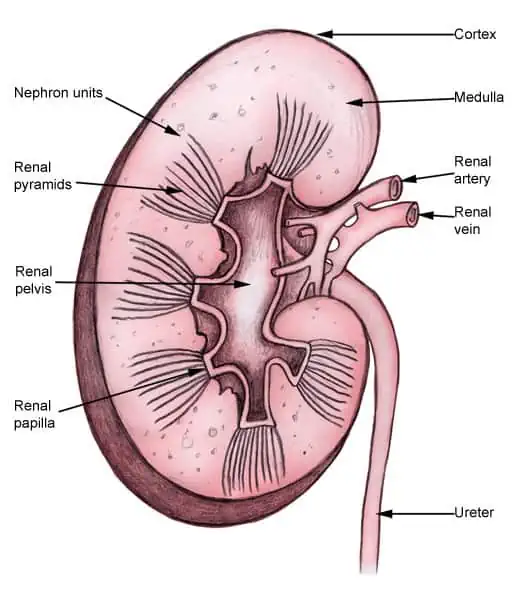
Figure 24
Sagittal plane
The thin fibrous connective tissue layer forms the surrounding renal capsule for every kidney. Graves (1971) stated that the renal capsule of the kidney provides the outer shell that is stiff to maintain the shape of the inner tissues that are soft as shown in Figure 25
Dense, soft vascular renal cortex are found deep in the renal capsule. The renal medulla is formed by seven cone shaped pyramids deep to the renal cortex. These renal pyramids are aligned with their apexes pointing inwardly toward the kidney’s centre, and their bases outwardly facing toward the renal cortex.
Each apex is connected to the minor carylx, which is a small hollow tube collecting urine. Kinne (1989) stated that the minor calyces then merge forming three larger and major calyces that also further merge forming the hollow renal pelvis and the kidney’s centre. The renal hilus, is the section which the renal pelvis exits, where the urine flows into the ureter.

Figure 25
The anatomy for the kidney’s blood supply is a network of both veins and arteries within the kidney organ. The renal arteries directly branching from the abdominal aorta enters into the kidneys via the renal hilus. The renal arteries inside the kidneys then diverge into afferent smaller arterioles of the kidneys. The afferent arterioles are connected to the renal cortex where they carry blood and separates into capillaries bundle referred to as the glomerulus. The blood recollects from the glomerulus into smaller efferent arterioles descending into the renal medulla. The renal tubules are surrounded by the peritubular capillaries which separated from the efferent arterioles. The peritubular capillaries merges to form veins which also further merge forming the larger renal vein, which exist the kidney and joining the inferior vena cava (Brenner & Rector, 1991).
The nephron
These are microscopic functional units of the kidney that filters blood to produce urine as waste. There are two main parts of the nephron: renal tubule and the renal corpuscle. The renal corpuscle is responsible for blood filtration and is formed by the glomerulus capillaries and the glomerular capsule or the Bowman’s capsule. Resnick & Parker (1982) indicated that the glomerulus is a bundled capillaries network that increases the blood surface area that is in contact with the walls of blood vessels. Glomerular capsule, which is a cup-shaped simple squamous epithelium which is double layered with a hollow space in between the layers, surrounds glomerulus. Podocytes which are special epithelial cells form glomerular capsule layer surrounding glomerulus capillaries. Podocytes work in conjunction with the capillaries’ endothelium to form a thin filter that separates urine from the blood that passes through the glomerulus. The glomerular capsule’s outer layer holds the separated urine from the blood within the capsule. Graves (1971) pointed out that at the glomerular capsule’s far end, opposite the glomerulus, is the renal tubule mouth
Series of tubes known as the renal tubule recover solutes that are non-waste from urine by concentrating urine. The renal tubule of the nephron carries urine to the renal pelvis from the glomerular capsule as shown in Figure 26

Figure 26
Case study 6: Liver anatomy
A brief justification
Liver organ is the second largest body organ and weighs about three pounds after the skin. The liver was selected for the case study because it performs several essential functions that are related to metabolism, digestion, storage of nutrients and immunity within the body hence making it a vital organ. These functions of the liver make it important without which the human body will die because of lack of nutrients and energy (Ryū, & Cho, 2009).
Overview & review of the imaging protocol performed
The three images used in this case study of the liver has applied contrast media to clearly show both external and internal anatomical structure of the liver. Clear presentation of the images has been done best demonstrate the relevant anatomy to enable answering of the clinical question poised for the case. The images presented the liver in the frontal plane which showed the anterior and posterior parts. Moreover, internal anatomical structure have also been shown. Some of the anatomical regions shown include the blood vessels, the four lobes, and the bile ducts among other minor anatomical regions
Detailed annotation of all normal anatomy demonstrated on each image
Frontal plane
The liver organ is grossly triangular extending across the whole abdominal cavity below the diaphragm. The liver is made of pinkish-brown very soft tissues that are encapsulated by a capsule of the connective tissue. The capsule is further reinforced and covered by the abdominal cavity’s peritoneum, which hold it in place and protects it within the abdomen (Gadžijev & Ravnik, 1996).
The peritoneum of the abdominal cavity connects the liver organ into four locations: the right and left triangular ligaments, coronary ligament and the falciform ligament. Self (2009) stated that the connections are not true or normal ligaments anatomically but are just peritoneal membrane regions that are condensed that supports the liver.
The liver is made up of four different and distinct lobes: quadrate, caudate, right and left lobes. The right and the left lobes are the largest and are separated by the falciform ligament. The caudate lobe that is small extends posteriorly of the right lobe wrapping around the inferior vena cava. Moreover, the quadrate lobe which is also small is inferior to the caudate lobe, extending posteriorly to the right lobe and wrapping around the gall bladder as shown in Figure 27
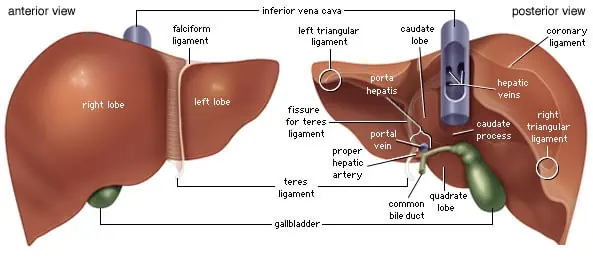
Figure 27
The bile ducts
These are tubes which carry bile through the gallbladder and liver and they form a biliary tree, which is a branched structure. Bile canaliculi are microscopic canals that join together to form many bile ducts, which also join together to form larger right and left hepatic ducts. These two hepatic ducts also join and form common hepatic duct which drains all the bile from the liver. Glisson et al (1994) pointed out that the common hepatic duct eventually joins the cystic duct which is from the gall bladder forming the common bile duct as shown in Figure 28.
Blood vessels
Because of the hepatic portal system, blood collected in the hepatic portal vein from the capillaries of the pancreas, stomach and spleen is delivered to the liver tissues where its contents are subdivided into smaller vessels and then processed before passing to the entire body. The blood that leaves the liver tissues collects in the hepatic veins leading to the vena cava and then heart. Additionally, the liver organ has its own arteries and arterioles system which provide its tissues with the oxygenated blood (Ryū & Cho, 2009).

Figure 28
Lobules
These are small hexagonal functional units found in the livers internal structure. Each lobule comprises of the central vein that is surrounded by six hepatic arteries and six hepatic portal veins. Sinusoids are capillary like tubes that connect these blood vessels, and extends from the arteries and portal veins to meet the central vein (Gadžijev & Ravnik, 1996).
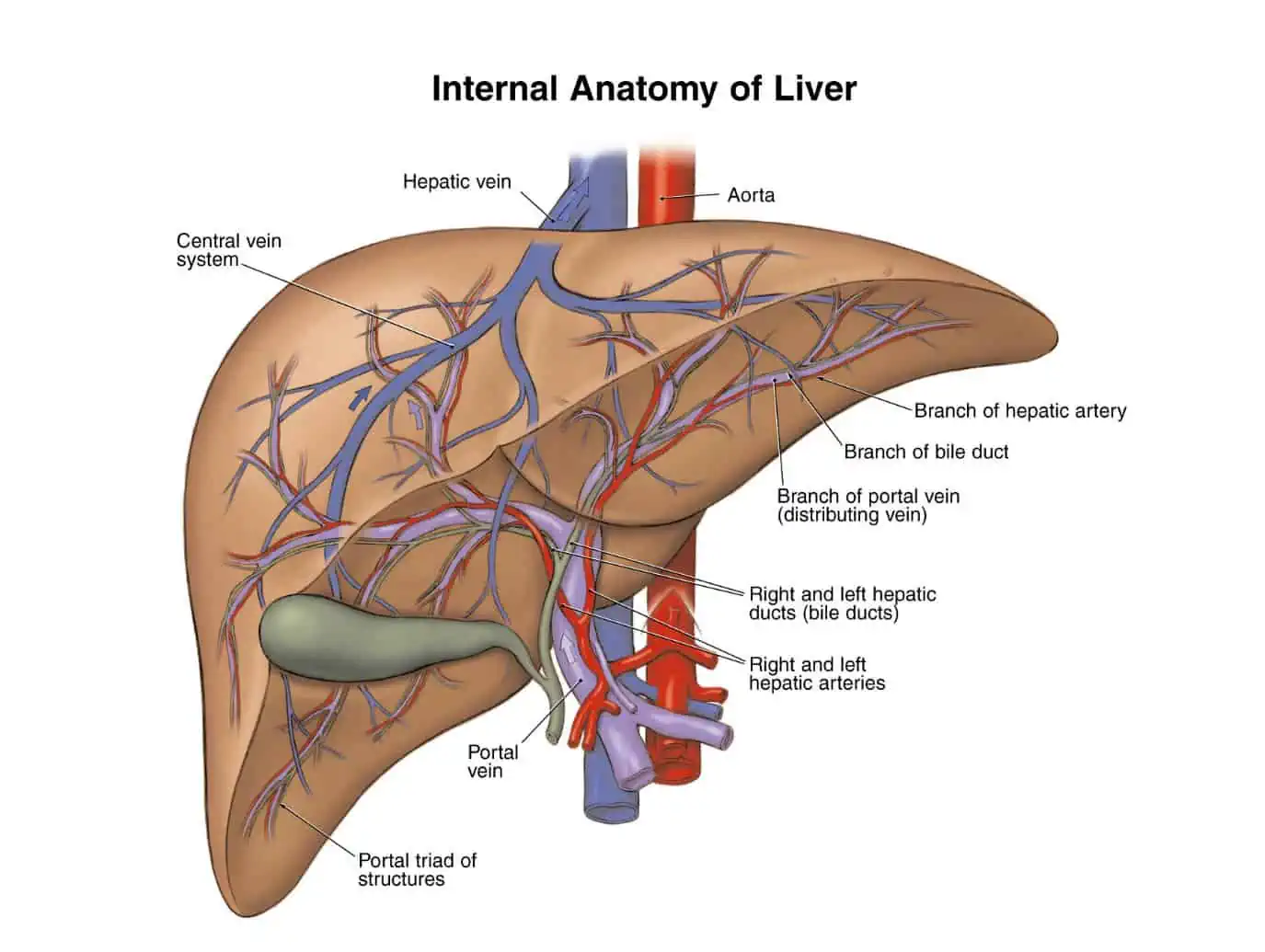
Figure 29
Case study 7: stomach anatomy
A brief justification
In the human body, stomach is the main storage tank of food. The stomach organ was chosen as a case study because of its significance to the body and the digestion system. Were it not for the storage capacity of the tank, then human beings would have to constantly eat. The stomach is also important in that it secretes digestive enzymes, mucus and mixture of acid that helps in the sanitization and digestion of the food while still in the stomach (Templeton, 1964)
Overview & review of the imaging protocol performed
Different images has been presented for this case study to better illustrate the anatomy of the stomach. First, contrast media has been applied to better bring out the frontal plane of the stomach’s different regions. Moreover, other images have used colours in the 3-D images to better elaborate on the layers of the stomach organ. Different anatomical regions has been shown in the diagrams and labelled in the images that are in the frontal plane. Some of the major anatomical regions presented include the fundus, cardia, body, and pylorus. Internally, the major anatomical regions include the rugae of mucosa, the pyloric canal, serosa and muscularis.
Detailed annotation of all normal anatomy demonstrated on each image
Anterior view
Stomach organ is rounded and hollow and is located inferior to the diaphragm to the abdominal cavity’s left part. The stomach is located between the duodenum and oesophagus and is roughly crescent shaped gastrointestinal tract enlargement as shown in Figure 30.

Figure 30
The stomach’s inner layer has many wrinkles known as gastric folds or rugae which allows the stomach the stomach to expand and stretch so as to accommodate large meals in addition to helping in gripping and moving food during the process of digestion (Agur et al, 1999).
Based on function and shape, the stomach organ can be classified into four regions according to Wolf-Heidegger & Köpf-Maier (2006) as shown in Figure 30 above:
- The oesophagus that connects to the stomach at cardia, which is tube-like narrow region opening up into wider regions of the stomach. Lower Oesophageal sphincter located within the cardia, is a bundle of muscle tissue contracting to hold acid and food inside of the stomach.
- The body of the stomach connects with the cardia and it forms the largest and central region of the stomach
- Fundus is superior to the body and has a shape of dome
- Pylorus is a funnel shaped region and is inferior to the body. The pylorus connects duodenum to the stomach and also contains the pyloric sphincter which controls the flow of chime or partially digested food out of the stomach to the duodenum.
Microscopic view of the stomach
Microscopic imaging of the stomach organ structures shows that it is made of multiple, distinct tissue layers: serosa, muscularis, sub-mucosa and mucosa layers as shown in Figure 31
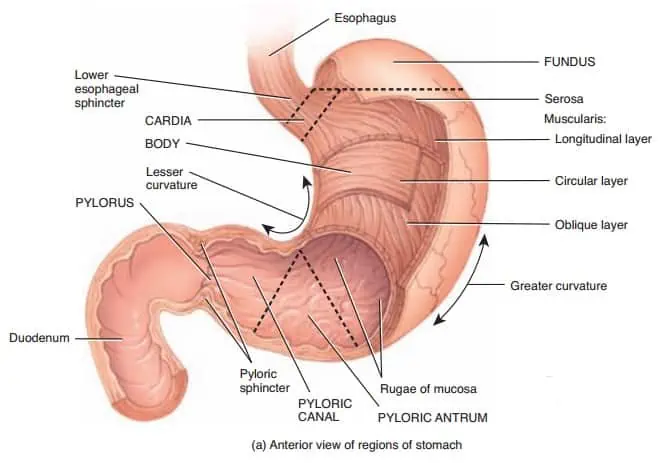
Figure 31
The mucosa is the stomach’s innermost layer made up of the mucous membrane. The stomach’s mucous membrane has simple columnar epithelium tissue with several exocrine cells. Muscularis mucosae is a thin layer of smooth muscle found deep inside the mucosa. The muscularis mucosae layer permits mucosa to form folds and also to increase its contact with the contents of the stomach (Templeton, 1964).
Sub-mucosa layer of the stomach surrounds the mucosa and is made up of different blood vessels, connective tissues, and nerves. The connective tissues of the submucosa supports the mucosa tissues and also connects it to the muscularis layer. Additionally, the supply of blood of the submucosa provides the stomach wall some nutrients (Agur et al, 1999).
The stomach’s muscularis layer surrounds the submucosa and forms the large amount of the mass of the stomach. Wolf-Heidegger & Köpf-Maier (2006) pointed out that the muscularis is made up of three smooth muscle tissue layers arranged with its fibres running in three different directions. These smooth muscle layers allow the stomach to contract, mix and move the food through the digestive tract.
Serosa is the stomach’s outermost layer surrounding the muscularis layer. Templeton (1964) defined serosa as a thin serous membrane that is made up of areolar connective tissue and the simple squamous epithelial tissue. Serosa has a slippery, smooth surface and secrets the serous fluid. The wet, smooth surface of serosa helps in protecting the stomach from friction wen the stomach is expanding with the food and also moves to churn and mix and propel the chime

Figure 32
Case study 8: Muscles of the arm and the Hand
A brief justification
The muscles found on the hand and the arm is designed specifically to meet the diverse needs of the body speed, strength and precision while completing several complex daily duties. This case study choose muscles of the arms and the hand because daily activities such as lifting heavy load such as the boxes and other weights requires arm muscles brute strength. Similarly, typing, paining and writing all require precision and speed from the same arm and hand muscles (Liberace, Lubkin, & Liberace Studio (Firm), 2013).
Overview & review of the imaging protocol performed
The imaging protocol performed in case study six varies depending on the image. Some of the imaging techniques applied in the images of this case study include use of the contrast colour images, line diagrams and CT scans that provided computerised images. all these techniques used in the imaging protocol has been applied to bring out the relevant anatomical regions in the arm and the hand body parts to enable answering of the clinical questions for the case study six. The images provided clear and distinct anatomical regions of the arm and the hand such as the upper arm muscles, shoulder muscles, forearm muscles and hand muscles that are relevant for the case. Moreover, the images are presented in different anatomical planes such as the frontal, and sagittal planes. Similarly, the images of the forearm have been presented in both posterior and anterior views to get better view of the inner muscles located in the arm and the forearm. However, these images as much as some of them were coloured, they lacked contrast colours to better distinguish specific muscles in a muscle group. For instance, in the triceps branchii, the image needs contrast media to distinguish individual muscles that comprise triceps branchi for clearer view.
Detailed annotation of all normal anatomy demonstrated on each image
The arm in human anatomy is the upper limb comprising of the body regions between the elbow joint and the glunohumeral joint (Chung & Steinbach, 2010). However, the arm is commonly used to refer to the arm and also the hand. The arm and the hand comprises of the upper arm, the forearm and the hand. Doyle & Botte (2003) indicated that anatomically, shoulder girdle is considered part of the arm. The muscles of the arm and hand are divided into anterior and posterior components. Moreover, other muscles also considered to be part of the arm include the deltoid muscle which has part of itself in the anterior compartment if the arm. The deltoid muscles extends over the shoulder is the major abductor muscle found in the upper limb. Another muscle is the branchioradialits muscle which originates from the arm and insert into the forearm. This muscle is responsible for supination or the rotation of the hand so that the palm can face forward as shown in Figure 33

Figure 33
The upper arm muscles are responsible for the extension and flexion of the forearm at the elbow joint. Liberace, Lubkin & Liberace Studio, (2013) indicated that forearm flexion is achieved by a three muscle group: the branchioradialis, biceps branchii and the branchialis. These flexor muscles are found on the upper arm anterior side and extend from the scapula and humerus to the radius and ulna of the forearm. In addition, the biceps branchii functions as forearm supinator by moving the palm of the hand and rotating the radius anteriorly as shown in Figure 34. The triceps branchi are located on the posterior side of the upper arm and it acts as the forearm extensor at the shoulder humerus and the elbow. As the name indicates, biceps branchii has three heads which originates from the scapula and the humerus. The three heads then merge and insert on the ulna’s olecranon as shown in Figure 34.

Figure 34
Chung & Steinbach (2010) pointed out that most of the muscles moving the fingers, hand and wrist are located on the forearm. These strap-like, thin muscles extend from the radius, ulna and humerus and insert into the carpals, phalanges and the metacarpals via long tendons as sown in Figure 35. The muscles located on forearm anterior side such as the flexor digitorum superficialis and the flexor carp radialis, forms the groups of flexor that flexes the hand as the wrists joints and each and every phalanges. Doyle & Botte (2003) indicated that the tendons of these muscles goes through a small corridor found in the wrist referred to as the carpal tunnels as shown in Figure 35
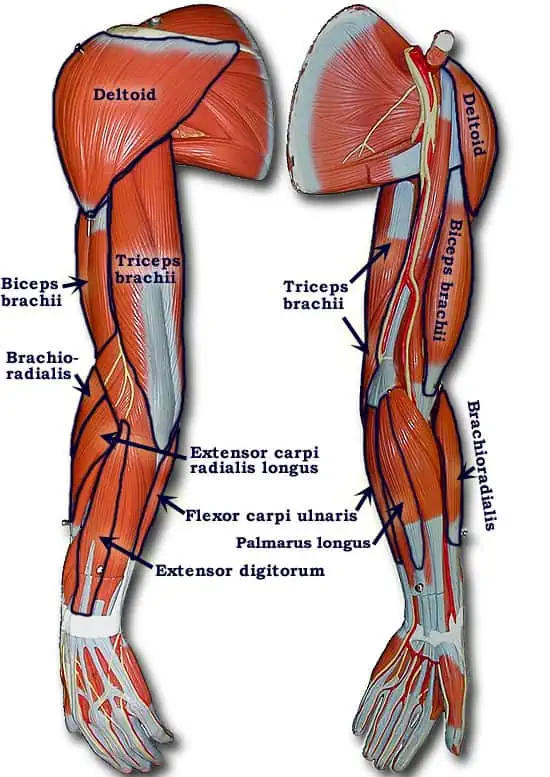
Figure 35
The extensor muscles on the posterior side of the arm such as the extensor digitorum, extensor carpi act as the antagonists to the flexor muscles found on the anterior side of the arm by extending the fingers and the hand. The extensor muscles run as thin, long straps from the humerus to the metacarpals and the phalanges as shown in Figure 36. Generally, extensors are somewhat weaker compared to the flexor muscles that they antagonize, because of the ease in opening a hand than gripping something firmly (Liberace, Lubkin & Liberace Studio, 2013).

Figure 36
Case study 9: Muscles of the leg and the Foot
A brief justification
Propelling, balancing and supporting of the human body is the work of the leg and foot’s muscular system. From the string and large muscles of the legs and buttocks to the fine, tiny muscles of the toes and feet, these muscles has the ability of exerting tremendous power while making small adjustments constantly for balance. This anatomical region of the human body was chosen for the case study because of the leg and foot muscles’ importance for the human movement and daily functions. It is the presence of the legs that human beings are able to be mobile and explore the environment for its own survival (Behnke & Donnelly, 2001).
Overview & review of the imaging protocol performed
The images of muscles of the leg and the foot of this case study has been presented in frontal anatomical plane. Moreover, different anatomical directions has been applied in the imaging of the case study leg muscles such as the frontal, lateral, posterior and superior anatomical directions. The anatomical structures of the muscles of the leg has been labelled in the diagrams for easier comprehension. Major anatomical structures identified include the quadriceps, hamstrings, soleus, gluteus muscle, Achilles tendon and the gastrocnemius. A contrast media particularly of colored imaging was also helpful especially in bringing out different anatomical parts in the muscles of the leg.
Detailed annotation of all normal anatomy demonstrated on each image
Anterior view and Posterior view
The anterior muscles of the leg such as the iliopsoas, quadriceps femoris and Sartorius function as a group to flex the hip thigh and also extend the knee as the knee joint. The posterior muscles such as the gluteus Maximus and hamstrings produce the opposite motion to the anterior muscles. That is thigh extension at the hip joint and leg flexion at the knee joint. The lateral muscles like the gluteus medius abduct the thigh region at the hip joint while the muscles of the medial groin adduct the thigh. These leg muscles elaborated provide powerful contractions to make the body move and also make fine adjustments for maintenance of the body posture and balance (Draves & Zelichowski, 1986).

Figure 37
On the lower part of the leg and the foot, there are a number of muscles that are located inferiorly to the leg and move the toes, foot and ankle. The muscles of the calf including soleus and gastrocnemius join and form the Achilles (calcaneal) tendon to the heel and also attach to the heel’s calcaneus bone. Shin muscles such as the extensor digitorium longus and tibialis anterior extends the toes and dorsiflex the foot. Additionally, the calf muscles subtly work to stabilize the foot and ankle joint so as to maintain the body balance (Gresczyk, 1967).
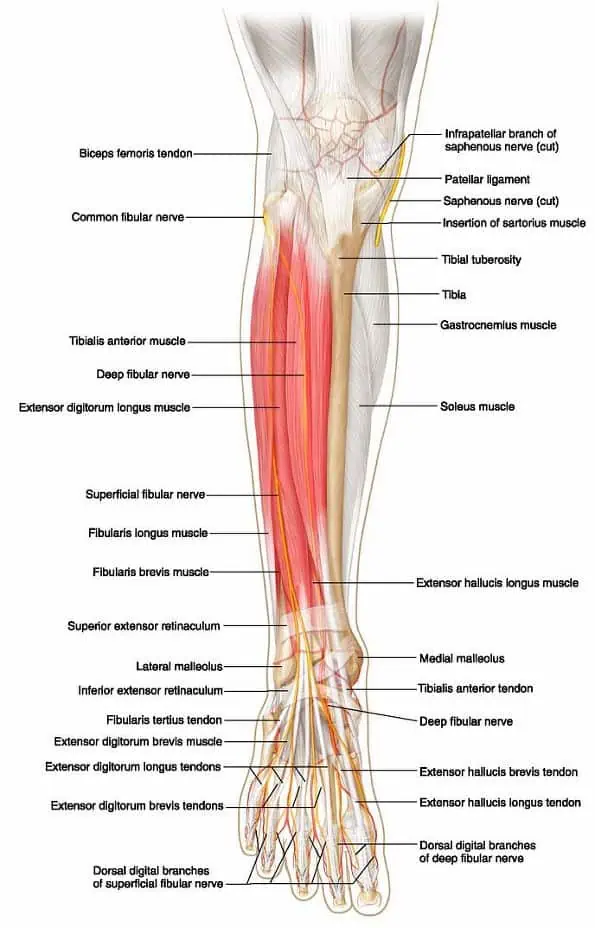
Figure 38
The largest leg muscles are present in the calf and thigh.
Quadriceps
Are the leanest and the strongest muscles in the body (MacConaill & Basmajian, 1969).quadriceps which is located on the front of the thigh is made up of four muscles and are the major knee extensors. They include:
- Vastus lateralis: it is the largest among the quadriceps and is located outside the thigh. In addition, it extends to the kneecap from the top of the femur.
- Vastus medialis-it is a muscle of the inner thigh that is tear dropped shaped and it attaches along the femur bone to the kneecap’s inner border
- Vastus intermedius– it is the deepest among the quadriceps and it lies between vastus lateralis and vastus medailis
- Rectus femoris– this muscle amongst the quadriceps it has the least effect on knee flexing and it attaches to the kneecap (Parker, 2004).

Figure 39
Hamstrings
These are the three muscles located at the back of the thigh and affect the movement of the knee and hip. They originate under the gluteus Maximus and attach to the knee to the tibia. They include:
- Biceps femoris– it is a long muscle that flexes the knee. It starts in the thigh area extending to the fibula head near the knee. It originates from ischium and back of femur. These fibres from two origins then joins and get attached to the head of tibia and fibula.
- Semitendinosus- it flexes the knee and extends the thigh
- Semimembranosus– this is a long muscle extending to the tibia from the pelvis. It flexes the knee, extends the thigh and helps in the rotation of the tibia (Behnke & Donnelly, 2001).
The muscles of the calf are significant to the toes, foot and ankle movement. Some of the major calf muscles include:
- Gastrocnemius (calf muscle) – it is one of the leg’s largest muscles connecting to the heel. It extends and flexes the foot, knee and ankle. This muscle originates from the back of femur and patella and join soleus and then get attached to the Achilles tendon at the heel
- Soleus– this muscle extends to the heel from the back of the knee. It is important in standing and walking
- Plantaris– the function of this thin, small muscle is superseded by the gastrocnemius muscles (Draves & Zelichowski, 1986).
Achilles tendon is the most important tendon found in the leg in terms of mobility. This tendon is located at the back of ankle and calf and connects the soleus, gastrocnemius and plantaris muscles to the heel bone (Gresczyk, 1967).

Figure 40
Adductor– are also referred to as the inner thigh muscles and they draw the body towards the median line. In the human thighs, there are three adductor muscles that are powerful and they include adductor longus, adductor Magnus and adductor brevis. These ribbon like muscles originate from the ischium and pubis which the pelvis lower portions and attach to the femur. Adductors muscles squeeze the thigh together and aid in flexion and rotation of the thigh (MacConaill & Basmajian, 1969).
Tibialis anterior– is a muscle strip that makes up the shin and assist in flexing the ankle to move the foot towards the knee.
Sartorius muscle-is ribbon like, narrow and long thigh muscle that begins at the pelvic girdle’s crest and obliquely extend down the front side and insert to the upper and inner portion of the tibia. It flexes the leg and thigh at the knee and outward femur rotation (Parker, 2004).
Figure 41 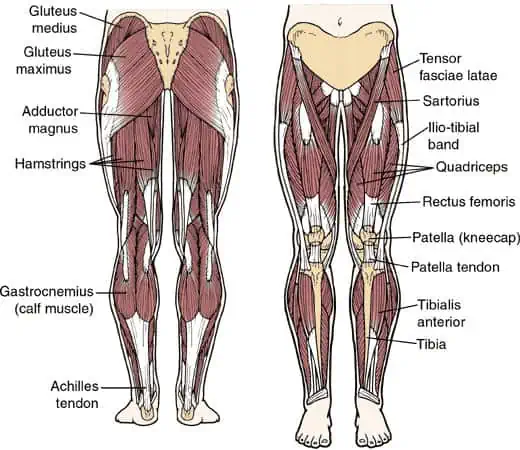
Gluteus muscle– it is the fleshy, large buttocks muscles that stretch from the pelvic girdle back portion down to the greater trochanter, which is the bony protuberance on femurs top. The gluteus muscle consists of three muscles which include:
- Gluteus maximus –is the thick, wide and large muscle at the buttocks surface originating at the ilium and the positions of the coccyx and sacrum. Its major functions is thigh extension such as climbing, running and arising from the sitting position. Moreover, it rotates the thigh outward (Behnke & Donnelly, 2001).
- Gluteus medius-is directly located under the gluteus Maximus and originates at the back of the ilium and stretches downward to the femur’s greater trochanter.
- Glueteus minimus– is located under the gluteus medius and also begin at the ilium and get attached to the femur. Gluteus minimus and gluteus medius abduct the thigh that is laterally pull away from the body’s midline. Additionally, they help in rotating inward the thigh (Draves & Zelichowski, 1986).
Case study 10: muscles of the hip
A brief justification
The human hip joint is one of the joints that is most flexible n the whole human body. The many hip muscles provide stability, strength and movement to the bones of the thigh and hip and the joint itself. These hip muscles can be categorised based upon their function and location. The hip muscles were chosen for this case study because the hip is the major joint that bears weight. Bearing of the body weight stress the hip when walking, running or jumping or even at rest. These large and strong hip muscles which move and support the hip is the major focus for this case study (Brungardt et al, 2006).
Overview & review of the imaging protocol performed
The imaging protocol used in this study varied to give a clear view of different anatomical planes, labels and directions of the hip muscles. First, the images has been taken from different views which included anterior and posterior view of the hip muscles at the thigh region. The views of the images in this case study were also taken at different angles sequentially in anterior oblique positions. The images of this case study also indicate that the subjects were standing in erect positions. The images are presented in different anatomical planes such as sagittal and frontal planes. The anatomical regions of the images are labelled clearly in each image for distinction. Contrast media were also used in the images to help in distinguishing key anatomical structures pertinent to each individual anatomical region of the hip muscles. Some of the anatomical regions identified has been grouped into four major muscles groups which include: the posterior group, anterior group, abductor group and adductor group
Detailed annotation of all normal anatomy demonstrated on each image
The muscles of the lower back and thigh work together in keeping the hip joint stable, moving and aligned. The muscles of the hip are divided into four distinct groups based on their location. The four categories include the posterior group, anterior group, abductor group and adductor group.
Frontal plane
The anterior group of muscles features the muscles which flex the thigh at the hip joint.these anterior group of muscles include:
- The quadriceps femoris group consisting of the vastus intermedius, rectus femoris, vastus medialis, vastus lateralis
- The iliopsoas group consisting of the iliacus muscles and psoas major (Dimon & Qualter, 2008).
The posterior muscle group comprises of the muscles which extend the thigh at the hip joint. The posterior muscles groups include gluteus maximus and the hamstring group which comprises of semimimebranosus, biceps femoris and the semitendinosus muscle (Muscolino, 2010) as shown in Figure 42.

Figure 42
Sagittal plane
The groin muscles of the adductor muscle group is located at the thigh’s medial side. The adductor muscles move the thigh towards the midline of the body. The adductor group of muscles consists of the adductor longus, adductor magnus, addutctor brevis, gracilis muscles and pectineus (Wilson, 1992) as shown in Figure 43
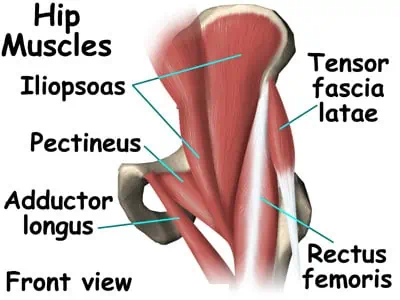
Figure 43
The abductor muscle group of the hip is located on the thigh’s lateral side and moves the thigh away from the midline of the body. These muscles include the superior gemellus, piriformis, tensor fasciae latae, inferior gemellus, gluteus medius, Sartorius and gluteus minimus muscle Brungardt et al (2006) as shown in Figure 44

Figure 44
Conclusion
In conclusion, the paper discussed ten case studies about normal anatomy of different body regions. Each case study was discussed individually where the major focus for each case study being brief justification, review and overview of the imaging protocol and image annotations. The case studies used in the paper include the skull, thoracic cage, arm skeleton, human heart, kidney anatomy, liver anatomy, stomach, muscles of the arm and hand, muscles of the leg and foot, and finally muscles of the hip
References
Agur, A. M. R., Lee, M. J., & Grant, J. C. B. (1999). Grant’s atlas of anatomy. Philadelphia: Lippincott Williams & Wilkins.
Behnke, R. S., & Donnelly, J. E. (2001). Kinetic anatomy. Champaign, IL: Human Kinetics.
Boyd, W. (2003). Any human heart: A novel. New York: A.A. Knopf.
Brenner, B. M., & Rector, F. C. (1991). The Kidney. Philadelphia: Saunders.
Brungardt, K., Brungardt, B., & Brungardt, M. (2006). The complete book of core training: The definitive resource for shaping and strengthening the “core”–the muscles of the abdomen, butt, hips, and lower back. New York: Hyperion.
Chung, C. B., & Steinbach, L. S. (2010). MRI of the upper extremity: Shoulder, elbow, wrist and hand. Philadelphia: Wolters Kluwer Health/Lippincott Williams & Wilkins.
Dimon, T., & Qualter, J. (2008). Anatomy of the moving body: A basic course in bones, muscles, and joints. Berkeley, Calif: North Atlantic Books.
Doyle, J. R., & Botte, M. J. (2003). Surgical anatomy of the hand and upper extremity. Philadelphia: Lippincott Williams & Wilkins.
Draves, D. J., & Zelichowski, J. E. (1986). Anatomy of the lower extremity. Baltimore: Williams & Wilkins.
Flynn, T. W. (1996). The thoracic spine and rib cage: Musculoskeletal evaluation and treatment. Boston: Butterworth-Heinemann.
Gadžijev, E. M., & Ravnik, D. (1996). Atlas of applied internal liver anatomy. Wien: Springer.
Glisson, F., Cunningham, A., & Wellcome Unit for the History of Medicine (University of Cambridge). (1994). From Anatomia hepatis (the anatomy of the liver), 1654. Cambridge: Wellcome Unit for the History of Medicine.
Graves, F. T. (1971). The arterial anatomy of the kidney: The basis of surgical technique. Bristol: John Wright.
Green, J. (2006). Skeleton. Mankato, Minn: Stargazer Books.
Gresczyk, E. G. (1967). Muscles of the leg and foot during walking: An electromyographic study of normal and flatfooted subjects. Kingston, Ont.
Hale, R. B., Art Students League (New York, N.Y.), & Jo-An Pictures, Ltd. (Firm). (1983). The Rib cage. New York: Jo-An Pictures.
Kenyon, C. M. P. (1989). The kinematics of the rib cage.
Kinne, R. K. H. (1989). Structure and function of the kidney. Basel: Karger.
Lapatza, C., Watters, J., Chaplin, C., & Goitiandian, E. R. (1994). The human heart. Bilbao, Spain: Near, S.A.
Larsen, C. 1997. Bioarchaeology: Interpreting Behaviour From The Human Skeleton. Cambridge: Cambridge University Press.
Liberace, R., Lubkin, A., & Liberace Studio (Firm). (2013). Anatomy : the arm and hand: With Robert Liberace. Washington, DC: Liberace Studio.
MacConaill, M. A., & Basmajian, J. V. (1969). Muscles and movements: A basis for human kinesiology. Baltimore: Williams & Wilkins Co.
Mays, S. 1999. The Archaeology of Human Bones. Glasgow: Bell & Bain Ltd.
Muscolino, J. E. (2010). The muscular system manual: The skeletal muscles of the human body. St. Louis, Mo: Mosby/Elsevier.
OpenStax CNX. (n.d.). Retrieved March 19, 2015, from http://cnx.org/contents/[email protected]:45/Anatomy_&_Physiology
Parker, S. (1989). The skeleton and movement. London: F. Watts.
Parker, S. (2004). The skeleton and muscles. Chicago, Ill: Raintree.
Parker, S., & Dowell, P. (1988). Skeleton. New York: Knopf.
Perin, R. (1983). The human heart. Buffalo, N.Y: Hallwalls.
Resnick, M. I., & Parker, M. D. (1982). Surgical anatomy of the kidney. Mount Kisco, N.Y: Futura Pub. Co.
Roberts, C. & Manchester, K. 2010. The Archaeology of Disease Third Edition. Stroud: The History Press.
Ryū, M., & Cho, A. (2009). New liver anatomy: Portal segmentation and the drainage vein. Tokyo: Springer.
Self, W. (2009). Liver: A fictional organ with a surface anatomy of four lobes. New York: Bloomsbury.
Templeton, F. E. (1964). X-ray examination of the stomach: A description of the roentgenologic anatomy, physiology, and pathology of the esophagus, stomach, and duodenum. Chicago: Univ. of Chicago Press.
White, T. & Folkens, P. 2005. The Human Bone Manual. London: Elsevier Academic Press.
Wilson, T. M. (1992). Effects of strengthening the stabilizing muscles of the hip joint on strength gain of the hamstring group.
Wolf-Heidegger, G., & Köpf-Maier, P. (2006). The color atlas of human anatomy. New York: Sterling.
With a student-centered approach, I create engaging and informative blog posts that tackle relevant topics for students. My content aims to equip students with the knowledge and tools they need to succeed academically and beyond.
by Herman Bailey | Jan 23, 2025 | Essays |
Budgeting for program implementation
Budgeting according to Kemper (2015) is the process of designing a plan on how the funds will be spent. The importance of developing a realistic budget for the health program will allow the health educators to get to know in advance whether the project will have enough money for performing the things that are needed to be done or those that the health educator wishes to do. Developing a realistic budget for this health program will also be important since it will allow the health educators to come up a plan for spending the money, and also ensure that enough money will be available for the needed things and for the most important things. Similarly, the realistic budget will and following it will keep the program out of running into debts or out of funds.
Lastly, developing a realistic budget for the program will be helpful for the long term financial planning for the program. This will be also significant in making realistic assumptions about the whole projects income and expenses and plan for the program goals. Below is a detailed overview of the anticipated program costs for the proposed health program. The program will run for two months and will cover the entire district.
|
|
First Month Amount in $ |
|
Second Month Amount in $ |
|
Total |
| Revenue & support |
|
|
|
|
|
| Contributions |
989.25 |
|
1200 |
|
2189.25 |
| Grants |
|
1745 |
|
1600 |
|
3345 |
| Participation fee |
450 |
|
400 |
|
850 |
| Sale of curriculum material |
800 |
|
600 |
|
1400 |
| Gifts |
|
150 |
|
400 |
|
550 |
| |
Total Revenue & Support |
4134.25 |
|
4200 |
|
8334.25 |
|
|
|
|
|
|
|
| Expenditures |
|
|
|
|
|
| Direct Costs |
|
|
|
|
|
| Personnel |
|
|
|
|
|
|
salary and wages |
1200 |
|
1000 |
|
2200 |
|
Fringe Benefits |
300 |
|
250 |
|
550 |
|
Consultants |
350 |
|
300 |
|
650 |
|
|
|
|
|
|
|
| Operating Expenses |
|
|
|
|
|
|
Supplies |
90 |
|
60 |
|
150 |
|
Instructional materials |
40 |
|
40 |
|
80 |
|
Incentives |
35 |
|
35 |
|
65 |
|
Meeting costs |
105 |
|
75 |
|
180 |
|
Equipment |
300 |
|
150 |
|
450 |
|
Travel |
900 |
|
700 |
|
1600 |
|
Postage |
25 |
|
20 |
|
45 |
|
Advertising |
250 |
|
200 |
|
450 |
| Total Direct Costs |
3595 |
|
2830 |
|
6425 |
|
|
|
|
|
|
|
| Indirect Costs |
|
|
|
|
|
|
(Include insurance, telephone and other utilities) |
|
|
|
|
|
| Total Indirect Costs (rate 15%) |
539.25 |
|
424.5 |
|
963.75 |
|
|
|
|
|
|
|
| Total Expenditure |
4134.25 |
|
3254.5 |
|
7388.75 |
|
|
|
|
|
|
|
| Net Surplus or deficit |
NIL |
|
945.5 |
|
945.5 |
Based on the anticipated costs, there are some changes that will be made to the program. Some costs may be adjusted when it will be forecasted that that some weeks coming ahead the finances may be tight or even if the finances will be extra. If these scenario will be forecasted, the health educators will look for ways to readjusting the budget to even the lows and thighs in the finances for easier management of the project
Budgetary concerns can impact the implementation strategy of a health program in several ways. Budgetary concerns cause the health educators to frequently revisit their deadlines and task lists. According to Kemper (2015), cost overruns in a programs implementation stage makes the administrators to see their programs or projects getting out of control.
budgetary concerns can also lead to unexpected budget cuts during the implementation stage of the program. A program with a strong project goals with a scope that has strong statements such as “good to have” “should have” can be disadvantaged in this scenario. The health educators whose duty is to ensure that the project is on course despite constraints in the budget may opt for eliminating the non-critical budgetary allocations before considering staff cuts.
Project evaluation plan
The program will entail working with the communities of the elderly population who are at risk of falling, and therefore it will be imperative to involve them in all the program evaluation phases. Community self-assessment according to Minkler (2012) is the process where the communities identify their resources and need perception. Through self-assessment, the community of the elderly persons strengthens their resources and can help itself to improve on their wellness. The strengths of the community include health determinants such as coping skills, knowledge, education and supportive environment. The health educators will be stimulated with the holistic wellness approach when doing evaluation. This will be helpful in shaping the design and evaluation of the program amongst all the stakeholders involved
Minkler (2012) indicated that a representative of a community of the elderly population who are at a risk of falling can initiate a community self-assessment. However, if it is unlikely, the health educators may opt for approaching the leaders of the community as this will ensure inclusive and active participation by members. Minkler (2012) discussed the significance of being committed to self-assessment by making community leaders and coalitions get involved. Involving every member provides an excellent opportunity of building partnerships
Given that partnerships is integral in community self-assessments, the health educators will look for ways to partnering that supports the whole community is the process of self-assessment and also in identification of the priorities for planning, implementation and evaluation of the health program
The evaluation findings will be utilised by different entities and stakeholders. First, the evaluation findings will be utilised by the policymakers in coming with policies that will be integral in reducing falls among the elderly population. These may include policies of improving facilities in parks and recreational areas and also nursing homes for the elderly people. Similarly, the evaluation findings will be utilised by different institutions and entities to improve on their facilities and also to put in place mechanisms that can helpful in reducing falls among the elderly population. The rational applied in selecting the entities and stakeholders that will utilise the evaluation findings was based upon how related or associated a stakeholder or an entity is associated with the elderly populations.
Evaluation plan
- State the evaluation question you are evaluating, and explain why it is important.
“Will the proposed program succeed in preventing falls among the elderly? Which aspects of the program can be modified to make it more effective?”
The outcome evaluation question above will be evaluated in this section of the project. The evaluation question above is important because it questions whether the proposed program will be successful, and also gives a room for modification of the program for it to be more effective. The following are the reasons why the paper chose the question above for evaluation
- The evaluation question above will be helpful in understanding the effects of different facets of the program are having. The question has been carefully framed and it can evaluate different parts of the program. Furthermore, if an element is added, or modification is done after the commencement of the program, its effects will be evident from the initial program. Therefore, it will be possible to look at different possible program effects entirely.
- The above question is also important because it shows the program educator clearly define what they will be trying to do. What the program educator will decide to evaluate will define what he will hope to accomplish at the end of the program. The question is well framed and will it clear for the program educator to understand what he will be trying to evaluate and the what the results are desired
- The question is also important since it shows the program promoter on where changes need to be made. The question is specific and is real and is real to the to the program objectives. Furthermore, the question tells the program promoter exactly where the program will be going on well and where the health program will not be having the effect intended
- Since the question generally covers the purpose of the proposed health program, the question is important because it also highlights the consequences that are unintended. In a scenario where the program educator will find unusual answers to the evaluation question above, t will mean that the program had some effects that were not expected. Sometimes the effects will be positive such that the elderly people under the program not only will they reduce their incidences of fall, but majority will change their way of living to live healthy lifestyles. However, sometimes the effect will be negative such that the elderly people under the program increased their incidences of falling even though they were trying new methods from the education program. Just like the medication side effects, the unintended program consequences can be of great importance to the program itself
- The evaluation question above will also guide the future choices of the program educator. For instance, if the program will be particularly successfully in some areas unlike other ways, the program educator will may decide to lay more emphasis on the areas that were more successful or even to make some modifications or even change completely the approaches that were applied in the areas that were unsuccessful
- Given that the program will involve many stakeholders in designing, and the participants will be subjects that will be evaluated, the evaluation question above will have a higher likelihood of meeting the needs of the community
- The evaluation question above is also important because it provides the focus for the program evaluation. The question has been carefully chosen and laid out to keep the program promoters from going astray or even to try to do many things at ago. The question is based on whether the program will prevent the elderly people from falling. A very straight forward evaluation question, focussed and on point
- Lastly, the evaluation question used is important because it determined the factors that need to be recorded during the process of data collection. The question has been clearly chosen and it will make data gathering much easier since it has made obvious the kind of records and data that need to be kept and the areas needing examination.
Discuss which evaluation design you use and why
Control group design
The evaluation design that will adopted by the paper will be control group design. This design is a common way of evaluating the effects of an independent variable using a control group. In this program, there will be two similar groups, the control group and the participants group. Using this design, the control group receives a different intervention or no intervention at all with the main goal being similar to the participant group. In the proposed health program, the eligible population would be randomized to receive either the proposed fall prevention intervention (intervention/participant group) or usual care (control group). In the intervention group, multifactorial intervention entailing a comprehensive assessment of the risk factor reduction. In the case of usual care, this would involve the provision of the community-based elderly primary care in which a standard care from family physician is to be followed by a letter summarizing the self-reported risk factors from the participants to the physician to establish their level of awareness
The main purpose of evaluation for the program educator in evaluating their efforts is to get the most accurate and reliable possible information given their program nature, their questions for evaluation, the time constraints, what the participants will agree with, and the available resources. The vital thing for the proposed program is not to set up a research study that is perfect but to design the evaluation that will be helpful in getting realistic information and to be able to separate the external factors effects and the program effects. There are several factors that prompted the program promoters to choose the control group design and they include:
Consideration of the evaluation questions
The evaluation question asked whether the proposed program will succeed in preventing the falls among the elderly patients, and whether some program aspects can be modified to be effective. Control group design was chosen because the intent of evaluation was to see whether some changes happened. The program educators will want to know whether any change took place, and if it occurred, whether it was caused by the program. Therefore, the design was used help in screening out the external influences effects and also the backgrounds of the participants.
The proposed health program of preventing a fall among the elderly population will incorporate two groups, having different interventions but working towards a common goal. The comparison across the groups will allow the program promoter to screen out the factors that may cause different results.
The nature of the program
The proposed program work with many participants in two groups and begin and end on specific dates. Moreover, the program is designed on a two month time limit where all the participants are expected to undergo through all at once. Control group design was chosen for the project because the work involved working in groups. Moreover, the program will have a clear and well elaborated beginning and end.
Consideration to what the staff and the participants will consent to
He control group design will be chosen after making deliberations and agreeing with the participants. Evaluation design is significant because of the effect that it might have on the evaluation results of the program. CTB (2015) indicated that an evaluation design might raise protests during the process of observation from the participants who may feel that their privacy are infringed. Similarly, the staff who are already overworked may see an evaluation as an additional burden to them. Therefore, control group design will be considered as a compromise and also to overcome these potential obstacles. Moreover, control group design is less intrusive and has different kinds of observations when collecting data among the elderly people who are at risk of falling.
Given that the evaluation will be majorly be based on observation, there are other reasons that can raise objection from the participants. For instance, desire for secrecy, potential for embarrassment or even self-protection. These factors can contribute to a participant’s unwillingness to participate in the evaluation. These concerns can also be raised among the staff members. Therefore, to deal with these issues when control group design shall have been adopted, the program educator will inform the participants from onset about what the program promoters and other staff are hopping to do, meet with the, listen to the participant’s objections and finally come up with an inclusive and satisfactory approach. CTB (2015) noted that staff members in the proposed health program have a lower likelihood of complaining if they are involved in the program evaluation planning, and this is also true to the participants.
Time constraints
The important thing for the proposed health program for reducing fall among the elderly people is to select an evaluation design that will give the program promoters reliable and reasonable information. According to CTB (2015), an evaluation design should be good enough for the program promoter to see reasonable indication that actually changes are taking place and they are because of the program results. The limits of time can only control an evaluation program based on the program considerations, funding and other factors.
Control group design will considered because of the imposed time constraints to the health program. The design fitted well with the program structure which corresponds with the regular program cycle. Time constraints also depended on the funding sources and that is another reason why control group design was preferred. The health program will be conducted within the timeframe of funding to show to the funders that it is successful and to be eligible for refunding. Evaluation time schedule will be part of the grant and it will be shown to the funders within the allocated time frame
Available resources
Control, group design was also favored for the proposed health program because of the available resources. Resources from the program include money, personnel, equipment, material, space, skills and expertise. Despite the fact that the program will work with the available resources, some of these resources will substitute one another. For instance, an experienced staff during the evaluation program will substitute money that would have been used for hiring a consultant. Moreover, the proposed health program will also consider partnering with the local universities to get the much needed expertise and also equipment. With the available resources, control group design will be the best option for the proposed evaluation program
Discuss the strengths and weaknesses of the design used. Identify any threats to measurement reliability and validity that you might encounter when collecting data, and discuss what you would do to reduce these threats.
Strengths
The core strength of control group design is that it is the most reliable design. In most evaluation designs, control, group design is essential and allow the researchers to isolate and eliminate variable
The design also provide a baseline from factors that can skew evaluation data such as environmental variation, researcher bias and other normal variation. The design also helps the program promoter to show that the experimental deign design used has capability of generating results from evaluation
Weakness
According to CTB (2015), control group design is the most difficult evaluating design to set up since the program evaluator need to find the groups that are appropriate, observe the groups regularly. CTB (2015) elaborated that the randomised control groups are the gold standard, and it should be totally selected randomly either among the program population of the intervention, or even the larger population if it’s appropriate. Rando groups eliminates the selection problems in addition to other issues such as differences in race, culture or other factors that might arise.
Threats to measurement reliability and validity during data collection
Reliability in the techniques was determined by the experiments producing consistent results. Validity, on the other hand, is the extent to which a measurement, conclusion or concept corresponds accurately or is well founded to the real world. Some of the threats to measurement of reliability and validity that the program may encounter when collecting data two. They are referred to as validity threats and reliability threats
Validity threats
These are threats to the program promoter’s claims that what was done caused changes in the direction the program promoter was aiming for. Validity and reliability threats are posed generally by factors that operate at the same time as the intervention or the program that may have an effect on the issues the program will be trying to address. Some of the validity threats that the program promoter might encounter when collecting data include the following:
History– the personal histories of the participant such as their background, cultures, education, experience among others, and other external events that may occur during the evaluation period such as conflict, election, disaster or even a new law may influence the data collection process. For instance, some cultures may not permit a participant to disclose some information or a conflict in the area of research may hamper data collection process
Maturation-these are social, psychological and physical processes that occur as time goes by. The elderly participants may develop arthritis, or they can get tired during the period of learning activities and this may hamper data collection
The effect of observation or testing to the participants-the presence of the program itself or the participants taking part may affect the attitude or behavior of the participants, or even the experience that they are being videotaped, tested or even measured or observed
Regression toward the mean– this refers that with time every low or high scores from a test or measurement often tend to drift to the average of the group hence resulting to validity threats
Participants selection– this may occur when the program promoter slant his selection of the participants towards a particular group that has a lower likelihood or recording some changes than across the population where the group was selected. For example, the program promoter may select the elderly populations who already has knowledge and skills about preventing falls and leaving out those who does not have the skills, and who need the knowledge. Similarly, participant’s selection can also results to validity threats when the participants chose to enroll themselves into the program. Since the self-selected participants are motivated already to make changes
Loss of participants/data- if too many participants drop out in the middle of the evaluation or too little information is collected. This creates unreliable results especially if they compared to another group of participants
Reliability threats
These are factors that affects a program promoter’s ability of applying the results in other data collection processes. That is to increase the chances of the program promoter’s data collection process to be reproduced somewhere else using other different participants. Reliability threats may be due to other factors interaction with the intervention or the program or may be because of specific program conditions. For example;
Data collection interaction with the intervention or the program– the initial observation during data collection might change the way the subjects will perceive or react to the whole program, and this may make different in the end results. Because it cannot be assumed that another participants group will also have a similar reaction or achieve same final outcomes, reliability becomes questionable
selection procedures interaction with the intervention or program-if the selected participants are sensitive to the purpose or methods of data collection, it cannot be assumed that it will be effective with other participants who are ready for the program and are particularly less sensitive
Ways of reducing the threats
Some of these threats may be beyond the control of the program promoter like history and maturation of the participants. However, to reduce these threats, the program educator will discuss the procedures before with the participants for them to understand and be ready and comfortable during the data collection process. Moreover, one type of instrument will be used to prevent regression towards the mean. Selection will also be broad to avoid selecting a particular group of participants with a similar characteristics. Full cooperation will also be expected from participants till the end to prevent dropping out or loss of data
Describe the methods you would use to collect data to answer the evaluation question.
Focus groups
These are small groups of people possessing a distinctive insight into the resources and health needs of the elderly population who are at risk of falling. This method of program, evaluation will consist of about 8-12 elderly participants who will come together and then discuss their common concern of falling. During focus groups, field notes will be taken for ensuring validity of contents. The moderator of the focus groups will influence the quality and nature of the information to be collected during these sessions
key informant interviews
These will be interviews with the persons who work or lie with the elderly persons who are at risk of falling and also who possess the special insight into the resources and the needs of the elderly. These interviews will be done either face to face, over the telephone or even tapping during evaluation of the program
surveys
This evaluation method will also be used especially with the participants using either open ended questions and asking for specific answers, or close-ended questions and requesting the participants to choose from given choices. This method will also be adopted after designing easily understood, simple and good questions. The survey questions will be structured to collect information on barriers to access to healthcare, satisfaction with their elderly homes, and their health status among others. When the programs will be evaluated, a representative random sample of the elderly participants who have undergone intervention or have used the program will be evaluated
Describe any modifications needed to an existing instrument, an instrument that would need to be developed, and/or existing records to access and provide your rationale.
The existing instrument that will need modification will be the questionnaire. Questionnaires will be modified with close-ended questions in order to get structured information from the respondents. A Likert scale will be used for designing the questionnaires. The answer choices in the Likert scale range from one extreme to another, therefore revealing the degree of opinion of respondents. Numerical values will be assigned for each scale point such as 5 for strongly agree, 4 for agree, 3 for neutral, 2 for disagree and 1 for strong disagreement.
The instrument that would need to be developed for the program is Morse Fall scale. This instrument is used for measuring risk of falls for the residents of the long term care homes, and hospitalized patients. This instrument was chosen to be developed its specific, sensitive and has high predictive values. This will be helpful to the program educator to make informed choices when collecting data
Summarize the ways in which your evaluation results might be used to improve the program’s quality, utility, and impact on the priority populations, and provide an explanation for why you think the results might be used in these ways.
The evaluation results that will be gotten from the proposed program/intervention will be used me improving the programs quality, utility and impact on the priority of the elderly population in risk of falling in several ways. Positive results from the evaluation will indicate that the program is successful and can be applied among the older population. The evaluation findings can also be used to detect where there were internal errors, where there is need for change both in methods of data collection, selection of instruments and the participants to improve the quality and utility of the program
The results will indicate that education on behavioral change to the elderly patients by the health care providers will be key in giving knowledge and skills to the elderly people to prevent them from having falls. The behavioral therapy works on specific environments and actions that either maintain or change behaviors (Schildmann et al, 2010). For instance, the patient trying to feel positive of his or her condition, the patient can be encouraged to change his or her habits that may deteriorate their health condition and increase chances of falling. Therefore, the patient will be encouraged to change behavior to practice activities that can promote healthy living in accordance to his condition and reduce chances of falling. Schildmann et al (2010) observed that replacement of negative behaviors with behaviors that are positive is the best strategy that helps in changing of behaviors, especially when reinforcement of new behaviors is done.
References
CTB,. (2015). Chapter 37. Op threats to measurement reliability and validity erations in Evaluating Community Interventions | Section 4. Selecting an Appropriate Design for the Evaluation | Main Section | Community Tool Box. Ctb.ku.edu. Retrieved 6 August 2015, from http://ctb.ku.edu/en/table-of-contents/evaluate/evaluate-community-interventions/experimental-design/main
Schildmann, J., Gordon, J.-S., & Vollmann, J. (2010). Clinical ethics consultation: Theories and methods, implementation, evaluation. Farnham, Surrey, England: Ashgate.
Kemper, B. (2015). Budgeting, spending and saving.
Minkler, M. (2012). Community organizing and community building for health and welfare. New Brunswick, N.J: Rutgers University Press.
With a student-centered approach, I create engaging and informative blog posts that tackle relevant topics for students. My content aims to equip students with the knowledge and tools they need to succeed academically and beyond.
by Herman Bailey | Jan 22, 2025 | Essays |
Task A
1. Determine the expected completion time for each of the nine project activities.
The PERT equation used in calculation of the expected time as illustrated by Chemuturi & Cagley (2010) is =
E = (O + 4M + P)/6, where
O= optimistic value
M= probability time value
P=pessimistic time value
E= expected time value
From the above formula, the paper used it in calculating the expected time values listed in the table in the embedded excel workbook (double click on the icon “Students_Task_4Vl_MF6_15”). An example of calculation for A is below:
E = (O + 4M + P)/6, where
O=2, M =3.1, P=3.6
E= (2+4(3.1) +3.6)/6
E=3
2. Determine the variance for each of the nine project activities.
The PERT equation used in calculation of the variance as illustrated by Chemuturi & Cagley (2010) is =
Variance= [(O-E) ² + 4(M-E) ² + (P-E) ²]/6, Where:
O= optimistic value
M= probability time value
P=pessimistic time value
E= expected time value
From the above formula, the paper used it in calculating the variance listed in the table in the embedded excel workbook (double click on the icon “Students_Task_4Vl_MF6_15”). An example of calculation for A2 is below
Variance= [(O-E) ² + 4(M-E) ² + (P-E) ²]/6, where
O=2, M =3.1, P=3.6, E=3
Variance= [(2-3)2 +4 (3.1-3)2 + (3.6-3)2]/6
Variance= [-1+0.04+0.36]/6
Variance= -0.1
3. Develop a PERT chart showing the network diagram with the activities and their expected times.
7 weeks
H
6 weeks
G
12 weeks
11.25 weeks D 12 weeks B D I
3weeks 13.9 weeks 26.5weeks A C E 33 weeks F 4.5 weeks I 4.5 weeks I
(a)Identify the critical path
In identifying the critical path, the paper determined the Earliest Start time (ES), the Earliest Finish time (EF), the Latest Start time (LS), and Latest Finish time (LF) for every activity.
1= (0, 0)
2= (3, 3)
3= (14, 18)
4= (17, 17)
5= (36, 44)
6= (26, 30)
7= (43, 43)
8= (32, 36)
9= (39, 44)
10= (48, 48)
From the diagram, the critical path is A-C-E-I- End since it has a slack of zero
4. Determine the value of each of the following:
a). Determine the expected duration of the entire project, showing all of your work or reasoning.
The expected duration of the project is the sum total of all the activities of the critical path. Therefore, from the PERT chart, the expected duration of the project is as follows:
A= 3, C= 13.9, E= 26.5, I=4.5
Total project duration =47.9
b). Determine the slack for project Activity E, showing all of your work or reasoning.
Earliest Start time (ES) = 17
The Earliest Finish time (EF) =43
The Latest Start time (LS) = 17
Latest Finish time (LF) =43
Slack= LF-EF; 43-43=0
c). Determine the slack for project Activity C, showing all of your work or reasoning.
Earliest Start time (ES) = 3
The Earliest Finish time (EF) =17
The Latest Start time (LS) = 3
Latest Finish time (LF) =17
Slack= LF-EF; 17-17=0
d). Determine the earliest week project Activity F is scheduled to start, showing all of your work or reasoning.
Project activity F Is to start when project activity A is finished. Project A needs 3 weeks to finish, so project activity F is scheduled to start in week 3
e). Determine the latest week project Activity G is scheduled to finish, showing all of your work or reasoning.
Project activity G is scheduled to finish after completion of project activities A, B, D. G or A, C, D, G
A, B, D, G=3+11.25+12+6=32.25
A, C, D, G= 3+13.9+12+6=34.9
Therefore, the latest week project activity G is scheduled to finish is 34.9
5. Determine the probability of completing this project in time for the product launch in 48 weeks, showing all of your work
| TASK |
Expected Time |
Variance (weeks) |
Critical Path Total |
| A |
3 |
-0.1 |
3 |
| C |
13.9 |
3.15 |
13.9 |
| E |
26.5 |
14.58 |
26.5 |
| I |
4.5 |
0.0833 |
4.5 |
| END |
|
|
47.9 |
|
|
|
|
Probability = (48-47.9)/2.55
=0.03922
51.20%
To determine the probability of finishing the project by 48 week, only the variance and the duration of critical path activities is relevant. Form the table, the probability is observed to be 51.20% that the project activity will be finished in less than 48 hours.
Task B
1. Determine the maximum reduction in time for each of the ten project activities. a. Include your answers for part B1 in Table 1.2, showing all of your work for one activity.
The maximum reduction in time for an activity as illustrated by Chemuturi & Cagley (2010) is;
=NT-CT, where
NT= Normal time for activity completion
CT= Crash Time for activity completion
Taking Task L as an example, where
NT=2 weeks
CT= 1.5 weeks
Using the formula of NT-CT= the maximum reduction in time for an activity
2-1.5= 0.5
From the above formula, the paper used it in calculating the maximum reduction in time for an activity values listed in the table in the embedded excel workbook.
2. Determine the crash cost per week for each of the ten project activities. a. Include your answers for part B2 in Table 1.2, showing all of your work for one activity.
Crashing cost per period as illustrated by Chemuturi & Cagley (2010) is
= Where,
CC= crash cost
NC= Normal cost for activity completion
NT= Normal time for activity completion
CT= Crash Time for activity completion
From the above formula, the paper used it in calculating the crash cost per week for each of the ten project activities as listed in the table in the embedded excel workbook. An example of calculation for B2 is below
=3000
C. Determine the following by using your results from part B: 1. Identify the activities, considering all paths, to be crashed to meet the following criteria: • completion of the project within 22 weeks • achievement of the lowest possible cost
To shorten the project, I will crash on the critical activities starting from the least expensive to the most expensive. From the provided network in task B, there are two paths and the times are shown as normal times;
LOP (M) S (Q) U=30.5
NR (MQ) TU=29.5
The activities that need to be crushed to complete the project in 22 weeks at the lowest possible cost is in path NR (MQ) TU. The activities that is prudent to crash are R, M and U because of their relevance to the project duration and low costs.
| TASK |
NORMAL WEEKS |
CRASH WEEKS |
NORMAL COSTS |
CRASH COSTS |
| N |
1.5 |
1.5 (not crashed |
11,000 |
0 |
| R |
3 |
2 |
12,750 |
19225 |
| M |
10 |
4 |
11,000 |
24,750 |
| Q |
6 |
6 (not crashed) |
9500 |
0 |
| T |
7 |
7 (not crashed) |
13,750 |
0 |
| U |
2 |
1.5 |
10,600 |
22,500 |
| TOTAL |
29.5 |
22 |
68,600 |
66475 |
2. Determine the number of weeks each of the activities identified in part C1 should be crashed. 3. Determine the sum of the individual costs of crashing each activity identified in part C1. D. When you use sources
Activity R can be crashed for one week (normal weeks- crash weeks= 3-1= 1 week) at a crash cost totaling to $6475 (crash cost-normal cost=19225-12750= $6475). When the total crash cost is divided by the total crash time allowable, it yields the weekly crash cost ($6475/1) = $6475.
Activity M can also be crashed to a total of 6 weeks (normal weeks- crash weeks= 10-4= 6 weeks) at a crash cost totaling to $13, 750 (crash cost-normal cost=24,750-11,000= $13,750). When the total crash cost is divided by the total crash time allowable, it yields the weekly crash cost ($13, 750/6) = $2291.67.
Lastly, activity U can also be crashed to a total of 0.5 weeks (normal weeks- crash weeks= 2- 1.5= 0.5 weeks) at a crash cost totaling to $11, 900 (crash cost-normal cost=22, 500-10,600= $11,900). When the total crash cost is divided by the total crash time allowable, it yields the weekly crash cost ($11, 900/0.5) = $23, 800
References
Chemuturi, M., & Cagley, T. M. (2010). Mastering software project management: Best practices, tools and techniques. Ft. Lauderdale, FL: J. Ross Pub.
With a student-centered approach, I create engaging and informative blog posts that tackle relevant topics for students. My content aims to equip students with the knowledge and tools they need to succeed academically and beyond.